

What if the rack you choose fits your equipment but not the way your facility distributes power, manages cooling or monitors operations? That’s the difference between selecting a cabinet and evaluating data center smart rack solutions as part of the wider facility infrastructure.
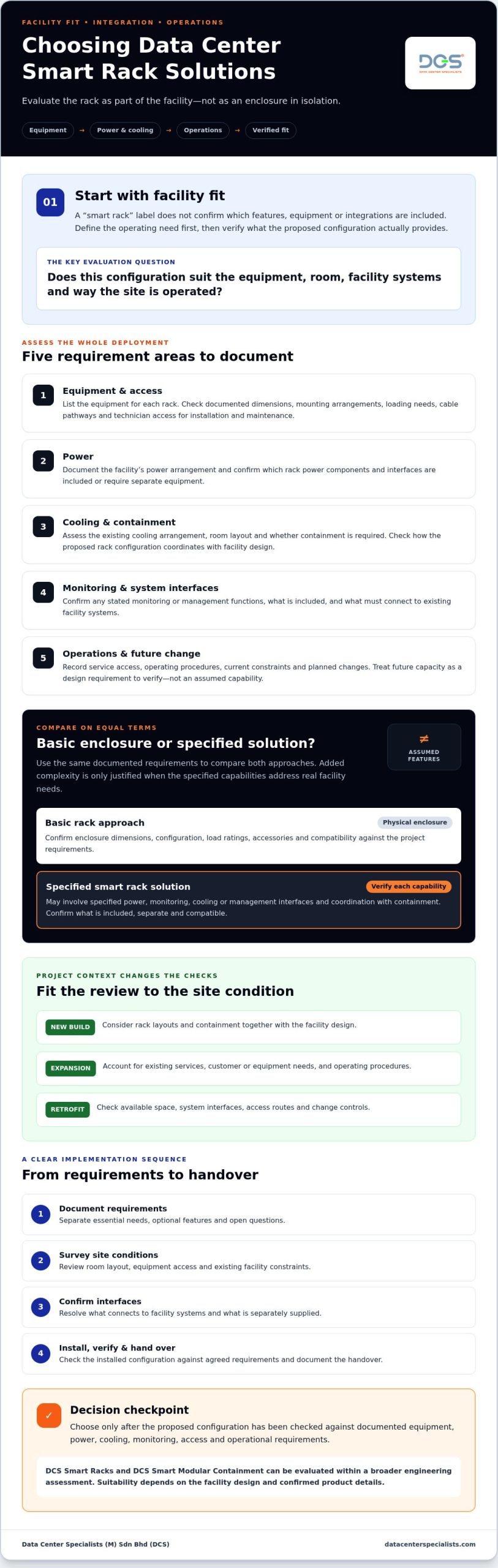
A smart rack should do more than house IT equipment, but the term can mean different things. Product claims alone won’t show whether a solution will integrate with your existing systems or suit planned changes. Start with your facility’s operating conditions and requirements, then check which capabilities are actually included.
This guide helps you define requirements before requesting proposals and compare rack and containment options against your power, cooling, monitoring and operational needs. It covers practical questions about compatibility, capacity, maintainability and future expansion, so you can assess fit without relying on unsupported promises. DCS Smart Racks and DCS Smart Modular Containment are options to consider within a broader engineering assessment, with suitability dependent on the facility design and confirmed product details.
Key Takeaways
- Assess rack selection in the context of facility operations, equipment access, cooling, power and planned changes.
- Look beyond the enclosure to evaluate facility fit, containment requirements and system interfaces.
- Compare a basic rack approach with a specified solution against the same documented requirements before deciding whether added complexity is justified.
- Use a structured implementation sequence: document requirements, survey conditions, confirm interfaces, install, verify and hand over.
- Evaluate DCS Smart Racks and modular containment through a technical discussion grounded in your facility configuration and project scope.
What Data Center Smart Rack Solutions Include, and Why Facility Fit Comes First
A rack enclosure is only one part of a deployment decision. Data center smart rack solutions should be assessed against the equipment they will house, the facility’s power and cooling arrangements, operating procedures and any planned containment. The term “smart rack” does not, by itself, confirm which features or integrations are included.
Requirements also vary by operating environment. A financial facility may prioritize controlled access and established change procedures, while a colocation operator may need to account for customer-specific equipment and service access. In healthcare IT environments supporting diagnostic equipment and mobile reading rooms from Dextro Imaging Solutions, racks must reliably handle specialized hardware and power requirements. Hyperscale and telecommunications environments may have different deployment patterns, cabling needs and expansion plans. Define the use case before comparing proposals, and document which requirements are essential versus optional.
The following video provides a visual example of a smart rack concept:
How a smart rack differs from a standard rack
Establish the difference through documented capabilities and operational requirements, not the product label. A standard enclosure provides a physical structure for mounting equipment. A broader smart rack solution may involve specified power, monitoring, cooling or management interfaces, and coordination with containment. Do not assume these features are included. Confirm what comes with the proposed configuration, what requires separate equipment and what must connect to facility systems.
Review supplier documentation for dimensions, configuration, load ratings, accessories, compatibility and any stated monitoring or integration functions. Check each proposed feature against your operating processes and existing infrastructure. The 19-inch rack standard offers foundational context for equipment mounting, but project-specific clearances and interfaces still need technical review.
Start with the facility use case
List the equipment each rack must accommodate, how technicians will access it, and the constraints for cabling, power, cooling and maintenance. Compare those requirements with the room layout and the equipment’s documented mounting and loading needs. Separate current requirements from future capacity or deployment plans. Treat future growth as a design consideration to verify, not a promise that any rack will support unspecified changes.
Project conditions also shape the solution. A new build may allow rack layouts and containment to be considered together. An expansion must fit around existing services and operating procedures. A retrofit may require checks of available space, interfaces, access routes and change controls. DCS supplies and implements DCS Smart Racks, with modular containment considered where the facility design calls for it. Confirm the proposed configuration and scope against the site’s technical requirements.
Assess Smart Rack Requirements Across Equipment, Cooling, Power, and Operations
Before comparing data center smart rack solutions, turn facility needs into a written requirement set. This gives procurement, IT and engineering teams a consistent basis for evaluating proposals and identifying assumptions that need confirmation. Record existing constraints, dependencies and acceptance criteria. Without them, a proposal may appear suitable while leaving key interfaces unresolved.
Check equipment compatibility and service access
Start with an equipment schedule showing what will go in each rack and the requirements documented for each item. Confirm enclosure dimensions, mounting arrangements, equipment loading, cable pathways and the clearances technicians need for installation and maintenance. Check these against the actual room layout, including the space needed to access equipment, not just a typical rack arrangement.
When coordinating with IT hardware and networking suppliers such as GenX Systems LLC, ask for written compatibility details for the proposed configuration. Where a requirement is unknown, list it as an open item for confirmation rather than treating it as an assumed fit.
Coordinate rack decisions with cooling and power
Review the cooling approach with the facility and engineering teams. Confirm equipment airflow direction and how rack placement relates to the room’s cooling design, including any hot-aisle or cold-aisle containment. Evaluate containment as part of the facility layout, not as a substitute for checking airflow assumptions through a data center air quality assessment. If modular containment is in scope, review the DCS containment solutions against the project requirements.
Clarify power distribution responsibilities before procurement. Document the required supply and interfaces, which party provides each component, and how the proposed arrangement fits the facility design. Don’t assume power equipment or integration is included simply because a proposal describes a rack as “smart.”
Apply the same checks to monitoring. State what the operations team needs to observe, where that information must be available and whether monitoring is native to the proposed solution, separately supplied or outside the rack scope. Request documentation for any stated interface or compatibility, and identify connections to existing monitoring systems that need separate technical validation.
Bring the requirements together in a review record before assessing offers. Include the equipment schedule, room and service clearances, cooling and power assumptions, monitoring scope, known dependencies and acceptance criteria for installation and handover. Mark which details are confirmed and which remain open. This makes differences between proposals visible without relying on broad product labels or unverified claims.
For facilities assessing rack layout alongside modular containment, a technical discussion with DCS Smart Racks specialists can help frame the review around the documented configuration, interfaces and scope.
Are Data Center Smart Rack Solutions Worth the Added Complexity?
They can be, but added capability has value only when it addresses a defined operational need. A rack with features your team won’t use may add integration, commissioning, training and maintenance work without a clear operational benefit. Compare a basic rack approach and a specified smart rack solution against the same facility requirements, then consider both the capabilities and the work needed to support them.
Compare operational value with implementation demands
Start with the recurring tasks the proposed capabilities are meant to support, such as checking rack conditions or coordinating maintenance. Identify who will use the information, what action it should inform and how the task is handled today. Then account for commissioning, staff training, ongoing maintenance and ownership boundaries. Don’t assume quantified savings or improved uptime; those require evidence specific to the facility and its operating conditions.
| Evaluation area | Basic rack approach | Specified smart rack solution |
|---|---|---|
| Scope | Confirm the enclosure and included components against project requirements. | Verify each proposed capability and whether it is included, separately supplied or outside scope. |
| Integration and support | Identify installation interfaces and who supports each component. | Confirm integration requirements, commissioning responsibilities, training and ongoing support ownership. |
| Maintainability and growth | Review access, service clearances and documented expansion assumptions. | Verify how proposed capabilities affect maintenance and what documented provisions exist for planned changes. |
| Documentation | Request configuration details and acceptance criteria. | Request the same, plus specifications and interface details for each claimed capability. Unconfirmed capabilities require supplier verification. |
Questions to ask during technical and procurement reviews
Request configuration drawings, technical specifications, exclusions and interface requirements. Ask who supplies, installs, commissions, documents and maintains each component. For proposed monitoring, power, cooling or management functions, ask for written details of what is provided and how compatibility will be established. Treat unverified capabilities as open items, not confirmed features.
Compare proposals using identical acceptance criteria and stated assumptions. This helps distinguish operational fit from a longer feature list and exposes gaps in responsibility before procurement. To discuss the documented scope and configuration of DCS Smart Racks, align the review with your facility requirements and project interfaces.
Plan Smart Rack Installation Around Integration, Safety, and Future Change
Carry the requirements established during evaluation into a controlled site process. For data center smart rack solutions, use a clear sequence: document requirements, survey site conditions, confirm interfaces, install, verify and hand over. Coordinate the work with facility operations and the relevant project or change-control process before equipment or rack components arrive.
Prepare the site and coordinate stakeholders
Survey the room layout, access routes, installation area, operating constraints and dependencies such as nearby services or planned works. Confirm how equipment and rack components will be moved to the installation point, and agree on work boundaries with site stakeholders. Define operational controls through the facility’s established procedures rather than assuming one approach will suit every live environment.
Identify coordination points across facility, IT, engineering, contractor and operations teams. Confirm who approves access, manages interfaces, provides required information and responds if site conditions differ from the plan. Record responsibilities alongside relevant change approvals and sequencing requirements. Clear ownership helps teams resolve issues through the correct channels while protecting operational continuity.
Verify installation and handover requirements
Agree on verification criteria before work begins. These should reflect the approved configuration, documented interfaces, installation quality and project scope. Specify what evidence is required, who reviews it and how deviations or incomplete items will be recorded and resolved before operational acceptance.
Define the handover package in advance. Depending on the agreed scope, it may include final configuration drawings, technical documentation, relevant commissioning records, operating information and a record of outstanding actions. Assign responsibility for preparing, reviewing and receiving each item. This makes the transfer from installation to operations explicit and gives facility teams a reference for future maintenance or changes.
- Before installation: Confirm requirements, site conditions, work boundaries, interfaces, access and stakeholder responsibilities.
- During installation: Follow approved site processes and record deviations from the agreed configuration or scope.
- Before handover: Verify acceptance criteria, close or document outstanding actions, and transfer agreed records to the responsible operations team.
When discussing a project with Data Center Specialists (M) Sdn Bhd (DCS), share the facility requirements, proposed configuration, interfaces and expected handover scope. Review your smart rack installation requirements against the project’s technical needs.
Evaluate DCS Smart Rack Solutions and Define Your Next Step
DCS supplies and implements DCS Smart Racks and modular containment systems for mission-critical environments. Evaluate them as part of a coordinated facility decision, not as standalone products. Suitability depends on the site, required configuration, documented interfaces and agreed project scope. Confirm proposed features against technical documentation and site conditions before treating them as included or suitable.
What to prepare before requesting a technical discussion
A focused review starts with clear project information. Bring the details needed to assess how a proposed rack and any related containment would fit the facility and operating model:
- Equipment schedules and available room layout information
- Cooling intent and power assumptions, including known interfaces
- Operational constraints, access requirements and installation boundaries
- Required capabilities, listed separately from optional or future needs
- Project stakeholders and expected technical, installation and handover documentation
List unresolved questions as well. If monitoring or another integration capability is required, state the intended function and ask for written confirmation of what the proposed configuration supports. This gives DCS and the facility team a defined basis for clarifying scope without presuming unverified specifications.
Connect racks with containment and facility performance
Consider modular containment where it aligns with the facility’s airflow strategy, rack arrangement and deployment plan. Review the design in context with the surrounding cooling approach and operating requirements. If containment is part of the evaluation, review DCS Smart Modular Containment as a related infrastructure option, then confirm configuration and project interfaces against site documentation.
Keep broader facility objectives in view. If energy evaluation is also in scope, DCS offers a data center energy assessment that can be considered alongside rack and containment planning. Treat this as a distinct assessment requirement, not an automatic outcome of selecting a rack solution.
A useful next step is a technical discussion based on your facility requirements, proposed configuration, interfaces and scope. Data Center Specialists (M) Sdn Bhd (DCS) can review the information with your team and clarify which details need confirmation before a decision is made. This keeps the evaluation grounded in documented needs rather than assumed capabilities or unsupported performance expectations.
Make Your Rack Decision with Facility Requirements in View
The right data center smart rack solutions begin with a clear account of equipment, power, cooling, monitoring, operations and planned changes. Compare options against the same documented requirements, verify proposed features and interfaces, and establish installation and handover responsibilities before procurement.
Data Center Specialists (M) Sdn Bhd (DCS) supplies and implements DCS Smart Racks and modular containment systems, alongside services for mission-critical facilities. A technical discussion can help clarify how rack and containment planning relates to site conditions, configuration and project scope. Check product details against supplier documentation before making a selection.
Discuss your data center smart rack requirements with DCS to assess your project against its documented needs and confirm the details that matter before procurement.
Frequently Asked Questions
What is a smart rack in a data center?
A smart rack is rack infrastructure specified for defined operational and facility requirements, rather than selected only as an equipment enclosure. Depending on the proposed solution, its scope may include additional capabilities or coordination with power, cooling, monitoring or containment systems. The term alone doesn’t confirm which features are included. Review the supplier’s technical documentation to understand the configuration, interfaces and any separately supplied components.
What should I look for in data center smart rack solutions?
Look for a documented fit with your equipment, room layout, operating procedures and facility infrastructure. Confirm dimensions, mounting arrangements, loading, service access, cable routes and any power or cooling interfaces relevant to the project. Ask whether monitoring or management functions are included, optional or outside scope. Compare proposals against the same requirements and acceptance criteria, and have suppliers verify claimed capabilities in writing.
Are smart racks compatible with existing data center infrastructure?
Compatibility depends on the proposed rack configuration and the facility’s existing conditions. Check available space, equipment and service clearances, cabling routes, power distribution, cooling design and any required connections to monitoring or management systems. Ask the supplier to document compatibility assumptions and identify interfaces that need engineering review. For an operating facility, coordinate the review with the teams responsible for IT, engineering and facility operations before approving the design.
Do smart racks include environmental monitoring?
Not necessarily. Environmental monitoring may be included, separately supplied or outside the rack scope, depending on the specific solution. Define what your operations team needs to monitor and where that information must be available. Then ask the supplier to confirm the proposed components, interfaces and compatibility in technical documentation. Don’t assume a rack includes sensors, software, remote access or integration with existing monitoring systems based on the “smart” label alone.
How do smart racks work with hot-aisle or cold-aisle containment?
Evaluate racks and containment together against the facility’s airflow strategy and room layout. Hot-aisle or cold-aisle containment is intended to support separation of air streams, but the suitability of a particular arrangement depends on site design and operating requirements. Confirm rack placement, airflow direction, clearances and containment interfaces with the responsible facility and engineering teams. Treat modular containment as a coordinated infrastructure decision, not an assumed rack feature.
Can smart racks be added to an operating data center?
They may be considered for an operating facility, but feasibility depends on available space, existing services, access routes, equipment requirements and installation constraints. Survey site conditions and define work boundaries before selecting a configuration. Coordinate the proposed work with facility operations, IT and relevant project or change-control processes. Agree on installation sequencing, verification criteria and handover records so the change is managed in line with the facility’s operating procedures.
What information should I provide when requesting a smart rack proposal?
Provide equipment schedules, room layout information, known dimensions and loading requirements, cooling intent, power assumptions, cable pathways and service-access constraints. Separate required capabilities from optional or future needs, and identify monitoring or system interfaces that need confirmation. Include project stakeholders, installation boundaries, relevant site constraints and expected documentation. This gives suppliers a clearer basis for proposing a configuration and identifying open technical questions before procurement.