

A clean-looking data hall can still contain airborne contaminants that affect equipment areas. A data center air quality assessment looks beyond visible dust to evaluate particulate conditions and, where relevant to the assessment objective, other environmental factors. For operators in Malaysia, outdoor conditions and humidity may also shape the contamination risks a facility needs to manage.
Particle counts are useful, but they need context. A single measurement is a snapshot of specific locations and conditions, not a guarantee of ongoing air quality. The appropriate response depends on what was detected, where it was detected, and what decision the assessment needs to support.
This article explains what an assessment can reveal, which facility areas and environmental indicators may warrant attention, and how to interpret findings without treating every result as a reason for major intervention. Use the evidence to determine whether monitoring, filtration review, targeted contamination control, professional cleaning, or airflow investigation is appropriate. The aim is to connect test results to practical facility decisions.
Key Takeaways
- A data center air quality assessment gathers evidence about airborne conditions to support specific facility decisions. It does not provide a blanket guarantee of equipment reliability.
- Particle counts, visible dust observations, and airflow evidence each reveal different aspects of facility conditions. Interpret each in relation to the assessment objective and operating context.
- Sampling location, timing, facility activity, and equipment state can affect results. Record these details to distinguish a useful baseline from evidence of ongoing conditions.
- Define the decision the assessment must support before setting its scope, then report findings in a way that connects evidence to proportionate actions.
- Use findings to consider source control, specialist cleaning, airflow review, or further testing where warranted. Make monitoring a risk-based facility decision.
What a data center air quality assessment evaluates, and why it matters
A data center air quality assessment gathers structured evidence about airborne conditions in selected facility spaces. Depending on the objective, the assessment may include particle count testing and observations of visible dust or other contamination. It helps teams understand conditions in context. It does not, by itself, establish equipment health or predict failure.
Particulate contamination can accumulate around racks, enter equipment areas, or affect heat-transfer surfaces. Dust and construction debris may contribute to blocked openings or reduced heat transfer, but their presence alone does not prove that a system is overheating or at imminent risk. An assessment documents what is observed and where, helping teams decide whether further investigation is warranted.
Air quality is one part of a facility’s environmental and operational picture. For a wider view of how facility efficiency fits into a sustainable data center approach, consider it alongside other facility priorities. Air quality assessment is distinct from energy assessment, which considers energy performance. Data Center Specialists provides a data center energy assessment for that broader operational question.
To see how sensing technology relates to data center measurement, watch this video:
Which data center spaces may be in scope?
Relevant areas may include equipment aisles, rack surroundings, raised-floor spaces, and underfloor plenums. Select locations according to the facility objective and site conditions. A concern about dust near equipment, for example, may call for different sampling points than an investigation following construction activity.
Construction, maintenance, occupancy, and the operating state of the facility can affect airborne conditions. Record these circumstances alongside observations and measurements. A sample taken from a convenient but irrelevant location may not help answer the facility team’s question.
What can an assessment help facility teams understand?
Findings can help teams prioritise contamination-control measures or identify where follow-up investigation may be useful. Keep observations separate from conclusions: a particle count or visible dust is evidence of conditions at a particular place and time, not proof of component damage or future performance.
Assessment evidence is a time- and location-specific observation. Ongoing environmental assurance requires an appropriate monitoring approach over time. An assessment is not continuous monitoring, physical cleaning, or Testing, Adjusting & Balancing (TAB). These activities address different needs: measuring conditions, removing accumulated contamination, and evaluating or adjusting airflow, respectively.
What data center air quality measurements reveal, and what they cannot
Different measurements answer different questions. A particle count characterizes airborne particles at a sampling point under defined conditions. A visual inspection records observable dust. Airflow-related evidence helps explain how air moves through a space. None of these, on its own, establishes the condition of every surface or predicts equipment performance.
Interpret particle-count results in relation to the sampling location, timing, operating conditions, and stated assessment objective. A result near a rack describes the sampled air at that place and time. It is not a facility-wide verdict.
| Evidence | What it can show | What it cannot establish alone |
|---|---|---|
| Particle count | Airborne particle levels at a defined sampling point and time | Settled dust, surface condition, particle source, or equipment health |
| Visible dust observation | Where dust or debris is visibly present | Airborne concentration or a quantified particle level |
| Airflow-related evidence | Air distribution patterns relevant to the assessment objective | Particulate cleanliness or complete cooling-system performance |
Particle counts and particulate contamination
Particle-count testing characterizes airborne particles under the conditions defined for the assessment. It is different from checking settled dust on a surface, inspecting contamination inside a rack, or identifying where particles originate. Construction work, maintenance activity, and movement through a space may provide useful context, but a count alone does not identify the source.
ISO 14644-1:2015 provides a framework for classifying air cleanliness by airborne particle concentration. Applying a class or limit to a data center requires a relevant, specified basis. Do not assume a universal threshold from a measurement alone. A single result does not certify equipment cleanliness or predict a future fault.
Airflow, filtration, and environmental context
Air distribution can affect where airborne particles travel and whether a sampling point represents the area of concern. Filtration condition may also help explain observed conditions. Depending on the objective, temperature, humidity, or pressure may provide useful context, but they are not automatic parts of every air quality assessment. Consider them in relation to the question being investigated.
If the concern is air distribution, Testing, Adjusting & Balancing (TAB) is distinct from particle-count testing. TAB addresses airflow measurement and adjustment rather than airborne cleanliness. Data Center Specialists provides specialized engineering testing to support facility assessment needs.
How to interpret air quality findings without mistaking a snapshot for certainty
A measurement describes conditions within a defined scope, not every condition a facility may experience. A sample collected in an equipment aisle during steady operation may differ from one taken after maintenance, during construction activity, or in another zone. Record location, timing, relevant activity, and equipment operating state alongside results. This context allows teams to interpret findings against the assessment objective.
Assessment conclusions must match the sampling scope and conditions. They should not claim more than the evidence supports. Even a result that meets a project-specific criterion cannot guarantee that conditions remain controlled in other locations or at other times.
What can distort or limit an assessment?
Temporary work, recent cleaning, access patterns, and system operating conditions can influence what a sample captures. Recent cleaning, for instance, may affect observations at the time of sampling without showing how conditions behave during normal activity. A location selected for ease of access rather than relevance may also fail to represent conditions around equipment or elsewhere in the facility.
These factors do not automatically invalidate a result, but they define its limits. Do not attribute a measured condition to a particular source, such as construction dust or a filtration issue, unless supporting evidence is available. Treat the result as an observation and investigate possible causes separately.
Spot assessment or ongoing monitoring?
A spot assessment can establish a focused baseline or help investigate a specific concern. Its strength is a defined observation; its limitation is that it covers only the sampled locations and conditions. Ongoing monitoring can help teams observe changes over time, but it is not automatically necessary or a substitute for a well-scoped assessment. Choose the approach according to the facility objective, risk, and decisions the evidence needs to support.
One acceptable-looking result does not establish consistently controlled conditions. Conditions may change with operational activity, maintenance, or other site circumstances. Compare later measurements only when their scope and context are sufficiently understood. Otherwise, differences may reflect how or when samples were collected rather than a meaningful change in the facility.
When should findings trigger further investigation?
Follow up when results conflict with the facility objective, visible conditions, or operating observations. First check whether the sampling location and conditions fit the question. Then consider whether additional measurements, a closer inspection, or a technical review would resolve the uncertainty. If airflow distribution is a concern, Testing, Adjusting & Balancing (TAB) may help assess that separate issue.
Cleaning is appropriate when evidence points to accumulated contamination that requires removal, not simply because a reading exists. Data Center Specialists provides professional data center cleaning as a targeted contamination-control measure. Link the response to the observed conditions, then assess again where verification is needed.
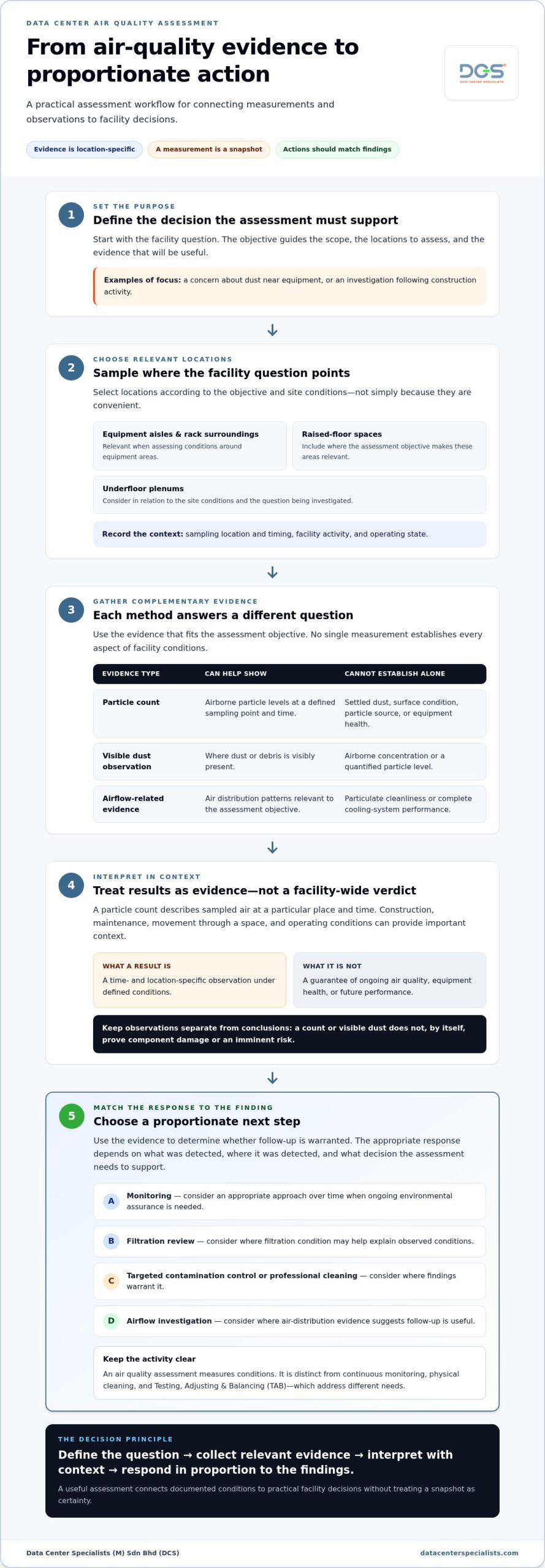
A practical data center air quality assessment workflow for facility teams
A well-scoped data center air quality assessment starts with the operational decision it needs to support. Before planning measurements, define the facility boundaries, relevant zones, access constraints, and concern under investigation. A clear objective connects the evidence gathered to a specific facility decision.
Prepare the scope around facility operations
Coordinate with facility operations before assessment activity begins. Identify relevant stakeholders, areas of concern, site access controls, operational constraints, and available facility information. Plan the work around live equipment and normal operations. Set expectations for what the assessment can establish, what it will not cover, and how teams will use the results.
- Step 1: Define the objective. State the question the assessment must answer, such as characterising conditions in a specified area or investigating a reported concern.
- Step 2: Set the scope. Identify facility boundaries and relevant zones. Note any access or operating constraints that affect the work.
- Step 3: Plan the assessment. Select sampling locations that reflect the objective and site conditions. Coordinate timing with facility teams, particularly when construction, maintenance, or other activity may affect interpretation.
- Step 4: Record conditions. Document the location and timing of each observation or measurement, along with relevant activity and operating conditions. Keep this context with the results rather than reporting readings in isolation.
Document findings and assign proportionate actions
Report observations separately from inferences. For each finding, record its location, timing, relevant conditions, and any limitation that affects interpretation. An observation in one zone, for example, should not be presented as representative of unassessed areas. Identify recommendations that can be acted on from the evidence, and distinguish them from proposals that need additional technical validation.
- Step 5: Link evidence to action. Assign follow-up based on the finding and original objective. This may involve further investigation, a technical review, or targeted contamination control where the evidence supports it.
- Step 6: Communicate and track. Share results and recommended actions with relevant facility stakeholders. Record ownership and follow-up so teams can close the loop and determine whether further assessment is appropriate.
For related environmental controls, consult the data center contamination prevention guide. Where assessment evidence supports physical contamination removal, explore professional data center cleaning as a focused facility action.
Turn assessment findings into data center air quality and continuity actions
Use assessment findings to choose a response proportionate to the evidence. A result may support closer inspection of an affected area, investigation of a potential contamination source, targeted physical cleaning, airflow review, or additional testing. It should not trigger a broad intervention by default. First establish what the findings show, which facility decision they affect, and what remains uncertain.
Connect air quality evidence to contamination control
Prioritise investigation around the locations and conditions where contamination was observed. If findings point to accumulated dust in a defined area, targeted cleaning may be appropriate. If a potential source is still active, address source control as well. Cleaning removes existing contamination but does not, by itself, identify or prevent its recurrence. The data center contamination prevention guide provides further context for environmental controls.
Keep the cleaning scope connected to the evidence, including the affected equipment area, surrounding surfaces, or underfloor space where relevant. For practical scope considerations, refer to the data center cleaning specifications guide. Where findings support physical contamination removal, professional data center cleaning can form part of a targeted response. It is not a substitute for controlling the source.
Coordinate air quality, airflow, and continuity decisions
Particle data does not establish whether air is being distributed correctly or whether cooling performance is adequate. If operational observations raise airflow questions, arrange a separate technical review rather than inferring a distribution problem from particle results. The data center TAB technical guide explains how Testing, Adjusting & Balancing relates to air distribution. Where airflow or cooling findings also prompt efficiency questions, a data center energy assessment can help inform that separate review.
Environmental assessment and testing support better-informed facility planning, but they cannot guarantee continuity or uptime. Treat recommendations as inputs to operational decisions, coordinate actions with facility teams, and use further testing where evidence leaves a material question unresolved. For organisations looking to align physical infrastructure resilience with broader technology governance, consulting specialists like Unisphere Solutions can assist in integrating operational risk into comprehensive strategic IT leadership. For a technical discussion about assessment and testing needs, contact Data Center Specialists about specialized engineering testing.
Use air quality evidence to guide your next facility decision
A useful data center air quality assessment does more than produce readings. It helps facility teams understand what was observed, where and under which operating conditions, then decide whether monitoring, further investigation, source control, targeted cleaning, or airflow review is appropriate.
Keep conclusions within the limits of the sampling scope. Particle-count results and visible observations inform contamination-control priorities, but they do not establish equipment condition or guarantee continuity. Airflow concerns may need a separate technical review, while cleaning is most effective as part of an evidence-led response that also considers contamination sources.
Data Center Specialists provides air quality assessment and particle count testing, alongside related technical services including contamination control, Cleanroom Performance Testing, and Testing, Adjusting & Balancing. These services support informed facility planning without replacing operational judgement.
For a focused discussion about your facility’s assessment needs, contact Data Center Specialists to discuss a data center air quality assessment. Clear evidence can help your team take practical, proportionate steps with greater confidence.
Frequently Asked Questions
What does a data center air quality assessment measure?
A data center air quality assessment can measure airborne particle levels and document visible dust or other relevant observations in selected facility areas. Depending on the objective, the scope may also consider gaseous contamination or environmental and airflow context. Interpret results against the stated sampling conditions and any applicable project criteria. ISO 14644-1:2015 provides a framework for classifying air cleanliness, but do not assume a classification is a universal data center requirement.
How is air quality tested in a data center?
Testing begins by defining the question, facility zones, and conditions the assessment needs to represent. Particle count testing may then characterize airborne particles at selected locations, alongside relevant observations. Record where and when measurements are taken, together with pertinent operating conditions or activity. The assessment scope determines what is measured. One reading or observation cannot establish conditions throughout the entire facility.
How often should a data center air quality assessment be performed?
There is no single assessment frequency that suits every data center. Set the schedule according to facility objectives, contamination risks, operational changes, and previous findings. An assessment may be appropriate after construction or maintenance activity, when a concern arises, or when teams need a baseline for a defined decision. Repeat assessment or ongoing monitoring can help track conditions over time, but the choice should reflect facility needs rather than a universal interval.
Can poor air quality damage data center equipment?
Airborne contamination can contribute to equipment risks, depending on the contaminant, its concentration, and exposure conditions. Particles may accumulate on surfaces or interfere with heat-transfer paths, while certain gaseous contaminants can contribute to corrosion. These possibilities do not mean every particle reading indicates damage or imminent failure. Assessment findings help identify conditions for investigation and proportionate control, but equipment condition and operational risk require appropriate technical evaluation.
Does a particle count test prove that a data center is clean?
No. A particle count characterizes airborne particles at specific locations and times under the test conditions. It does not establish the condition of settled dust, rack surfaces, underfloor spaces, or every other facility zone. Nor does one result prove equipment cleanliness or predict reliability. Interpret counts alongside the assessment objective and relevant observations, then determine whether further investigation or targeted physical cleaning is supported by the evidence.
Is air quality assessment the same as airflow testing?
No. Air quality assessment focuses on airborne conditions, such as particle counts, while airflow testing examines air distribution for a separate facility question. Particle data alone cannot confirm whether airflow is balanced or cooling is performing as intended. Where air distribution requires measurement or adjustment, Testing, Adjusting & Balancing (TAB) is a distinct technical service. Use the assessment objective to determine which evidence or specialist review is relevant.
What should facility teams do after an air quality assessment?
Review each finding alongside its location, timing, operating context, and limitations. Separate direct observations from assumptions about sources or equipment condition. Then assign proportionate follow-up: investigate a potential source, consider targeted contamination control or professional cleaning where evidence supports it, or arrange airflow review or additional testing if needed. Data Center Specialists provides data center air quality assessment and particle count testing to inform these facility decisions.