
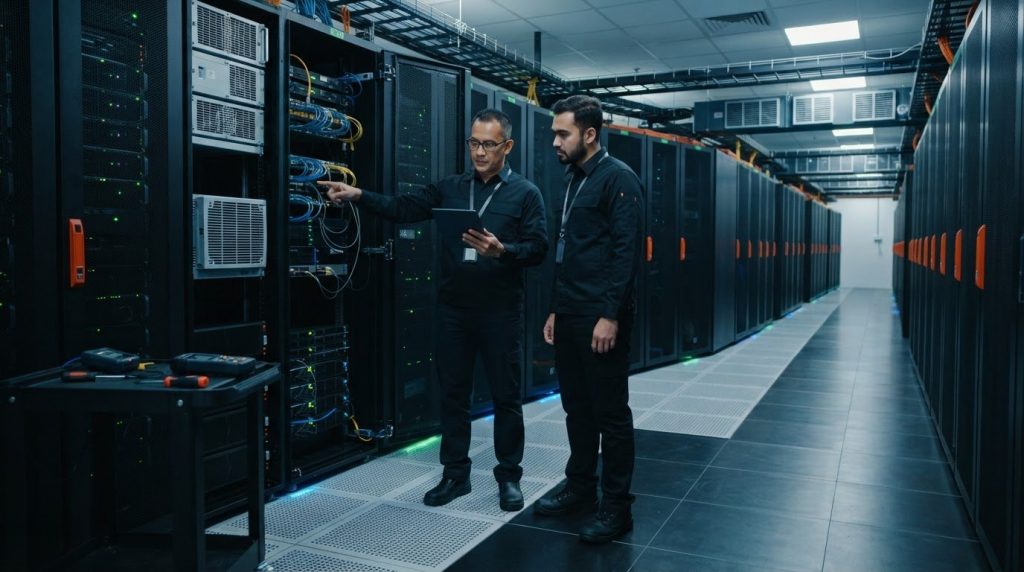
A routine maintenance task can create operational risk if it is poorly scoped or coordinated. For financial institutions, planned work on cooling, airflow or facility infrastructure must fit the live operating environment, change approvals and site controls. Effective financial institution data center maintenance treats controlled execution and clear records as part of the work, not as paperwork to complete afterward.
Facility teams need to define the scope for critical equipment and supporting conditions, assign responsibilities across operators and service teams, and retain evidence for internal review and future planning. Maintenance helps manage facility risk, but it cannot guarantee uninterrupted service.
This guide explains how to prioritise maintenance, plan work around operating requirements and document activities. It also shows how preventive maintenance can work alongside technical assessments, physical contamination control, Testing, Adjusting & Balancing (TAB), and airflow and cooling optimisation. The aim is a disciplined approach based on facility conditions, with controls and records that make each intervention easier to manage and review.
Key Takeaways
- Define maintenance scope by system, operational consequence, method and accountable team, including cooling, airflow and contamination controls.
- Compare reactive, scheduled and risk-informed maintenance by their triggers, limitations and evidence requirements rather than relying on one approach for every asset.
- Structure financial institution data center maintenance around a traceable sequence: inventory, criticality review, scope definition, work control, execution and follow-up.
- Maintain records that connect findings, approvals, completed work, exceptions and corrective actions to support operational review and future planning.
- Coordinate preventive maintenance with relevant physical cleaning, energy assessment, TAB and Cleanroom Performance Testing to address facility conditions through a tailored scope.
Why Financial Institution Data Center Maintenance Needs a Controlled Approach
In a financial data center, maintenance is more than a repair ticket. It includes planned inspection, servicing, testing and corrective follow-up for infrastructure that supports facility operations. Financial institution data center maintenance should make clear what work is proposed, which systems or areas it may affect, who has approved it and how operations will be informed. The objective is disciplined risk management, not a promise that service will never be interrupted.
Facility maintenance is distinct from IT asset support, cybersecurity and database maintenance. It focuses on the physical environment and supporting infrastructure, while coordinating with teams responsible for technology services. The wider operational context is outlined in Data center management, which includes ongoing facility and infrastructure responsibilities.
For useful context on how data center operations are organised, watch this overview:
What financial data center maintenance covers
Scope should distinguish mechanical systems, such as cooling equipment, from electrical support systems and installed power infrastructure. Environmental conditions, airflow and physical contamination controls are additional areas to consider. The inventory depends on the facility’s installed systems, redundancy arrangements and operating model.
Routine visual inspections can flag abnormal conditions for review. Specialist testing or adjustment may be needed to assess performance. Physical cleaning addresses contamination in areas such as raised floors and equipment spaces, while corrective work responds to a specific finding. These activities have different methods, access requirements and approval needs. DCS provides data center preventive maintenance tailored to facility requirements.
Why controlled work matters in live facilities
In a live environment, timing and coordination matter as much as task scope. A work plan should identify the activity, affected area, operational dependencies and response steps if conditions change. A cooling inspection, for example, may require coordination with facility operations before equipment is accessed or adjusted.
Facility teams, data center operations, security and service teams need clear roles and communication routes. Set out those responsibilities and required records under the institution’s procedures and applicable obligations. Documenting approvals, completed work, findings, exceptions and follow-up supports review, but maintenance cannot eliminate every risk or guarantee uninterrupted service.
Which Systems and Maintenance Activities Belong in the Scope?
A useful maintenance scope connects each asset to its operating consequence, work method and accountable team. An inventory might include cooling equipment and air distribution, electrical support systems, environmental monitoring, and physical contamination controls. Since facilities differ, use equipment records, operating procedures and observed conditions to identify what needs attention.
For each item, distinguish routine inspection from specialist servicing, performance assessment, adjustment, testing, physical cleaning or corrective work. Manufacturer instructions can guide equipment servicing; an independent assessment may answer a different question, such as whether airflow is distributed as intended or whether environmental conditions warrant follow-up. Assign ownership clearly, including how service-team findings reach facility operations for review and action.
Prioritisation should reflect both condition and consequence. A risk assessment framework such as the NIST Guide for Conducting Risk Assessments can help teams structure their consideration of risk, but it does not prescribe a maintenance schedule for a particular facility. Use it as a reference alongside institutional procedures and site-specific information.
Cooling, airflow and environmental conditions
Review cooling performance and airflow distribution as related but distinct concerns. An observation may flag an apparent issue; a technical assessment can examine conditions in more detail; TAB measures and adjusts air distribution within the agreed scope. These activities are not interchangeable and do not automatically prove that every operating condition is suitable.
Document the area assessed, conditions observed and recommended follow-up. When energy performance is part of the review, DCS’s data center energy assessment can inform maintenance planning alongside cooling and airflow considerations.
Contamination control and physical facility condition
Include raised floors, underfloor plenums, rack areas and relevant overhead or other surfaces when site conditions put them within the contamination-control scope. Dust or construction residue may warrant assessment and carefully planned physical cleaning, with access and work methods suited to the operating environment. This is specialist facility work, not general janitorial cleaning.
Record the area and condition that prompted the task, the agreed cleaning scope, completed work and any exceptions or follow-up. For more on physical contamination control, see DCS’s professional data center cleaning service. These records help teams connect maintenance activity to observed need and operational priorities.
Reactive, Scheduled, or Risk-Based Maintenance: How Should Institutions Compare Them?
No single maintenance model suits every asset. Financial institution data center maintenance may combine reactive response, scheduled servicing and condition- or risk-informed planning, with each approach serving a different purpose. The decision is not simply how often to perform work. Teams also need to weigh asset condition and operational impact against the risks that maintenance itself may introduce if it is poorly scoped or coordinated.
What each maintenance approach can and cannot do
Reactive work responds to an observed fault or abnormal condition. Scheduled maintenance supports repeatable inspections and servicing, but a calendar alone may not reflect current site conditions. Risk-informed planning uses available evidence, asset condition and potential operational consequences to help prioritise work. In practice, these methods can complement one another.
| Approach | Trigger and strength | Limitations | Useful records and applications |
|---|---|---|---|
| Reactive | An observed fault or condition prompts action. It focuses response on a known issue. | Waiting for a fault can leave a developing condition unidentified; the response may also require urgent coordination. | Record the finding, response, approvals, corrective action and outcome. Use for unplanned issues that require investigation or correction. |
| Scheduled | A time- or calendar-based plan supports consistency and helps teams organise recurring tasks. | A fixed interval may not account for changing operating conditions, observed deterioration or differences in asset consequence. | Keep schedules, task completion evidence, exceptions and findings. Apply to repeatable servicing or inspection activities defined for the facility. |
| Risk-informed | Condition, operational impact and available evidence guide prioritisation and review. | Decisions depend on the quality of asset information and the assumptions used; priorities need reassessment as conditions change. | Document evidence, rationale, priority, approvals and follow-up. Use to focus attention where potential consequences or observed conditions warrant it. |
How to limit disruption during planned work
Planned maintenance is not automatically low risk. Before work begins, define the task and affected assets, assign responsible parties, agree access arrangements and obtain approvals for the work window through institutional change-management procedures. Identify dependencies with facility operations and security, and establish how teams will raise and manage changes in site conditions.
When a task requires isolation, testing or adjustment, determine the applicable controls and sequence with the authorised facility team. Include appropriate testing and return-to-service checks in the work plan, and record results, exceptions and follow-up actions. Do not assume redundancy removes the need for review. The facility’s actual configuration and operating conditions should inform the controls.
For a coordinated approach tailored to site requirements, explore DCS data center preventive maintenance.
How to Build a Financial Data Center Maintenance Framework
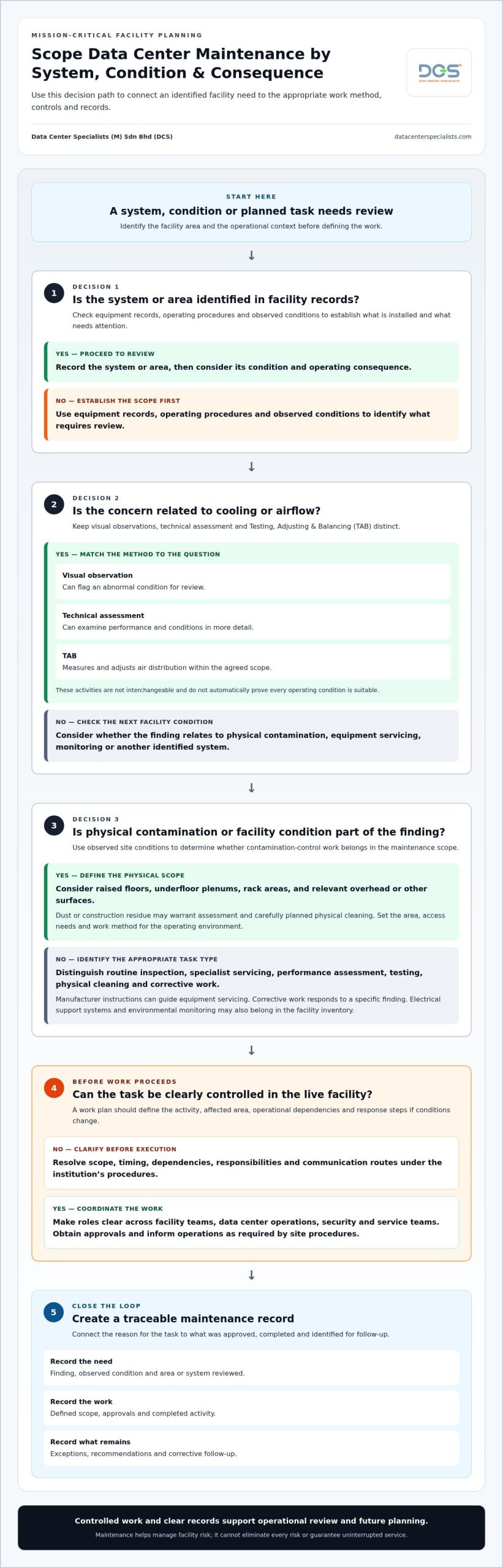
A practical framework turns asset information and operational priorities into controlled, reviewable work. For financial institution data center maintenance, use a sequence that links each decision to its rationale, owner and outcome. Treat the framework as a planning tool, not a substitute for institution-specific engineering, risk or compliance review.
- Build an asset inventory. Map installed facility systems and their dependencies using available drawings, equipment records and maintenance history. Note known condition issues and gaps in documentation.
- Review criticality. Consider the potential operational impact of an asset issue, its role in facility operation and relevant dependencies. Record the basis for each priority so teams can understand and revisit it.
- Define the scope. Separate recurring inspection and servicing from specialist assessment, testing, balancing, physical cleaning and corrective work. Identify the intended outcome and boundaries of each task.
- Control and execute work. Set task ownership, approvals, access arrangements, operational coordination and completion requirements before work begins.
- Review findings and adjust. Close the loop by assessing results, exceptions and outstanding actions. Update priorities and plans when evidence or site conditions change.
Prioritize assets and define service scope
Set priorities with facility, operations and engineering stakeholders, involving procurement when scope or service coordination requires it. Consider a cooling asset in relation to its facility role and dependencies, rather than listing it only as a recurring task. Maintenance intervals should account for applicable manufacturer guidance, observed site conditions, asset history and institutional procedures. Avoid applying one interval uniformly without considering the equipment and operating context.
Write each scope so teams can distinguish what is included, what evidence is expected and which findings require escalation. This reduces ambiguity between recurring maintenance and a separate technical assessment or corrective intervention.
Control work and review evidence
Before execution, identify who performs and approves each task, who authorises access, and how facility operations will coordinate the work. Align the process with the institution’s change controls and internal requirements. Check regulatory references against current authoritative guidance and the institution’s own obligations rather than assuming they apply uniformly.
Maintain records that let reviewers trace work from decision to closure. A useful record set includes the asset and task reference, scope, approval, date, responsible parties, completion evidence, findings, exceptions and accountable follow-up actions with review dates. Record the rationale for deferred or changed work as well. This helps facility teams distinguish completed tasks from unresolved conditions and plan future maintenance.
Data Center Specialists provides preventive maintenance for mission-critical facilities. Discuss a data center maintenance framework with the DCS team.
How DCS Supports Financial Institution Data Center Maintenance
Data Center Specialists (M) Sdn Bhd is a Malaysia-based specialist providing services for financial institutions and other mission-critical facilities. Its services include data center preventive maintenance, professional ISO cleaning, energy assessments, Testing, Adjusting & Balancing (TAB), and Cleanroom Performance Testing (CPT). These activities address different facility needs. The appropriate scope depends on the installed systems, observed conditions, operating requirements and priorities agreed with the institution.
For financial institution data center maintenance, technical work should fit the facility’s operational controls. Maintenance, assessment and specialist testing are not interchangeable. Each needs a defined purpose, agreed scope and suitable records of findings and follow-up.
Coordinate maintenance with specialist assessments
Preventive maintenance supports planned servicing and inspection of facility infrastructure. An energy assessment can examine facility energy use within its agreed scope. TAB tests and balances air distribution in relevant systems, while CPT evaluates cleanroom performance against its defined assessment scope. Findings can inform facility planning, but each service answers a different technical question and is not a substitute for the others.
DCS can coordinate these activities with maintenance priorities and site requirements. Review data center maintenance services to learn more about the maintenance offering. When airflow distribution is the focus, TAB provides a separate assessment of relevant conditions. When environmental cleanliness is in scope, professional ISO cleaning addresses physical contamination in mission-critical areas.
Define the next step for your facility
Start with the information needed to define a practical scope: the facility areas and systems involved, operational priorities, access or scheduling constraints, known issues and relevant documentation. Include site procedures so proposed work can be considered alongside the institution’s approval and operational controls.
A technical discussion can establish whether preventive maintenance, an assessment, testing, balancing or physical contamination control best addresses the identified need. If contamination is a concern, identify the affected spaces and conditions before setting cleaning activities. The scope should reflect the facility, not simply follow a generic schedule.
Discuss a facility assessment or maintenance scope with DCS. Start a technical discussion about data center maintenance to outline your facility requirements and priorities.
Build a Maintenance Programme Your Teams Can Review
Effective financial institution data center maintenance connects asset priorities with controlled work and clear evidence. Define the scope around facility systems and operating conditions, then select reactive, scheduled or risk-informed activities according to the asset, available information and potential operational impact. Record approvals, findings, exceptions and follow-up so teams can review decisions and refine future plans.
Maintenance supports facility reliability, but no programme can remove every risk or guarantee uninterrupted service. Its value lies in a disciplined process that coordinates technical work with the institution’s operational controls.
Data Center Specialists (DCS) provides preventive maintenance and specialist technical services for mission-critical facilities. Discuss your data center maintenance requirements with DCS to identify a practical next step for your facility.
Frequently Asked Questions
What does financial institution data center maintenance include?
Financial institution data center maintenance includes planned inspection, servicing, testing and corrective follow-up for facility infrastructure. Scope may cover cooling and airflow, electrical support systems, environmental conditions, and physical contamination controls such as raised-floor or underfloor cleaning. It should identify the assets, task methods, responsible teams and approval requirements. This facility work is distinct from IT asset support, cybersecurity and systems management handled by teams or technology partners like reisinformatica.com, though it must be coordinated with operational teams.
How often should a financial institution data center be maintained?
There is no single interval suitable for every system or facility. Set maintenance timing using applicable manufacturer guidance, observed condition, operating environment, asset history and institutional procedures. A recurring inspection schedule can provide consistency, while a new finding or change in operating conditions may call for earlier review. Document the rationale for intervals and reassess them when equipment condition, facility requirements or available evidence changes.
Can data center maintenance be performed while the facility is operating?
Some maintenance activities may be planned in an operating facility, but suitability depends on the task, affected systems, access requirements and operational risk. Before work begins, define the scope, responsible parties, approvals, work window and coordination arrangements. Tasks involving isolation, adjustment or physical access near live equipment need facility-specific controls and review. The work plan should include applicable testing and return-to-service checks; operating during maintenance should never be assumed safe by default.
How can maintenance reduce the risk of disruption to financial services?
Maintenance can help identify conditions requiring attention before they develop into larger facility issues, while controlled planning reduces avoidable work-related risk. Prioritise assets according to condition, dependencies and potential operational impact. Coordinate proposed tasks through the institution’s change and access procedures, and clarify communication, responsibilities and escalation paths. Record results and follow-up actions. These practices support reliability, but maintenance cannot eliminate every risk or guarantee uninterrupted financial services.
What records should a data center maintenance program retain?
Retain records that connect each task to its scope, approval and outcome. Useful documentation includes the asset reference, work date, responsible parties, inspection or test findings, completed activities, exceptions, and corrective actions with an owner and review date. Keep relevant evidence of work completion and record why work was deferred or changed. A traceable record set helps facility teams review open issues, support internal scrutiny and plan future maintenance.
What is the difference between preventive and reactive data center maintenance?
Preventive maintenance is planned in advance to inspect, service or test facility systems according to defined intervals, conditions or priorities. Reactive maintenance responds to an observed fault or abnormal condition. Preventive work supports early identification and repeatable planning, while reactive action addresses issues that have already emerged. Neither approach is sufficient for every asset on its own. Institutions commonly combine planned tasks with a controlled process for investigating and correcting findings.
How should institutions evaluate a data center maintenance service?
Assess whether the proposed service scope reflects the facility’s installed systems, operating conditions and priorities. A sound approach defines task methods, responsible parties, access and approval coordination, completion evidence, exception handling and follow-up. Consider how specialist activities such as assessment, testing, balancing or physical contamination control fit the stated need. DCS provides preventive maintenance and technical services for mission-critical facilities, with scope tailored to facility requirements and agreed priorities.
Does ISO 14644 define a complete data center maintenance program?
No. ISO 14644 concerns cleanrooms and associated controlled environments, with relevant parts addressing matters such as air cleanliness classification and testing. It does not, by itself, establish a complete maintenance program for a data center’s mechanical, electrical and supporting infrastructure. Operators should define maintenance scope using facility-specific engineering information, equipment guidance and institutional procedures. Where cleanroom performance or contamination control is relevant, apply the appropriate standard and assessment scope accurately.