
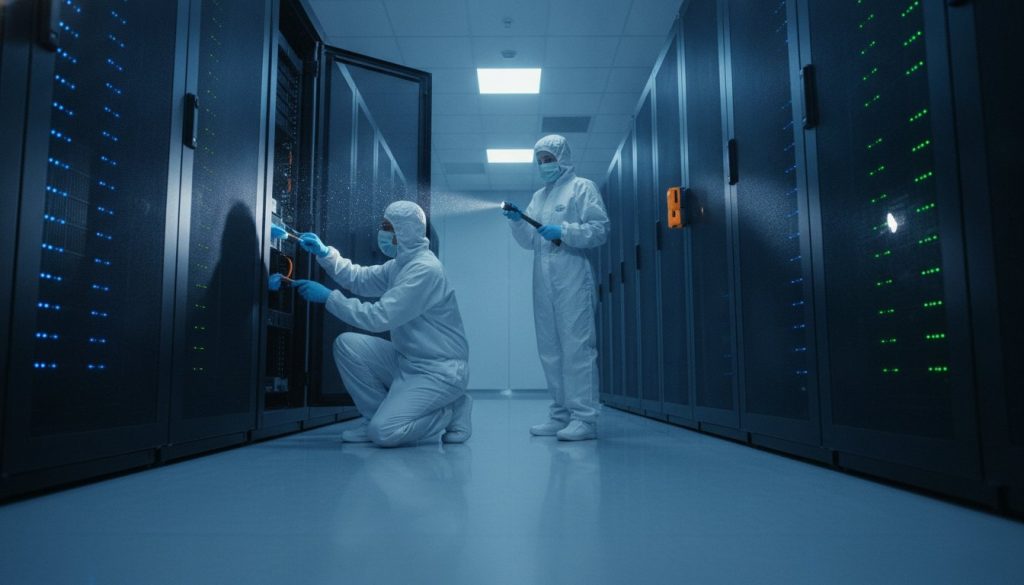
Can a particle of dust smaller than a human hair actually trigger a multi-million dollar outage? In the high-stakes world of mission-critical facilities, data center contamination prevention isn’t just a maintenance task; it’s a fundamental engineering requirement for uptime. You already know that while hardware redundancy and power backups are essential, the silent accumulation of micro-dust and construction debris in underfloor plenums and rack surfaces remains a persistent threat to your operational continuity. Clogged heat sinks and particulate buildup don’t just reduce cooling efficiency; they lead to catastrophic hardware failures that your redundancy might not catch in time.
This guide provides the professional strategies and rigorous ISO standards required to neutralize these invisible threats and protect your sensitive IT infrastructure. You’ll discover how to maintain strict ISO 14644-1 Class 8 compliance and extend the lifespan of your equipment through specialized environmental control. We’ll examine the technical methodologies for managing contamination during construction, the importance of surface cleanliness as defined by the updated ISO 14644-13:2026 standard, and the precise steps needed to ensure 100% operational continuity in live environments.
Key Takeaways
- Recognize how microscopic particulate matter acts as a silent threat by causing hardware overheating and critical component failure.
- Identify the primary entry points for contaminants, including external air infiltration and the persistent risks of residual construction debris.
- Learn how to align your facility with ISO 14644-1 Class 8 standards to establish a robust framework for data center contamination prevention.
- Implement specialized access protocols and airflow management strategies to minimize dust settlement in critical equipment zones.
- Discover the technical requirements for professional decontamination, including the use of HEPA filtered vacuums and lint-free materials for underfloor and rack areas.
What is Data Center Contamination and Why Does It Matter?
Data center contamination refers to the physical particulate matter that accumulates within a data center environment. While it might seem like a minor aesthetic issue, these particles are a primary driver of hardware failure. Effective data center contamination prevention involves more than just surface dusting; it requires a deep understanding of how micro-particles interact with high-density electronics. These contaminants settle on sensitive components, creating a “silent killer” effect where hardware slowly degrades without immediate alarms, eventually leading to catastrophic failure.
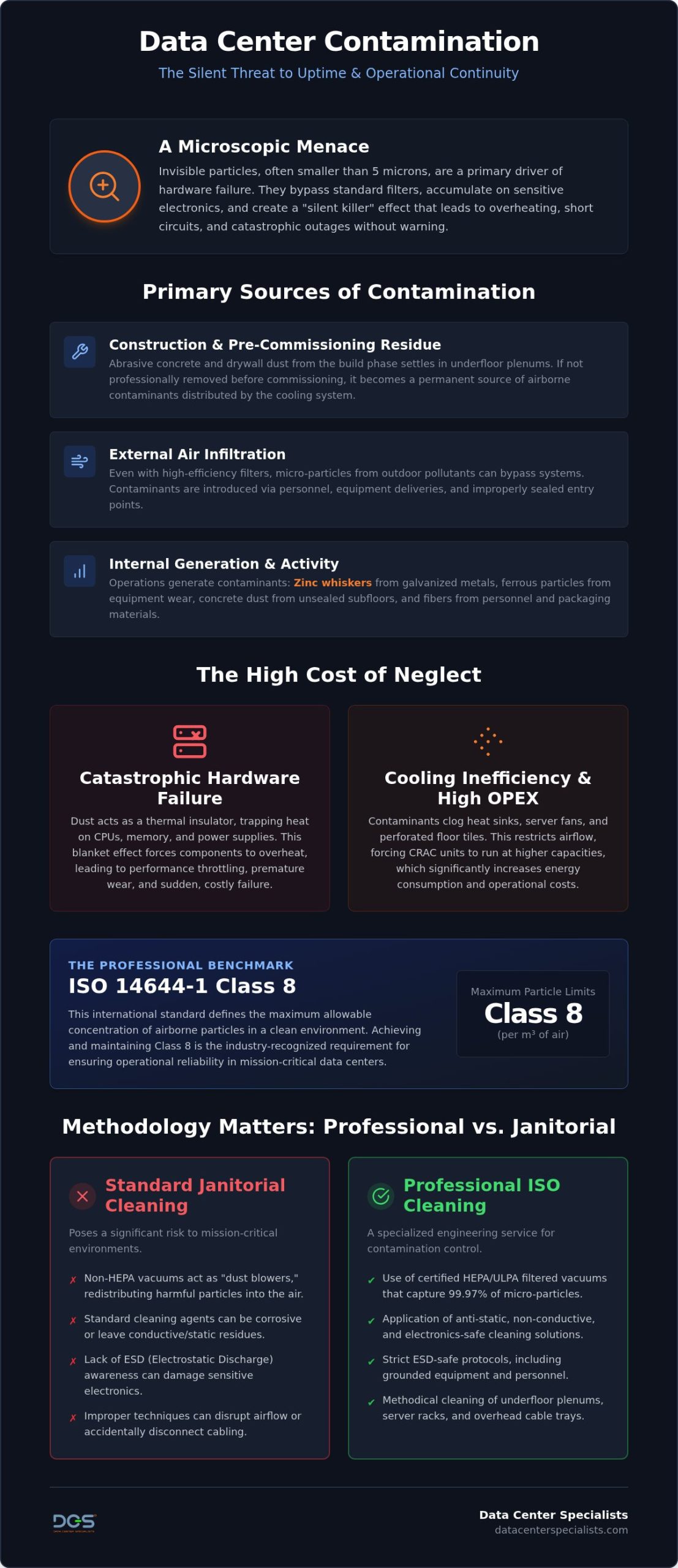
We distinguish between macro-particles and micro-particles based on visibility and size. Macro-particles, such as hair, clothing fibers, or cardboard debris, are visible and often trapped by floor-level filters. Micro-particles are invisible to the naked eye, often measuring less than 5 microns. These smaller particles are dangerous because they remain suspended in the air and are pulled deep into server chassis by high-velocity cooling fans. Common sources include:
- Zinc whiskers from galvanized metal surfaces.
- Concrete dust from unsealed sub-floors.
- Ferrous particles from equipment wear and tear.
- Skin cells and clothing fibers introduced by personnel.
To better understand the scale of modern infrastructure and the environmental footprint involved, watch this report:
The Difference Between Janitorial and Technical Cleaning
Standard janitorial equipment is inherently dangerous for mission-critical spaces. Most commercial vacuums don’t have the filtration capacity to trap micro-dust, effectively acting as blowers that redistribute particles into the airflow. Additionally, standard cleaning agents can cause corrosive damage or introduce static discharge. Technical cleaning is a specialized engineering service designed to remove contaminants without risking the integrity of live electrical systems. Utilizing HEPA-filtered vacuums and anti-static protocols is an integral part of data center contamination prevention that ensures no harmful residues are left behind.
The Cost of Neglect: Hardware Failure and Cooling Inefficiency
Dust acts as a thermal insulator. When it coats a server’s internal components, it traps heat and forces fans to run at higher RPMs to compensate. This leads to increased energy consumption and premature component failure. Beyond the racks, contamination in the underfloor plenum clogs floor tiles and reduces airflow efficiency, which disrupts the balance of the entire cooling system. Regular Data Center Maintenance ensures that these airflow paths remain clear and that heat sinks don’t become blanketed in insulating debris, protecting your facility from expensive, avoidable downtime.
Primary Sources of Contaminants in Mission-Critical Environments
Contaminants don’t enter a facility by accident; they follow predictable pathways. Understanding these entry points is the first step in robust data center contamination prevention. We categorize these sources into three primary streams: external air infiltration, internal operational activity, and mechanical equipment wear. While high-efficiency filtration systems manage most outdoor pollutants, micro-particles often bypass standard filters during extreme weather events or filter bypass conditions. Internal mechanical wear, such as belt dust from cooling units or metal shavings from rack adjustments, adds a constant baseline of particulate matter to the environment.
Construction and Pre-Commissioning Residue
Concrete dust is particularly aggressive due to its abrasive and alkaline nature. During the build phase, drywall sanding and masonry work create fine dust that settles deep within underfloor plenums. If you don’t address this residue before commissioning, the cooling system will distribute these particles directly into your new IT hardware. Professional data center cleaning is mandatory before equipment handover to prevent immediate fan clogging and circuit board abrasion. This process ensures that the “clean” state of the facility is actually achieved before live operations begin.
Zinc Whiskers: The Hidden Threat in Raised Floors
Legacy facilities with electroplated raised floor tiles face a unique molecular threat. Zinc whiskers are microscopic, conductive filaments that grow from the underside of tiles that were finished using an electroplating process. These crystalline structures are often dislodged during floor tile movement or sudden changes in airflow. Once they become airborne, these filaments bypass most server filters and cause intermittent short circuits on motherboards. Identifying these requires specialized microscopic inspection. If your facility uses older raised flooring, a technical contamination assessment is a necessary step to mitigate this risk.
Personnel remain the most significant source of organic contaminants in an operational white space. Every individual entering the room sheds thousands of skin cells and hair fragments per minute. Clothing fibers, especially from natural materials like cotton, add significantly to the particulate load. These organic materials don’t just clog filters; they can also become a substrate for biological growth if humidity levels aren’t strictly managed. Implementing strict gowning protocols and utilizing dedicated technical footwear helps reduce this human-generated load, though regular professional intervention remains the only way to remove what has already settled.
Understanding ISO 14644-1 Standards for Data Centers
Environmental control in mission-critical facilities isn’t a matter of opinion or visual preference. It’s a technical discipline governed by ISO 14644-1:2015, the global benchmark for air cleanliness classification. For facility managers, this standard provides the framework for effective data center contamination prevention by defining exactly how many particles of a specific size are permitted per cubic meter of air. Relying on a visual “clean” is a dangerous gamble; micro-particles that cause hardware failure are invisible to the naked eye. Without instrumentation, you’re effectively operating blind.
ISO Class 8 is the industry-recognized minimum standard for operational data center halls, as recommended by ASHRAE TC 9.9. This classification limits the concentration of particles 0.5 microns or larger to no more than 3,520,000 per cubic meter. While this might sound like a high number, it represents a significantly cleaner environment than a standard office space. Maintaining this standard requires disciplined maintenance and specialized cleaning protocols that go far beyond basic janitorial services.
ISO Class 8 vs. Class 5: When Do Standards Change?
While Class 8 is the baseline for general server rooms, certain mission-critical zones require much stricter controls. A Class 5 environment, for example, allows only 3,520 particles of 0.5 microns per cubic meter, exactly 1,000 times cleaner than Class 8. You’ll typically see these higher standards in tape libraries, optical labs, or specialized hardware assembly areas where even minor particulate interference can ruin sensitive media or components. If your facility houses these high-sensitivity zones, you’ll need specialized Cleanroom Performance Testing CPT to verify that your air filtration and pressurization systems are meeting these rigorous requirements. Facility managers operating in the region can also benefit from understanding the specific requirements for cleanroom performance testing in Malaysia, where hyperscale investment is driving increasingly stringent ISO 14644-1 audit standards.
Particle Count Testing and Environmental Assessments
Validation of your contamination control strategy requires laser particle count testing. This process involves sampling air at various heights and locations—including floor level, rack intake, and overhead—to map the particulate distribution across the hall. The 2026 update to ISO 14644-13 has further expanded these requirements to include surface cleanliness, recognizing that settled dust is often re-suspended by high-velocity cooling fans. Monitoring ambient room air quality alone can mask the true risks lurking at the equipment intake; measuring the server rack particle count at the inlet is the only measurement that directly correlates with hardware reliability. By establishing a technical baseline through regular audits, you can identify rising contamination levels before they trigger hardware alarms. For a comprehensive understanding of the methodology behind these measurements, our cleanroom particle count testing guide provides the technical clarity needed to interpret ISO 14644-1 reports and turn raw data into a long-term contamination control strategy. Independent validation of particulate levels provides the objective proof required for audit compliance and insurance risk mitigation.
Strategies for Effective Contamination Prevention
Robust data center contamination prevention starts at the facility threshold. You can’t eliminate every environmental threat, but you can strictly control the volume of particulate matter entering the white space. Implement multi-zone access control where personnel must pass through transition areas before entering the main hall. High-tack sticky mats at every entrance are a simple yet critical requirement; they capture fine dust from shoes and equipment wheels that would otherwise settle on the raised floor. Ensure these mats are replaced according to a strict schedule to maintain their capture efficiency.
Beyond the entrance, you must treat the entire room as a dynamic environment. Integrating contamination control into your broader data center maintenance strategy ensures that small issues don’t escalate into hardware-threatening events. This proactive approach involves monitoring the physical condition of the facility alongside your power and cooling metrics.
Airflow Management and Cooling Optimization
Airflow is more than a cooling mechanism; it’s a transport system for particulate matter. When a cooling system is out of balance, stagnant air pockets form in corners or behind high-density racks. These low-velocity zones allow suspended micro-dust to settle on sensitive equipment surfaces. Professional Testing, Adjusting & Balancing (TAB) ensures that air velocity remains consistent throughout the room, keeping particles in suspension until they’re captured by high-efficiency filters. Utilizing DCS Containment solutions, such as hot or cold aisle isolation, further limits particle distribution. By isolating the IT equipment from the ambient facility air, you create a controlled micro-environment that is significantly easier to keep within ISO limits.
Maintenance Protocols for Live IT Environments
Cleaning live, energized environments requires specialized engineering knowledge and non-conductive equipment to prevent accidental trips or ESD events. We recommend a quarterly deep decontamination of the underfloor plenum and a monthly technical wipe of all rack exteriors and overhead surfaces. Never use standard water-based mops or high-alkaline chemicals that could introduce moisture or corrosive vapors into the airflow. For project managers overseeing new builds, following a detailed Data Center Cleaning Specifications: The ISO 14644-1 Post-Construction Checklist is essential to establish a clean baseline before hardware handover. To ensure your facility remains compliant and optimized, contact us for a professional data center contamination assessment.
Professional ISO Cleaning: The DCS Methodology
The DCS methodology treats data center contamination prevention as a technical discipline rather than a surface-level chore. We don’t just “clean” a room; we decontaminate a mission-critical environment using an engineering-led approach. Our teams utilize Class H HEPA-filtered vacuums that are certified to capture 99.97% of particles down to 0.3 microns. Unlike standard commercial vacuums that exhaust micro-dust back into the airflow, our equipment ensures that contaminants are permanently removed. We combine this with lint-free microfiber technology and non-conductive, anti-static cleaning agents specifically formulated for high-density electronics.
Electrostatic Discharge (ESD) awareness is a core component of our operational protocol. Every technician is trained to work safely around energized IT equipment, utilizing grounded equipment and following strict movement patterns to minimize static buildup. This level of specialization is what separates us from general janitorial services. Professional cleaning isn’t merely a maintenance expense; it’s a strategic investment in operational continuity. By removing insulating layers of dust from heat sinks and clearing the airflow paths in the sub-floor, we directly contribute to PUE (Power Usage Effectiveness) improvement and hardware longevity.
Comprehensive Underfloor and Overhead Cleaning
The underfloor plenum serves as the primary air supply route for the entire facility. However, it also acts as a massive gravity-fed reservoir for construction debris and settled particulate. When air pressure fluctuates or floor tiles are moved, these particles are swept up and pushed into the server intakes. We perform deep decontamination of these spaces, along with overhead cable trays and light fixtures, to eliminate the risk of “particle fall” onto the racks below. Our detailed Data Center Cleaning service ensures that every surface, whether visible or hidden, meets the technical specifications required for uptime.
Smart Racks and Infrastructure Solutions
Our expertise extends beyond maintenance into the design of the environment itself. DCS Smart Racks are engineered to provide a cleaner, more controlled environment for high-density hardware. These racks are designed to integrate seamlessly with our containment solutions, minimizing the exposure of sensitive components to ambient facility dust. There is a powerful synergy between professional cleaning and smart hardware installation; one provides the clean state, while the other maintains it through superior airflow management. This holistic approach creates a robust defense against the environmental threats that compromise your facility’s mission-critical success.
Secure Your Infrastructure Through Technical Precision
Maintaining a mission-critical environment requires a shift from reactive cleaning to proactive engineering. Effective data center contamination prevention isn’t achieved through visual inspection alone; it’s a measurable outcome of strict adherence to ISO 14644-1 standards. By neutralizing invisible threats like micro-dust and zinc whiskers, you protect your IT equipment from the silent failures that compromise operational continuity and cooling efficiency. Whether you’re managing a new build post-construction or maintaining a live hyperscale facility, technical precision is your most reliable safeguard against avoidable downtime.
As specialized engineering and technical infrastructure experts with over 15 years of mission-critical experience, Data Center Specialists understands the unique challenges of operational white spaces. We are ISO 14644-1 compliance specialists dedicated to protecting your technical assets through disciplined, technical methodology. Don’t leave your uptime to chance. Contact Data Center Specialists for a Professional Contamination Assessment and ensure your facility remains a high-performance environment. We’re ready to partner with you to achieve long-term resilience and technical excellence.
Frequently Asked Questions
What is the ISO 14644-1 standard for data center cleaning?
ISO 14644-1:2015 is the global standard for air cleanliness in controlled environments. For operational data center halls, ISO Class 8 is the recognized benchmark recommended by ASHRAE TC 9.9. This standard specifies the maximum allowable concentration of airborne particles per cubic meter. Achieving this classification requires specialized data center contamination prevention strategies to ensure that microscopic particulate matter doesn’t reach levels that compromise sensitive IT hardware and critical infrastructure.
How often should a data center undergo professional ISO cleaning?
Frequency is determined by your facility’s specific risk profile and operational activity. Most mission-critical facilities benefit from a quarterly deep decontamination of the underfloor plenum and a monthly technical wipe of server rack surfaces. Facilities undergoing expansion or maintenance work may require more frequent particle count testing to ensure air quality remains within ISO Class 8 limits. Regular assessments help maintain a stable baseline and prevent the gradual accumulation of harmful micro-dust.
What are zinc whiskers and how do they impact server rooms?
Zinc whiskers are microscopic, conductive crystalline filaments that grow from electroplated metal surfaces, most commonly found on legacy raised floor tiles. These whiskers are extremely fragile and can become airborne during floor tile movement or changes in airflow. Because they are electrically conductive, they bypass most equipment filters and cause intermittent short circuits on circuit boards. Identifying and remediating these structures requires specialized microscopic inspection and technical infrastructure expertise to prevent catastrophic hardware failure.
Can standard janitorial services clean a data center?
Standard janitorial companies aren’t equipped to handle the complexities of mission-critical environments. They typically use commercial vacuums that lack Class H HEPA filtration, which simply redistributes micro-dust into the airflow. Furthermore, general cleaners lack the necessary ESD awareness and non-conductive equipment required to work safely around energized electrical systems. Entrusting your facility to non-specialists significantly increases the risk of accidental downtime, hardware corrosion, and failure to meet ISO 14644-1 compliance standards.
What is the difference between pre-commissioning and routine cleaning?
Pre-commissioning cleaning is a rigorous post-construction decontamination performed before IT equipment is installed. It focuses on removing abrasive construction dust, such as concrete and drywall residue, from the underfloor plenum and overhead surfaces. Routine cleaning is a preventive maintenance service performed in live environments to manage organic contaminants like skin cells and clothing fibers. Both are essential components of data center contamination prevention, ensuring a clean environment from the initial handover through the entire operational lifecycle.
How does contamination affect data center energy efficiency?
Particulate accumulation acts as a thermal insulator, trapping heat within server chassis and forcing internal fans to operate at higher RPMs. This increases energy consumption and accelerates component wear. Additionally, debris in the underfloor plenum disrupts airflow distribution and clogs floor tiles, reducing the overall effectiveness of the cooling system. Professional decontamination improves your Power Usage Effectiveness (PUE) by ensuring that cooling air reaches its destination without obstruction or the insulating effects of dust.
What equipment is used in professional data center decontamination?
Professional decontamination requires specialized, non-conductive tools designed for energized environments. This includes Class H HEPA-filtered vacuums capable of capturing 99.97% of particles down to 0.3 microns. Technicians also utilize lint-free microfiber cloths and non-residual, anti-static cleaning agents that won’t leave corrosive films on equipment. Laser particle counters are employed during and after the process to provide real-time air quality data and verify that the facility meets the required ISO cleanliness classifications. Understanding how these instruments work and how to interpret their output is covered in detail in our cleanroom particle count testing guide for data centers.
Is it safe to clean a live or operational data center environment?
Yes, cleaning a live data center is safe and often necessary to maintain uptime, provided it is performed by mission-critical specialists. Our teams follow disciplined movement protocols and utilize specialized engineering tools to prevent accidental trips or ESD events. We prioritize safety and operational continuity, ensuring that every action taken within the white space is calculated to protect your technical assets while removing the particulate threats that lead to long-term hardware degradation and silent failures.