
Can your mission-critical facility withstand the scrutiny of an ISO 14644-1:2015 audit if your last validation was performed by a general contractor rather than a specialist? For facility managers managing national infrastructure, the stakes for cleanroom performance testing Malaysia have never been higher as regional hyperscale investments continue to surge. You likely understand that maintaining an ISO Class 8 environment is non-negotiable for equipment reliability. However, the line between mandatory compliance tests and optional secondary protocols often feels blurred, leaving your environment at risk of unseen contamination.
We recognize the intense pressure of safeguarding a live data hall where even minor particulate spikes lead to catastrophic hardware failure. This guide provides the technical clarity you need to master ISO-compliant testing requirements and select a partner with genuine mission-critical expertise. We’ll examine the essential primary tests, from HEPA filter integrity to room pressurization, while outlining the documentation required to keep your facility audit-ready. By the end, you’ll have a clear framework for validating airflow and pressure to ensure long-term operational success.
Key Takeaways
- Master the technical distinction between primary tests like particle counting and secondary tests like airflow visualization to ensure your facility meets ISO 14644-1:2015 standards.
- Identify the critical selection criteria for cleanroom performance testing Malaysia, focusing on providers with NEBB-standard methodology and proven experience in live mission-critical environments.
- Learn how to implement a risk-based requalification strategy under ISO 14644-2 to maintain continuous compliance and avoid costly downtime during equipment upgrades.
- Discover the operational benefits of integrating CPT with Testing, Adjusting & Balancing (TAB) to optimize cooling efficiency and support comprehensive energy assessments.
- Safeguard your hardware reliability by treating CPT as the final validation step following professional ISO decontamination and pre-commissioning cleaning.
Understanding Cleanroom Performance Testing (CPT) in Malaysia
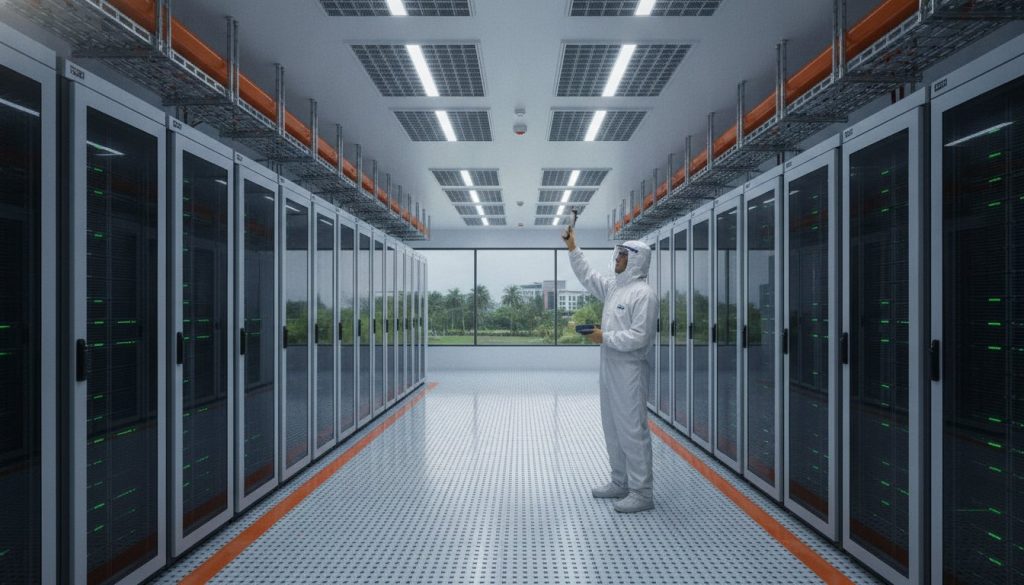
Cleanroom performance testing Malaysia involves more than just a routine inspection of dust levels. It’s a comprehensive technical validation suite designed to ensure that controlled environments operate within specific airborne particulate limits. While many associate “cleanrooms” with semiconductor fabrication or pharmaceutical labs, these standards are now essential for high-density data center halls. Modern servers have smaller component tolerances; this makes them highly susceptible to microscopic contaminants that cause cooling inefficiencies or electrical shorts. Professional CPT provides the empirical evidence that your facility’s environmental controls are functioning as designed.
To better understand the fundamental mechanics of these controlled environments, watch this helpful video:
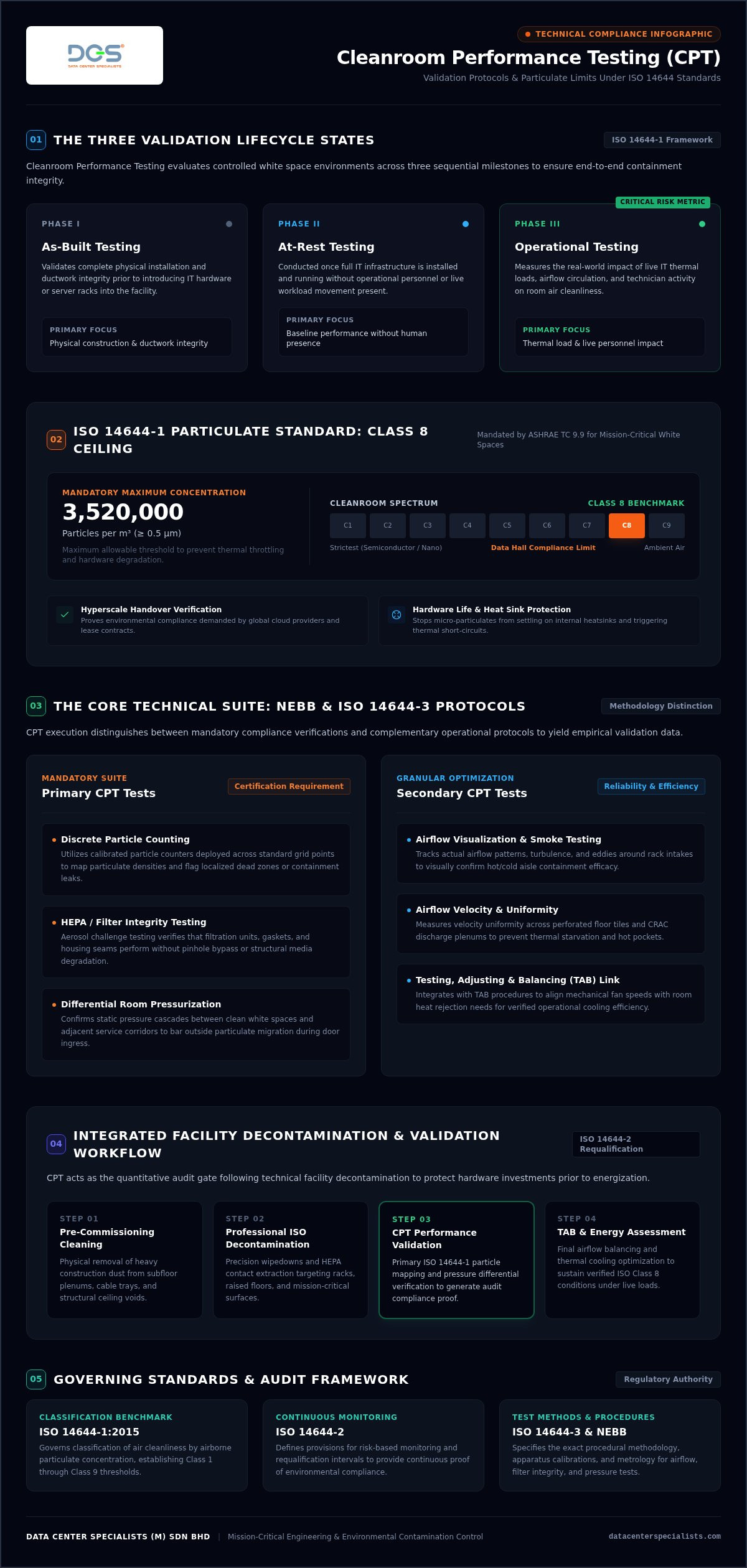
When you commission cleanroom performance testing Malaysia, the validation occurs across three distinct states to provide a full lifecycle view of the environment. “As-built” testing confirms the physical construction and ductwork integrity before any IT equipment is introduced. “At-rest” testing is conducted once the infrastructure is in place but personnel are absent. Finally, “operational” testing represents the real-world environment. This final state measures the impact of equipment heat loads and technician movement on air quality, which is the most critical metric for ongoing risk management.
ISO 14644-1 Classification Standards
The global benchmark for these environments is ISO 14644-1:2015. This standard defines nine levels of cleanliness, ranging from Class 1 to Class 9. You can review the specific cleanroom classifications and airborne particulate limits to understand the logarithmic scale of these requirements. For most mission-critical data center white spaces in Malaysia, ISO Class 8 is the industry standard mandated by ASHRAE TC 9.9. Under this standard, the particle concentration ceiling for Class 8 is capped at 3,520,000 particles per cubic meter for particles 0.5 microns or larger. Achieving this classification proves compliance during hyperscale handover, ensuring the facility meets the strict criteria required by global cloud providers.
The Business Value of Performance Testing
Investing in professional testing isn’t just about ticking a compliance box. It’s a strategic move to protect millions of ringgit in IT infrastructure. Micro-particulates often bypass standard filtration, settling on heat sinks and causing thermal throttling or hardware failure. For financial institutions and telecommunications providers, CPT provides the necessary documentation for rigorous internal audits and regulatory requirements. By establishing a baseline through technical validation, you reduce long-term operational risks and ensure that your cooling systems aren’t working against localized contamination zones.
The Core Technical Suite: Primary and Secondary CPT Tests
Effective cleanroom performance testing Malaysia requires a disciplined adherence to NEBB and ISO 14644-3 protocols. We categorize these technical evaluations into primary and secondary tests. Primary tests are the mandatory components required for basic certification, while secondary tests provide the granular data needed for operational reliability and cooling optimization. Without this data, facility managers are essentially operating in the dark, relying on design assumptions rather than empirical field measurements.
Primary Tests for Environmental Validation
Airborne particle count testing is the most critical component of the validation process. By using calibrated discrete particle counters, technicians map the concentration of particulates at specific grid points throughout the room. This process doesn’t just confirm your ISO class; it identifies contamination hotspots where stagnant air or poor filtration allows particulates to accumulate. If these hotspots align with your server inlets, the risk of hardware failure increases significantly.
HEPA and ULPA filter integrity testing, commonly referred to as leak testing, follows the particle count. We introduce a challenge aerosol like Polyalphaolefin (PAO) upstream of the filters and scan the downstream face for penetrations. This ensures that both the filter media and the housing seals remain airtight. These rigorous procedures align with the same principles found in FDA aseptic processing guidance, which emphasizes the necessity of airflow velocity and filter integrity in maintaining sterile boundaries. Finally, we measure room pressure differentials to ensure your white space remains positive relative to adjacent corridors, physically pushing dust away from your mission-critical equipment. A single Pascal of lost pressure can compromise your entire clean zone, which is why understanding the full scope of cleanroom pressure testing methodologies and ISO 14644-3 requirements is essential for any facility manager. For detailed technical specifications on these protocols, you can explore our Cleanroom Performance Testing CPT service page.
Secondary Tests for Operational Optimization
Secondary tests focus on the stability and safety of the environment. Airflow visualization, or smoke testing, is a powerful diagnostic tool. It uses non-toxic vapor to reveal exactly how air moves through containment aisles or around high-density equipment racks. If you notice turbulence or bypass airflow during these studies, it’s a clear sign that your cooling efficiency is compromised. We also perform comprehensive temperature and relative humidity mapping to ensure your HVAC system maintains a steady baseline across the entire floor, preventing localized “hot spots” that standard sensors might miss.
Light intensity and sound level testing are also included in the secondary suite to ensure the environment remains safe and productive for technicians. While these don’t affect equipment reliability directly, they’re essential for occupational health compliance. If you’re preparing for a facility handover or an annual audit, it’s worth discussing a specialized engineering assessment to verify your facility’s current standing and operational efficiency.
Evaluating CPT Providers: Certifications and Standards
Selecting a strategic partner for cleanroom performance testing Malaysia requires a checklist that extends far beyond the lowest bid. In a mission-critical environment, the cost of a false positive or an inaccurate particle count is measured in hardware failure and unplanned downtime. Facility managers must demand transparency regarding the credentials of the testing firm and the individual technicians entering the white space. A qualified provider doesn’t just deliver a report; they provide a technically defensible validation of your facility’s integrity.
Rigorous adherence to international standards is the primary differentiator. Every piece of instrumentation used during the assessment, from discrete particle counters to thermal anemometers, must have a current, NIST-traceable calibration certificate. We recommend that facility managers request these calibration records as part of the pre-work submittal package. Furthermore, an independent third-party tester provides an essential layer of risk mitigation, offering an unbiased verification that the original MEP contractors have met the design specifications without the conflict of interest inherent in self-testing.
Why Specialist Expertise Matters
General HVAC contractors often lack the specialized tools and procedural discipline required for high-tier cleanroom validation. While they may understand basic air balancing, they rarely possess the expertise to navigate the nuances of live data center airflows or the strict contamination control protocols necessary in a Class 8 environment. Mismanaging a smoke study or using uncalibrated sensors in a high-density hall can lead to catastrophic oversights. To ensure your facility’s specific complexities are addressed, it’s vital to engage a partner with a background in Specialized Engineering Testing who understands the high-stakes nature of mission-critical infrastructure.
Standards Compliance in Malaysia
In Malaysia, compliance is governed by the ISO 14644 series. Specifically, technicians must follow the ISO 14644-3 cleanroom test methods, which detail the exact procedures for airflow parallelity, recovery rates, and filter leak testing. DCS ensures that every assessment results in audit-ready documentation that satisfies the stringent requirements of global hyperscale operators and financial regulators. This level of detail is a natural extension of our broader commitment to Data Center Contamination Prevention, ensuring that your facility remains a pristine environment for your most valuable IT assets. By verifying that your provider follows NEBB-standard methodology, you gain the peace of mind that your performance data is accurate, repeatable, and legally compliant.
Developing a CPT Strategy: Frequency and Reporting
A successful strategy for cleanroom performance testing Malaysia isn’t a “one and done” event. It’s a continuous lifecycle of validation that ensures your mission-critical environment remains within operational tolerances as equipment loads fluctuate. While the initial handover testing establishes your baseline, periodic requalification is what protects your long-term hardware availability. Facility managers who treat CPT as a recurring operational discipline rather than a one-time construction requirement are better equipped to handle the environmental stresses of high-density AI and cloud workloads.
Recommended Testing Intervals
ISO 14644-2:2015 provides the governing framework for monitoring and requalification. For data center white spaces targeting an ISO Class 8 environment, the standard maximum interval for demonstrating continued compliance is 12 months. However, your facility’s criticality and hardware refresh cycle should dictate the actual frequency. High-traffic colocation halls or enterprise facilities undergoing frequent rack populations often require semi-annual testing to mitigate contamination risks introduced by personnel and packaging materials.
Certain trigger events demand immediate, unscheduled testing regardless of your annual cycle. These include major HVAC repairs, the installation of new containment systems, or post-construction activities. If you’ve recently completed a facility expansion, performing a baseline CPT is the final, non-negotiable step in our ISO 14644 Post-Construction Checklist. This ensures that construction-related particulates haven’t compromised the underfloor plenum or settled into sensitive server components before the room is energized.
Analyzing the CPT Technical Report
A professional CPT technical report should be dense with empirical evidence, providing a transparent view of your facility’s health. It must include raw particle count data for every grid location, current NIST-traceable calibration certificates for all testing instruments, and detailed floor maps showing the exact coordinates of each test point. When you review filter integrity results, look for the specific upstream challenge concentrations and the exact downstream leakage percentages. A simple “pass” or “fail” is insufficient for engineering-grade analysis; you need to see the numerical margin of safety.
Actionable insights are the most valuable part of the report. If a specific zone fails classification, the documentation should pinpoint the likely cause, such as stagnant air pockets or localized bypass airflow. By trending this data over several testing cycles, you can move toward a predictive maintenance model. This allows you to identify degrading HEPA filters or shifting pressure differentials before they lead to an environmental breach. For a deeper understanding of how differential pressure validation fits within your broader compliance strategy, our technical reference on cleanroom pressure testing provides the ISO 14644-3 and ISO 14644-4 framework you need. If you’re due for an annual requalification or need an immediate baseline assessment, contact our team to schedule your professional cleanroom performance testing today.
Integrated Reliability: Beyond Basic Performance Testing
Viewing cleanroom performance testing Malaysia as a siloed compliance exercise ignores its most significant benefit: the optimization of your entire cooling ecosystem. While CPT validates the purity of your air, its true value is unlocked when integrated with testing adjusting and balancing data center procedures. This synergy ensures that your facility doesn’t just meet particulate standards but also operates at peak mechanical efficiency. By aligning these disciplines, facility managers can bridge the gap between environmental safety and operational cost-control.
Empirical data from airflow validation is a cornerstone of a comprehensive Data Center Energy Assessment. If your performance testing reveals significant bypass airflow or localized turbulence, your CRAC and CRAH units are likely overworking to maintain set points. This translates directly to higher utility costs and unnecessary wear on HVAC components. Transitioning from basic testing to an integrated reliability model allows you to identify these inefficiencies and implement corrective measures that improve your Power Usage Effectiveness (PUE). Understanding how cleanroom air quality testing data center protocols integrate with your broader ISO 14644 compliance strategy is essential for facility managers seeking to move beyond reactive maintenance toward a proactive environmental control framework.
Remediation is the final, critical step in the testing lifecycle. If a zone fails classification, the solution isn’t just to adjust fan speeds; it often requires professional ISO data center cleaning to remove the particulate source. To maintain these pristine conditions long-term, we recommend future-proofing your white space with modular containment or DCS Smart Racks. These solutions stabilize airflow patterns, making it significantly easier to achieve consistent pass results during your annual requalification cycles.
Optimizing Airflow and Cooling
Utilizing CPT data to refine your HVAC System Commissioning provides a level of precision that design documents alone cannot offer. Pressure differential testing is particularly useful for identifying where cold air is escaping the containment aisle before it reaches the server inlets. By sealing these leaks and balancing the air volume, you ensure that every kilowatt of cooling energy is utilized effectively. This disciplined approach to airflow management doesn’t just protect your hardware; it provides a measurable return on investment through reduced energy consumption.
The DCS Advantage in Malaysia
Data Center Specialists provides a multidisciplinary approach that general testing firms cannot match. We don’t just hand you a report; we provide a roadmap for facility health based on decades of experience in the country’s most demanding mission-critical environments. Our teams support national infrastructure, providing technical services for hyperscalers and enterprise operators who require more than just surface-level validation.
We invite data center owners, facility managers, and M&E consultants to contact us for a professional facility assessment. Whether you’re preparing for a post-construction handover or need to requalify an operational environment, our seasoned engineers have the specialized skills to ensure your facility remains audit-ready and resilient. We focus on safeguarding your mission-critical infrastructure through technical precision and unwavering reliability across all national regions.
Securing the Future of Your Mission-Critical Infrastructure
Environmental stability is the foundation of high-availability data center operations. By prioritizing cleanroom performance testing Malaysia, you move beyond basic compliance and toward a model of predictive facility health. We’ve explored how technical validation, when integrated with airflow balancing, protects hardware and improves energy efficiency. Selecting a partner who understands the nuances of a live data hall is the most critical decision in your procurement process.
Data Center Specialists (M) Sdn Bhd (DCS) has served national mission-critical facilities since 2008. Our specialized engineering team possesses the live-environment experience necessary to navigate high-stakes halls across all national regions. We provide comprehensive technical reports fully compliant with ISO 14644-1 and 14644-2, ensuring your facility is always audit-ready. Don’t leave your equipment reliability to chance; invest in the precision that only a seasoned specialist can provide.
Ready to validate your environment? Contact Data Center Specialists for a professional CPT assessment and technical quotation. We’re here to help you maintain a pristine, high-performance facility.
Frequently Asked Questions
What is the difference between Cleanroom Performance Testing and ISO 14644 classification?
Cleanroom Performance Testing refers to the entire suite of technical methodologies used to validate a facility’s integrity, while ISO 14644-1 is the specific international standard defining cleanliness classes. Testing includes evaluations of airflow, pressure, and filter leaks, whereas classification specifically focuses on airborne particulate concentration limits. You perform the testing suite to achieve and document a specific ISO classification, ensuring your white space meets the requirements of your mission-critical hardware.
How often should a data center in Malaysia undergo CPT?
Most mission-critical facilities should undergo cleanroom performance testing Malaysia at least every 12 months to demonstrate continued compliance with ISO 14644-2 standards. Facilities with high equipment turnover or those supporting high-density AI workloads often benefit from semi-annual testing. Regular intervals help establish a performance baseline, making it much easier to detect environmental shifts or filter degradation before they lead to hardware failure or unplanned downtime.
Does CPT require the data center to be powered down?
No, CPT does not require a facility power down; testing in the operational state is actually essential for capturing real-world conditions. We perform particle counts and airflow visualization while your IT equipment is live to measure the impact of thermal loads and technician activity on air quality. Testing an energized environment provides the most accurate data regarding your facility’s ability to protect active hardware from microscopic contaminants and bypass airflow.
What are the primary causes of a failed cleanroom particle count test?
Failed particle counts typically stem from construction-related debris, bypass airflow, or degraded filtration systems. If microscopic dust bypasses primary filters, it accumulates in stagnant zones and triggers a classification failure. Other common causes include improper technician protocols, unsealed floor penetrations, or high-activity maintenance events that allow particulates from the sub-floor plenum to enter the white space. Identifying these sources is the first step toward professional environmental remediation.
Is NEBB certification mandatory for CPT providers in Malaysia?
While not a legal requirement for all facilities, NEBB certification is the industry benchmark for independent third-party validation in Malaysia. Most hyperscale operators and financial institutions mandate NEBB-certified firms to ensure that testing follows standardized, repeatable methodologies. Using a certified provider guarantees that your documentation is audit-ready and that all instrumentation has been calibrated to NIST-traceable standards, providing the highest level of technical accuracy for your facility.
What is the typical duration for a full CPT suite in a medium-sized data center?
A full CPT suite for a medium-sized data center typically requires one to three days of on-site technical work. The duration depends on the total number of grid points required for particle counting and the complexity of the airflow visualization studies. We coordinate closely with your operations team to ensure that testing proceeds methodically without disrupting daily facility management tasks or critical maintenance windows, ensuring a thorough assessment with minimal operational impact.
Can CPT help in reducing data center energy consumption?
Yes, cleanroom performance testing Malaysia identifies bypass airflow and pressure imbalances that force cooling systems to work harder than necessary. By validating airflow patterns, you can optimize fan speeds and set points to improve your Power Usage Effectiveness (PUE). This technical data supports broader energy assessments, allowing facility managers to reduce electricity consumption while maintaining the pristine environment required for high-density server racks and overall infrastructure reliability.
What happens if our facility fails the HEPA filter integrity test?
If a HEPA filter fails the integrity test, it indicates a leak in the media or a breach in the housing seal. Our technicians pinpoint the exact location of the leak using aerosol photometers during the PAO leak scan. Depending on the severity, the solution involves re-seating the gasket or replacing the filter element entirely. Following the repair, we perform a re-test to ensure the barrier is fully restored and audit-ready.