
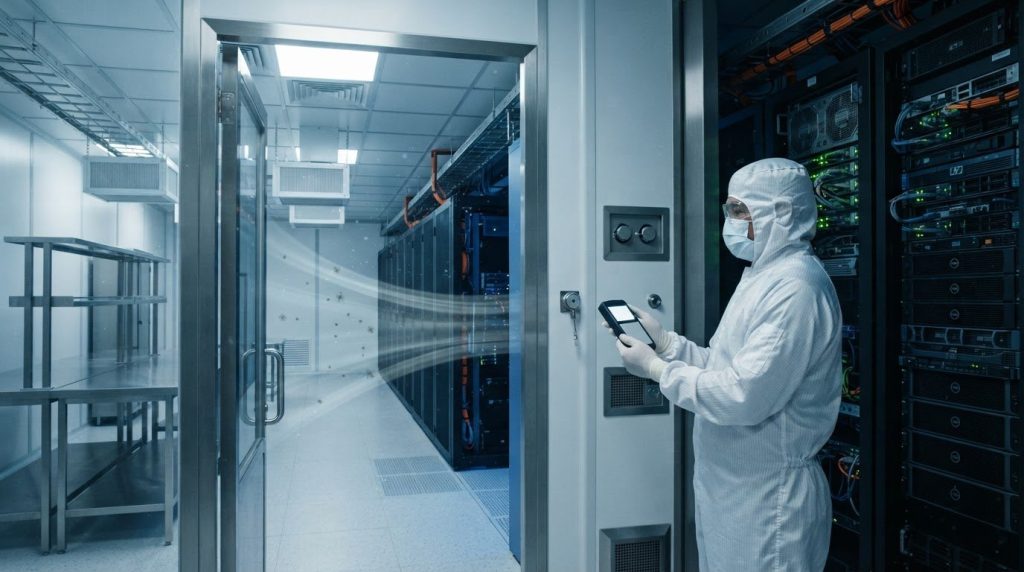
A single Pascal of lost pressure can be the difference between a certified clean zone and an expensive, uncontained contamination event. In mission-critical facilities across Malaysia, from Cyberjaya to Johor, cleanroom pressure testing serves as the primary physical barrier that prevents particulate ingress from lower-grade areas. You recognize that maintaining a pristine environment requires more than just high-quality filtration. It demands a precise pressure cascade that remains stable even during significant HVAC load shifts or door breach events.
It’s challenging to manage unexplained particulate spikes when your monitoring systems suggest everything is within spec. This technical reference will help you master the specific requirements of ISO 14644-3:2019 and ISO 14644-4:2022 to ensure your facility remains within the recommended 5 to 20 Pa range. We’ll examine the professional methodologies for differential pressure validation, the critical differences between sensor types, and how to optimize airflow to reduce energy wastage while securing a successful ISO 14644-1 certification handover.
Key Takeaways
- Understand how differential pressure serves as a physical barrier against particulate migration to protect sensitive mission-critical equipment.
- Learn to apply ISO 14644-3:2019 standards during cleanroom pressure testing to maintain the recommended 5 Pa to 12 Pa differential.
- Evaluate the technical differences between thermal mass flow and membrane sensors to select the most reliable instrumentation for your facility’s specific needs.
- Identify common “silent killers” of pressure stability, including unsealed envelope penetrations and HVAC load shifts, to prevent contamination risks.
- Discover how professional third-party validation ensures successful hyperscale handovers and long-term energy efficiency through optimized airflow.
What is Cleanroom Pressure Testing and Why is it Critical?
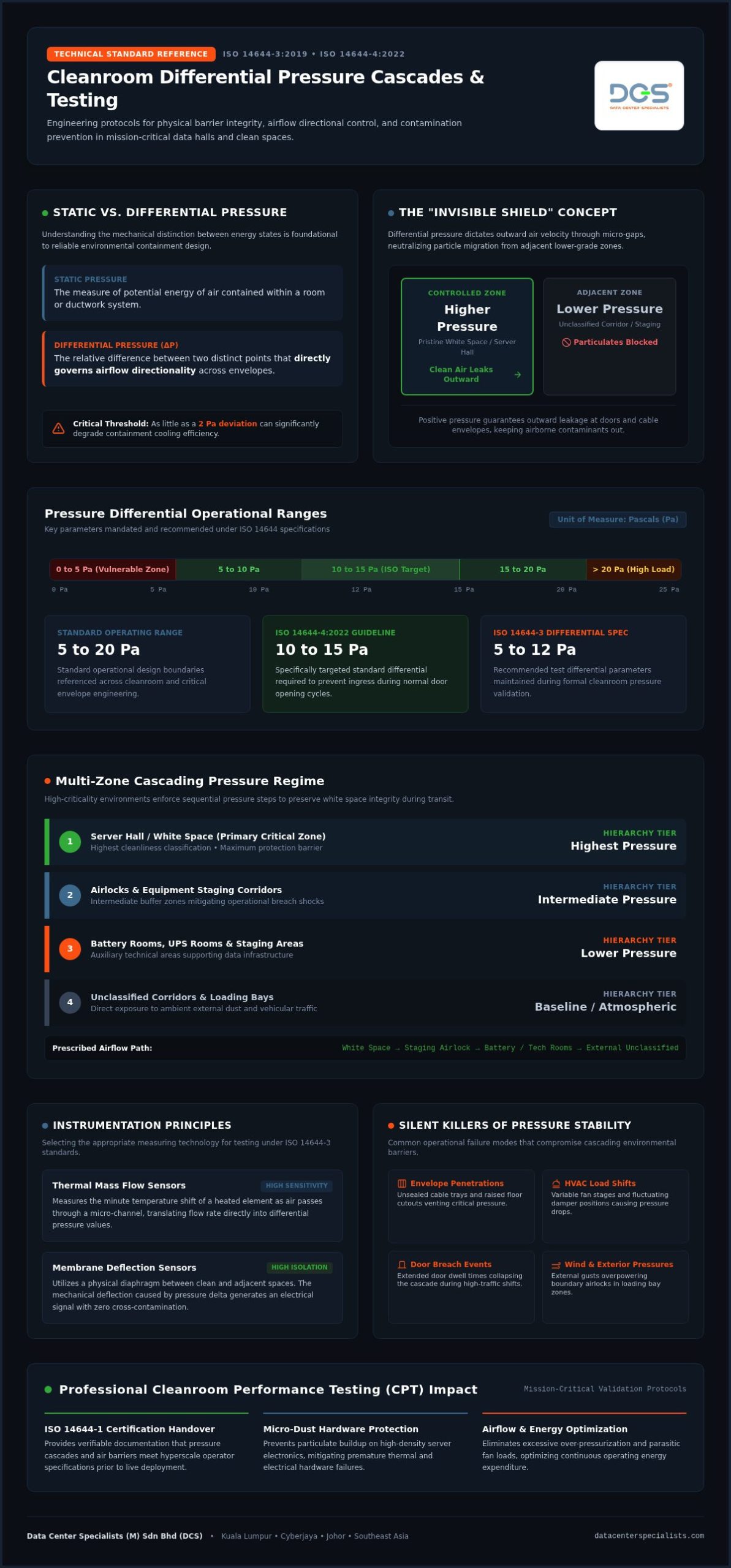
Differential pressure is the measured difference in air pressure between two distinct areas, typically a controlled cleanroom and its surrounding unclassified space. In the context of cleanroom pressure testing, this delta serves as a physical barrier that dictates the direction of airflow. By maintaining a higher pressure inside the cleanroom, facility managers ensure that air always leaks out through door gaps or envelope penetrations, rather than allowing contaminated air to seep in.
This “Invisible Shield” is the foundation of contamination control. While positive pressure protects the environment from external pollutants, negative pressure is utilized in containment settings to prevent hazardous materials from escaping. For modern data centers in Malaysia, especially those in high-growth corridors like Johor and Cyberjaya, these pressure cascades are no longer optional. They’re vital for maintaining the integrity of the white space during adjacent construction or high-traffic operational shifts.
To better understand the mechanics of the instruments used to measure these differences, watch this helpful video:
The Role of Pressure in Contamination Control
The fundamental cleanroom design and airflow principles rely on pressure to prevent dust ingress from unclassified corridors or loading bays. Without a stable pressure differential, usually targeted between 10 to 15 Pa according to ISO 14644-4:2022, even advanced HEPA filtration can’t stop particulates from entering via wind effects or door cycles. Regular cleanroom pressure testing ensures that these barriers remain intact throughout the facility’s lifecycle. This is particularly critical for supporting ISO 14644-1 particle count stability. In 2026, as server power densities increase, micro-dust accumulation on sensitive components can lead to premature hardware failure. Effective Cleanroom Performance Testing (CPT) identifies these vulnerabilities before they impact uptime.
Differential Pressure vs. Static Pressure
It’s common for facility personnel to confuse these terms, but the distinction is vital for accurate engineering. Static pressure refers to the potential energy of the air within a duct or room, whereas differential pressure is the relative comparison between two points. Engineers prioritize differential pressure because it directly governs airflow directionality. If the pressure cascade fails, the airflow can reverse, pulling warm, humid, or particle-laden air into the critical zone. Maintaining this balance is essential for the effectiveness of DCS Smart Modular Containment solutions, where even a 2 Pa deviation can significantly degrade cooling efficiency and energy performance.
ISO 14644-3 Standards for Pressure Differential
The globally recognized framework for validating environmental control is ISO 14644-3:2019. This standard provides the definitive ISO 14644-3 testing methodologies required to verify that a facility’s air pressure difference remains within design specifications. For critical facilities in Malaysia, adhering to these protocols is a prerequisite for achieving ISO 14644-1 certification. It’s not merely about recording a single number; the standard requires a methodical approach to ensure the pressure cascade effectively prevents the migration of airborne particulates between zones of different classifications.
In multi-zone data center environments, engineers implement a cascading pressure regime. This hierarchy typically places the most sensitive areas, such as the white space or server halls, at the highest pressure. Adjacent corridors, staging areas, and battery rooms are maintained at progressively lower pressures. This intentional gradient ensures that if a door is opened or a seal is compromised, air moves from the cleanest zone toward the less critical areas. For hyperscale operators in Cyberjaya or financial institutions in Kuala Lumpur, this cascading barrier is the primary defense against external contamination during high-traffic operational periods.
Understanding Pascal (Pa) Requirements
While ISO 14644-4:2022 suggests a broad design range of 5 to 20 Pa, the industry benchmark for high-integrity cleanrooms is often set at 12 Pa. This specific threshold provides a robust safety margin against external wind loads and seasonal monsoon pressure shifts common in Southeast Asia. However, more isn’t always better. Over-pressurization leads to significant energy waste and can create mechanical issues, such as door-latch failures or difficulty in closing fire-rated doors. Conversely, falling below a 5 Pa minimum risks “wind tunnel” effects at airlocks, where ambient drafts easily overcome the internal pressure barrier. Precise cleanroom pressure testing identifies the “sweet spot” where protection is maximized without compromising operational efficiency.
Documentation and Certification Standards
An ISO-compliant pressure test report must be thorough and technically accurate. It should document the occupancy state (as-built, at-rest, or operational), the specific instrumentation used, and its traceable calibration status. For mission-critical infrastructure, we recommend annual testing as a baseline, though semi-annual audits are often required for facilities with high personnel throughput or ongoing expansion. This documentation is a core component of Cleanroom Performance Testing (CPT), providing the evidence needed for facility handover and regulatory audits. If you’re preparing for a new facility commissioning or a periodic audit, it’s wise to consult with experts in HVAC system commissioning to ensure your pressure regimes meet the latest global standards.
Measuring Principles: Thermal vs. Membrane Sensors
Accurate cleanroom pressure testing depends entirely on the physics of the sensor used during the assessment. It’s not enough to simply record a number; facility managers must understand how different instrumentation reacts to the specific environmental conditions of a mission-critical space. Selecting the wrong sensor type can lead to phantom pressure drops or false stability readings that compromise the integrity of your contamination control strategy. For high-stakes Cleanroom Performance Testing (CPT), we categorize instrumentation into two primary technologies: thermal mass flow and membrane-based diaphragm sensors.
Thermal Mass Flow Sensors
Thermal sensors operate by measuring the cooling effect of a microscopic amount of air passing over a heated element through a bypass channel. Their primary advantage is extreme sensitivity at very low pressure ranges, often detecting changes smaller than 0.1 Pa. This makes them ideal for ultra-clean environments where airflow is laminar and highly predictable. However, they’ve significant drawbacks in operational data centers. Because they rely on a physical air bleed, they’re susceptible to dust contamination which can clog the internal bypass. They’re also sensitive to changes in air density and temperature, meaning they require frequent recalibration if the HVAC load shifts significantly during the testing period.
Membrane-Based Differential Pressure Sensors
Membrane or diaphragm sensors utilize a physical barrier, typically made of silicon or ceramic, that deflects when pressure is applied. This mechanical deformation is converted into an electrical signal. Unlike thermal sensors, there’s no air bypass, making pneumatic “cross-talk” impossible. This feature is critical when you’re using daisy-chained reference points across multiple rooms in a complex pressure cascade. These sensors are far more durable in live environments where particulates might still be present, such as during the post-construction phase. Their stability aligns with the rigorous FDA guidance on aseptic processing, which emphasizes the need for reliable, continuous monitoring of the 10 to 15 Pa differentials required to maintain sterility and prevent ingress.
Regardless of the sensor technology, zero-point calibration remains the most critical factor in cleanroom pressure testing. All sensors experience mechanical or electronic drift over time. Without a verified zero-point before the test begins, your baseline is fundamentally flawed. Professional testing teams utilize auto-zeroing solenoid valves to eliminate this drift without needing to disconnect the pneumatic lines. This level of precision is what separates a basic janitorial-style check from a true engineering assessment. If you’re managing a facility handover, ensuring your service provider uses calibrated, membrane-based instrumentation is essential for long-term operational continuity.
Common Pressure Issues and Troubleshooting
A mission-critical facility can have the most advanced HVAC system in the world and still fail a cleanroom pressure testing audit. We often identify “Silent Killers” of pressure stability that remain invisible to the naked eye but manifest as unexplained particulate ingress. These issues usually stem from a disconnect between the mechanical air supply and the physical integrity of the room’s envelope. While many facility managers reflexively blame fan failures, industry data suggests that 80% of cleanroom pressure failures during initial commissioning are actually attributable to unsealed envelope penetrations rather than mechanical equipment malfunction.
Resolving these fluctuations requires a holistic approach that integrates pressure monitoring with professional Testing, Adjusting, and Balancing (TAB). If your supply and return air volumes aren’t precisely synchronized, the room will struggle to maintain its design setpoint, leading to “hunting” behavior in the VAV controllers. This instability doesn’t just risk contamination; it forces the HVAC system to work harder, significantly increasing energy consumption. Identifying the root cause requires a methodical investigation of both the infrastructure and the airflow management strategy.
Detecting Air Leaks in the Envelope
The most common culprits for pressure loss are unsealed cable penetrations, particularly within raised floor systems. In many Malaysian data centers, frequent equipment refreshes lead to new cable runs that bypass original transit seals. These openings act as high-velocity leak points that bleed off positive pressure. Similarly, degraded gaskets on server room entry doors or structural leaks in modular containment systems can undermine the entire pressure cascade. We utilize smoke testing and airflow visualization testing to pinpoint these breaches, ensuring the “Invisible Shield” of positive pressure remains intact across all boundaries.
HVAC and Airflow Management Issues
Airflow management is a dynamic challenge. As HEPA filters become loaded with particulates, their resistance increases, which naturally lowers the room’s static pressure if the fans don’t compensate. Improperly balanced supply and return air volumes are the primary drivers of pressure “drifting.” To counter this, implementing DCS Containment solutions helps stabilize internal pressure by creating a more controlled environment around the server racks. This reduces the volume of air that needs to be pressurized, making it easier for the HVAC system to maintain the 12.5 to 25 Pa thresholds required for ASHRAE TC 9.9 compliance. If you suspect your facility is losing its protective barrier, contact Data Center Specialists for a professional pressure stability assessment.
The Value of Professional Cleanroom Performance Testing (CPT)
For hyperscale operators and financial institutions in Malaysia, objective third-party validation is a non-negotiable requirement for facility handover. While basic handheld meters provide a snapshot, they fail to capture the dynamic pressure fluctuations that occur during airlock cycling or HVAC load shifts. Professional cleanroom pressure testing provides the documented proof that your mission-critical environment meets design specifications under real-world operational loads. This level of verification is essential for risk mitigation, ensuring that your facility’s “Invisible Shield” is robust enough to handle the high ambient moisture and particulate loads common in Southeast Asia.
Our methodology at Data Center Specialists goes beyond simple point-in-time measurements. We utilize high-speed data logging and capacitive membrane sensors that feature a resolution of 0.1 Pa. This precision ensures that measurement uncertainty remains well within the ±1.5% full-scale limit mandated by ISO 14644-3:2019. By integrating these assessments into a recurring Data Center Maintenance program, facility managers can detect subtle baseline drifts before they manifest as critical contamination events. This proactive approach preserves hardware longevity and maintains the G1 severity level required for sensitive server electronics.
Comprehensive CPT Reporting
A professional CPT report is a strategic asset, not just a compliance checkbox. We provide detailed mapping of pressure gradients across the entire white space, identifying “weak zones” where the differential might dip below the 5 Pa minimum threshold during peak traffic. These reports offer actionable recommendations for airflow optimization, allowing you to fine-tune your VAV control loops. By resolving these pressure imbalances, you don’t just secure your environment; you also reduce energy wastage by preventing the HVAC system from over-pressurizing adjacent unclassified areas. This data-driven strategy is vital for long-term operational continuity in high-density facilities. Complementing this with standardized airflow visualization testing provides the empirical proof needed to diagnose bypass currents and underfloor pressure imbalances that pressure readings alone cannot reveal.
Choosing a Specialist Partner in Malaysia
It’s critical to distinguish between professional engineering services and general janitorial cleaning. Mission-critical environments require partners who understand ESD awareness, physical contamination control, and the complexities of live IT infrastructure. A specialist knows how to navigate operational halls without disrupting airflow or risking accidental downtime. With experience spanning the Klang Valley, Johor, and Singapore, we provide the technical expertise needed to navigate complex ISO standards and regional environmental challenges. Contact Data Center Specialists for a professional Cleanroom Performance Test assessment to ensure your facility remains at the top of its field.
Securing the Integrity of Your Mission-Critical Environment
Maintaining a stable pressure cascade is the definitive first line of defense against particulate contamination. As server densities increase and environmental tolerances tighten, the “Invisible Shield” of positive pressure becomes more vital than ever. You’ve seen that achieving compliance requires more than just high-quality filtration; it demands precise instrumentation, rigorous cleanroom pressure testing, and a holistic approach to envelope integrity. By addressing “silent killers” like unsealed cable penetrations and improperly balanced VAV loops, you protect sensitive electronics from the corrosive effects of tropical humidity and industrial dust.
Relying on seasoned expertise ensures that your facility doesn’t just meet a compliance checkbox but operates at peak efficiency. Our team at Data Center Specialists provides the specialized engineering and comprehensive technical reporting required for successful hyperscale handovers and ongoing operational continuity. Don’t leave your facility’s safety to chance when specialized validation is within reach. Request a Professional Cleanroom Performance Test (CPT) Assessment today to fortify your environment. Protecting your mission-critical infrastructure starts with mastering the air that surrounds it.
Frequently Asked Questions
What is the ideal pressure differential for an ISO Class 8 data center?
The ideal pressure differential for an ISO Class 8 data center typically ranges between 5 Pa and 12 Pa relative to adjacent unclassified spaces. While ISO 14644-4:2022 provides broader design guidance; this specific window ensures a robust “Invisible Shield” against particulate ingress. Maintaining this delta prevents external contaminants from entering the white space during door cycles or through minor envelope penetrations; which is essential for protecting high-density server racks from micro-dust accumulation.
How often should cleanroom pressure testing be performed?
We recommend that cleanroom pressure testing be performed at least annually to maintain ISO 14644-3 compliance. However; for hyperscale facilities or financial institutions with high personnel throughput; semi-annual testing is often required. Frequent assessments help identify physical infrastructure failures; such as degraded door gaskets or unsealed cable transits; before they lead to a significant loss of environmental control. Regular testing is a core component of a professional data center preventive maintenance program.
Can pressure testing be done while the data center is live?
Yes; pressure testing is frequently conducted in live environments to capture “operational” state data. ISO 14644-3 distinguishes between as-built; at-rest; and operational occupancy states. Testing during normal operations is critical because it accounts for the actual heat loads; personnel movement; and server fan activity that impact air pressure stability. Professional specialists use non-disruptive; high-precision instrumentation to ensure that cleanroom pressure testing does not interfere with critical IT services or facility uptime.
What is the difference between cleanroom pressure testing and TAB?
Cleanroom performance testing (CPT) evaluates the effectiveness of the room as a contamination barrier; while Testing; Adjusting; and Balancing (TAB) focuses on the mechanical HVAC system performance. CPT measures the pressure delta across the room’s envelope to ensure protection. TAB; on the other hand; involves adjusting fan speeds and dampers to synchronize supply and return air volumes. Both disciplines are integrated during commissioning to ensure the facility meets its technical design specifications.
Why does my room pressure drop when the cooling load increases?
Room pressure often drops during cooling load increases because the HVAC system modulates its airflow to handle the higher heat density. If the VAV controllers or return fans don’t respond in perfect synchronization with the supply fans; the pressure balance is disrupted. This “hunting” behavior can lead to temporary negative pressure events. Integrating pressure sensors with the Building Management System (BMS) through a fast-acting control loop is necessary to stabilize these fluctuations.
What are the risks of having too much positive pressure?
Excessive positive pressure; often exceeding 25 Pa; leads to significant energy wastage and mechanical operational risks. High pressure can cause door latching failures; making it difficult for personnel to secure the room or for fire-rated doors to close properly during an emergency. It also places unnecessary strain on the building envelope and HVAC components. The goal is to maintain the “sweet spot” of 10 to 15 Pa to ensure protection without compromising safety or efficiency.
Does ISO 14644-3 require specific instruments for pressure testing?
ISO 14644-3:2019 mandates the use of differential pressure gauges or micromanometers that meet specific precision standards. These instruments must have a measurement uncertainty not exceeding plus or minus 1.5% of the full-scale reading for low-pressure ranges. Additionally; the standard requires that all testing apparatus have a valid; traceable calibration certificate. Utilizing uncalibrated or generic handheld meters can result in inaccurate data that fails to meet the rigorous reporting requirements for hyperscale or enterprise facility handovers.
What happens if a data center fails its pressure differential test?
Failing a pressure differential test typically indicates a breach in the building envelope or a significant HVAC imbalance. This failure allows uncontrolled infiltration of warm; humid; and particle-laden air; which causes immediate risks of hardware corrosion and optical transceiver failure. Operationally; it prevents the facility from achieving ISO 14644-1 certification handover. Remediation usually involves identifying air leaks in the raised floor or modular containment and performing a professional TAB assessment to re-balance the airflow volumes.