
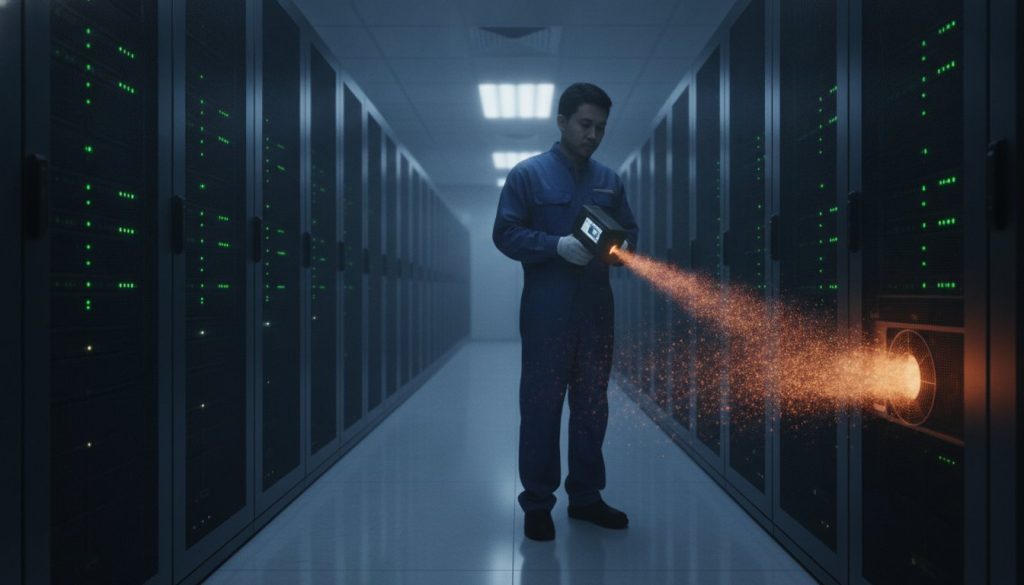
Monitoring ambient room air quality is often a vanity metric that masks the true risks lurking at the equipment intake. While a data hall might appear compliant on a wall-mounted sensor, the server rack particle count at the inlet is the only measurement that directly correlates with hardware reliability and the prevention of micro-dust-induced failures. You likely recognize that even the most advanced filtration systems cannot stop the silent accumulation of particulates that settle on mission-critical components. It’s a technical reality that puts your uptime at risk and complicates ISO compliance during rigorous audits.
This reference guide provides the technical framework needed to implement ISO 14644-1:2015 standards at the rack level, ensuring your facility remains audit-ready and your hardware stays operational. We’ll examine the specific thresholds for ISO Class 8 compliance, including the limit of 3,520,000 particles per cubic meter for sizes ≥0.5 µm. We’ll also establish a repeatable testing methodology for live environments and explain why specialized contamination control is a strategic necessity for hyperscale and colocation facilities in Malaysia and across Southeast Asia. By the end of this article, you’ll have a clear roadmap for justifying professional ISO cleaning services to protect your high-value GPU clusters and critical infrastructure.
Key Takeaways
- Learn why ISO 14644-1:2015 Class 8 is the industry benchmark and how to interpret the specific particle concentration thresholds required for hardware warranties.
- Master the methodology for measuring server rack particle count at the air inlet to identify risks that ambient room sensors often miss.
- Understand the critical differences between testing in “as-built,” “at-rest,” and “operational” states to ensure your data reflects real-world contamination risks.
- Identify the “Red Line” thresholds in your particle distribution curve that necessitate an immediate professional deep clean to prevent hardware failure.
- Establish a data-driven preventive maintenance schedule that replaces guesswork with precise environmental assessments and specialized contamination control.
Understanding Particle Counts and ISO 14644-1 Standards
Maintaining a clean environment isn’t just about aesthetics; it’s a technical requirement for hardware survival. A particle count measures the concentration of airborne particulates within a cubic meter of air, providing a quantifiable metric for environmental risk. In mission-critical facilities, the ISO 14644 standards serve as the definitive global benchmark for air cleanliness. While many facility managers focus on general room air, the server rack particle count at the equipment intake is what truly dictates the risk of hardware failure.
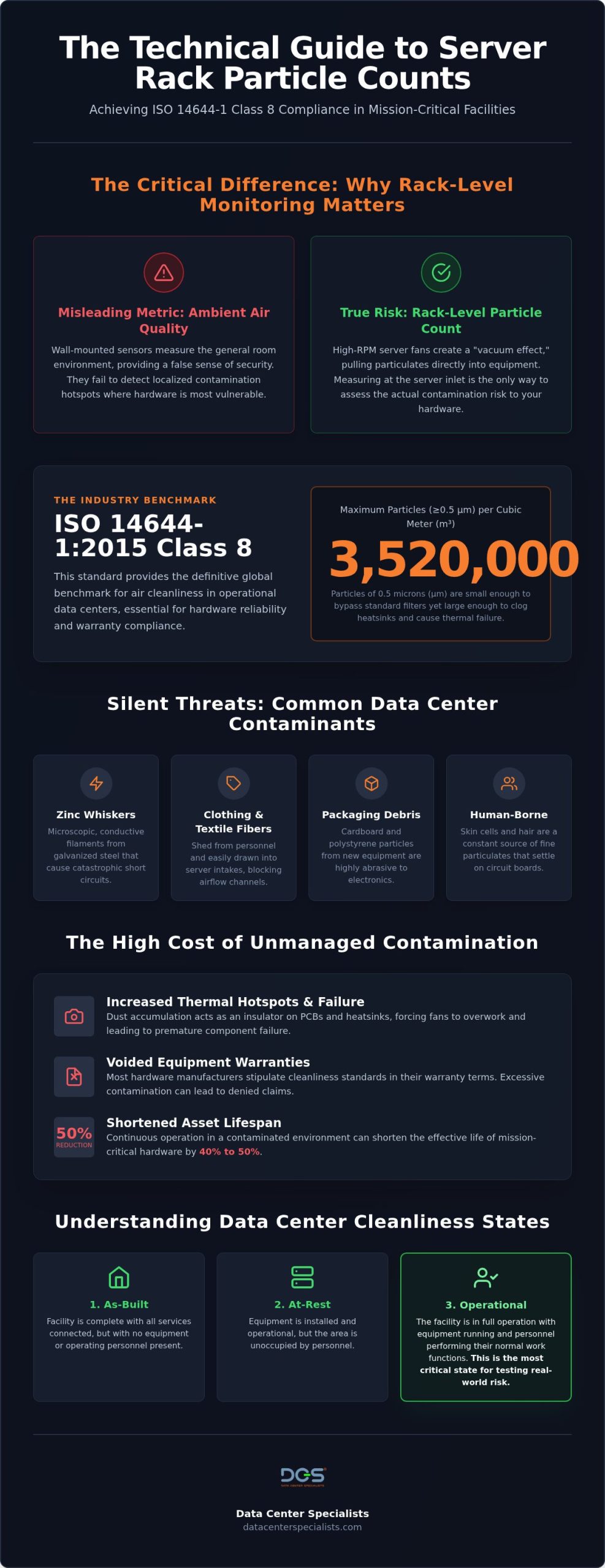
Particles measuring 0.5 microns (µm) are widely considered the critical threshold. These microscopic grains are small enough to bypass standard filters but large enough to accumulate within server cooling fans and high-density heat sinks. When these particulates settle, they disrupt airflow and create thermal hotspots that degrade performance over time. Precision is vital because even a slight deviation from cleanliness standards can void equipment warranties and shorten asset life by 40 to 50 percent.
The ISO 14644-1 Classification Table
The ISO classification system categorizes environments based on the number and size of particles present. For high-precision environments like semiconductor labs, an ISO Class 5 rating is required. However, most mission-critical facilities target ISO Class 8. In the 2015 revision of the standard, the limit for 5.0µm particles was removed for Class 5 spaces because the concentration levels were too low for statistically significant measurement. For an ISO Class 8 environment, the maximum concentration for particles ≥0.5µm is 3,520,000 per cubic meter. ISO Class 8 serves as the recommended baseline for operational data centers to ensure equipment longevity and warranty compliance.
Micro-Dust vs. Macro-Contaminants
Contamination in a data hall originates from diverse sources. Macro-contaminants like cardboard debris and clothing fibers are often visible, but micro-dust poses a more insidious threat. Common pollutants include human skin cells and microscopic fibers that enter through unsealed penetrations or poor gowning protocols. In legacy facilities across Malaysia, particularly in older sites in Kuala Lumpur or Selangor, Zinc Whiskers remain a significant danger that requires professional zinc whisker detection. These conductive filaments grow on the underside of galvanized steel floor tiles and can cause catastrophic short circuits if they become airborne and enter the server rack.
When micro-dust settles on printed circuit boards (PCBs), it forms an insulating layer. This layer prevents heat dissipation, forcing fans to spin faster and eventually leading to thermal throttling. Implementing a professional data center cleaning program is the only way to mitigate these risks and maintain a stable server rack particle count. This proactive approach ensures that micro-contaminants are captured before they can accumulate on sensitive electronics.
Why Rack-Level Contamination Monitoring is Critical for Uptime
Wall-mounted sensors often provide a false sense of security by measuring the room’s average air quality rather than the specific environment entering your equipment. The server rack particle count at the air inlet is the only metric that accounts for the “Vacuum Effect.” Modern high-density servers utilize high-RPM fans that act as industrial-scale vacuums, drawing in any particulates present in the cold aisle. If these contaminants aren’t managed, they bypass room-level filtration and settle directly on sensitive logic boards, where they’re most destructive.
Humidity control plays a dual role in this environment. In many facilities, maintaining low humidity to prevent condensation inadvertently increases static electricity. These electrostatic charges turn server components into magnets for micro-dust, accelerating the accumulation of debris on circuit paths. This leads to “silent” hardware failures, such as intermittent data corruption or localized component overheating, that don’t trigger immediate environmental alarms but significantly shorten the equipment’s mean time between failures (MTBF).
The Micro-Climate Inside the Server Rack
Airflow velocity within a chassis significantly influences particle deposition. As air speeds increase to cool high-TDP processors, the kinetic energy of airborne particles also rises, allowing them to penetrate deeper into heat sink fins. Utilizing DCS Smart Racks allows operators to manage this micro-climate more effectively by optimizing airflow paths and reducing internal turbulence. Monitoring the server rack particle count in both hot and cold aisles reveals how effectively your containment system is isolating contaminants. Typically, hot aisles show higher concentrations due to internal component shedding and air agitation, making cold aisle purity your primary line of defense.
Risk Factors for Financial and Hyperscale Facilities
For banks and hyperscale operators in Malaysia, particularly in Cyberjaya and Johor, air quality is a matter of regulatory and operational necessity. The GBI Data Centre Tool Version 2.0 now mandates stricter technical standards for mission-critical infrastructure. A single contamination-related outage can cost a financial institution upwards of $50,000 per hour in lost transactions and reputational damage. Maintaining a rigorous data center operational continuity plan requires moving beyond ambient monitoring toward precise, rack-level assessments. If your facility relies solely on wall sensors, it’s time to conduct a professional contamination assessment to identify hidden hotspots before they impact your uptime.
Methodology: How to Measure Server Rack Particle Counts
Precision measurement requires more than just holding a handheld device in a cold aisle. To obtain an accurate server rack particle count, you must select instrumentation that aligns strictly with ISO 14644-1 requirements. Discrete Particle Counters (DPC) are the industry standard for mission critical facilities because they categorize particulates by specific size bins, allowing for the precise classification of air purity. While condensation nuclei counters offer higher sensitivity for cleanrooms, they’re often less practical for the ISO Class 8 environments typical of Malaysian data centers.
Before sampling begins, you must define the occupancy state. Tests conducted in an “as-built” or “at-rest” state provide a baseline for construction cleanliness, but “operational” testing is the only way to assess risk during live compute loads. Using the ISO 14644-1 formula, which is based on the square root of the floor area, determines the minimum number of sample locations. In high-density racks where server fans create high-velocity airflow, isokinetic sampling is mandatory. This technique ensures that the air enters the sampling probe at the same velocity as the surrounding airstream, preventing the undercounting or overcounting of heavier particles that would otherwise be deflected by air turbulence.
Step-by-Step CPT Protocol for Racks
Positioning is the most critical variable in rack-level testing. The probe must be placed within the “breathing zone” of the equipment, typically 2 to 5 centimeters from the rack’s perforated front door. To achieve high-accuracy results, we recommend a sample volume of 1 cubic meter per location. This volume provides a statistically significant data set for particles ≥0.5µm, which is the primary concern for hardware reliability. Because air quality varies vertically due to floor-level turbulence and overhead air return paths, technicians must record and average results across the top, middle, and bottom elevations of each rack.
Advanced Testing: TAB and Airflow Balancing
Integrating Testing, Adjusting & Balancing (TAB) into your contamination assessment helps identify stagnant air zones where particles are likely to settle. These “dead zones” often correlate with air pressure differentials that drive particle migration from hot aisles back into cold aisles. For a comprehensive environmental audit, combining TAB with professional Cleanroom Performance Testing (CPT) provides the granular data necessary for optimizing cooling and contamination control. For facility managers seeking a deeper understanding of the instrumentation and protocols involved, our cleanroom particle count testing guide for data centers covers the precise methodology of light-scattering airborne particle counters and how to interpret ISO 14644-1 reports. This methodology ensures that your facility in Cyberjaya or Johor meets the highest technical standards for operational reliability and ISO compliance.
Interpreting Test Results: Benchmarks and Failure Points
Raw data from a laser particle counter is only as useful as the technical analysis behind it. When reviewing your server rack particle count report, pay close attention to the slope of the particle distribution curve. A sudden spike in 5.0µm particles, for instance, rarely indicates atmospheric dust; instead, it typically signals mechanical wear within cooling units or the introduction of coarse debris from unboxing activities. If your counts exceed the ISO Class 8 threshold of 3,520,000 particles per cubic meter for the 0.5µm size bin, you’ve crossed the “Red Line.” This is a critical failure point that requires an immediate emergency deep clean to prevent thermal throttling and permanent hardware damage.
Documenting these findings is essential for maintaining ISO 14644-1 compliance and satisfying insurance underwriters during annual audits. They look for consistent, logged evidence that the environment is being managed according to manufacturer specifications to honor warranty claims. Furthermore, comparing these results with data center energy assessments often reveals a direct correlation between high contamination levels and cooling inefficiencies. Dust-clogged heat sinks force servers to draw more power to maintain target temperatures, which an energy audit will flag as a clear performance bottleneck.
Common Causes of High Particle Counts
High particle counts usually stem from three primary sources. Post-construction dust remains the most frequent culprit in new facilities, where fine concrete particles can linger in underfloor plenums for months if not professionally remediated. Secondary causes include bypass air leakage in CRAC or CRAH units, where failed HEPA filtration or unsealed cabinet gaps allow unfiltered air to enter the white space. Finally, human activity remains a constant variable; un-gowned staff shed thousands of biological skin cells and clothing fibers per minute, directly impacting the air quality at the rack inlet.
The Impact of Malaysian Environmental Factors
Environmental factors in Malaysia, such as the annual haze season and high ambient humidity, place extreme stress on facility filtration systems. In industrial clusters like Cyberjaya or Johor, external pollutants are more concentrated due to nearby manufacturing and heavy transport. Outdoor PM2.5 levels directly correlate with indoor rack counts if filtration is compromised or if pressure differentials are improperly balanced. To ensure your facility remains within safe operating parameters and avoids costly hardware replacements, request a professional data center cleaning assessment to secure your operational uptime.
Professional Contamination Control and Mitigation
Effective contamination control requires a fundamental shift from reactive janitorial cleaning to a disciplined, data-driven engineering approach. Standard office cleaning companies lack the specialized equipment and technical training necessary to operate in mission-critical environments without risking accidental downtime. At Data Center Specialists, our methodology is dictated by the server rack particle count data collected during assessments. By analyzing these concentrations, we help operators implement a structured data center preventive maintenance schedule that targets high-risk areas before they impact hardware reliability.
Mitigation begins with removing settled particulates from surfaces that contribute to airborne counts. Our technicians utilize ULPA and HEPA-filtered vacuuming protocols specifically designed for live IT equipment and overhead cable trays. These areas often act as reservoirs for micro-dust that server fans eventually draw into the chassis. To further isolate sensitive equipment, we deploy DCS Containment solutions. By physically separating hot and cold aisles, you create a controlled micro-environment that prevents ambient room contaminants from migrating toward your server inlets.
Decontamination of Live IT Environments
Cleaning an operational server room requires meticulous precision to avoid electrostatic discharge (ESD) or physical disruption of cables. We use anti-static tools and non-conductive, residue-free cleaners that are safe for use around active logic boards and power supplies. While rack-level cleaning is vital, the underfloor plenum must not be ignored. Because the plenum acts as the primary air distribution path, any construction dust or debris left beneath the tiles will eventually contribute to a high server rack particle count. A comprehensive underfloor inspection should also include zinc whisker detection protocols to identify conductive metallic filaments that standard cleaning programs routinely miss. Professional data center cleaning must include a comprehensive decontamination of the underfloor space to ensure the air delivered to your racks is as pure as possible.
Evaluating a Technical Cleaning Partner
When selecting a service provider for facilities in Cyberjaya, Johor, or Kuala Lumpur, verify their technical credentials rather than their price point. A qualified partner should demonstrate a deep understanding of ISO 14644-1 standards, hold current ESD safety certifications, and possess real-world cleanroom performance testing (CPT) experience. A “visual clean” is insufficient for mission-critical hardware; you need a partner who can provide verifiable particle count reports that prove the effectiveness of their work. If your current maintenance provider doesn’t offer technical air quality assessments, your uptime is at unnecessary risk. Contact Data Center Specialists for a professional particle count assessment to establish a baseline for your facility’s environmental health.
Securing Long-Term Uptime Through Environmental Precision
Ensuring hardware reliability requires moving beyond visual cleanliness and adopting a rigorous, data-driven approach to contamination control. Managing your server rack particle count is the only verifiable way to protect high-density GPU clusters and financial infrastructure from the silent degradation caused by micro-dust. By implementing ISO 14644-1 standards at the rack inlet, you eliminate the “vacuum effect” risks that ambient room sensors frequently overlook.
Data Center Specialists (DCS) has served Malaysia’s mission-critical facilities since 2008, providing the technical expertise required for complex ISO 14644-1 compliance. Our advanced Cleanroom Performance Testing (CPT) and Testing, Adjusting & Balancing (TAB) capabilities ensure that your facility in Kuala Lumpur, Cyberjaya, or Johor remains within manufacturer-specified limits. Don’t leave your operational continuity to chance or general janitorial services.
Request a Professional Contamination Assessment from DCS to safeguard your infrastructure and maintain the highest standards of technical excellence. Your hardware deserves a partner that understands the high-stakes nature of your environment.
Frequently Asked Questions
What is the maximum allowable particle count for a server room?
The maximum allowable particle concentration for a standard operational environment is defined by ISO Class 8. This classification limits airborne particulates to no more than 3,520,000 particles per cubic meter for sizes ≥0.5 µm. Most hardware manufacturers require adherence to this standard to maintain warranty coverage. Facilities housing high-density GPU clusters or specialized financial infrastructure often opt for stricter thresholds to mitigate the risk of micro-dust accumulation on sensitive logic boards.
How often should server rack particle counts be tested?
According to ISO 14644-2, the maximum interval for re-testing and re-classification in environments rated above ISO Class 5 is 12 months. However, mission-critical facilities often perform a server rack particle count assessment quarterly or after any significant maintenance activity. Regular monitoring allows facility managers to identify trends in contamination levels before they reach critical failure points. More frequent testing is recommended during haze seasons or if nearby industrial activity increases external pollutant loads.
Can high particle counts cause server overheating?
High particle concentrations directly contribute to server overheating by creating an insulating layer on printed circuit boards. This accumulation prevents efficient heat dissipation, forcing cooling fans to spin at higher RPMs and eventually leading to thermal throttling. When heat sinks become clogged with micro-dust, the cooling system’s effectiveness can drop by up to 40 percent. This inefficiency increases cooling energy consumption and significantly reduces the mean time between failures for expensive IT assets.
What is the difference between ISO Class 8 and ISO Class 5 for data centers?
The primary difference lies in the allowable concentration of particulates, with ISO Class 5 being significantly more stringent than the standard Class 8. While Class 8 allows for 3,520,000 particles per cubic meter for sizes ≥0.5 µm, Class 5 limits that same size bin to just 3,520 particles. Standard data halls typically operate at Class 8, whereas Class 5 is reserved for high-precision environments like semiconductor labs or specialized cleanroom spaces where microscopic contaminants can ruin sensitive processes.
Do I need to test for particle counts after construction but before equipment install?
Testing in the “as-built” state is essential to ensure that post-construction dust has been fully remediated before installing active equipment. Fine concrete dust and drywall particulates are highly abrasive and can cause immediate damage to server fans and logic boards if they become airborne. Performing a professional assessment at this stage verifies that the facility meets ISO standards. This prevents construction-related contaminants from being drawn into the chassis by the high-velocity fans of newly commissioned servers.
What equipment is used to measure server rack particle counts?
Technicians use calibrated Discrete Particle Counters (DPC) to perform these measurements. These laser-based instruments sample a specific volume of air and categorize particulates into size bins ranging from 0.1 µm to 5.0 µm. For accurate results at the rack level, technicians use isokinetic sampling probes that match the velocity of the server’s intake air. This specialized equipment ensures that the data reflects the true environmental risk at the equipment inlet rather than just the ambient room air.
Can general office cleaners perform data center particle testing?
General office janitorial services lack the technical expertise, specialized equipment, and ESD safety training required to operate in mission-critical environments. Professional particle testing must be conducted by specialists who understand ISO 14644-1 protocols and Cleanroom Performance Testing (CPT) methodologies. Standard cleaning companies often use equipment that actually re-introduces particulates into the air. DCS provides seasoned industry leaders who utilize HEPA-filtered tools and non-conductive cleaners to maintain the integrity of your operational compute environment.
How does airflow management affect rack-level particle concentration?
Airflow management is a primary factor in controlling rack-level contamination. Implementing hot or cold aisle containment helps isolate equipment from ambient room pollutants and prevents the re-circulation of air. Poorly balanced pressure differentials can drive particles from underfloor plenums or hot aisles directly into the server inlets. Utilizing advanced solutions like DCS Smart Racks and modular containment systems optimizes airflow paths, which reduces turbulence and helps maintain a lower server rack particle count across all rack elevations throughout the facility.