
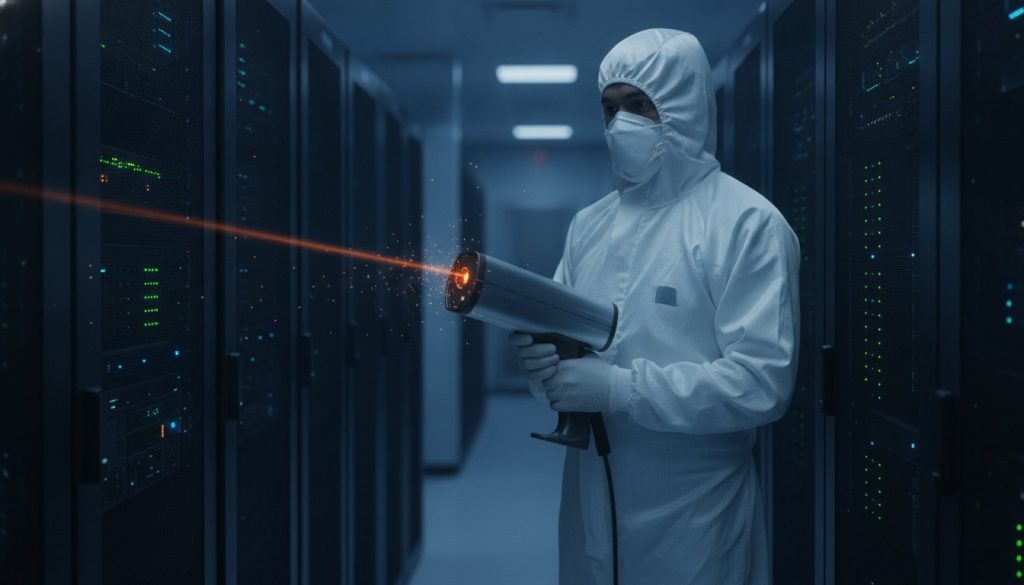
A single microscopic particle, invisible to the naked eye, can be the catalyst for a catastrophic hardware failure in a high-density server environment. While your facility might look spotless, the real threats often linger in the air as sub-micron contaminants that bypass standard filtration. We understand that interpreting complex ISO 14644-1 reports is often frustrating. The uncertainty surrounding micro-dust impact on hardware reliability can keep even the most seasoned facility manager up at night, especially when high-value warranties from global manufacturers are at stake.
Mastering cleanroom particle count testing is the only way to move from guesswork to verifiable environmental control. This guide provides the technical clarity you need to navigate airborne particulate testing and secure ISO 14644-1 compliance for your next audit. We’ll explore the specific concentration limits for ISO Class 8, the precise methodology of light-scattering airborne particle counters, and how to turn raw data into a long-term contamination control strategy. By the end of this technical brief, you’ll have a clear roadmap to reduce the risk of silent hardware failure and establish a baseline for mission-critical facility excellence in Malaysia’s growing data center sector.
Key Takeaways
- Understand the fundamental difference between physical contamination control and software-based data cleansing to ensure your facility meets physical safety standards.
- Identify why ISO Class 8 is the mandatory benchmark for most mission-critical environments and how it protects high-density hardware warranties.
- Learn the professional methodology for cleanroom particle count testing, including how to determine sampling locations based on room area and equipment density.
- Discover how to interpret complex test reports to locate contamination hotspots caused by common issues like failing CRAC belts or poor floor sealing.
- Establish clear criteria for selecting a Cleanroom Performance Testing (CPT) specialist who utilizes calibrated, high-precision laser particle counters.
What is Cleanroom Particle Count Testing in a Data Center Context?
In the technical environment of a mission-critical facility, cleanroom particle count testing refers to the quantitative measurement and classification of airborne particulates within a controlled space. Unlike general office environments, data centers require a disciplined approach to environmental hygiene to protect sensitive IT equipment from microscopic debris. It’s vital to clarify that this process involves the physical monitoring of air quality; it has no relation to digital “data cleaning” or software-based dataset management. Instead, we focus on the concentration of solid matter that can compromise hardware integrity.
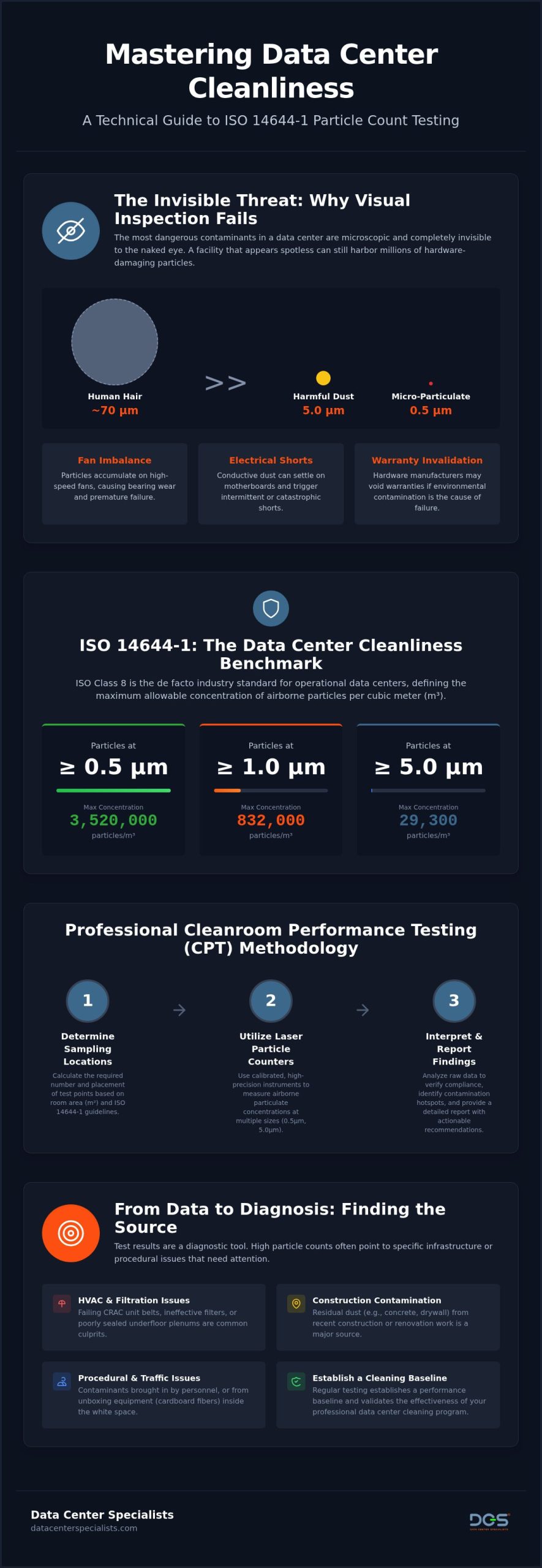
The link between airborne contamination and “silent” hardware failure is well-documented in the engineering community. Particulates that settle on high-speed cooling fans can cause imbalance and premature bearing wear, while conductive dust may trigger intermittent electrical shorts on motherboards. In legacy environments with spinning media, even a single sub-micron particle can lead to a catastrophic head crash. To provide a standardized framework for these risks, the industry relies on Cleanroom classifications established by ISO 14644-1, which dictates the maximum allowable particle concentrations for various facility types.
To better understand this concept, watch this helpful video:
The Objective of Particle Monitoring
Professional cleanroom particle count testing serves several strategic purposes beyond simple compliance. First, it validates the actual performance of your HVAC and filtration systems, ensuring that HEPA or high-efficiency MERV filters are functioning as specified. Second, it’s an essential diagnostic tool for identifying contamination sources, such as residual construction debris in a new build or dust ingress caused by high personnel traffic. For facilities operating in diverse industrial and urban environments, where external air quality can vary significantly, this testing ensures a stable environment for high-density server racks and mission-critical storage arrays.
Why Visual Inspection is Insufficient
One of the most dangerous misconceptions in facility management is the idea that a room is “clean” because it looks tidy. The particulates most harmful to IT infrastructure, typically ranging from 0.5µm to 5.0µm, are entirely invisible to the naked eye. A room can appear spotless while harboring millions of particles that exceed the limits of ISO Class 8 or Class 7 standards. Laser particle counters are the only reliable way to detect these micron-level threats, providing the empirical data needed to verify that your environment is truly safe for operational use.
ISO 14644-1 Standards: The Benchmark for Data Center Cleanliness
ISO 14644-1:2015 is the definitive international standard for classifying air cleanliness by particle concentration. It’s the primary benchmark our engineers use during cleanroom particle count testing to validate that a mission-critical environment is fit for purpose. While the standard covers a range from Class 1 to Class 9, ISO Class 8 has become the de facto industry requirement for operational data centers. This classification provides a necessary balance; it’s clean enough to protect sensitive electronics while allowing for the high volume of airflow required for modern cooling systems.
Rigorous adherence to these standards isn’t uniform across the entire facility. Different zones require different levels of environmental control. For example, a server hall housing high-density racks requires strict Class 8 compliance, whereas a staging area where hardware is unboxed might only require Class 9. Maintaining this distinction prevents cross-contamination from cardboard fibers and packing materials into the primary white space. For specific, granular benchmarks at the cabinet level, consult our Server Rack Particle Count Guide to understand how localized air quality impacts equipment longevity.
Comparing ISO Classes 5 through 8
The ISO classification system operates on a logarithmic scale, meaning each step represents a significant shift in air purity. For a facility to achieve ISO Class 8, the concentration of airborne particles ≥0.5 µm must not exceed 3,520,000 per cubic meter. For particles ≥1.0 µm, the limit is 832,000. In contrast, an ISO Class 5 environment, often found in semiconductor manufacturing, is 1,000 times cleaner than Class 8. Most Malaysian data center operators target Class 7 for post-construction handover to ensure a “clean slate” before servers arrive, eventually settling into a maintained Class 8 state during live operations.
Global vs. Regional Standards in Malaysia
In Malaysia, particularly within the hyperscale clusters of Cyberjaya and Johor, ISO 14644-1 serves as the universal language for compliance. Multinational clients and financial institutions require documented proof of cleanliness before they’ll authorize equipment deployment. Professional Cleanroom Performance Testing (CPT) is now a standard component of regional facility audits. It provides the empirical data needed to satisfy both internal risk management teams and external auditors. If your facility hasn’t been benchmarked recently, consider a professional data center cleaning assessment to establish a baseline for your contamination control strategy.
Methodology: How Professional Particle Count Testing is Conducted
Professional cleanroom particle count testing isn’t a casual spot-check; it’s a rigorous validation of a facility’s environmental integrity. The process begins by defining the room state. We categorize testing into three distinct phases: As-Built (the empty facility), At-Rest (equipment installed but idle), and Operational (live IT load). Each state reveals different contamination risks, from residual construction dust to particles shed by personnel during daily maintenance. Before testing begins, the HVAC system must remain operational for a stabilized period, typically 24 hours, to ensure that airflow patterns have normalized and filtration systems are at peak efficiency.
Precision is non-negotiable in mission-critical environments. Our engineers utilize light-scattering airborne particle counters (LSAPC) that carry current, NIST-traceable calibration certificates. Without this documentation, the data gathered lacks the technical weight required for ISO 14644-1 compliance audits. We don’t just measure air in the center of the room; we strategically select sampling points based on the density of critical equipment and the specific geometry of the white space to ensure no “dead zones” are missed.
Step-by-Step Testing Protocol
To ensure a repeatable and accurate assessment, we follow a disciplined four-step protocol at every facility:
- Step 1: Determine locations. We calculate the minimum number of sampling points using the square root of the floor area as dictated by the ISO 14644-1:2015 standard.
- Step 2: Position the probe. The counter probe is placed at “work level” or, more critically in a data center, at the server rack air intake height (usually 1.2m to 1.5m).
- Step 3: Sampling duration. We perform multiple 1-minute samples at each location to ensure statistical accuracy and account for transient air movements.
- Step 4: Data averaging. The results for 0.5µm and 5.0µm particles are averaged to determine if the zone meets the specified cleanliness classification.
Testing Operational vs. Non-Operational Environments
Testing a live data center presents unique challenges compared to an empty shell. High airflow velocities and turbulence from server fans can complicate readings. However, “Operational” state testing is the most valuable metric for a facility manager. It provides a real-world view of how the environment performs under thermal load and human activity. This phase often uncovers “hotspots” where particulates accumulate due to poor airflow management or bypass air. For a more comprehensive look at your facility’s health, this process is often integrated into broader Specialized Engineering Testing to validate cooling and power resilience alongside air quality.
Interpreting Test Results and Managing Contamination Risks
Receiving a technical report after cleanroom particle count testing provides the empirical evidence required to validate your facility’s health. A raw data sheet can be overwhelming, but interpretation should focus on identifying outliers. If most sampling locations meet ISO Class 8 requirements but a specific zone fails, you’ve identified a “hotspot.” These failing zones are often the result of localized air turbulence or proximity to a contamination source that bypasses your primary filtration. When counts exceed the 3,520,000 particles per cubic meter threshold for 0.5µm debris, immediate remediation is mandatory to protect your hardware warranties.
Identifying the root cause requires a systematic assessment of the facility’s physical state. High particle counts often trace back to three common culprits: poor floor sealing, belt dust from CRAC units, or the presence of unboxed cardboard. Unsealed concrete sub-floors undergo “dusting,” releasing fine alkaline particulates into the underfloor plenum. Similarly, worn drive belts in cooling units shed microscopic rubber debris directly into the supply air stream. If your report indicates a failure, it serves as the technical trigger for Professional Data Center Cleaning to restore environmental integrity.
Identifying Contamination Sources
Distinguishing between different types of debris is vital for effective remediation. Construction dust is typically coarse and jagged, often found in new builds or after recent M&E upgrades. In contrast, operational wear-and-tear produces finer particulates, such as metallic flakes or rubber fibers. Legacy raised floor systems are a particularly high-risk area, as galvanized components can generate conductive metallic growths that require specialized zinc whisker detection to identify and remediate before they trigger electrical shorts in live equipment. The sub-floor plenum is particularly critical; it acts as the “lungs” of the data center. If the plenum is contaminated, high-velocity airflow will carry those particles directly into your server intakes. For a deeper look at remediation strategies, consult our guide on Data Center Contamination Prevention.
Establishing a Testing Schedule
Consistency is the foundation of a proactive contamination control strategy. For high-density hyperscale facilities in Malaysia, we recommend a quarterly testing frequency to account for high equipment turnover and frequent personnel entry. Smaller enterprise sites may find an annual schedule sufficient, provided they maintain strict access controls. You should also perform ad-hoc testing after any significant facility event, such as a UPS replacement or CRAC unit maintenance, to ensure no debris was introduced during the work. If your current results show rising trends, contact our engineering team for a comprehensive environmental assessment.
Selecting a Specialist for Cleanroom Performance Testing (CPT)
Selecting a technical partner for cleanroom particle count testing requires a rigorous vetting process that goes beyond comparing equipment lists. In a mission-critical environment, the cost of a false positive, or worse, an accidental outage during testing, far outweighs the savings of hiring a non-specialized contractor. A qualified specialist must demonstrate four core competencies to ensure your facility’s operational continuity and compliance with ISO 14644-1 standards.
- Technical expertise: The provider must understand the specific thermal and airflow dynamics of a server hall, which differ significantly from pharmaceutical or hospital cleanrooms.
- Precision instrumentation: All laser particle counters must carry current, NIST-traceable calibration certificates to ensure data defensibility for audits and warranties.
- Remediation insight: The specialist should provide actionable advice on identifying contamination sources, such as CRAC belt wear or sub-floor plenum dusting, rather than a simple pass/fail report.
- Safety and ESD awareness: Testers must be trained in Electrostatic Discharge (ESD) protocols and data center safety to prevent accidental damage to live IT equipment.
Why Mission-Critical Expertise Matters
Hiring general janitorial or non-specialized environmental testers in a live IT environment introduces unnecessary risk. Generalists often lack the specialized knowledge required to navigate high-density rack areas without interfering with sensitive sensors or accidentally triggering fire suppression systems. At Data Center Specialists, we provide an integrated approach that bridges the gap between environmental validation and facility engineering. By combining CPT with Data Center Maintenance and Testing, Adjusting & Balancing (TAB) services, we identify not just the presence of particulates, but the underlying mechanical failures causing them.
The DCS Advantage in Malaysia and Southeast Asia
Since 2008, Data Center Specialists (DCS) has served as a strategic partner to hyperscale operators, financial institutions, and telecommunications providers across Malaysia and Southeast Asia. Our engineers are seasoned in the specific challenges of regional climates, from humidity management in Kuala Lumpur to the rapid expansion of facilities in Cyberjaya and Johor. We provide comprehensive reporting that translates complex engineering data into clear, executive-level summaries, facilitating informed decision-making for procurement and technical teams alike. We don’t just supply data; we provide the peace of mind that comes from meticulous, specialized knowledge.
Don’t leave your infrastructure’s health to chance. Contact Data Center Specialists today for a professional contamination assessment and ensure your facility remains a benchmark for mission-critical excellence.
Securing Your Infrastructure Through Environmental Precision
Environmental integrity isn’t a subjective observation; it’s a measurable engineering metric that directly impacts the longevity of your IT assets. By adhering to the ISO 14644-1 framework, you ensure that your facility meets the rigorous standards required by global hardware manufacturers. Regular cleanroom particle count testing provides the empirical data needed to identify latent risks, such as sub-floor dusting or mechanical wear, before they escalate into catastrophic failures.
Since 2008, Data Center Specialists has been a trusted guardian of Malaysia’s mission-critical infrastructure. We combine seasoned engineering expertise with NIST-traceable instrumentation to deliver reports that satisfy both technical auditors and executive stakeholders. Don’t leave your equipment’s reliability to chance. Take the next step in your contamination control strategy and Request a Professional Cleanroom Performance Test Assessment today. We look forward to helping you maintain a resilient and compliant environment.
Frequently Asked Questions
What is the difference between ISO Class 8 and ISO Class 5 for data centers?
ISO Class 8 allows for a maximum of 3,520,000 particles (≥0.5µm) per cubic meter, which is the widely accepted benchmark for operational data centers. In contrast, ISO Class 5 is 1,000 times cleaner, permitting only 3,520 particles of the same size. While Class 5 is necessary for semiconductor fabrication, it’s rarely used in server halls because the extreme filtration required can severely restrict the high-volume airflow needed to cool modern hardware.
How often should particle count testing be performed in an operational server room?
Frequency depends on your facility’s density and traffic. We recommend quarterly cleanroom particle count testing for hyperscale and colocation facilities due to frequent hardware turnover. For enterprise sites with stricter access controls, an annual assessment is usually sufficient. You should also schedule ad-hoc testing after any major M&E maintenance, UPS replacements, or facility upgrades to ensure that no harmful debris was introduced into the mission-critical space.
Can particle count testing be conducted while servers are running?
Yes, testing during live operations is the most accurate way to assess environmental health. This is known as the “Operational” state in ISO 14644-1. Conducting the test while servers are running allows engineers to see how high-velocity airflow and thermal turbulence affect particle distribution. It helps identify hotspots where contaminants might be getting pulled into server intakes, providing a real-world view of your contamination control strategy’s effectiveness.
What are the most common sources of airborne contamination in data centers?
Contamination typically originates from both internal and external sources. Internal sources include dusting from unsealed concrete sub-floors, rubber debris from CRAC unit drive belts, and zinc whiskers from legacy galvanized components that require specialized detection protocols to identify before they cause conductive short circuits. External contaminants often enter via personnel on clothing or through poorly managed staging areas where cardboard is unboxed. Even microscopic skin cells shed by technicians can contribute to the overall particulate load in a high-traffic mission-critical environment.
Does a ‘pass’ on particle count testing guarantee no hardware failures?
A passing result indicates that your air quality meets the specific concentration limits of ISO 14644-1 at that moment. It doesn’t guarantee zero hardware failures, as failures can also result from power surges, high humidity, or gaseous chemical contaminants. However, maintaining a verified ISO Class 8 environment significantly reduces the risk of failures caused by dust insulation or electrical shorts, ensuring you remain compliant with equipment manufacturer warranty requirements.
What instrumentation is required for professional cleanroom particle count testing?
Professional cleanroom particle count testing requires a high-precision light-scattering airborne particle counter (LSAPC). These devices use laser technology to detect and size individual particles in the air stream. It’s vital that the instrumentation carries a current, NIST-traceable calibration certificate. Using uncalibrated or consumer-grade sensors is insufficient for official facility audits, as they lack the sensitivity and statistical accuracy required to validate a data center against international standards.
How long does a typical cleanroom performance test take to complete?
The duration varies based on the total floor area and the number of sampling locations required by the ISO 14644-1 formula. For a standard 5,000 square foot server hall, a comprehensive cleanroom performance test usually takes between four to six hours. This timeframe includes the initial setup, HVAC stabilization checks, and the actual sampling process at multiple heights. Larger hyperscale facilities with multiple halls will naturally require a more extended multi-day engagement.
What happens if our data center fails to meet the ISO 14644-1 requirements?
Failing an ISO 14644-1 audit means your facility is operating in a contaminated state that poses a risk to IT hardware. This can lead to the voiding of equipment warranties from major manufacturers. If a failure occurs, you must identify the contamination source and engage in professional data center cleaning. Once the environment is remediated, a re-test is necessary to confirm that particle concentrations have returned to acceptable levels for mission-critical operations.