
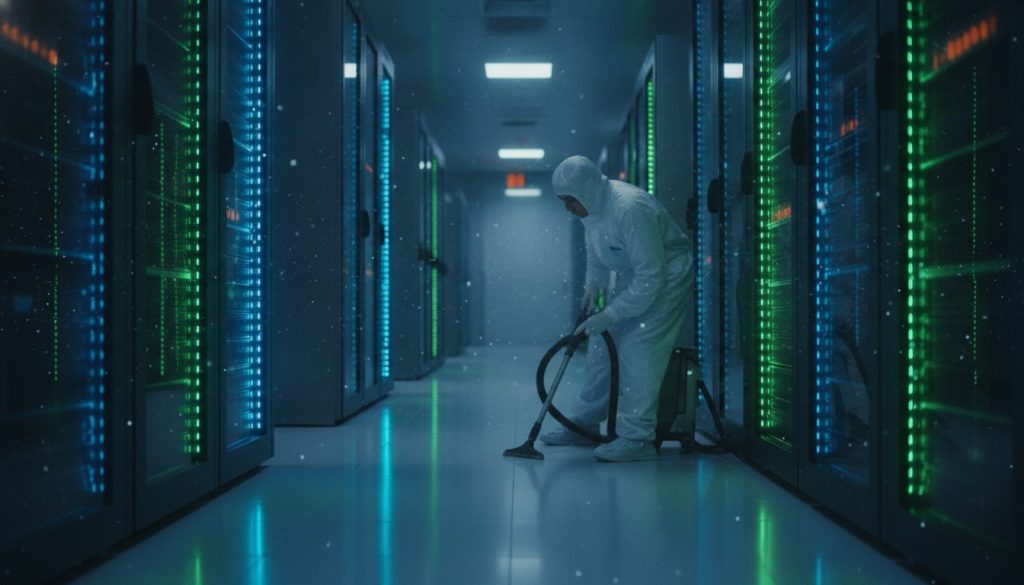
Can a standard mop and bucket actually jeopardize your entire operation? While it sounds extreme, treating your server room like a typical office space often invites the very downtime you work so hard to prevent. Most facility managers understand the pressure of maintaining 100% uptime, yet many still struggle to justify the cost of technical decontamination over basic janitorial services. It’s a high-stakes gamble where the invisible accumulation of micro-dust can lead to catastrophic hardware failure.
It’s time to bridge the gap between simple housekeeping and specialized data center cleaning. This guide explains why deep technical decontamination is an engineering necessity that protects your mission-critical hardware from latent failures. We’ll examine the technical risks of improper maintenance and help you validate your maintenance budget to senior management. You’ll gain a clear framework for evaluating professional providers while ensuring your facility remains compliant with ISO 14644-1 standards. By the end of this discussion, you’ll understand how precision cleaning directly supports cooling optimization and long-term infrastructure health across Southeast Asia’s demanding technical environments.
Key Takeaways
- Understand that technical decontamination targets microscopic particulates that standard janitorial methods cannot address, protecting delicate PCBs from latent failures.
- Discover the physics of how dust acts as a thermal insulator and hygroscopic contaminant, directly impacting hardware longevity and mission-critical uptime.
- Learn why specialized data center cleaning requires ULPA-rated equipment and non-volatile chemicals to ensure safety in sensitive electronic environments.
- Gain clarity on ISO 14644-1 compliance requirements and the role of regular particle count testing in maintaining certified cleanroom standards.
- Identify how professional contamination control integrates with infrastructure engineering to improve airflow efficiency and lower Power Usage Effectiveness (PUE).
Beyond Visible Dust: Busting the “Looks Clean” Myth
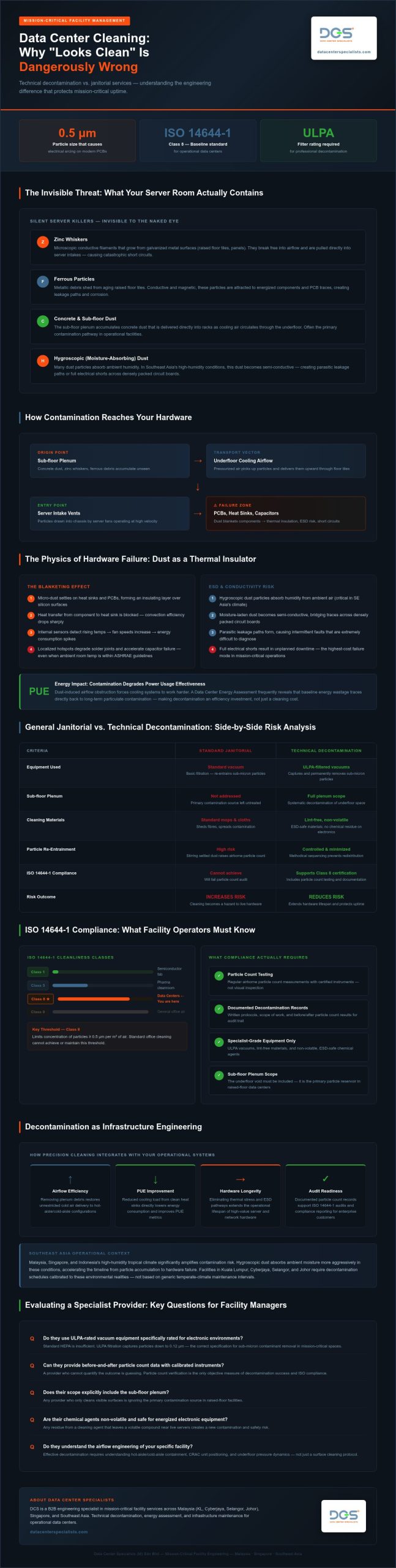
A server room might appear pristine to the naked eye, yet remain dangerously contaminated. We define specialized data center cleaning as a technical decontamination process, not a janitorial task. While a standard office cleaner focuses on removing visible debris, mission-critical specialists address microscopic particulate matter (PM) that is invisible to the human eye. These “silent server killers” include zinc whiskers, which grow from galvanized metal surfaces, and ferrous particles shed from aged floor tiles. These conductive materials are small enough to be pulled into server intakes, leading to catastrophic short circuits and hardware failure.
The Threshold of Technical Cleanliness
ISO 14644-1 Class 8 represents the baseline standard for operational data centers. This standard strictly limits the concentration of particles per cubic meter of air, specifically focusing on particles 0.5 microns and larger. To put this in perspective, a particle just 0.5 microns in size is sufficient to cause electrical arcing across modern, densely packed circuit boards. The sub-floor plenum typically serves as the primary source of this hidden contamination. As air moves through the underfloor to cool the racks, it picks up concrete dust and metallic debris, delivering them directly into your most sensitive equipment. A facility can look spotless but still fail an ISO audit if these microscopic counts exceed the allowed threshold.
Why Aesthetic Cleaning is a Risk
Traditional cleaning methods often exacerbate the problem through a process called re-entrainment. When an untrained crew uses a standard vacuum, the internal filtration system often fails to trap sub-micron particles, effectively spraying them back into the airflow. This movement stirs up settled dust from the floor and surfaces, increasing the airborne particle count during the very process intended to lower it. Professional specialized data center cleaning utilizes specialized ULPA-filtered vacuums and lint-free materials to ensure that once a contaminant is captured, it is permanently removed from the environment. Proper decontamination requires a methodical approach that prioritizes particle removal over surface shine.
Effective contamination control is about risk mitigation. It’s the difference between a room that looks clean and an environment that is technically safe for high-density hardware. Without the right equipment and technical knowledge, cleaning becomes a hazard rather than a maintenance benefit.
The Physics of Hardware Failure: Why Micro-Particles Matter
The accumulation of particulate matter is more than a housekeeping issue; it’s a physical barrier to heat transfer. In mission-critical environments, micro-dust acts as a high-efficiency thermal insulator. When these particles settle on heat sinks and printed circuit boards (PCBs), they create a “blanketing effect” that traps heat directly against sensitive silicon. This layer of contamination prevents the cooling system from effectively removing heat from the component surface. Consequently, internal sensors detect rising temperatures and trigger increased fan speeds. This leads to a measurable spike in energy consumption and puts unnecessary mechanical stress on the cooling infrastructure.
Thermal Insulation and Hotspots
Component-level hotspots can occur even when the room’s ambient temperature remains within ASHRAE guidelines. This happens because the dust layer reduces the convection efficiency of the heat sink. Over time, these localized temperature spikes degrade the integrity of solder joints and accelerate the failure of capacitors. To mitigate these risks, operators must integrate decontamination into their broader efficiency strategy. Performing a Data Center Energy Assessment often reveals that baseline energy wastage is directly linked to airflow obstructions caused by long-term contamination. Regular removal of these thermal barriers is essential for maintaining cooling optimization.
Electrostatic Discharge (ESD) and Conductivity
The risk profile changes significantly when dealing with hygroscopic contamination. Many dust particles are moisture-absorbing, meaning they pull humidity from the air. In high-humidity conditions, this dust can become semi-conductive, creating parasitic leakages or full electrical shorts across high-density components. In legacy environments, the presence of metallic contaminants like zinc whiskers poses an even greater threat. These microscopic metal filaments can break off from galvanized surfaces and travel through the airflow, causing immediate hardware arcing upon contact with energized circuits.
Maintaining a clean environment requires more than just removing visible dirt. It demands a rigorous approach to specialized data center cleaning that utilizes anti-static protocols and specialized chemicals. These methods ensure that the cleaning process itself doesn’t generate static charges that could damage sensitive components. By addressing the physical properties of contamination, facility managers can effectively extend the lifecycle of their hardware. If you haven’t reviewed your contamination levels recently, consider scheduling a professional data center maintenance review to identify hidden risks before they trigger a failure.
General Janitorial vs. Specialized Decontamination: A Risk Analysis
Engaging a general janitorial crew for mission-critical spaces creates an immediate operational risk. Standard cleaning companies operate on aesthetic outcomes, while specialized data center cleaning focuses on technical integrity. The most visible difference lies in filtration. Standard HEPA vacuums, while better than domestic units, are often insufficient for data centers. They typically capture 99.97% of particles down to 0.3 microns. In contrast, technical teams use ULPA-rated vacuums that trap 99.999% of particles as small as 0.12 microns. This prevents the “exhaust effect” where fine dust is simply redistributed into the cooling stream.
Liability is another critical differentiator. Most janitorial vendors carry general liability insurance that doesn’t cover the catastrophic costs of accidental downtime in a tier-rated facility. Specialized providers understand the high-stakes environment and maintain coverage specifically for mission-critical operations. They bring the technical literacy required to distinguish between a harmless piece of plastic and a critical fiber optic jumper.
Specialized Tooling and Chemicals
Standard industrial cleaning supplies have no place in a server room. Floor waxes and high-speed buffers are strictly prohibited because they generate static and shed fine particulates during the application and curing process. Technical cleaners must be non-conductive, non-corrosive, and low-VOC to prevent chemical interactions with sensitive electronic traces. Ammonia-based cleaners, for example, can cause stress corrosion cracking in copper components over time. The precision required for Server Rack & Equipment Cleaning involves using micro-attachment tools and specialized wipers that won’t snag on sensitive connections or block air intakes.
Operational Protocol and Safety
Technical decontamination follows a rigorous top-down methodology. Teams begin with high-level surfaces like cable trays and lighting fixtures, moving downward to the racks, and finishing with the sub-floor plenum. This prevents gravity from pulling dust onto already-cleaned surfaces. This disciplined approach is essential for maintaining the particle thresholds required for operational stability.
Safety training is where the gap between vendors becomes most dangerous. A specialized technician knows the “no-go” zones of a live rack. They understand that a misplaced hand or an untethered tool can trigger an Emergency Power Off (EPO) or disconnect a critical uplink. Integrating these protocols into your broader Data Center Maintenance schedule ensures that cleaning happens without interrupting service delivery. It isn’t just about removing dirt; it’s about navigating a live environment with the expertise of an engineer.
Decoding ISO 14644-1 Compliance for Facility Operators
Compliance with ISO 14644-1:2015 isn’t a static achievement. Many facility managers mistakenly treat ISO certification as a “one-and-done” event, typically occurring only during the initial commissioning phase. In reality, maintaining a mission-critical environment requires ongoing validation to ensure that specialized data center cleaning protocols effectively manage the particulate load. While enterprise sites might perform annual audits, hyperscale environments often require quarterly testing. This frequency accounts for the massive air volumes exchanged and the constant influx of contaminants introduced during high-frequency hardware hot-swaps.
Post-construction environments demand even more rigorous handover requirements. Before a facility goes live, a deep decontamination must be performed to remove fine concrete dust and metallic residues that accumulate during the build. This process concludes with a formal particle count test to verify the space meets the ISO Class 8 baseline. Without this technical validation, you’re essentially migrating million-dollar hardware into a compromised environment that could trigger early-life failures.
The Particle Count Audit Process
Technical audits rely on calibrated discrete-particle counters (DPCs) to measure air quality at specific sample points throughout the white space. The focus remains on two critical thresholds: 0.5μm and 5.0μm. A successful audit requires documenting the concentration of these particles in both “at-rest” and “operational” states. To pass, the facility must stay below the maximum concentration limits defined by the ISO standard for its specific class. This data is then compiled into a comprehensive technical report, providing the documented proof required for internal compliance and insurance audits. For a deeper look at the methodology, review our guide on specialized engineering testing and validation.
Cleanroom Performance Testing (CPT)
CPT represents the pinnacle of facility validation, moving beyond surface cleanliness to evaluate the integrity of the entire room. While cleaning removes existing debris, Cleanroom Performance Testing (CPT) validates that the infrastructure is actually preventing new contaminants from entering. This involves testing pressure differentials to ensure the room remains positively pressured against adjacent spaces, as well as HEPA filter leak testing to identify compromised seals in the CRAC/CRAH units. It’s a holistic engineering approach that confirms your contamination control strategy is functioning as designed. If you’re preparing for an audit or a new facility handover, schedule a professional cleanroom performance test to secure your operational baseline.
Integrating Decontamination with Infrastructure Engineering
Airflow in a mission-critical facility is a matter of fluid dynamics. When the sub-floor plenum, the primary delivery mechanism for cold air, is littered with construction debris, abandoned cables, or settled dust, it creates significant turbulence. This resistance forces CRAC units to work harder, directly inflating your Power Usage Effectiveness (PUE) ratio. By treating specialized data center cleaning as an engineering optimization rather than a janitorial chore, facility operators can restore the design-intent airflow of their cooling infrastructure. This isn’t just about appearances; it’s about the physical efficiency of the cooling loop.
Airflow Management and Cooling Efficiency
Professional decontamination of the underfloor plenum is a prerequisite for any meaningful cooling optimization. It’s impossible to achieve accurate results during Testing, Adjusting, and Balancing (TAB) if the physical pathways for air are obstructed by legacy contamination. Removing these barriers ensures that the air volume calculated by engineers actually reaches the server intakes without being diverted by underfloor debris. This synergy between cleaning and balancing is what differentiates a high-performing site from one that merely survives.
To maintain these clean zones over the long term, strategic physical barriers are essential. Implementing DCS Containment solutions doesn’t just manage heat; it creates a controlled environment that limits the migration of particles between high-traffic areas and sensitive server rows. This integrated approach ensures your contamination control efforts aren’t undermined by poor airflow design. It’s a holistic strategy that views the white space as a single, interconnected machine.
A Strategic Maintenance Framework
Transitioning from a reactive “cleaning on demand” model to a proactive decontamination schedule is a hallmark of mature facility management. This roadmap begins with a baseline particle count audit to identify existing risks, followed by a deep-clean of the underfloor and rack levels. The Return on Investment (ROI) for this framework is realized through reduced fan energy costs and the prevention of latent hardware failures that often occur months after the initial contamination event. Proactive care is always more cost-effective than emergency hardware replacement.
DCS operates as a strategic partner in your facility’s operational success. We provide the technical expertise required to navigate complex infrastructure, ensuring every decontamination task supports your uptime goals. It’s about protecting the engineering integrity of your site through disciplined, repeatable processes. If you’re ready to move beyond aesthetic cleaning and implement a technically sound contamination control strategy, our team is available for a comprehensive review. Contact Data Center Specialists today for a technical assessment of your facility’s environment and cooling efficiency.
Securing Your Mission-Critical Uptime Through Precision
Maintaining a mission-critical facility requires moving beyond the surface-level aesthetics of standard janitorial work. Technical decontamination is a fundamental engineering requirement that directly impacts hardware longevity and cooling efficiency. By addressing microscopic particulates and ensuring ISO 14644-1 technical compliance, you protect your infrastructure from the silent threats of thermal insulation and electrical arcing.
DCS provides national coverage for mission-critical facilities, utilizing an engineering-led decontamination methodology that integrates with your existing maintenance schedules. Our approach ensures that every square meter of your white space and underfloor plenum meets the rigorous standards required for modern high-density hardware. Implementing a regular schedule for specialized data center cleaning isn’t just a best practice; it’s a strategic investment in operational continuity and energy optimization.
Take the first step toward a more reliable and efficient environment. We invite you to contact our specialized engineers for a professional data center contamination assessment to identify hidden risks before they impact your uptime. Your facility deserves the precision that only technical experts can provide.
Frequently Asked Questions
What is the difference between ISO 14644 Class 8 and Class 5 for data centers?
ISO 14644-1 Class 8 is the standard baseline for most data centers, allowing up to 3,520,000 particles ≥0.5μm per cubic meter. Class 5 is significantly more stringent, permitting only 3,520 particles of the same size. While Class 8 is sufficient for general white space, Class 5 is typically reserved for semiconductor manufacturing or high-precision laboratories. Understanding these thresholds is essential for technical decontamination and maintaining the specific cleanliness requirements of high-density hardware.
How often should a mission-critical server room be professionally cleaned?
Frequency depends on facility activity, but we recommend a deep technical decontamination at least twice per year. High-traffic hyperscale sites or facilities undergoing frequent hardware refreshes often require quarterly sub-floor and rack-level cleaning. Regular particle count testing helps determine the optimal schedule for your site. Maintaining a consistent specialized data center cleaning routine prevents the “blanketing effect” of micro-dust, which can lead to latent hardware failures and cooling inefficiencies over time.
Is it safe to perform specialized cleaning while the IT equipment is live?
Yes, specialized cleaning is specifically designed to be performed while IT equipment is live and operational. Technicians use non-conductive tools, anti-static protocols, and ULPA-filtered vacuums to ensure no interference with energized circuits. This engineering-led methodology avoids the need for maintenance windows or downtime. However, it requires strict adherence to “no-go” zones and high-stakes expertise to navigate the environment without triggering accidental Emergency Power Off (EPO) events or disconnecting critical fiber links.
Can regular janitorial staff be trained for data center cleaning?
No, standard janitorial staff shouldn’t be used for mission-critical environments. The risk of accidental downtime, static discharge, and improper chemical use is simply too high. Professional decontamination requires specialized engineering knowledge and equipment, such as ULPA vacuums and low-VOC technical cleaners. Janitorial training focuses on aesthetics, whereas specialized data center cleaning focuses on particle physics and operational reliability. Attempting to bridge this gap without technical infrastructure expertise often leads to catastrophic hardware arcing.
What specific tools are required for professional sub-floor decontamination?
Professional sub-floor cleaning requires a specific technical kit. This includes ULPA-filtered vacuums capable of trapping particles down to 0.12 microns, lint-free microfiber wipes, and non-conductive, anti-static cleaning solutions. Technicians also use specialized floor pullers to access the plenum without damaging tiles and telescopic brushes for high-level cable trays. These tools ensure that contaminants are permanently removed from the airflow rather than being redistributed through the cooling system via a process called re-entrainment.
Does professional cleaning actually improve Power Usage Effectiveness (PUE)?
Professional cleaning directly supports cooling optimization and can lower your Power Usage Effectiveness (PUE). By removing debris from the sub-floor plenum, you restore the design-intent airflow, allowing CRAC units to operate more efficiently. This reduces the static pressure required to move air through the racks, which lowers fan energy consumption. When integrated with Testing, Adjusting & Balancing (TAB), technical decontamination ensures the facility’s cooling infrastructure performs at its peak engineering capacity rather than struggling against obstructions.
What are zinc whiskers and why are they a risk during cleaning?
Zinc whiskers are microscopic, conductive filaments that grow from galvanized metal surfaces, such as older floor tiles or cable trays. During cleaning, improper techniques can break these filaments, allowing them to enter the airflow and cause immediate short circuits on PCBs. Specialized teams identify these risks early and use specific capture methods to remove the whiskers without dispersing them into the room. This is a critical component of contamination control in legacy mission-critical facilities with older infrastructure.
How do I verify if a cleaning service provider is truly ISO compliant?
You verify compliance through a formal technical audit using calibrated discrete-particle counters (DPCs). A provider should offer a comprehensive report detailing particle concentrations at 0.5μm and 5.0μm thresholds across multiple sample points. Documentation should also include the technician’s methodology and the calibration certificates for the testing equipment used. Simply claiming to follow standards is insufficient; actual compliance requires verifiable data from Cleanroom Performance Testing (CPT) or regular air quality assessments to secure your operational baseline.