
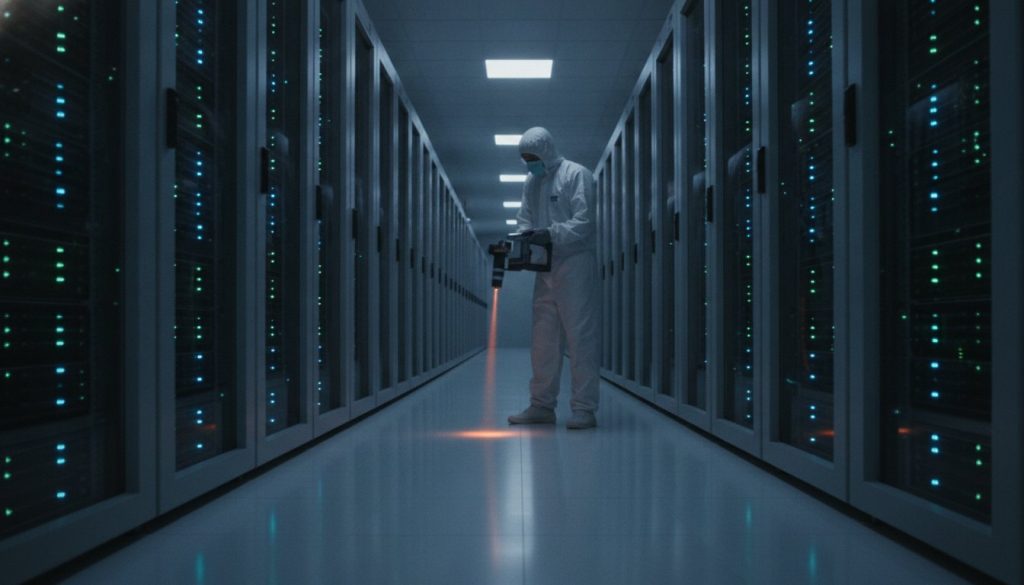
A single micron of zinc whisker or a buildup of sub-visible particulate can compromise a RM100 million infrastructure investment faster than a localized power surge. For facility managers in Malaysia and Singapore, a “clean enough” standard often leads to unexplained hardware failures in high-density racks and failed tenant audits. Relying on the inconsistent results of general janitorial staff who lack specialized equipment creates unnecessary vulnerability in mission-critical environments. Implementing a rigorous data center ISO 14644 audit checklist is the only way to move beyond visual inspections and achieve true contamination control.
Maintaining strict compliance for financial and enterprise tenants requires a level of precision that general maintenance services cannot provide. This technical reference provides a clear path to mastering ISO 14644-1 requirements, helping you distinguish between the air quality needs of ISO Class 8 and the precision of Class 5 environments. We’ll explore the 2026 updates, including the new ISO 14644-13 standards for surface cleanliness, and provide a repeatable framework to eliminate micro-dust risks. By the end of this guide, you’ll have the technical knowledge to ensure your facility meets the highest global benchmarks for air purity and operational continuity.
Key Takeaways
- Understand the technical transition from Federal Standard 209E to ISO 14644-1 and why ISO Class 8 remains the industry benchmark for operational uptime.
- Utilize a comprehensive data center ISO 14644 audit checklist to define critical testing points based on floor area and specific occupancy states.
- Learn how to calculate statistical sampling requirements to validate air quality and satisfy strict compliance audits from financial and enterprise tenants.
- Discover the role of airflow management and H13 HEPA filtration in maintaining a repeatable framework for contamination control in high-density environments.
- Evaluate the engineering-led methodologies required to differentiate professional cleanroom performance testing from basic janitorial services.
Fundamentals of ISO 14644-1 for Critical IT Infrastructure
ISO 14644-1 serves as the definitive international standard for air cleanliness in controlled environments, providing a rigorous framework for measuring particle concentration. In the context of mission-critical facilities, this standard dictates the maximum allowable levels of airborne contaminants that can exist without compromising hardware integrity. For facility managers developing a data center ISO 14644 audit checklist, understanding these fundamentals is the first step in mitigating the risk of micro-dust-induced downtime.
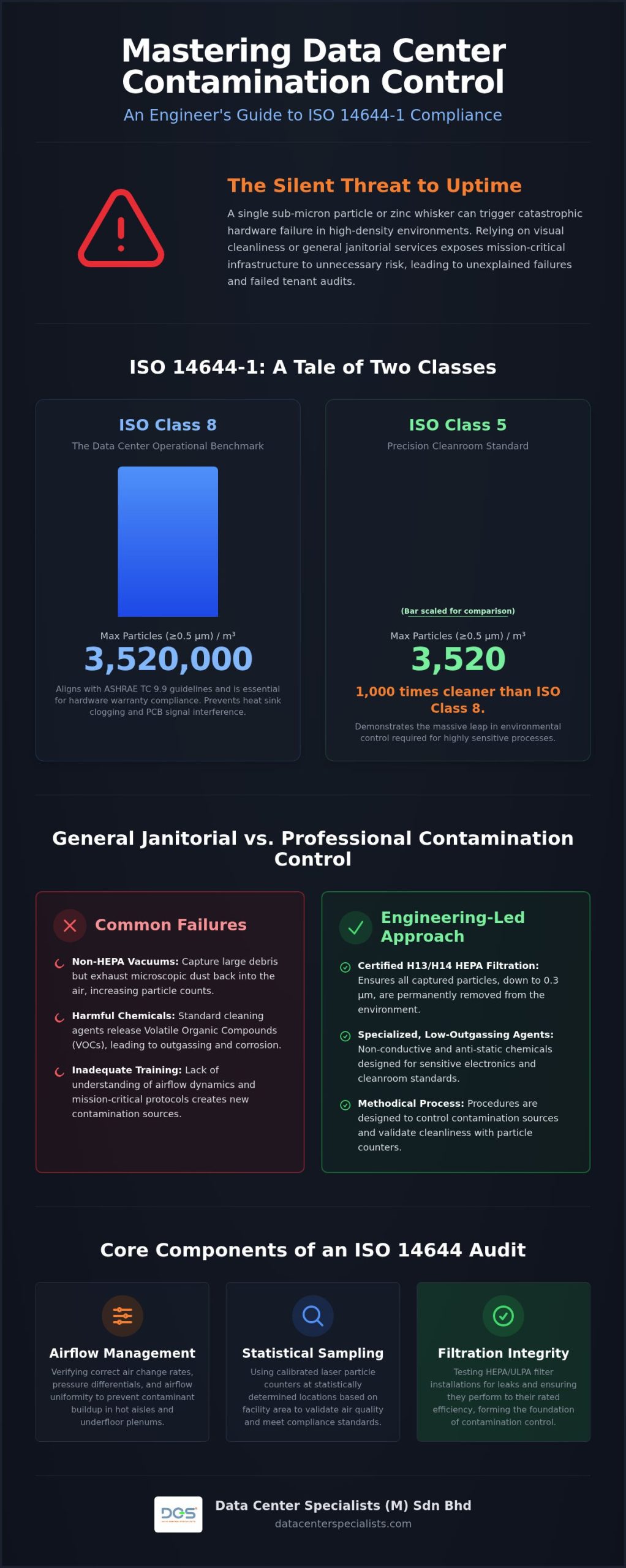
The industry’s transition from the legacy Federal Standard 209E to the ISO 14644 standards reflects a move toward global technical uniformity. While the old US standard relied on imperial measurements, such as Class 100,000, the ISO framework utilizes a metric-based classification from Class 1 to Class 9. Data centers typically target ISO Class 8 in operational states, which limits particles 0.5 μm and larger to 3,520,000 per cubic meter. ISO 14644-1 compliance is a non-negotiable requirement for hyperscale facilities to ensure the technical reliability and warranty validity of high-density server infrastructure.
The Evolution of Contamination Standards
Contamination control has evolved from simple dust management to a complex engineering discipline. ISO 14644-1 Part 1 specifically focuses on the classification of air cleanliness, providing the benchmarks needed for initial certification and ongoing audits. As Malaysia expands its data center footprint across its key regions, the focus has shifted toward monitoring smaller particulates. High-density AI-driven environments generate significant heat, requiring increased airflow that can keep smaller 0.1 μm to 1.0 μm particles in suspension longer. This increases the likelihood they’ll settle on sensitive PCB components, leading to latent failures or signal interference.
Why General Janitorial Services Fail ISO Standards
General cleaning crews often lack the specialized equipment and training required for mission-critical sites. A primary risk involves the use of standard commercial vacuums. These units frequently lack certified H13 HEPA filtration, causing them to capture large debris while exhausting microscopic dust back into the data hall. This dust redistribution can cause immediate spikes in particle counts during an audit. It’s a common cause for failing a data center ISO 14644 audit checklist despite the room appearing visually clean.
Additionally, domestic cleaning agents often contain volatile organic compounds (VOCs) that lead to chemical outgassing. These vapors can react with cooling systems or settle on server components, leading to corrosion over time. Professional data center cleaning requires specialized, non-conductive, and low-outgassing chemicals that meet strict cleanroom standards. Utilizing an engineering-led approach ensures that cleaning activities don’t become a source of contamination themselves. To understand why the gap between basic housekeeping and specialized data center cleaning is so consequential, it’s worth examining the most common misconceptions that put mission-critical infrastructure at risk.
ISO 14644 Particle Concentration Limits: Class 8 vs. Class 5
ISO 14644-1:2015 defines air cleanliness through a logarithmic scale ranging from Class 1, the most stringent, to Class 9. Each classification specifies the maximum allowable concentration of particles per cubic meter of air across various diameters, typically from 0.1 μm to 5.0 μm. For facility managers utilizing a data center ISO 14644 audit checklist, these numbers aren’t just theoretical; they’re the technical boundaries that separate a reliable environment from one prone to intermittent hardware failure. ISO Class 5 is 1,000 times cleaner than ISO Class 8 for particles 0.5 μm and larger, representing a massive leap in environmental control and filtration requirements.
ISO Class 8: The Operational Benchmark
ISO Class 8 serves as the standard operational benchmark for the majority of data halls in Malaysia and Southeast Asia. It permits a maximum of 3,520,000 particles (≥0.5 μm) per cubic meter. This limit is critical because it aligns with ASHRAE TC 9.9 guidelines, which hardware manufacturers use to define the environmental conditions required for warranty support. When particle counts exceed Class 8, the risk of “heat sink clogging” and signal interference on PCBs increases significantly. Common audit failures in Cyberjaya and Johor facilities often trace back to unsealed concrete subfloors or the introduction of cardboard packaging into the white space. Maintaining these levels requires precise Sensor Calibration for ISO 14644 to ensure that monitoring equipment provides a true reflection of the environment’s health.
ISO Class 5: When Higher Precision is Required
While Class 8 suffices for general server rooms, ISO Class 5 is required for high-sensitivity zones such as hard disk drive (HDD) repair labs or during the pre-commissioning of advanced optical networking equipment. At this level, the environment is restricted to just 3,520 particles (≥0.5 μm) per cubic meter. Achieving Class 5 necessitates specialized airflow management and the use of ultra-low particulate air (ULPA) filters or high-efficiency H14 HEPA systems. Validating these stringent environments is a primary focus of Cleanroom Performance Testing (CPT). If your facility is transitioning to support high-density AI infrastructure, conducting a specialized engineering assessment can determine if your current airflow architecture can maintain the higher purity levels required for sensitive liquid-cooling components or optical interconnects.
Audit Testing Methodology: Validating ISO Compliance
To achieve a valid certification, a data center ISO 14644 audit checklist must specify the room’s occupancy state. ISO 14644-1:2015 recognizes three distinct conditions that significantly impact particulate concentration. The “As-built” state refers to a completed room without equipment or personnel. “At-rest” involves installed hardware running without staff present, while the “Operational” state measures the environment under live load with active personnel. Operational testing remains the most challenging state to certify due to the constant introduction of particulates from human activity and high-velocity fan cycles, yet it’s the only state that truly reflects the risks to live mission-critical hardware.
Statistical sampling is required to ensure the entire data hall meets the target classification. The number of sampling locations is determined by the square root of the floor area, ensuring that test points are distributed evenly across the white space. Auditors use calibrated laser particle counters that comply with ISO 21501-4 standards. These devices must be professionally calibrated annually to ensure the accuracy of the 0.5 μm and 5.0 μm readings. Relying on uncalibrated or consumer-grade sensors can lead to false compliance, leaving your infrastructure vulnerable to latent failures and micro-dust accumulation.
Cleanroom Performance Testing (CPT) Protocols
Effective validation requires more than just counting particles. Cleanroom Performance Testing (CPT) includes differential pressure monitoring to ensure the data hall maintains higher pressure than adjacent non-critical spaces, such as corridors or loading docks. This positive pressure prevents external contaminants from being drawn into the server room during door cycles. Airflow visualization and velocity testing are also conducted to verify that the cooling system provides uniform distribution without stagnant zones. For facilities requiring deep technical validation, Specialized Engineering Testing provides the necessary data for high-stakes audits.
Particle Count Testing (PCT) Procedures
The Particle Count Testing (PCT) methodology involves taking air samples at specific heights, usually at the server intake level, to capture a representative volume of air. Each sample must be large enough to be statistically significant for the target ISO class. Once the data is collected, a technical PCT report is generated, providing the 95% Upper Confidence Limit (UCL) for the entire facility. This report serves as essential documentation for management and financial tenants who require proof of environmental stability. These procedures are especially critical during the final stages of a Data Center Commissioning Cleaning project, where baseline air quality must be established before the handover to operations.
Live Environment Compliance: Underfloor and Rack Systems
Maintaining compliance in a live environment requires more than occasional reactive cleaning. Facility operators must develop a preventive maintenance schedule (PMS) that uses the data center ISO 14644 audit checklist as a technical baseline. This schedule should dictate the frequency of decontamination based on actual particle concentration trends observed during quarterly or semi-annual audits. In high-density zones, airflow management plays a critical role in suppressing airborne contaminants by ensuring high-velocity air passes through filtration systems rather than swirling in turbulent pockets where dust settles. Implementing infrastructure-level protection, such as DCS Smart Racks, effectively isolates sensitive IT equipment from the surrounding room environment, creating a micro-controlled space that’s easier to maintain at ISO Class 8 or better.
Contamination Hotspots: Sub-Floor and Rack Cleaning
The sub-floor plenum often acts as a massive reservoir for micro-dust and construction debris left behind during initial fit-outs. If left unmanaged, the pressurized air moving through this space will carry particulates directly into the server intakes. Professional cleaning of the plenum is essential to prevent these reservoirs from compromising the entire facility’s air quality. When cleaning live rack equipment, technicians must use specialized, non-conductive tools to avoid inducing electrostatic discharge (ESD) or thermal events. For a detailed methodology on plenum decontamination, refer to our guide on Sub-Floor Construction Cleaning: Decontaminating the Data Center Plenum.
Linking ISO Standards to Energy Efficiency
There’s a direct correlation between air cleanliness and Power Usage Effectiveness (PUE). Particulate buildup on heat sinks and server fans forces cooling systems to work harder, increasing fan power consumption to maintain thermal setpoints. By maintaining ISO 14644 standards, facility managers reduce the thermal resistance caused by dust layers on components. Utilizing Testing, Adjusting, and Balancing (TAB) services allows for the optimization of airflow while ensuring that the air quality remains within compliance limits. Integrating these technical audits into a broader Data Center Energy Assessment provides a holistic view of how cleanliness impacts operational costs and sustainability goals in Malaysia’s tropical climate.
To ensure your live environment remains within strict particulate limits, contact our engineering team for a technical maintenance discussion.
Professional Contamination Control: The Path to ISO Certification
Evaluating a strategic partner for data center ISO 14644 audit checklist compliance requires looking beyond surface-level cleaning capabilities. You need a team with engineering-level training that understands the high-stakes nature of mission-critical environments. General labor forces often lack the specialized technical literacy required to navigate live racks without triggering thermal alarms or ESD events. A seasoned provider acts as a protective guardian of your technical environment, ensuring that every action taken supports operational continuity rather than introducing new risks. Facility managers looking to validate this distinction will find it useful to review the critical myths surrounding specialized data center cleaning that continue to expose infrastructure to preventable contamination risks.
Technical equipment must meet rigorous specifications to be effective in a controlled environment. Vacuum systems must utilize certified H13 HEPA filtration or better to ensure that microscopic particulates are captured rather than exhausted back into the data hall. Using standard commercial units is a primary reason for failed ISO 14644-1 audits in facilities across Malaysia and Singapore. All cleaning materials must be non-conductive and anti-static to prevent signal interference or component degradation. Safety protocols should prioritize ESD-safe materials and specialized low-outgassing chemicals that won’t compromise sensitive server components or airflow sensors.
Post-Construction Handover to ISO Class 8
The transition from a construction site to a live data hall involves a multi-stage decontamination process. It begins with a rough clean to remove heavy debris, followed by a detailed technical clean of all high-level surfaces and the sub-floor plenum. The final clinical handover stage is the most critical; it ensures the facility meets target particulate limits before any IT equipment is unboxed or commissioned. Verifying the air quality at this stage prevents new hardware from being exposed to residual concrete dust or drywall particulates that can lead to early-life hardware failures. For a granular breakdown of these phases, refer to our Data Center Cleaning Specifications: The ISO 14644-1 Post-Construction Checklist.
Ongoing Monitoring and Recertification
Achieving certification is not a one-time event but an ongoing commitment to quality. ISO 14644-2 dictates the requirements for continuous monitoring to provide evidence of environmental stability. While annual testing is the technical baseline, high-utilization facilities in industrial hubs like Johor and Cyberjaya often benefit from semi-annual recertification to manage higher external particulate loads. Integrating environmental sensors allows for real-time particulate awareness, yet these automated systems cannot replace the periodic physical audits required for formal certification. Professional maintenance schedules protect long-term infrastructure ROI by ensuring that PUE remains optimized and hardware lifespan is maximized through consistent contamination control.
Securing Long-Term Operational Continuity
Adhering to the technical requirements of ISO 14644-1 is the only way to safeguard your mission-critical infrastructure from latent contamination failures. This guide has detailed how to differentiate between Class 8 and Class 5 environments while establishing a repeatable framework for air quality management. By utilizing a comprehensive data center ISO 14644 audit checklist, facility managers can satisfy the strict compliance demands of financial and enterprise tenants across Malaysia and Singapore.
Since 2008, Data Center Specialists (M) Sdn Bhd (DCS) has served as a strategic partner for hyperscale and financial institution facilities. Our team provides advanced Cleanroom Performance Testing (CPT) and specialized engineering assessments to ensure your white space remains within strict particulate limits. Don’t leave your uptime to chance with general janitorial services that lack the technical literacy required for live rack environments. We’ve seen the risks of micro-dust firsthand and possess the specialized skills to navigate them.
Contact Data Center Specialists (M) Sdn Bhd (DCS) for a professional ISO 14644 assessment and contamination control consultation. We’re ready to help you achieve and maintain the highest standards of environmental purity.
Frequently Asked Questions
What is the most common ISO standard for data center cleaning?
ISO 14644-1 is the primary international benchmark for air cleanliness in controlled environments. For operational data halls in Malaysia, ISO Class 8 is the de facto industry standard. This classification limits particles of 0.5 μm and larger to a maximum of 3,520,000 per cubic meter. While Class 8 is the baseline, newer standards like ISO 14644-13 now provide specific guidelines for surface cleanliness to prevent the re-suspension of settled contaminants into the airflow.
How often should a data center undergo ISO 14644 particle count testing?
ISO 14644-2 recommends a maximum interval of 12 months for particle count testing in cleanroom environments. However, mission-critical facilities in Malaysia’s tropical climate often benefit from semi-annual audits. Increased humidity and external construction activity can lead to rapid particulate accumulation. A robust data center ISO 14644 audit checklist should incorporate regular testing to detect air quality degradation before it impacts server reliability or triggers hardware warranty disputes.
Can a general cleaning company achieve ISO Class 8 standards?
General cleaning companies typically struggle to meet these stringent requirements because they use standard janitorial equipment. Standard commercial vacuums often lack certified H13 HEPA filtration, which means they capture large debris while exhausting microscopic dust back into the room. Achieving ISO Class 8 requires specialized engineering knowledge, non-conductive materials, and anti-static protocols. Professional contamination control is a technical discipline that focuses on protecting hardware rather than just visual aesthetics.
What happens if a data center fails its ISO 14644-1 audit?
Failing an audit indicates that airborne particulate levels exceed safe limits for mission-critical hardware. This failure can lead to formal non-compliance notices from enterprise or financial tenants who require strict environmental guarantees. Beyond compliance risks, high particle counts correlate with increased rates of heat sink clogging and signal interference. Remediation typically involves a comprehensive deep clean of the sub-floor plenum and rack systems followed by a secondary verification audit.
What is the difference between ISO 14644 and Fed Std 209E?
ISO 14644 is the current metric-based international standard that replaced the legacy US Federal Standard 209E. While Fed Std 209E used imperial measurements like “Class 100,000,” the ISO system uses a logarithmic metric scale from Class 1 to Class 9. ISO Class 8 is the direct metric equivalent to the old Class 100,000 standard. This transition ensures global technical uniformity, allowing hyperscale operators to apply the same environmental benchmarks across different geographic regions.
Does ISO 14644 address zinc whiskers in data centers?
ISO 14644-1 specifically measures airborne particle concentrations rather than metallic surface growth. While airborne monitoring is essential, zinc whiskers are physical growths on galvanized surfaces that require specialized physical removal. However, the 2026 update to ISO 14644-13 now provides a technical framework for cleaning surfaces to defined levels. This helps facility managers address the risk of whiskers being dislodged and becoming airborne contaminants that could cause short circuits in server components.
What equipment is required for ISO 14644-1 compliance testing?
Compliance testing requires a discrete-particle-counting, light-scattering instrument, commonly known as a laser particle counter. These devices must comply with the ISO 21501-4 calibration standard to ensure accuracy across all particle sizes from 0.1 μm to 5.0 μm. Handheld or consumer-grade sensors aren’t acceptable for formal certification. Professional auditors use tripod-mounted, high-volume counters that are calibrated annually to provide the statistically significant data required for a valid data center ISO 14644 audit checklist report.
Is ISO Class 8 mandatory for all server rooms?
Adherence to ISO Class 8 isn’t a legal requirement under Malaysian law, but it’s a mandatory technical requirement for most hyperscale and financial institution service level agreements. Hardware manufacturers like Dell and HPE often cite these air quality standards in their warranty documentation. If a facility doesn’t maintain these levels, the risk of “silent” hardware failure increases. Most professional operators treat Class 8 as a non-negotiable benchmark for ensuring long-term operational continuity and infrastructure ROI.