
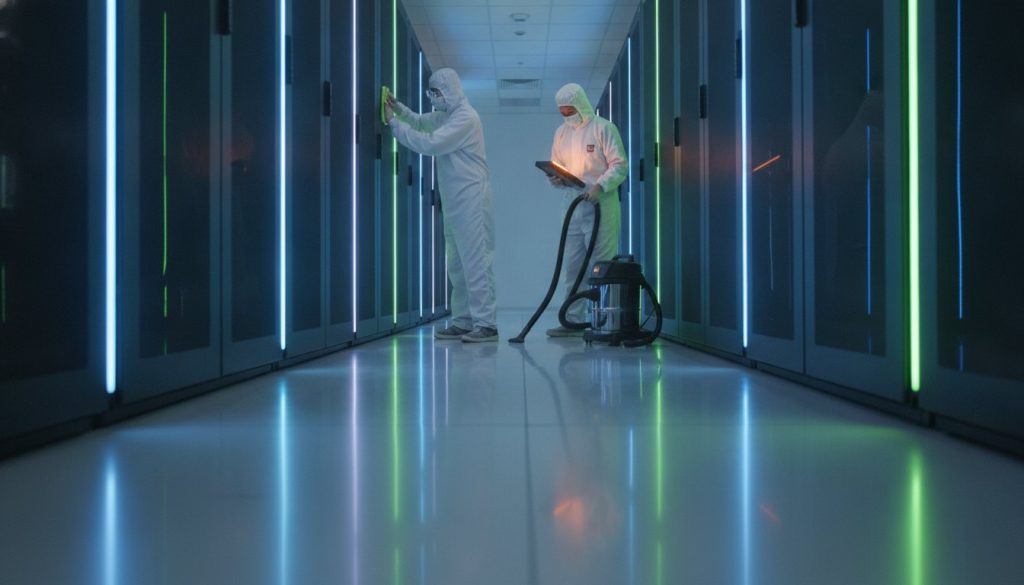
Thinking a facility is ready for live hardware just because the floors look swept is a multimillion-ringgit gamble that most facility managers can’t afford to lose. In the high-stakes environment of a new build, the invisible threat of micron-sized construction dust often lingers in sub-floor voids and cable trays, waiting to bypass filtration systems and trigger early-stage hardware failure. For those overseeing a handover, the pressure to secure a successful ISO 14644-1 certification is immense, especially as Malaysia’s data center capacity is projected to reach 6.43 GW by 2031. Standard janitorial services simply don’t possess the technical literacy required for a specialized data center deep cleaning Malaysia project.
We understand that commissioning is a one-time opportunity to establish a baseline of environmental integrity. This guide provides the technical protocols needed to transition your site from a dusty construction zone to a sterile, mission-critical environment. You’ll learn the precise decontamination methodologies for raised floors, server racks, and airflow paths that ensure zero hardware failures during startup. We’ll also detail the documentation and testing procedures, including Cleanroom Performance Testing (CPT), required to provide stakeholders with definitive proof of operational readiness.
Key Takeaways
- Understand why micro-dust particles act as “silent killers” for new hardware and how technical decontamination bridges the gap between construction and live operations.
- Identify the specific ISO 14644-1:2015 air cleanliness benchmarks required to secure certification for modern hyperscale and enterprise facilities.
- Master the “Top-Down, Inside-Out” methodology for data center deep cleaning Malaysia, ensuring critical zones like ceiling plenums and sub-floor voids are fully decontaminated.
- Learn how to integrate Cleanroom Performance Testing (CPT) with physical cleaning to provide stakeholders with documented, scientific proof of operational readiness.
- Establish a controlled handover environment by implementing rigorous room-sealing protocols and access restrictions during the final commissioning phase.
The Critical Role of Technical Decontamination in Data Center Commissioning
Commissioning represents the final, most critical phase before a facility goes live. It’s the technical bridge that transforms a chaotic construction site into a functional mission-critical environment. While many operators confuse this with basic site cleanup, specialized data center deep cleaning Malaysia protocols are required to mitigate the risk of microscopic particulate contamination. These micro-dust particles are silent server killers. They settle on sensitive circuitry during the initial power-up, causing electrical shorts or “zinc whiskers” that lead to catastrophic downtime. This isn’t an aesthetic task; it’s an engineering necessity.
Unlike standard post-construction data center cleaning, technical decontamination focuses on sub-micron debris hidden in ceiling plenums and underfloor voids. If left unaddressed, this residual debris is sucked into server intakes. This leads to cooling inefficiency and localized hotspots that force fans to run at higher RPMs, wasting energy and shortening the lifespan of your infrastructure. Every milligram of dust left behind is a potential point of failure for your cooling strategy.
Why General Janitorial Services Fail Mission-Critical Sites
General cleaning crews lack the specialized equipment and chemistry knowledge required for high-availability environments. Standard commercial cleaning agents often contain ammonia or chlorides that cause chemical outgassing or corrode copper components over time. Using non-HEPA vacuums is another primary point of failure. These standard machines lack the filtration to trap sub-micron particles; they simply suck up large dust and redistribute the most dangerous, fine particulates back into the air. True decontamination requires adherence to global cleanroom standards, where equipment is certified to trap 99.97% of particles down to 0.3 microns. General crews also lack awareness of Electrostatic Discharge (ESD), often using materials that generate static charges near sensitive rack locations.
Hardware Warranties and the Risk of Silent Failures
Major IT equipment manufacturers increasingly tie warranty validity to the cleanliness of the operating environment. If a server fails and an OEM technician finds evidence of construction dust or corrosive particulate matter inside the chassis, your claim may be denied. Beyond dust, particulates can carry corrosive salts that react with humidity to eat away at circuit traces. This leads to intermittent logic errors that are notoriously difficult to troubleshoot. In the context of 2026 hyperscale operations, micro-dust accumulation creates a thermal insulating layer on components that traps heat and triggers silent logic errors or permanent hardware failure before the facility even reaches full capacity.
ISO 14644-1 Standards: Benchmarking Cleanroom Performance in 2026
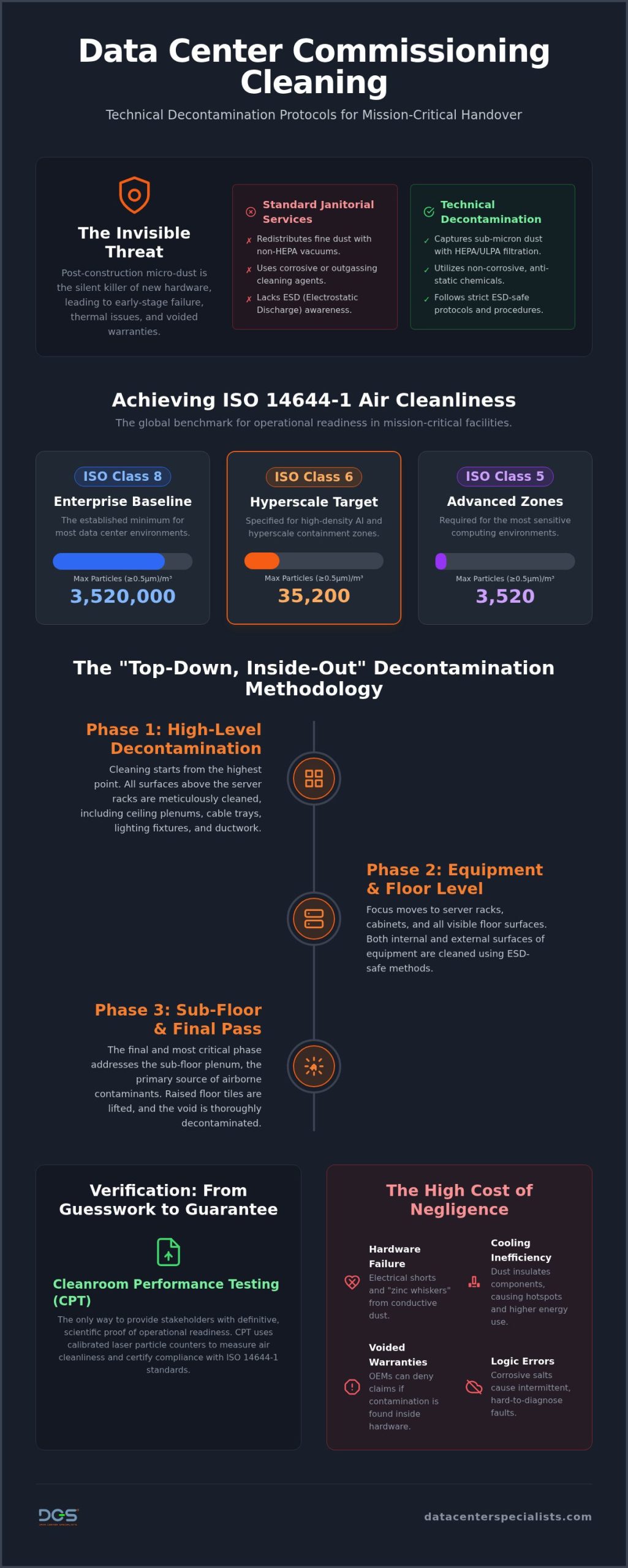
ISO 14644-1:2015 provides the global framework for air cleanliness, and in the Malaysian context, it serves as the definitive benchmark for facility handover. For most enterprise environments, ISO Class 8 is the established minimum baseline. This standard limits the concentration of particles 0.5 microns or larger to 3,520,000 per cubic meter. However, as AI-driven workloads increase power densities, hyperscale operators are increasingly specifying ISO Class 6 or even Class 5 for high-density containment zones. Achieving these stringent levels requires rigorous data center deep cleaning Malaysia protocols followed by objective validation.
The primary method for this validation is Cleanroom Performance Testing (CPT). This isn’t a visual inspection; it’s a scientific measurement using calibrated laser particle counters. Facility managers should consult a comprehensive Data Center Commissioning Checklist to ensure technical decontamination is scheduled at the correct stage of the L3 and L4 commissioning process. Without this data-driven approach, you’re simply guessing at the readiness of your environment.
Particle Count Thresholds for Commissioning Handover
When reviewing a handover report, engineers focus on two primary metrics: 0.5 micron and 5.0 micron particle concentrations. For an ISO Class 8 environment, the limit for 5.0 micron particles is 29,300 per cubic meter. High counts in the 5.0 micron range often indicate residual construction debris or shedding materials, while high 0.5 micron counts suggest failure in the HEPA filtration or room sealing. Understanding these nuances is vital for a successful transition, as detailed in our guide to data center cleaning services in Malaysia. Facility teams seeking a structured approach to ongoing compliance should also reference a dedicated data center ISO 14644 audit checklist to move beyond visual inspections and establish a repeatable contamination control framework.
Synergizing CPT and TAB for Environmental Compliance
Technical decontamination doesn’t exist in a vacuum. It must be paired with Testing, Adjusting & Balancing (TAB) to ensure the environment remains stable. Airflow balancing is critical; if a room is negatively pressured, construction dust from adjacent corridors will migrate into the clean data hall, nullifying the cleaning efforts. DCS provides an integrated approach where CPT and TAB are performed in tandem, ensuring that both the physical surfaces and the mechanical airflow meet operational specs. If your facility is approaching handover, you may wish to discuss your specific ISO targets with our engineering team to ensure compliance.
The Three Phases of Technical Decontamination Methodology
Executing a successful data center deep cleaning Malaysia project requires a disciplined “Top-Down, Inside-Out” methodology. This engineering-led approach ensures that gravity works in your favor by starting at the highest points of the facility and moving toward the floor. If a crew cleans the floor first, any subsequent work on overhead cable trays or lighting fixtures will simply redistribute dust onto the freshly sanitized surfaces. This methodical sequence is the only way to achieve and maintain the stringent ISO 14644-1 cleanliness standards required for modern hardware warranties.
The tools used in this process are just as critical as the sequence. Standard vacuums are strictly prohibited; they lack the filtration to trap sub-micron particles and often exhaust fine dust back into the room. Technical crews must utilize industrial-grade HEPA-filtered vacuums certified to capture 99.97% of particles down to 0.3 microns. All wiping is performed with lint-free, specialized microfibers that don’t shed fibers, paired with anti-static, solvent-free cleaning agents that won’t cause chemical outgassing or damage sensitive component finishes.
Phase 1 & 2: High-Level and External Rack Decontamination
The first phase targets the ceiling plenum and overhead structures. Crews meticulously vacuum and wipe lighting fixtures, sprinkler pipes, and HVAC ductwork. Overhead cable trays and support struts are primary collection points for construction dust and must be decontaminated before any IT equipment is unboxed. Once the high-level surfaces are secure, the focus shifts to the external surfaces of the infrastructure. This includes the exterior panels of DCS Smart Racks, containment systems, and power distribution units. Using specialized anti-static agents during this phase prevents the buildup of charges that could attract more dust during the commissioning process.
Phase 3: Sub-floor and Raised Floor Void Decontamination
The sub-floor void is the most overlooked yet vital phase of decontamination because it typically serves as the pressurized air supply plenum. Any debris left under the floor, such as concrete dust, metal shavings, or drywall scraps, will be pushed directly into the server intakes once the CRAC units are energized. Crews must remove all physical debris and perform a comprehensive vacuuming of the sub-floor slab. Pedestals and stringers are wiped down to prevent the formation of zinc whiskers, which are microscopic metal filaments that can cause electrical shorts. For a detailed breakdown of the specialized HEPA filtration protocols and ISO 14644-1:2015 alignment required for this critical zone, our guide on sub-floor construction cleaning and data center plenum decontamination provides the complete technical methodology. Only after the sub-floor is certified clean are the raised floor tiles replaced, followed by a final vacuuming and technical wipe of the floor surface to establish the baseline for operational readiness.
How to Execute a Successful Commissioning Clean: A Step-by-Step Guide
Executing a professional decontamination requires more than technical skill; it demands a rigid operational sequence. A successful data center deep cleaning Malaysia project begins with the total isolation of the data hall from ongoing construction activities in adjacent corridors. This isn’t merely about tidiness. It’s about establishing a controlled environment where every entry and exit is monitored to prevent the reintroduction of particulates. Without these strict controls, the decontamination effort is compromised before it even concludes.
Real-time monitoring is essential during this phase. Technical teams utilize handheld laser particle counters to verify that cleaning activities aren’t causing spikes in airborne contamination that exceed the project’s target ISO class. This data-driven approach allows for immediate corrective action if a specific zone shows persistent high counts. The final goal is a comprehensive documentation package that proves to stakeholders and insurers that the facility is fit for purpose.
Pre-Cleaning Preparation and Access Control
The preparation phase sets the foundation for a successful ISO handover. Technical crews must follow a disciplined three-step protocol before physical cleaning begins:
- Step 1: Secure the Environment. Seal all floor grommets, cable entries, and door gaps. Shut down non-essential HVAC systems or bypass CRAC units to prevent the circulation of construction dust during the initial high-level vacuuming.
- Step 2: Gowning and Entry Protocols. Establish a dedicated transition zone. Technical crews must utilize “Sticky Mats” to trap sole-borne debris and wear non-shedding, anti-static coveralls, shoe covers, and gloves.
- Step 3: HEPA-Filtered Initial Pass. Perform a high-level vacuuming of all overhead structures. This includes cable trays, ductwork, and lighting fixtures, ensuring that any larger construction debris is captured before it can settle on lower surfaces.
Post-Cleaning Validation and ISO Certification
Validation is the final gate in the commissioning process. Once the physical cleaning is complete, the room must be left to “recover” for a specified period, allowing the filtration system to stabilize the environment. Following this, an independent Cleanroom Performance Testing (CPT) protocol is executed. This involves taking particle count samples at a statistically significant number of locations throughout the data hall, as dictated by the 2015 ISO 14644-1 lookup tables.
The resulting CPT report serves as the official record of compliance. It details the concentration of particles at 0.5 microns and 5.0 microns, providing the data center owner with the “Certificate of Cleanliness” required for insurance validation and OEM warranty activation. If your facility is preparing for a critical handover, you can book a pre-commissioning assessment with our technical team to ensure your site meets these rigorous benchmarks.
Strategic Handover: Partnering with Specialists for Operational Readiness
Selecting a partner for commissioning is a decision that impacts the facility’s Mean Time Between Failures (MTBF) for years to come. While general janitorial firms often attempt to bid for these projects by citing their experience in hospitals or commercial offices, they don’t have the technical literacy to manage mission-critical environments. A hospital cleaner doesn’t understand the aerodynamic properties of a pressurized sub-floor plenum or the risks of electrostatic discharge (ESD) in a live rack environment. Data Center Specialists (M) Sdn Bhd (DCS) bridges this gap by operating as an engineering firm first. Our specialized data center deep cleaning Malaysia services are designed to protect your investment from the specific particulate threats found in the region’s rapidly growing hyperscale hubs.
The long-term ROI of professional commissioning cleaning is found in the absence of hardware failures and the preservation of OEM warranties. It’s a strategic investment in the reliability of your facility. We don’t just clean; we provide an engineering-grade environment that allows your IT teams to focus on deployment rather than troubleshooting dust-related logic errors. By establishing a sterile baseline from day one, you reduce the risk of early-stage failures and ensure that your infrastructure operates at its peak designed efficiency.
The DCS Integrated Approach: Cleaning, TAB, and CPT
The primary advantage of partnering with Data Center Specialists (M) Sdn Bhd (DCS) is our ability to deliver an integrated suite of technical services. Cleaning shouldn’t be a siloed activity; it’s the physical foundation for environmental performance. By combining decontamination with Testing, Adjusting & Balancing (TAB) and Cleanroom Performance Testing (CPT), we ensure your facility’s airflow and air quality work in perfect synchronization. This holistic method has made us a trusted partner for financial institutions and hyperscalers across Malaysia, where we provide documented proof of readiness. For those looking to optimize their facility further, our guide on The Definitive Guide to Data Center Energy Assessments (2026) explains how environmental control directly correlates with PUE targets.
Future-Proofing Infrastructure with Smart Rack Solutions
Operational readiness extends beyond the surfaces of the room to the very racks housing your hardware. Our DCS Smart Racks and modular containment solutions are designed to maintain the sterile baseline established during the commissioning clean. These systems integrate seamlessly with a cleanroom-certified environment, reducing the rate of dust ingress and improving cooling efficiency. However, even the most advanced hardware requires a disciplined post-commissioning strategy. Transitioning from a commissioning clean to a schedule of Data Center Maintenance is vital for preventing the gradual buildup of operational particulates that lead to hotspots. Consult with Data Center Specialists (M) Sdn Bhd (DCS) for your ISO commissioning cleaning today to ensure your facility transitions from construction to operation with zero technical compromises.
Securing Your Mission-Critical Baseline
Transitioning from a construction site to an operational facility is a high-stakes engineering handover that leaves no room for error. We’ve explored how microscopic construction dust acts as a silent threat to hardware and why specialized data center deep cleaning Malaysia protocols are essential for meeting ISO 14644-1:2015 standards. By following a disciplined “Top-Down, Inside-Out” methodology and utilizing HEPA-certified technology, you ensure that your facility is truly ready for live IT loads.
Don’t let residual particulates compromise your equipment warranties or lead to premature hardware failure. Data Center Specialists provides a strategic partnership backed by guaranteed ISO compliance and integrated CPT and TAB testing services. Trusted by Malaysia’s leading hyperscalers and financial institutions, we possess the technical expertise to secure your environment. Ensure your site meets ISO standards; contact Data Center Specialists for a professional commissioning clean today. It’s time to move forward with total confidence in your facility’s operational readiness.
Frequently Asked Questions
What is the difference between post-construction and commissioning cleaning?
Post-construction cleaning focuses on removing visible debris and bulk dust left by building contractors. Commissioning cleaning, or data center deep cleaning Malaysia, is a technical decontamination process targeting sub-micron particles invisible to the eye. It involves high-level wiping, sub-floor plenum sanitation, and rack decontamination. While post-construction cleaning makes a site look ready, commissioning cleaning ensures it meets ISO 14644-1 standards for active IT hardware deployment.
How long does a full data center commissioning cleaning take?
The duration depends on the facility size and infrastructure complexity, but a standard 5,000 square foot data hall typically requires three to five days. This timeline accounts for the “Top-Down” methodology, including ceiling plenums, rack exteriors, and the sub-floor void. We also factor in a 24-hour settling period before Cleanroom Performance Testing (CPT) to ensure airborne particles have stabilized for accurate ISO certification.
Which ISO 14644-1 class is required for a new data center in Malaysia?
ISO Class 8 is the globally recognized baseline for data center environments, limiting particles of 0.5 microns to 3,520,000 per cubic meter. However, many Malaysian hyperscalers and financial institutions now specify ISO Class 7 or Class 6 for high-density AI zones. Adhering to these stricter standards is often a prerequisite for OEM warranty validation and insurance compliance during the critical facility handover phase. A structured data center ISO 14644 audit checklist can help facility managers systematically verify compliance across all classification levels and document readiness for tenant and insurer review.
Can we commission the data center while cleaning is in progress?
We strictly advise against simultaneous cleaning and commissioning activities. Powering up servers or CRAC units while technical crews are decontaminating the sub-floor can pull residual construction dust into the active airflow. This leads to immediate hardware contamination and potential failure. The room should be sealed and all non-essential traffic halted during the decontamination process to ensure the environment reaches its target ISO classification.
What equipment is used in professional data center decontamination?
Technical crews use industrial-grade HEPA vacuums certified to capture 99.97% of particles down to 0.3 microns. Standard commercial vacuums are prohibited as they redistribute fine dust. Other essential tools include lint-free microfibers, anti-static cleaning agents, and calibrated laser particle counters for real-time monitoring. For validation, we utilize specialized Cleanroom Performance Testing (CPT) equipment to generate the final compliance reports for all stakeholders.
Why is sub-floor cleaning critical before powering up servers?
The sub-floor void acts as a pressurized air plenum that delivers cooling to the racks. If construction debris, concrete dust, or metal shavings remain in this void, they’ll be blasted directly into server intakes once the CRAC units start. This causes immediate logic errors or thermal hotspots. Professional sub-floor construction cleaning ensures this plenum is sterile, preventing the circulation of contaminants through the sensitive IT infrastructure.
Does professional cleaning help with data center energy efficiency?
Yes, technical decontamination directly improves cooling efficiency and reduces Power Usage Effectiveness (PUE). Particulate buildup on server heat sinks and floor grilles restricts airflow, forcing cooling fans to run at higher speeds and consume more power. By removing these obstructions and ensuring balanced airflow through Testing, Adjusting & Balancing (TAB), facility operators can reduce energy waste and extend the operational life of their hardware.
How often should a data center be cleaned after the initial commissioning?
Following the initial commissioning clean, we recommend a quarterly preventive maintenance schedule for high-traffic facilities. At a minimum, a comprehensive deep clean should occur annually to address the gradual accumulation of skin flakes, clothing fibers, and zinc whiskers. Regular maintenance ensures the facility remains compliant with ISO 14644-1 standards and prevents the long-term degradation of hardware reliability and facility cooling performance.