

A microscopic filament less than two microns thick can bypass the most sophisticated firewalls and redundant power supplies to trigger a catastrophic short circuit in your mission-critical hardware. For facility managers, these metallic growths represent a hidden threat to operational uptime that often goes unnoticed until a server rack fails without warning. You’re likely already concerned about the integrity of your legacy raised floor tiles or the presence of unusual conductive particles in your underfloor plenum.
It’s a valid concern because standard janitorial cleaning doesn’t address the unique molecular risks of metallic contamination. This technical guide will help you master zinc whisker detection to protect your IT infrastructure from airborne conductive debris. You’ll learn how to identify at-risk areas, understand the critical differences between common dust and metallic whiskers, and establish a professional remediation plan. We’ll provide the clarity you need to move from uncertainty to a structured protocol for environmental safety and long-term hardware reliability. By following these industry standards, you can ensure the continued integrity of your mission-critical facility.
Key Takeaways
- Identify legacy electroplated floor tiles and galvanized cable trays as the primary sources of conductive crystalline growth within your facility.
- Master specialized zinc whisker detection techniques, such as the high-intensity flashlight test, to uncover hidden contamination risks in sub-floor plenums.
- Avoid the dangers of aerosolization by understanding why professional decontamination requires specialized HEPA filtration rather than standard janitorial equipment.
- Learn to integrate contamination control protocols into your broader data center maintenance strategy to maintain ISO 14644-1 standards.
What are Zinc Whiskers and Why do They Threaten Data Centers?
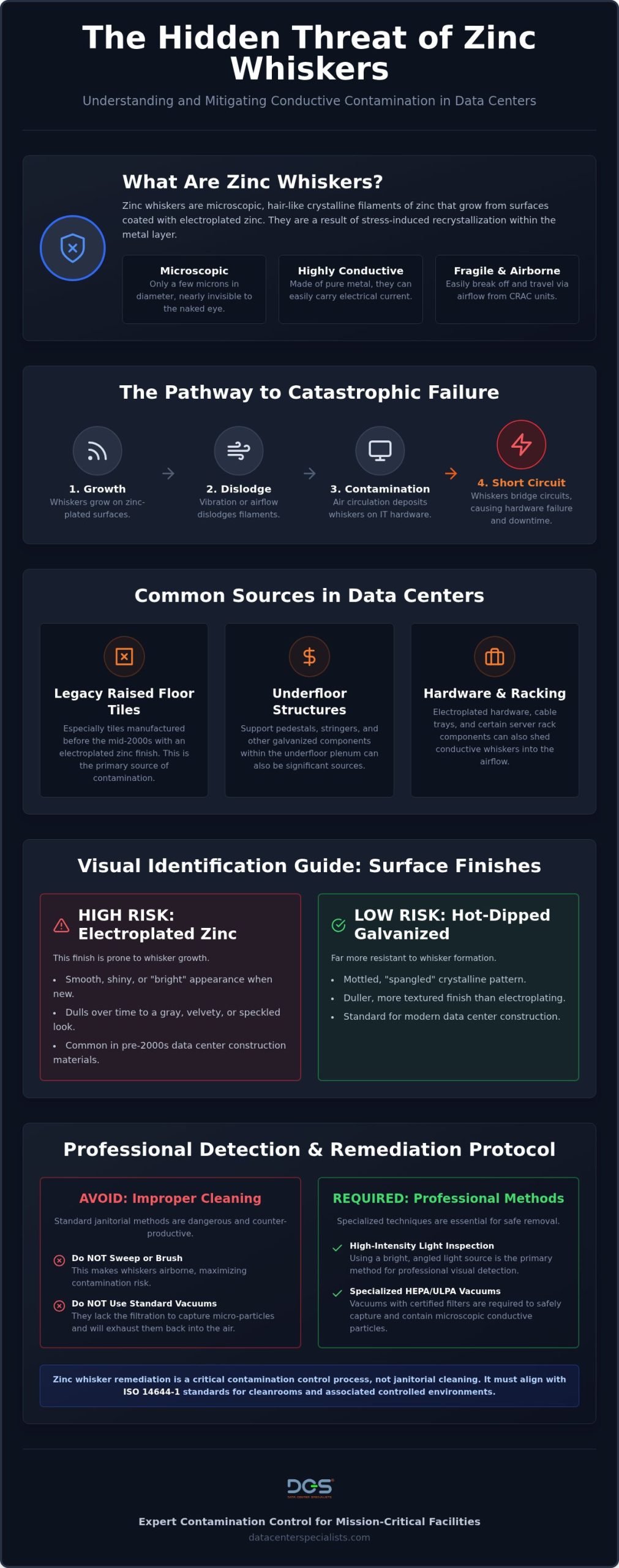
Zinc whiskers are hair-like, monocrystalline filaments that grow from surfaces coated in electroplated zinc. This phenomenon is primarily a result of stress-induced recrystallization within the galvanized layer. While the steel remains structurally sound, the zinc coating “relaxes” by pushing out these microscopic metallic hairs. They’re incredibly thin, often measuring only a few microns in diameter, which makes them nearly impossible to identify without professional zinc whisker detection protocols. Under standard facility lighting, these structures are practically invisible to the naked eye.
The primary danger lies in their conductivity. When these filaments reach a critical length, mechanical vibration or changes in airflow cause them to break off and become entrained in the cooling stream. Once airborne, they settle on sensitive IT components. Because they are pure metal, they create an immediate electrical path between traces that should remain isolated. This leads to terminal short circuits that can permanently damage expensive server hardware. Comprehensive zinc whisker detection is the only way to identify these risks before they translate into hardware failure.
The Physics of Conductive Contamination
Whiskers behave differently than typical atmospheric dust. While standard particulates might cause thermal issues or minor signal interference, zinc whiskers bridge the physical gaps on printed circuit boards (PCBs). They’re particularly dangerous in the underfloor plenum. As CRAC units circulate high-velocity air, these metallic particles are distributed directly into the server intakes. Unlike organic dust, which is often non-conductive, a single zinc whisker can carry enough current to bridge power rails or signal lines, causing immediate logic errors or physical component meltdowns.
The Impact on Mission-Critical Uptime
In many legacy facilities across Malaysia, zinc whiskers act as a “silent killer” of hardware. Facility managers often struggle with unexplained hardware resets or intermittent power supply failures that don’t show up in standard error logs. These “ghost” failures are frequently caused by microscopic shorts that burn out the whisker, leaving no trace of the culprit behind. Modern high-density racks are even more susceptible. As component spacing shrinks to accommodate more processing power, the “bridgeable” distance for a whisker decreases. Maintaining strict environmental standards is essential for operational continuity. You can find more details on these benchmarks in our Server Rack Particle Count reference guide.
Where are Zinc Whiskers Commonly Found in Facilities?
The underside of legacy raised floor tiles is the most frequent site for contamination in mission-critical environments. Specifically, tiles manufactured before the mid-2000s often utilized an electroplated zinc finish rather than hot-dipped galvanization. While modern facilities in Cyberjaya or Johor typically specify powder-coated or hot-dipped alternatives, legacy data halls remain at significantly higher risk. Environmental conditions in tropical climates can accelerate this growth. High humidity levels or fluctuating temperatures within the plenum often trigger the internal stress required for zinc recrystallization.
Beyond floor tiles, facility managers must look at the entire infrastructure supporting the white space. Any component that has been electro-galvanized is a potential candidate for whisker growth. This includes the support pedestals, stringers, and even the hardware used to secure power distribution units. Effective zinc whisker detection requires a comprehensive survey of all metallic surfaces within the airflow path, as these particles can migrate far from their point of origin once they become airborne.
Identifying At-Risk Raised Floor Systems
Electroplated tiles typically have a smooth, shiny, or “bright” finish when new. Over time, this finish dulls into a gray, speckled, or velvety appearance as whiskers develop. In contrast, hot-dipped galvanized steel has a mottled, “spangled” look that’s far more resistant to whisker formation. Identifying these components is a core part of zinc whisker detection during facility audits. Mitigation is most effective when addressed early, ideally during the sub-floor construction cleaning phase, where initial assessments can catch contaminated materials before they’re fully integrated into the live environment.
Electroplated Hardware Hotspots
While floor tiles are the primary concern, other galvanized components in the data hall contribute significantly to the particle load. Facility managers should maintain a checklist of these common hotspots:
- Galvanized cable trays and wire baskets
- J-hooks and overhead support brackets
- Equipment rack mounting rails and internal brackets
- Conduit fittings and electrical junction boxes
Watch for a “dusty” texture on metallic surfaces that doesn’t wipe away like standard particulate. This often indicates advanced whisker growth rather than simple debris. When upgrading to DCS Smart Racks, it’s vital to ensure that any legacy support hardware is verified as non-zinc-plated to prevent cross-contamination. If you suspect your facility contains electroplated materials, a professional contamination assessment is the most reliable way to confirm your risk profile and protect your uptime.
Professional Zinc Whisker Detection Methodologies
Effective zinc whisker detection requires a multi-stage protocol that moves from field observation to laboratory verification. Because these filaments are often thinner than a human hair, they don’t show up during routine janitorial walk-throughs. Facility managers must employ specialized technical assessments to identify the presence of conductive debris before it enters the server intake stream. This process should be executed methodically to avoid disturbing the particles and causing premature aerosolization.
- Step 1: Oblique Lighting Inspection. Use high-intensity flashlights to illuminate surfaces at a parallel angle, revealing the characteristic “shimmer” of metallic growth.
- Step 2: Macroscopic Sub-floor Survey. Inspect the underfloor plenum and CRAC air intake areas for accumulated debris that matches the visual profile of metallic filaments.
- Step 3: Physical Sampling. Utilize specialized tape lifts or micro-vacuum sampling to collect specimens from suspected surfaces for forensic analysis.
- Step 4: Elemental Laboratory Analysis. Submit samples for Scanning Electron Microscopy (SEM) to confirm the physical structure and elemental composition.
- Step 5: Environmental Correlation. Cross-reference findings with results from cleanroom particle count testing to determine the concentration of airborne threats.
In-Situ Visual Inspection Techniques
The most effective field method for preliminary zinc whisker detection is the high-intensity oblique light test. Standard overhead fluorescent or LED lighting is too diffuse to catch the reflections from microscopic crystals. You’ll need a professional-grade flashlight capable of 10,000+ lumens. By holding the light source nearly parallel to the underside of a floor tile or the surface of a cable tray, you create a high-contrast environment. Whiskers will appear as a “glitter” or “shimmering” effect. If you see these reflections, it’s a clear indicator that the surface has reached a critical stage of recrystallization.
Laboratory Testing and Elemental Analysis
Visual identification is a strong indicator, but it doesn’t provide the forensic certainty required for a full-scale remediation plan. We use Scanning Electron Microscopy (SEM) to visualize the whiskers at thousands of times their actual size, confirming their unique hair-like morphology. This is paired with Energy Dispersive X-ray (EDX) analysis to identify the “Zinc” signature. EDX is crucial because it distinguishes zinc whiskers from other metallic fragments or non-conductive fibers. A professional contamination report will provide these elemental maps, giving stakeholders the technical evidence needed to justify floor replacement or specialized decontamination services.
Risks of Improper Detection and Remediation
Attempting zinc whisker detection or remediation without specialized engineering oversight often creates more risk than it resolves. The fragile nature of these crystalline structures means that even a minor physical disturbance can cause thousands of conductive filaments to detach simultaneously. Once these particles are airborne, they’re drawn into the server intakes by the very cooling systems designed to protect your hardware. This process, known as aerosolization, turns a localized contamination issue into a facility-wide hardware failure event.
Untrained personnel often attempt to inspect surfaces by wiping them down or using standard cleaning tools. This is a critical error. Wiping a contaminated surface breaks the whiskers into smaller, more mobile fragments that are harder to track and easier for server fans to ingest. A simple, well-intentioned check by a facility staffer can trigger a cascade of equipment short circuits across the white space. Without the correct containment and vacuum equipment, you aren’t cleaning; you’re distributing a conductor.
The Dangers of Standard Janitorial Equipment
Standard commercial vacuums are entirely unsuitable for mission-critical environments. These machines lack the ultra-fine HEPA filtration required to trap microscopic metallic particles. Instead of capturing the debris, they act as “whisker cannons,” drawing the conductive filaments in and exhausting them back into the room at high velocity. Additionally, general cleaning tools are rarely designed with Electrostatic Discharge (ESD) safety in mind. Using non-conductive plastics near live server racks introduces unnecessary static risks. You can read our analysis on why general janitorial services fail post-build DCs to understand these technical gaps better.
Why Physical Disturbance Triggers Failures
We frequently observe a “disturb and fail” cycle in legacy facilities. This occurs when facility teams rotate or lift floor tiles for maintenance without following professional data center cleaning protocols. Lifting a contaminated tile releases a cloud of whiskers directly into the underfloor air stream. Professional remediation requires specialized containment and source-removal techniques to ensure that detection activities don’t compromise uptime. If you suspect your facility is at risk, don’t attempt a DIY inspection. Contact Data Center Specialists (M) Sdn Bhd (DCS) for a professional zinc whisker detection assessment to secure a controlled remediation plan that prioritizes your operational continuity.
Integrating Detection into ISO 14644 Maintenance Programs
Effective contamination control isn’t a one-time event; it’s a core component of your technical infrastructure management. Integrating professional zinc whisker detection into your Data Center Maintenance schedule ensures that microscopic threats are identified before they cause unplanned outages. By aligning your contamination control efforts with ISO 14644-1 Class 8 (or better) standards, you establish a measurable baseline for environmental purity that protects high-density server deployments. This proactive approach is significantly more cost-effective than the emergency hardware replacement and data recovery efforts required after a major short circuit event.
Facility managers in Cyberjaya and Kuala Lumpur often oversee legacy halls where the risk profile changes as infrastructure ages. A structured maintenance roadmap allows you to move from reactive “firefighting” to a strategic remediation plan. This involves deciding whether to encapsulate existing electroplated surfaces or commit to a full replacement of the raised floor system. Whichever path you choose, the goal is to maintain a mission-critical environment where conductive particles are neutralized at the source.
Regular Contamination Assessments
For legacy sites, we recommend performing specialized whisker inspections at least once every twelve months. These checks should be more frequent if you’re planning significant hardware refreshes or floor tile reconfigurations. We utilize Cleanroom Performance Testing to validate air quality and ensure that particle counts remain within acceptable limits. Training your on-site operations team to recognize early warning signs, such as a velvety gray texture on underfloor stringers, acts as an essential first line of defense. Early detection prevents the “disturb and fail” cycle described in previous sections.
Professional Remediation Strategies
If routine zinc whisker detection confirms the presence of conductive filaments, you must implement a specialized remediation protocol. This isn’t a task for general janitorial staff. It requires specialized HEPA-filtered vacuuming and damp-wiping with lint-free, ESD-safe materials to capture particles without breaking them. In cases of severe contamination, we often recommend full floor tile replacement with modern powder-coated or hot-dipped galvanized alternatives. Every remediation project must close with a final ISO 14644-1 validation. This technical certification provides the documented proof of cleanliness required by stakeholders and insurers to confirm that the environment is safe for live IT operations.
Securing Your Infrastructure Against Conductive Contamination
Protecting your facility from the hidden threat of metallic filaments requires more than periodic visual checks; it demands a technical commitment to environmental purity. By identifying legacy electroplated components and integrating specialized monitoring into your preventive maintenance cycle, you effectively neutralize the risk of airborne conductive debris. These proactive efforts ensure your high-density racks operate within the strict parameters required for long-term hardware reliability. It’s a strategic investment that preserves your uptime and prevents the catastrophic costs associated with unmanaged metallic contamination.
Professional zinc whisker detection is the foundational step in this process. It provides the forensic evidence needed to implement a controlled remediation plan without risking the accidental aerosolization of particles. With over 15 years of experience in mission-critical environments, Data Center Specialists (M) Sdn Bhd (DCS) offers ISO 14644-1 compliant cleaning methodologies and specialized engineering testing to safeguard your facility. Contact Data Center Specialists (M) Sdn Bhd (DCS) for a Professional Contamination Assessment to verify your facility’s safety and secure your operational continuity. We look forward to partnering with you to maintain a pristine technical environment.
Frequently Asked Questions
Can I see zinc whiskers with the naked eye?
Zinc whiskers are typically invisible to the naked eye under standard facility lighting because they’re microscopic filaments, often only a few microns in diameter. You can only detect them in-situ by using high-intensity oblique lighting to reveal their characteristic metallic shimmer. For absolute certainty, professional zinc whisker detection requires laboratory analysis using Scanning Electron Microscopy (SEM) to visualize the crystalline structures that remain hidden during a routine walk-through.
How fast do zinc whiskers grow in a data center?
The growth rate of these filaments is highly variable and depends on the internal stress of the zinc plating and environmental factors. Whiskers may lie dormant for years before growing several millimeters in length. In tropical environments with fluctuating humidity, this stress-induced recrystallization can accelerate. Because growth is non-linear, a facility that tested clear five years ago may now harbor significant contamination, making regular monitoring a critical part of your infrastructure maintenance.
Are new data centers at risk for zinc whisker contamination?
Modern facilities are at lower risk because engineers now specify hot-dipped galvanized or powder-coated materials that don’t support whisker growth. However, risk remains if you introduce legacy hardware, electroplated cable trays, or non-compliant server racks into the white space. We recommend strict procurement audits to ensure that no electro-galvanized components enter the environment. Even in a new build, a baseline contamination assessment provides the technical documentation needed to verify a whisker-free status.
Will a standard HEPA vacuum remove zinc whiskers safely?
A standard household or commercial HEPA vacuum is insufficient and potentially dangerous for this task. These units often lack the specialized ESD-safe construction required for live IT environments and may actually exhaust microscopic metallic particles back into the room. Professional zinc whisker detection and remediation require industrial-grade, triple-filtered HEPA vacuums. These specialized tools ensure that conductive filaments are captured at the source without being redistributed into the server intake stream or causing electrostatic discharge.
What is the most common source of zinc whiskers?
The most prevalent source is the underside of legacy electroplated floor tiles manufactured before the mid-2000s. These tiles were often finished with a bright zinc coating that is highly susceptible to stress-induced whisker growth. Other common hotspots include galvanized cable management systems, J-hooks, and equipment mounting brackets. Identifying these high-risk materials during a facility audit is the first step in preventing conductive particles from migrating into your mission-critical hardware.
How much does a professional zinc whisker assessment cost?
The cost of a professional assessment varies based on the total floor area, the number of samples required for laboratory analysis, and the complexity of the facility’s infrastructure. We provide customized quotations after reviewing your specific site requirements and legacy hardware profile. Investing in a technical assessment is a strategic decision that prevents the catastrophic financial impact of unplanned hardware failure. Contact our engineering team for a detailed proposal tailored to your facility’s operational needs.
Can zinc whiskers cause a fire in a server rack?
While zinc whiskers primarily cause logic errors and power supply resets, they can trigger localized electrical arcing that damages circuit boards. In extreme cases, a sustained short circuit on a high-current power rail could lead to component overheating or fire. Most failures appear as “ghost” resets where the whisker vaporizes during the short, leaving no visible evidence. Maintaining an ISO-standard environment is the most effective way to mitigate these high-stakes electrical risks.
What should I do if I find zinc whiskers under my raised floor?
Stop all work in the affected area immediately and avoid moving any floor tiles, as physical disturbance triggers aerosolization. You should isolate the contaminated zone and contact a specialist for a formal zinc whisker detection and remediation plan. Attempting a DIY cleanup with untrained staff often spreads the contamination throughout the cooling system. A professional team will use specialized containment and source-removal protocols to neutralize the threat while maintaining your mission-critical uptime.