
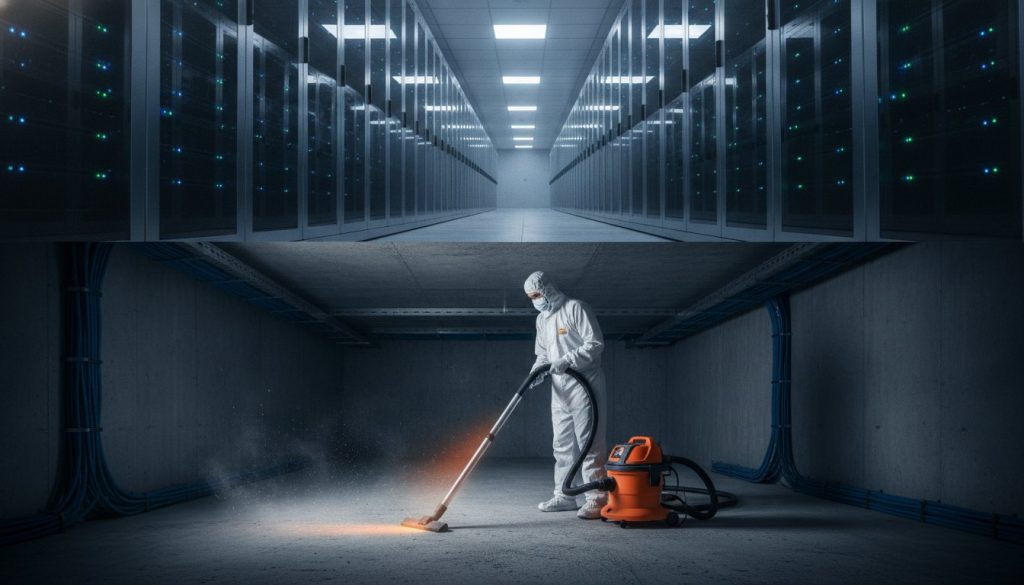
Leaving post-construction debris in your air plenum can reduce the operational lifespan of new IT equipment from seven years to just three. This 40% to 50% reduction in asset life is a direct consequence of bypassing professional sub-floor construction cleaning in favor of general janitorial services. As Malaysia expands its capacity with over 1,000 MW currently under construction, the risk of micro-contaminants like conductive ferrous metal particles and abrasive silica dust entering high-density AI cooling streams has never been higher.
You understand that a visual “broom-clean” finish is insufficient for a mission-critical environment. It’s a common frustration to see persistent concrete dust settling on sensitive components despite initial site handovers. This guide details the technical methodology and specialized HEPA filtration protocols required to achieve a pristine sub-floor void ready for airflow. You’ll discover how to align your facility with ISO 14644-1:2015 Class 8 standards and the newly published ISO 14644-13:2026 surface cleanliness requirements. We’ll preview the decontamination steps necessary to mitigate early equipment failure and ensure your infrastructure meets the rigorous handover expectations of hyperscale and enterprise operators across Southeast Asia.
Key Takeaways
- Understand why the underfloor plenum is the most critical airflow path and how residual construction debris can reduce IT equipment life by up to 50%.
- Identify specific micro-contaminants, including abrasive concrete dust and conductive metal shavings, that threaten new hardware during initial power-up.
- Learn the technical requirements for sub-floor construction cleaning to achieve ISO 14644-1 Class 8 compliance and validate results through particle count testing.
- Discover the professional methodology for underfloor decontamination, including the use of specialized triple-HEPA vacuum technology and strategic cleaning sequences.
- Determine the ideal timing for final cleaning to coordinate effectively with multiple trades and prevent re-contamination before facility commissioning.
Why Post-Construction Sub-Floor Cleaning is Mission-Critical
The sub-floor void in a mission-critical facility is frequently the most neglected area during the final stages of a build, yet it serves as the literal lung of the data hall. Professional sub-floor construction cleaning is an essential engineering safeguard rather than a simple janitorial task. While construction teams might consider a site “broom clean,” this surface-level approach fails to meet the ISO 14644 cleanroom standards necessary for hardware longevity. Construction dust acts as a silent killer. It remains dormant until the cooling system is energized, at which point it’s distributed throughout the facility, compromising new IT hardware before it even goes live.
The Sub-Floor as a Pressurized Air Plenum
In modern data centers, the sub-floor acts as a pressurized plenum that distributes chilled air to the server racks. This environment is designed for high-velocity airflow. If the plenum contains residual concrete dust, drywall micro-particles, or metal shavings, these contaminants don’t remain stationary. They’re picked up by the air stream and forced directly into the intake of server equipment. In high-density environments common across Malaysia and Singapore, even minor particulate bypass can compromise the efficiency of data center cleaning efforts conducted on the surface level later. Any debris left behind becomes a permanent threat to the operational environment.
Risks of Neglecting Post-Build Decontamination
Neglecting specialized sub-floor construction cleaning introduces several operational risks that manifest shortly after handover. Concrete dust is particularly hazardous because it’s highly abrasive and alkaline. When these particles enter high-speed fan bearings, they cause premature wear and eventual failure. Other critical risks include:
- Filter Saturation: CRAC and CRAH units will experience rapid HEPA filter loading. This leads to increased pressure drops and higher fan energy consumption.
- Thermal Hotspots: Heavy debris accumulation can obstruct airflow through perforated floor tiles. This creates localized hotspots that trigger server throttling or emergency shutdowns.
- Equipment Damage: Micro-contaminants can settle on circuit boards. This potentially causes electrical shorts or hinders heat dissipation through insulating layers of dust.
Beyond the immediate hardware risks, the financial impact of cooling inefficiencies is substantial. A contaminated plenum forces the cooling system to work harder to maintain temperature setpoints, driving up PUE and operational costs from day one. For facility operators in emerging hubs like Johor or Cyberjaya, ensuring this baseline cleanliness is vital for meeting the strict Service Level Agreements demanded by global hyperscalers. Strategic decontamination ensures that the facility begins its lifecycle at peak efficiency, protecting both the hardware and the bottom line.
Identifying Construction Contaminants in the Underfloor Void
The sub-floor void often accumulates a diverse array of debris that general contractors overlook. Effective sub-floor construction cleaning requires a forensic understanding of the materials left behind during the build phase. Common contaminants include abrasive silica from concrete, alkaline drywall dust, and organic fibers from packaging materials. Each of these poses a unique threat to the operational integrity of the server hall. For instance, chemical residues from floor sealants and adhesives can lead to outgassing; this compromises air quality long after the construction team has departed. Failing to address these specific pollutants increases the risks of non-compliance with ISO 14644-1, potentially voiding hardware warranties or leading to audit failures during commissioning.
The Danger of Conductive Particulates
Conductive debris represents the most immediate threat to IT hardware. Metal shavings generated during the installation of cable trays, racks, and floor pedestals are highly mobile in a pressurized environment. These fragments can bridge the tiny gaps between circuits on motherboards, causing micro-shorts that lead to intermittent failures or total system crashes. While modern facilities use better materials, the phenomenon of zinc whiskers remains a concern if electroplated steel components are used in the underfloor. These microscopic filaments can break off and circulate, causing catastrophic electrical faults. For facilities still utilizing spinning media, magnetic debris is particularly dangerous as it can cause head crashes or data corruption.
Micro-Dust and Air Quality
Micro-dust, classified as PM2.5 and PM10, is often invisible to the naked eye but highly destructive. Standard server intake filters are designed to capture larger particles; however, fine construction dust often bypasses these defenses. Once inside the chassis, these particles settle on hot components, creating an insulating layer that hinders heat dissipation. In a pressurized plenum, particulate distribution follows the path of least resistance, concentrating contaminants at the high-velocity discharge points of perforated floor tiles. This ensures that the most sensitive equipment receives the highest dose of contaminants if the void isn’t properly decontaminated. Understanding why specialized data center cleaning differs fundamentally from standard janitorial services is essential for any facility manager responsible for protecting mission-critical hardware.
To ensure your facility meets these rigorous standards, consider a professional data center cleaning assessment to identify hidden risks before your equipment is populated.
ISO 14644 Standards for Underfloor Construction Cleaning
Quantifying cleanliness in a mission-critical environment requires a shift from visual inspections to objective, standardized metrics. The international benchmark for this process is the ISO 14644 series. While general construction handovers often rely on a “broom clean” standard, professional sub-floor construction cleaning must align with ISO 14644-1 Class 8. This standard specifies the maximum allowable concentrations of airborne particles, ensuring that the environment is safe for sensitive IT hardware. In the pressurized environment of an underfloor plenum, adhering to these limits is the only way to guarantee that contaminants won’t be forced into server intakes during commissioning.
ISO Class 8 vs. Class 5: Setting Realistic Benchmarks
It’s vital for facility managers to distinguish between different ISO classifications to set achievable targets. ISO Class 5 is typically reserved for sterile pharmaceutical or semiconductor environments, requiring fewer than 3,520 particles of 0.5 microns per cubic meter. In contrast, ISO Class 8 allows for 3,520,000 particles of the same size. For most data centers in Malaysia and Singapore, Class 8 is the industry-accepted baseline recommended by ASHRAE. Achieving this in the plenum is more challenging than on the surface floor because the void traps heavy construction particulates. Utilizing Cleanroom Performance Testing (CPT) during the handover phase provides the empirical data needed to confirm that the sub-floor has reached these critical benchmarks.
Validating the Decontamination Process
Validation isn’t a one-time event but a structured technical process. We utilize calibrated laser particle counters to measure air quality at various points across the data hall, focusing specifically on the discharge air from the underfloor void. Surface sampling is equally important; it identifies settled dust that might become airborne once the cooling system reaches full operational pressure. DCS integrates these measurements into a comprehensive reporting framework through Specialized Engineering Testing. This documentation is essential for a successful facility handover, providing owners and hyperscale tenants with the assurance that the environment meets strict operational standards.
A successful ISO handover requires meticulous documentation of the cleaning sequence, the equipment used, and the final particle count results. These reports often serve as a prerequisite for hardware warranty validation. By treating the sub-floor as a controlled environment from the outset, facility operators can prevent the long-term operational risks associated with residual construction debris. If you are preparing for a facility launch in Johor or Cyberjaya, ensuring these standards are met today will protect your uptime for years to come. Facility managers seeking a structured approach to compliance documentation should reference a comprehensive data center ISO 14644 audit checklist to move beyond visual inspections and achieve verifiable contamination control.
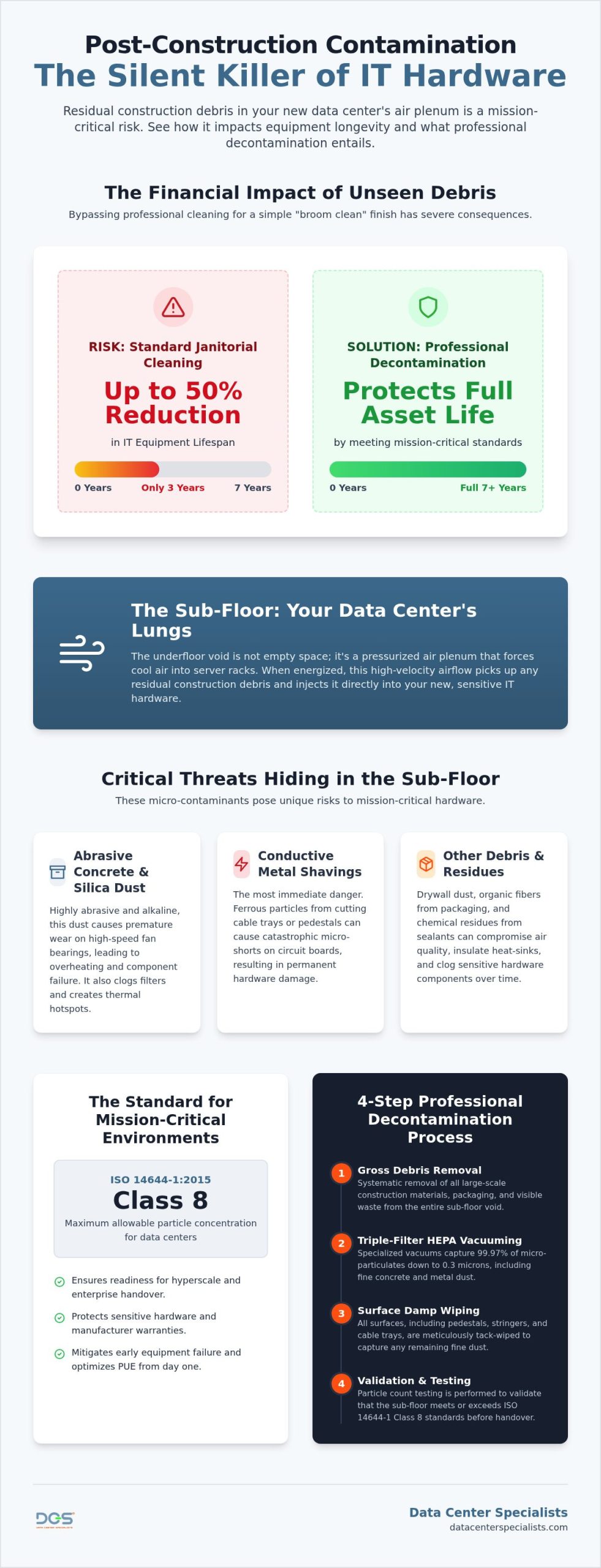
Professional Methodology for Sub-Floor Decontamination
Executing a rigorous sub-floor construction cleaning program requires a transition from general site cleanup to controlled environment decontamination. Standard janitorial tools, such as industrial brooms or basic shop vacuums, are prohibited in mission-critical voids. These tools often aerosolize micro-dust rather than capturing it. Instead, we utilize specialized triple-HEPA filtered vacuums, and in certain high-sensitivity applications, ULPA (Ultra-Low Penetration Air) options that trap 99.999% of particles down to 0.12 microns. All cleaning agents must be non-conductive, non-combustible, and low-VOC to ensure they don’t leave residues that could compromise electrical components or outgas into the airflow stream. Facility managers who want to validate this technical distinction for their stakeholders will find it useful to review the critical myths surrounding specialized data center cleaning that often lead organizations to underestimate the engineering rigor required.
Step-by-Step Underfloor Cleaning Process
Our methodology follows a disciplined sequence to ensure no area is missed and re-contamination is minimized. This process includes:
- Gross Debris Removal: Technicians perform bulk vacuuming of the concrete slab to remove larger construction waste, including drywall offcuts and excess sealant.
- Detailed Component Cleaning: We perform precision vacuuming of every pedestal, stringer, and cable tray. These structural elements often harbor hidden dust that the airflow will eventually dislodge.
- Damp Wiping: All non-porous underfloor surfaces are damp-wiped using microfiber cloths and specialized anti-static solutions. This neutralizes static charges that attract and hold micro-particulates.
- Encapsulation: If the concrete slab is unsealed, we apply a technical-grade sealer to prevent “dusting,” where the concrete itself sheds particles over time under high-velocity air pressure.
Safety is a non-negotiable priority during these operations. Technicians wear full PPE, including anti-static coveralls and respiratory protection. For deep or complex voids, we implement strict confined space protocols to ensure personnel safety while maintaining the integrity of the plenum.
Managing Airflow During Cleaning
Controlling air movement is critical to prevent cross-contamination between clean and dirty zones. During the construction phase, we often employ negative air machines to ensure that any dust disturbed during cleaning is captured and filtered rather than migrating into the upper data hall. This process must be carefully coordinated with HVAC System Commissioning teams. Timing the final clean just before the cooling systems are energized ensures that the first breath of air the facility takes is pristine. If you’re managing a facility handover in Cyberjaya or Johor, a strategic decontamination partner is vital for operational readiness.
Protect your mission-critical infrastructure by engaging specialists who understand the engineering requirements of the plenum. Contact us for a professional data center cleaning assessment to ensure your sub-floor is ready for commissioning.
Integrating Cleaning into the Data Center Handover
The successful commissioning of a mission-critical facility depends on precise timing. We identify the “Goldilocks” zone for sub-floor construction cleaning as the window immediately following the completion of heavy mechanical and electrical (M&E) works but prior to the unboxing of sensitive IT equipment. Executing the clean too early risks re-contamination from lagging trades; waiting too long allows the cooling system to distribute construction particulates into the server racks. Coordinating with multiple contractors is essential to ensure that once the plenum is decontaminated, it remains in a controlled state until the facility is operational.
The Post-Clean Lockdown Protocol
Once the sub-floor has achieved its ISO certification, the environment must transition into a strict lockdown phase. We recommend restricting access to essential personnel only. All entry points should be equipped with multi-layered sticky mats to capture sole-borne particulates. Personnel entering the white space must utilize shoe covers and adhere to cleanroom-lite protocols. Facility managers should conduct a final visual inspection and formal sign-off only after these controls are in place. This disciplined approach ensures that the investment in high-level decontamination isn’t undermined by foot traffic or incidental debris during the final days of the build.
Transitioning to Operations
A pristine sub-floor void is the foundation for operational efficiency. Removing construction-related resistance in the plenum allows for more accurate initial Data Center Energy Assessments. When the air path is clear, fan speeds can be optimized and PUE benchmarks established with greater precision. This clean environment is also a prerequisite for the installation of high-density infrastructure like DCS Smart Racks, which rely on unobstructed underfloor airflow for peak performance. To ensure every step of the transition is managed correctly, facility operators should follow the Post-Construction Data Center Cleaning: The ISO Handover Checklist for a comprehensive process overview.
The handover is not the end of the cleanliness journey but the beginning of a strategic Data Center Maintenance schedule. DCS views the transition from construction to operations as a critical bridge where engineering expertise meets facility management. By establishing a baseline of ISO-standard cleanliness from day one, operators in hubs like Cyberjaya and Johor can ensure long-term reliability and equipment health. Our approach prioritizes this continuity, ensuring your facility moves from a construction site to a world-class data hall without the hidden risks of underfloor contamination.
Securing Your Infrastructure for Day-One Operational Readiness
The transition from a construction site to a live data hall is the most vulnerable period for your mission-critical IT assets. Residual concrete dust, alkaline drywall particles, and conductive metal shavings left in the plenum are direct threats to uptime and hardware warranties. Implementing a rigorous sub-floor construction cleaning program ensures that your pressurized air plenum delivers cooling rather than contaminants to your server intakes. By adhering to ISO 14644-1 Class 8 standards before commissioning, you eliminate the “silent killers” that cause premature fan failure and thermal hotspots.
As ISO 14644-1 compliance experts, we provide the specialized critical environment equipment and technical methodology required to meet the stringent handover standards of global hyperscalers. With Malaysia-wide technical support, our team acts as your strategic partner in verifying facility readiness through empirical particle count testing and professional decontamination. Contact Data Center Specialists for a Professional Sub-Floor Assessment to protect your infrastructure investment. We’re ready to help you bridge the gap between construction completion and long-term operational success with precision and technical authority.
Frequently Asked Questions
How soon after construction should sub-floor cleaning be performed?
Sub-floor construction cleaning should be performed during the final handover phase. This is the period after all heavy mechanical and electrical trades have finished their work but before IT hardware is unboxed. Cleaning too early allows other trades to re-contaminate the void. Cleaning too late means the cooling system will distribute particulates into the servers during initial power-up. This strategic timing ensures the plenum is pristine for the facility’s first breath.
Can we use our regular janitorial staff for sub-floor construction cleaning?
You shouldn’t use general janitorial staff for this specialized task. Standard cleaning crews lack the HEPA-filtered vacuum technology and technical training required for mission-critical environments. Using industrial brooms or non-certified vacuums often aerosolizes micro-dust rather than capturing it. Professional sub-floor construction cleaning requires a forensic approach to identify conductive metal shavings and abrasive silica. It’s an engineering safeguard that protects your infrastructure investment, not a surface-level aesthetic task.
What is the specific ISO standard for data center underfloor voids?
The primary benchmark is ISO 14644-1:2015 Class 8, which defines the allowable airborne particle concentrations. This standard was confirmed in 2021 and is the baseline recommended by ASHRAE for data halls. Additionally, the new ISO 14644-13:2026 standard provides specific requirements for surface cleanliness. Adhering to these ensures your facility in Malaysia meets the strict environmental requirements demanded by global hyperscalers and validates equipment warranties from major hardware manufacturers.
What happens if we skip sub-floor cleaning before commissioning?
Skipping this step can reduce the operational lifespan of your IT equipment by 40% to 50%. Construction debris like concrete dust is highly abrasive and damages high-speed fan bearings. Conductive metal shavings can cause micro-shorts on motherboards, leading to intermittent failures or total system crashes. Additionally, residual waste clogs air filters and creates thermal hotspots, which forces your cooling system to work harder and drives up energy costs from day one.
Does sub-floor cleaning include the cable trays and pedestals?
Yes, a professional clean must include every structural element within the void. Micro-dust settles on pedestals, stringers, and cable trays during the build process. If these aren’t vacuumed and wiped with anti-static solutions, the high-velocity air from the cooling system will eventually dislodge them. Our methodology ensures that all underfloor components are decontaminated to prevent them from becoming a source of ongoing particulate bypass once the facility goes live.
How do you verify that the sub-floor is actually clean enough for servers?
Verification is conducted through Cleanroom Performance Testing (CPT) using calibrated laser particle counters. These devices measure the concentration of airborne particles at various sizes, such as 0.5 microns. We also perform surface sampling to check for settled dust that might become mobile under operational air pressure. This empirical data is compiled into a technical report that validates the environment meets ISO Class 8 standards, providing facility managers with objective proof of cleanliness.
Is concrete slab sealing necessary after construction cleaning?
Sealing the concrete slab is often a critical final step in the decontamination process. Unsealed concrete can shed microscopic particles over time, a phenomenon known as “dusting,” particularly when exposed to high-velocity air in a pressurized plenum. Applying a technical-grade, non-combustible sealer encapsulates the slab. This creates a durable finish that prevents the concrete from becoming a source of ongoing contamination, ensuring the air quality remains stable throughout the facility’s lifecycle.
How does sub-floor debris affect data center energy efficiency?
Underfloor debris significantly degrades energy efficiency by obstructing the intended airflow paths. Large waste items can block air distribution, while micro-dust clogs the filters in CRAC and CRAH units. This increases the pressure drop across the system, forcing fans to spin faster and consume more power to maintain temperature setpoints. A clean plenum reduces this resistance, allowing for lower fan speeds and a more favorable Power Usage Effectiveness (PUE) rating.