
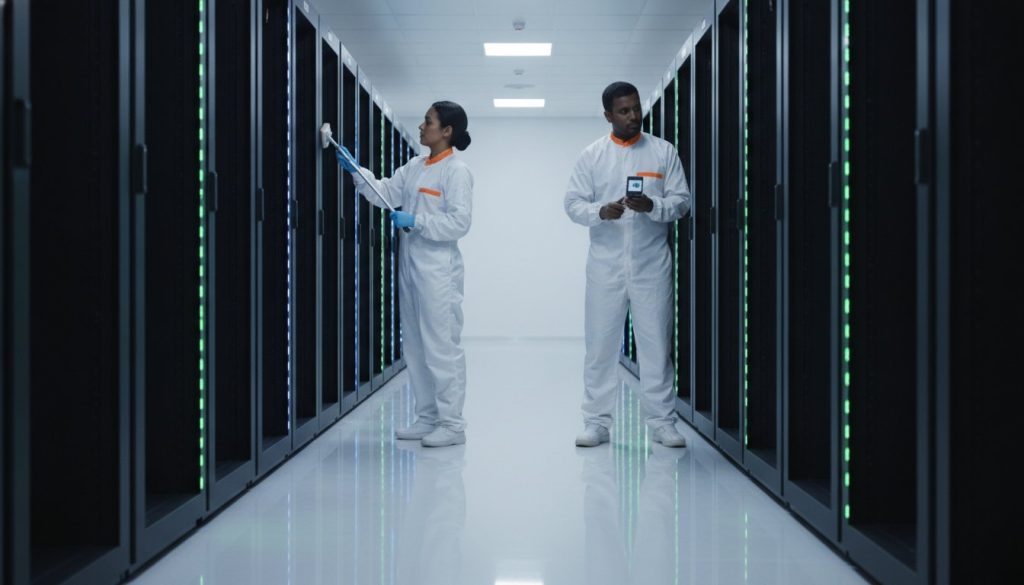
Would you risk RM100 million in mission-critical hardware on a facility that only looks clean to the naked eye? For facility managers in Malaysia’s booming data center sector, the gap between “broom clean” and ISO-certified is where catastrophic hardware failure begins. You’ve likely felt the pressure of a looming handover deadline while worrying that construction dust remains trapped under the raised floor or within the cooling vents. Relying on a standard janitorial crew for this stage isn’t just a risk; it’s a violation of the rigorous data center cleaning specifications required to maintain your IT warranties and operational uptime.
We understand that achieving a certified clean environment is a non-negotiable milestone for your 2026 project. This guide provides the technical roadmap you need to master ISO 14644-1:2015 particle concentration limits and the latest ISO 14644-13:2026 surface cleanliness standards. You’ll learn how to navigate the post-construction transition with precision, ensuring your facility moves from a dusty build site to a live, high-availability environment without compromising hardware integrity. We will examine the specific particle counts for ISO Class 8 handovers and the specialized methodology required to secure a seamless transition for your mission-critical infrastructure.
Key Takeaways
- Identify the “silent killers” in post-construction environments, including sub-micron gypsum and silica particles that compromise server fan longevity and heat dissipation.
- Master the 3-Zone decontamination strategy designed to establish a sterile white space perimeter and prevent re-contamination during the critical handover phase.
- Apply technical data center cleaning specifications to validate compliance with ISO 14644-1 Class 8 standards and the emerging Class 5 hyperscale benchmarks for 2026.
- Learn how professional contamination control improves cooling efficiency and ensures the factual integrity of your initial Data Center Energy Assessment.
- Align post-construction cleaning milestones with your facility commissioning timeline to protect hardware warranties and ensure a seamless transition to live operations.
The Risks of Construction Debris in Mission-Critical Sites
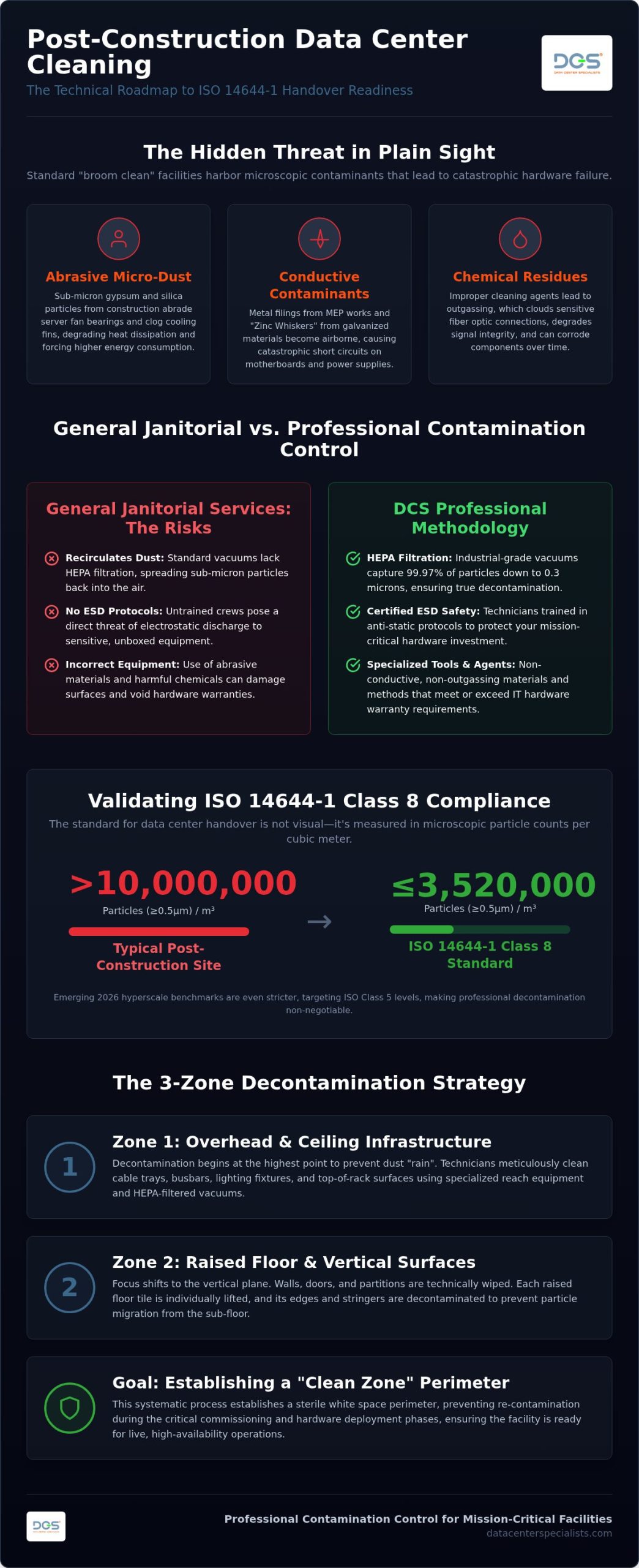
Post-construction environments are inherently hostile to sensitive IT hardware. While a floor may look clean to the naked eye, the sub-micron particulates left behind by MEP (Mechanical, Electrical, and Plumbing) works are the true silent killers of uptime. Gypsum dust from drywall finishing, silica from concrete drilling, and conductive metal filings from conduit installation settle into the smallest crevices of the facility. These contaminants don’t just sit there; they become airborne the moment the cooling systems are energized. Failing to follow technical data center cleaning specifications creates a direct correlation between post-build contamination and premature hardware failure within the first 18 months of operation.
Micro-Dust and High-Density Cooling Challenges
Modern facilities in Malaysia, especially those supporting generative AI workloads, utilize high-density cooling with tightly packed fins and high-efficiency coils. Fine particulates clog these systems, forcing server fans to spin at higher RPMs and significantly degrading heat dissipation across the aisle. There’s also the persistent threat of “Zinc Whiskers.” These are microscopic filaments that grow from galvanized construction materials and subfloor pedestals, which can break off and cause catastrophic short circuits on motherboards. Adhering to the ISO 14644 Standard ensures that these risks are quantified and mitigated before equipment deployment. In 2026 high-density environments, micro-dust accumulation acts as a thermal insulator that creates localized server hotspots and triggers premature thermal throttling.
Why General Janitorial Services Fail Data Centers
Entrusting a mission-critical site to a standard office cleaning crew is a significant operational liability. General janitorial equipment lacks the specialized HEPA filtration required to trap sub-micron debris. Standard vacuums often recirculate these particles back into the atmosphere, worsening the air quality. Professional data center cleaning requires industrial-grade equipment that captures particles down to 0.3 microns at 99.97% efficiency. Improper cleaning agents also lead to chemical outgassing, which clouds sensitive fiber optic connections and degrades signal integrity over time. Most crucially, general crews lack training in anti-static (ESD) protocols, posing a direct threat to unboxed equipment. Without strict data center cleaning specifications, you risk introducing more contamination than you remove, potentially voiding hardware warranties before the site even goes live.
The 3-Zone Post-Construction Decontamination Checklist
Transitioning a facility from a construction site to a live data hall requires more than a standard sweep. It demands a systematic 3-Zone strategy that establishes a “Clean Zone” perimeter to prevent re-contamination during the delicate handover phase. High-performance HEPA-filtered vacuuming is the cornerstone of this process; it removes 99.97% of construction particulates that standard equipment simply recirculates. By shifting from “Rough Clean” protocols to “Technical ISO Clean” standards, you ensure the facility is ready for pre-commissioning. Adhering to strict data center cleaning specifications ensures that every cubic meter of air meets the required purity levels defined by the IEST ISO 14644 Standards.
Zone 1: Overhead and Ceiling Infrastructure
Gravity is the primary enemy of uptime during handover. Decontamination must begin at the highest point to prevent dust “rain” from settling on newly installed IT equipment later in the process. Technicians must clean cable trays, busbars, and lighting fixtures using specialized reach equipment. We give specific attention to decontaminating top-of-rack surfaces and overhead DCS Smart Modular Containment structures. Every HEPA filter housing and air supply diffuser is inspected and cleaned to ensure that the initial airflow remains pristine and free of construction-era debris.
Zone 2: The Raised Floor and Vertical Surfaces
Once the ceiling is secure, focus shifts to the vertical plane. Technicians perform technical wiping of walls, doors, and glass partitions using lint-free microfibers and high-purity solutions. Before equipment mounting, we clean server rack exteriors and internal rails, including the preparation for DCS Smart Racks installation. The final step in this zone involves specialized anti-static floor cleaning. This process maintains the essential ESD dissipative properties of the raised floor tiles, which is critical for protecting sensitive components from static discharge during the first equipment rack-and-stack.
Zone 3: The Subfloor Plenum and Voids
The subfloor is the most critical area for facilities utilizing underfloor air distribution (UFAD). We begin by removing heavy construction debris, such as screws, wire clippings, and concrete chunks, which can damage cooling units if ingested. HEPA vacuuming the concrete slabs is vital to prevent particulate bypass into the cooling airflow. We also recommend sealing the subfloor concrete to prevent future “dusting” and ongoing particle release. For a detailed technical breakdown of the protocols involved, our guide on sub-floor construction cleaning and decontaminating the data center plenum outlines the specialized HEPA filtration methodology required to achieve a pristine air void. If you’re managing a new build in Malaysia, engaging professional contamination control specialists is the only way to guarantee these zones meet the data center cleaning specifications required for a successful ISO handover.
Validating ISO 14644-1 Compliance for Handover
ISO 14644-1:2015 serves as the global benchmark for classifying air cleanliness by particle concentration. For a successful facility handover, facility managers must verify that the site meets rigorous data center cleaning specifications through empirical testing. While ISO Class 8 was historically the industry baseline, ISO Class 5 is rapidly becoming the 2026 hyperscale benchmark in Malaysia. This stricter standard is necessary to protect the ultra-sensitive components found in modern high-density AI and liquid-cooled infrastructure. Validation isn’t a mere formality; it’s a technical requirement that ensures the environment is safe for multi-million ringgit IT investments.
Achieving this validation requires independent Cleanroom Performance Testing (CPT). This process documents the facility in two critical states: “As-Built” (construction is finished and all services are connected) and “At-Rest” (equipment is installed but not yet operational). These snapshots provide a baseline for future maintenance and serve as essential documentation for hardware warranty claims. If a server fails prematurely, these records prove the environment was within spec at the point of deployment. Facility managers seeking to understand the full scope of testing protocols and vendor selection criteria should consult a dedicated cleanroom performance testing Malaysia buying guide to ensure they are commissioning the right specialist for their ISO audit requirements.
Particle Count Testing Procedures
Testing begins with the use of calibrated laser particle counters to measure concentrations of 0.5μm and 5.0μm particulates per cubic meter. The number of sampling points isn’t arbitrary; it’s determined by the total square footage of the data hall and specific ISO requirements to ensure statistical accuracy. While ISO Class 8 permits up to 3,520,000 particles of 0.5μm per cubic meter, the 2026 hyperscale benchmark of ISO Class 5 restricts that concentration to just 3,520 particles to protect ultra-sensitive AI hardware. Technicians must map these points carefully to identify any “dead zones” where air might be stagnating and accumulating debris.
Handover Certification and Reporting
A professional ISO cleaning report provides the technical evidence required by IT hardware vendors to honor their performance guarantees. This documentation must be integrated with Testing, Adjusting & Balancing (TAB) results to confirm that the cooling system is providing clean, balanced airflow as designed. Once certification is achieved, facility operators must maintain a strict “Chain of Cleanliness.” This involves limiting access to the white space and enforcing gowning protocols until the first IT equipment arrives. Adhering to these data center cleaning specifications ensures that your transition from construction to live operations is both seamless and technically sound.
Operational Readiness: Beyond the Cleaning Process
Achieving the required data center cleaning specifications isn’t an isolated task; it’s a critical dependency for the entire facility commissioning timeline. If you perform load bank testing or thermal mapping in a hall contaminated with construction residue, your baseline data will be fundamentally flawed. Fine dust acts as a thermal insulator on heat sinks and sensors, leading to inaccurate temperature readings that haunt your operations for years. This is particularly vital for your initial Data Center Energy Assessment. Cleanliness ensures that your Power Usage Effectiveness (PUE) and cooling efficiency metrics reflect the true capability of the design, rather than the temporary resistance caused by clogged grilles or dusty coils.
Establishing an “At-Rest” performance baseline requires an environment that is technically sterile. Ongoing contamination control protocols must be drafted during this phase to ensure the transition to a live production environment doesn’t degrade the air quality achieved during the handover. A comprehensive approach to data center contamination prevention must be embedded into your operational procedures from day one, ensuring that the sterile baseline established during handover is actively maintained as equipment is deployed and the facility scales toward full capacity. By integrating professional decontamination into the broader engineering schedule, you protect mission-critical infrastructure from the moment it’s unboxed. This methodical approach ensures that your facility is not just visually clean, but operationally ready for the high-availability demands of 2026 workloads.
Airflow Optimization Post-Cleanup
Once professional decontamination is complete, technical teams must verify that all perforated tiles and air distribution grilles are completely free of microscopic obstructions. Even a thin layer of gypsum dust on a floor tile can alter static pressure within the plenum, forcing CRAC and CRAH units to consume more energy to maintain the required airflow. Removing construction obstructions allows for the validation of ASHRAE-compliant airflow patterns. This stage ensures that when you transition to live operations, the cooling system operates at the peak efficiency levels promised during the design phase. It’s the only way to verify that your airflow management strategy is functioning without the interference of construction-era debris.
ESD and Safety Compliance
Operational readiness also depends on the physical safety and electrical integrity of the environment. After post-construction chemical application, it’s essential to test floor-to-ground resistance to ensure the raised floor retains its electrostatic dissipative (ESD) properties. Standard cleaning agents often leave a residue that insulates the floor, potentially leading to static buildup that endangers sensitive IT components. Technicians must also conduct a final “white glove” walkthrough to ensure that emergency exits and safety signage are decontaminated and clearly visible. This meticulous attention to detail identifies any remaining construction snags that could impede the operations team. For facilities in Malaysia, ensure your operational baseline is built on a certified clean environment by contacting our team for a comprehensive Data Center Facility Assessment to validate your site’s readiness.
DCS: Your Partner for Professional ISO Handover
DCS bridges the critical gap between construction completion and operational readiness. We don’t just clean; we engineer a sterile environment. Our team combines deep mission-critical engineering knowledge with specialized contamination control expertise to ensure your facility meets the most stringent data center cleaning specifications. With national service coverage across Malaysia, we support hyperscale, financial, and enterprise projects from their final build stages through to live operations. This engineering-led approach is why leading financial institutions trust DCS to protect their high-stakes infrastructure during the delicate transition from a construction site to a secure data hall.
Our involvement doesn’t end at the handover. We provide a seamless transition from post-construction decontamination to a structured Data Center Maintenance program. This continuity ensures that the ISO-certified environment we establish is preserved throughout the facility’s lifecycle. By acting as a strategic partner rather than a mere vendor, we help facility managers mitigate the long-term risks of latent construction debris and airborne particulates that often lead to early hardware failure.
The DCS Technical Handover Protocol
The DCS protocol is designed for transparency and technical accuracy. We provide comprehensive reporting for all stakeholders, including detailed particle counts and Cleanroom Performance Testing (CPT) validation. Our services are often integrated with the installation of DCS Smart Racks and modular containment systems, ensuring that every component is decontaminated before it’s even bolted to the floor. We customize our data center cleaning specifications based on your specific ISO target class, whether you require the standard Class 8 or the 2026 hyperscale benchmark of Class 5. Every square meter of the white space is validated against these metrics to guarantee that your environment is safe for the deployment of high-density IT hardware.
Next Steps for Your Facility
Early coordination is the key to a successful technical handover. We recommend scheduling a site audit during the final stages of MEP construction, allowing us to identify potential contamination risks before they become operational hazards. Our team works directly with general contractors to establish a seamless technical cleaning window that doesn’t disrupt your commissioning timeline. This proactive engagement ensures that all zones, from the subfloor plenum to the overhead busbars, are sterile and ready for hardware arrival. Don’t leave your hardware warranty to chance with a general cleaning crew. Contact Data Center Specialists for a professional ISO handover audit to ensure your facility meets the highest standards of technical cleanliness and operational readiness.
Securing Your Operational Future with Technical Precision
Transitioning from a construction site to a live, high-availability data hall is a high-stakes engineering milestone. The presence of sub-micron particulates like gypsum and silica poses a direct threat to hardware longevity and cooling efficiency. Adhering to technical data center cleaning specifications is the only way to validate compliance with ISO 14644-1 and protect your multi-million ringgit IT investment. By implementing a systematic 3-Zone decontamination strategy and performing independent Cleanroom Performance Testing, you establish a sterile baseline that ensures operational readiness and warranty protection.
Data Center Specialists (M) Sdn Bhd (DCS) serves as the guardian of your technical environment throughout this critical transition. Our ISO 14644-1 certified specialists provide national Malaysia coverage with deep expertise in hyperscale and enterprise environments. We ensure your facility doesn’t just look clean but is technically sterile and ready for 2026 workloads. Secure Your ISO Handover with DCS Professional Cleaning and move forward with the confidence that your facility is built for unwavering reliability.
Frequently Asked Questions
What is the difference between post-construction cleaning and regular data center cleaning?
Post-construction cleaning focuses on removing heavy industrial contaminants like gypsum, silica, and metal filings left by MEP contractors. Regular data center cleaning specifications prioritize controlling airborne particulates and organic matter in a live environment. The post-construction phase is a one-time, deep decontamination process designed to establish the facility’s “As-Built” baseline. It requires industrial-grade HEPA filtration and technical wiping of every surface from the ceiling busbars to the concrete subfloor plenum.
How soon after construction should the ISO cleaning take place?
Technical decontamination should occur immediately after all construction and MEP works are finalized but before any IT hardware is unboxed. Ideally, you should schedule this during the facility commissioning phase. This timing ensures that the first time your cooling units are energized, they aren’t recirculating construction dust into the white space. Performing the clean too early risks re-contamination from late-stage snags; performing it too late risks damaging sensitive equipment.
Is ISO 14644-1 Class 8 mandatory for all data center handovers in 2026?
ISO Class 8 remains the minimum industry requirement for standard enterprise facilities in Malaysia. However, 2026 hyperscale projects and AI-driven data halls are increasingly mandating ISO Class 5 air purity. These higher data center cleaning specifications are necessary to protect the high-density cooling coils and ultra-sensitive optics found in modern infrastructure. Always verify your specific IT hardware vendor’s warranty requirements, as some now demand stricter particle concentration limits than the traditional Class 8 baseline.
Can construction dust actually void my server hardware warranty?
Construction dust is a primary cause of denied warranty claims. Particulates like silica and gypsum are abrasive and can cause premature bearing failure in server fans. Conductive metal filings can lead to catastrophic short circuits on motherboards. IT vendors often require proof of ISO 14644-1 compliance at the point of handover. If your facility isn’t certified clean, vendors can argue that the environmental conditions led to the hardware failure, potentially voiding RM millions in coverage.
Do I need to clean the subfloor if it won’t be used for cooling airflow?
Subfloor decontamination is essential regardless of your cooling strategy. Even in facilities without underfloor air distribution, vibrations from cooling units and personnel movement can cause concrete “dusting” and the release of trapped debris. These particles eventually migrate into the server hall and settle on sensitive components. Cleaning the subfloor plenum and sealing the concrete protects your environment from long-term contamination and prevents the growth of “Zinc Whiskers” from galvanized hardware. Our detailed resource on sub-floor construction cleaning for data center plenums explains how conductive ferrous particles and abrasive silica dust in the void can reduce IT equipment lifespan by 40% to 50%.
How long does a professional post-construction data center clean typically take?
The duration depends on the facility size and the level of construction residue. A standard enterprise data hall typically requires 3 to 7 days for a comprehensive 3-Zone decontamination. Hyperscale sites often require a phased approach over several weeks to align with the staggered handover of different data halls. DCS works with your general contractor to establish a methodical cleaning window that ensures technical accuracy without delaying your live operational date.
Does DCS provide ISO certification reports after the cleaning is completed?
DCS provides comprehensive technical documentation after every project. This includes detailed particle count results and Cleanroom Performance Testing (CPT) validation as part of the data center cleaning specifications. These reports serve as the official “At-Rest” baseline for your facility. You’ll need this documentation to satisfy internal audit requirements and to provide IT hardware vendors with evidence that the environment meets their specific operational and warranty standards.
What happens if the facility fails the initial particle count test after cleaning?
If a facility fails the initial particle count test, our technicians investigate the source of the contamination. We identify whether the issue is localized to a specific zone or caused by external factors like poor HVAC filtration or inadequate perimeter sealing. We then re-clean the affected area and perform a follow-up test to ensure compliance. This iterative process guarantees that your facility doesn’t transition to live operations until it meets the required ISO purity levels.