
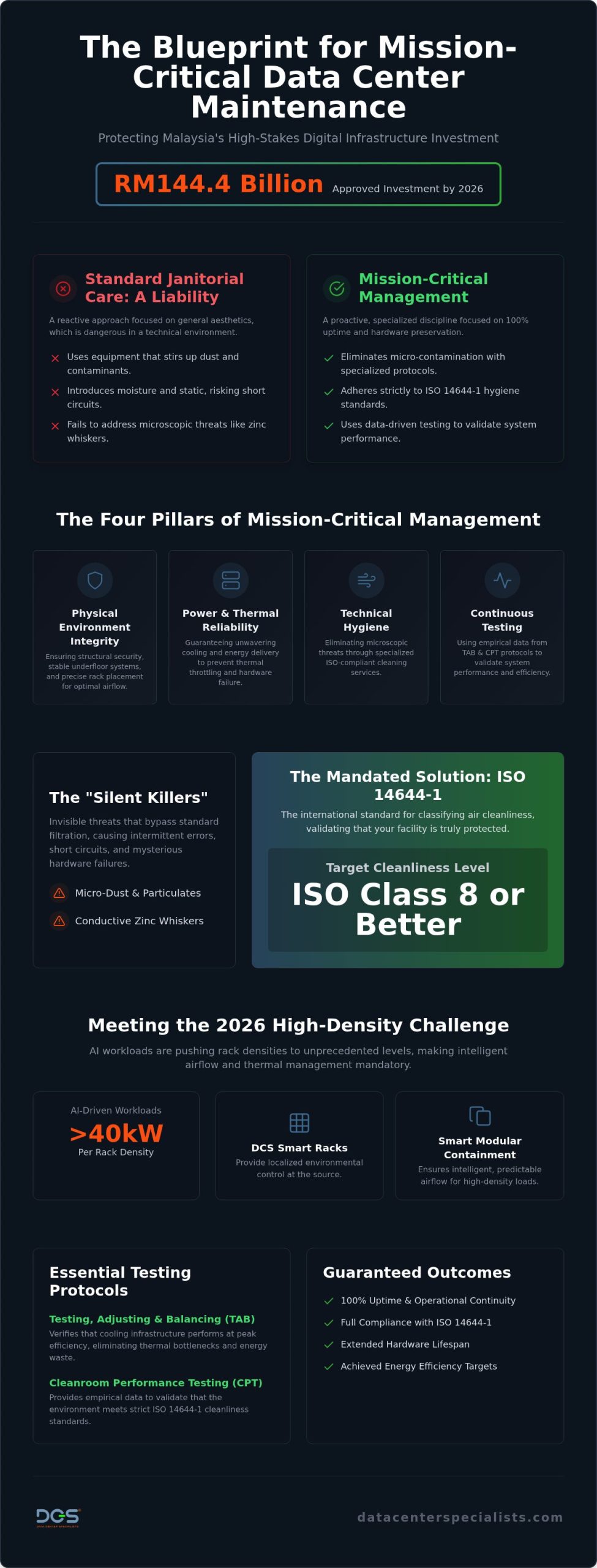
With RM144.4 billion in approved data center investments flowing into Malaysia through 2026, the stakes for data center preventative maintenance services have reached an all-time high. You understand that even the most robust cooling systems can’t protect against the silent threat of micro-contamination. These microscopic particles often bypass standard filtration, settling on sensitive circuitry and causing hardware failure that traditional monitoring misses. It’s a high-stakes environment where standard janitorial care is a liability rather than a solution.
This article empowers you to master the technical requirements and specialized protocols essential for infrastructure protection. You’ll learn how to implement a rigorous framework that ensures 100% uptime and full compliance with ISO 14644-1 standards. We’ll explore the critical intersection of professional contamination control, Testing, Adjusting & Balancing (TAB), and Cleanroom Performance Testing (CPT). By the end of this guide, you’ll have a clear roadmap to extend hardware lifespan and meet your facility’s energy efficiency targets with meticulous precision.
Key Takeaways
- Establish the critical distinction between standard facility care and mission-critical management to protect your organization’s most essential IT assets.
- Identify the specialized protocols required to eliminate micro-contamination and zinc whiskers through strict adherence to ISO 14644-1 hygiene standards.
- Master the technical application of Testing, Adjusting & Balancing (TAB) and Cleanroom Performance Testing (CPT) to ensure your cooling infrastructure performs at peak efficiency.
- Explore how integrating DCS Smart Racks and DCS Smart Modular Containment provides the intelligent airflow control necessary for high-density 2026 environments.
- Gain a framework for evaluating specialized vendors in Malaysia to secure reliable data center preventative maintenance services that guarantee long-term operational continuity.
Defining Mission Critical Facility Management and Its Core Pillars
Mission-critical facility management is the specialized discipline of ensuring 100% availability for essential IT services. While traditional commercial property management focuses on tenant comfort and general building aesthetics, mission-critical operations prioritize the continuous survival of hardware and data. In a Mission Critical environment, there’s no margin for error. A single second of downtime can trigger catastrophic financial losses or permanent data corruption. This high-stakes reality requires a shift from general maintenance to a specialized technical standard.
To maintain such rigorous uptime, facility leaders must adhere to four core pillars. Physical Environment Integrity ensures the structural shell remains secure and optimized. Power and Thermal Reliability guarantees that cooling and energy delivery never waver. Technical Hygiene focuses on the elimination of microscopic contaminants through a Data Center Professional ISO Cleaning Service. Finally, Continuous Testing provides the empirical data needed to validate system performance. Adopting a “protective guardian” mindset is essential for modern hyperscalers and financial institutions. It’s about proactive preservation rather than reactive repair.
Effective data center preventative maintenance services are built on this meticulous approach. This proactive strategy is the hallmark of professional data center preventative maintenance services in Malaysia, where the digital economy demands unwavering reliability.
The Evolution of Data Center Facility Management in 2026
The industry landscape has shifted dramatically. In 2026, the surge in AI-driven workloads has pushed rack densities to unprecedented levels, often exceeding 40kW per rack. This evolution has made liquid cooling and high-efficiency thermal management mandatory. These environments are hypersensitive to micro-contamination. Even invisible particles can settle on high-performance GPUs, causing thermal throttling or silent hardware failure. Strategic partners are now essential to help operators manage these complex infrastructure challenges with precision.
Why Uptime Starts with the Physical Environment
Operational reliability begins with the physical foundation. Structural integrity, including the stability of underfloor systems and the precision of server rack placement, impacts airflow dynamics. Technical infrastructure solutions, such as DCS Smart Racks, act as a proactive defense mechanism by providing localized environmental control. Additionally, regular facility health checks must include a Data Center Energy Assessment. This process identifies thermal bottlenecks and energy waste, ensuring the facility remains both efficient and resilient. High-stakes environments can’t afford to overlook these physical prerequisites.
The Invisible Threat: Contamination Control and ISO 14644-1 Standards
In the high-stakes environment of a mission-critical facility, the most dangerous threats are often invisible to the naked eye. Micro-dust and zinc whiskers represent the primary “silent killers” of modern server hardware. Zinc whiskers, microscopic filaments that grow from galvanized metal surfaces, are particularly hazardous because they are conductive. When these filaments break free and enter the airflow, they can cause short circuits on motherboards and power supplies. Unlike a catastrophic power failure, these contaminants cause intermittent errors and mysterious reboots that are difficult to diagnose. This makes specialized data center preventative maintenance services a baseline requirement for operational stability.
Adherence to the ISO 14644-1:2015 standard is the only way to validate that your environment is truly clean. This international standard classifies air cleanliness based on particle concentration per cubic meter. For most data centers, achieving an ISO Class 8 or better is the target. Standard janitorial services are insufficient and dangerous for these environments. Traditional cleaning crews often use equipment that stirs up dust or introduces moisture and static. Professional decontamination requires specialized knowledge of airflow dynamics and the chemical properties of technical surfaces.
Protecting your infrastructure requires a disciplined approach to technical hygiene. If you are concerned about your current facility’s particle levels, engaging an expert for a Data Center Professional ISO Cleaning Service is the most effective way to mitigate these risks.
The Data Center Professional ISO Cleaning Service
Technical methodology is what separates a professional service from a general cleaning crew. We utilize specialized HEPA-filtered vacuums capable of capturing particles as small as 0.3 microns with 99.97% efficiency. Every surface, from the tops of server cabinets to the internal cable trays, is treated with anti-static materials to prevent electrostatic discharge (ESD). This meticulous process significantly reduces the risk of intermittent hardware errors and ensures that cooling fans don’t become clogged with abrasive debris. It’s a precise operation designed to safeguard the delicate circuitry of your 2026 infrastructure.
Contamination Control Strategies for Raised Floors
The underfloor plenum serves as the primary artery for cold air distribution. When debris, construction dust, or abandoned cabling accumulate under the tiles, airflow performance drops. This creates turbulence and forces cooling units to work harder, driving up energy costs. Professional underfloor cleaning involves a systematic removal of floor tiles, followed by deep vacuuming of the concrete sub-floor and wiping of all accessible conduits. Micro-dust accumulation within the chassis leads to “silent” hardware failure in high-density racks by creating conductive paths and thermal hotspots that monitoring software cannot immediately detect. Maintaining a sterile plenum is essential for data center preventative maintenance services that prioritize long-term hardware health.
Technical Testing Protocols: TAB and CPT for Operational Excellence
Empirical data is the only reliable metric for infrastructure health. While professional cleaning mitigates surface-level and microscopic threats, technical testing protocols provide the validation required for 100% availability. These rigorous procedures are the backbone of advanced data center preventative maintenance services, moving beyond visual inspections to provide scientific proof of system performance. In the high-stakes environment of 2026, you can’t afford to rely on guesswork or outdated design assumptions.
Testing, Adjusting & Balancing (TAB) Services
Testing, Adjusting & Balancing (TAB) is the foundation of efficient thermal management. This disciplined process involves measuring and calibrating the airflow and hydronic systems to meet precise design specifications. In Malaysia’s high-humidity environment, even minor deviations in cooling performance can lead to excessive condensation or inadequate heat rejection. Air balancing reduces energy waste by ensuring that conditioned air reaches the server inlets rather than leaking into the plenum. This optimization is critical for improving PUE and managing the extreme heat loads of high-density racks that are now standard in AI-driven facilities.
Cleanroom Performance Testing (CPT) and Certification
Cleanroom Performance Testing (CPT) provides the final layer of mission-critical validation. It encompasses a suite of tests including particle counting, airflow velocity profiles, and room pressure differentials to ensure the environment stays within ISO-standard limits. These tests aren’t merely administrative; they are a protective barrier for your hardware. Particle count testing is mandatory for the health of high-performance IT equipment to prevent the accumulation of conductive debris that leads to silent hardware failure. By verifying that your facility meets these international standards, you gain the peace of mind that comes from meticulous environmental control.
To maintain this level of precision, facility managers must look deeper than the dashboard. A thorough data center energy assessment identifies infrastructure bottlenecks that testing alone won’t uncover. This integrated approach ensures that every component of your data center preventative maintenance services contributes to a resilient and efficient operation.
Modernizing Infrastructure with Smart Racks and Modular Containment
Technical hygiene and empirical testing are only as effective as the infrastructure they support. As Malaysian facilities scale to meet the demands of global hyperscalers, the physical architecture must evolve to support advanced thermal management and rapid maintenance access. Standard enclosures are no longer sufficient. In 2026, the integration of intelligent hardware with professional data center preventative maintenance services creates a resilient feedback loop that protects against the thermal stresses of high-density computing.
DCS Smart Racks: Intelligent Design for Uptime
DCS Smart Racks represent a shift toward intelligent critical infrastructure management. These units aren’t merely steel frames; they are purpose-built environments designed to support high-performance GPUs and AI-driven server configurations. Intelligent rack design prioritizes maintenance access, allowing technicians to perform deep cleaning and hardware swaps without disrupting adjacent airflow. By utilizing purpose-built mission-critical hardware, you reduce the risk of structural failure and thermal bottlenecks. These racks provide the visibility needed to monitor environmental conditions at the source, ensuring that your data center preventative maintenance services are informed by real-time data.
Implementing DCS Smart Modular Containment
Airflow efficiency is won or lost in the aisles. DCS Smart Modular Containment systems optimize the path of cold air, ensuring it reaches the server inlets without mixing with exhaust heat. Whether you implement a hot aisle or cold aisle strategy, the primary goal remains the same: reducing the load on CRAC and CRAH units. By isolating air streams, you eliminate the hotspots that often lead to hardware throttling. This modular approach allows for scalability, ensuring that your cooling capacity can grow alongside your compute requirements without requiring a complete facility overhaul.
When evaluating modular containment manufacturers in Malaysia, consider the following criteria to ensure operational excellence:
- Material Integrity: Ensure all panels and doors meet fire safety standards and utilize anti-static materials.
- Sealing Precision: Look for high-quality gaskets and brush strips that prevent air leakage at the rack-to-containment interface.
- Scalability: The system should allow for the addition of new racks or cooling units without breaching the containment envelope.
- Integration Capability: Verify that the containment system can house various rack sizes and integrate with existing fire suppression systems.
Precision infrastructure is the foundation of a reliable facility. To upgrade your environment for 2026, explore the technical specifications of our DCS Smart Modular Containment solutions.
The synergy between high-quality hardware and professional maintenance is undeniable. While the hardware provides the capacity for high-density workloads, the maintenance protocols ensure that capacity remains available. This holistic approach is what defines a modern mission-critical facility, moving away from reactive repairs and toward a state of constant readiness.
Selecting a Mission Critical Facility Management Partner in Malaysia
Selecting a partner for your data center preventative maintenance services is a strategic decision that directly affects your organization’s risk profile. In Malaysia’s rapidly maturing digital landscape, the distinction between a vendor and a strategic partner is defined by technical depth and operational commitment. You require a partner who views your facility through the lens of a protective guardian, someone who understands that a single oversight in a high-density AI environment can have national implications for service continuity. National coverage is essential for maintaining consistency across a distributed portfolio of assets, ensuring that every site adheres to the same rigorous standards of excellence.
DCS stands as a seasoned industry leader in this specialized field. We provide a comprehensive suite of professional ISO cleaning and technical testing services designed specifically for the Malaysian market. Our approach integrates the physical infrastructure solutions discussed previously with the disciplined maintenance protocols required to guarantee 100% uptime. By choosing a data center cleaning specialist with a proven track record, you secure the specialized knowledge necessary to navigate the complexities of 2026 infrastructure.
The Value of Specialized Expertise vs. General Contractors
The risks associated with using uncertified janitorial staff in a server room are significant. General cleaners often lack the training to handle anti-static requirements or the specialized HEPA-filtered equipment needed to capture micro-contaminants. In contrast, ISO-standard specialists provide a level of precision that protects your capital investment. Investing in specialized contamination control offers a high long-term ROI by preventing the silent hardware failures that lead to expensive emergency repairs. With over 15 years of experience since our founding in 2008, DCS understands the unique environmental and regulatory challenges faced by Malaysian facilities, providing a level of seasoned expertise that general contractors simply cannot match.
Next Steps for Your Facility Audit
Achieving operational excellence begins with a clear understanding of your current environment. We encourage facility managers to initiate a comprehensive assessment to identify hidden contamination risks and thermal bottlenecks. This audit serves as the baseline for your 2026 strategy. Once the initial state is established, you must integrate TAB and CPT into your annual maintenance schedule to ensure ongoing compliance and performance. This methodical approach transforms data center preventative maintenance services from a reactive necessity into a proactive competitive advantage. By following this clear path toward certified uptime, you protect your infrastructure, extend hardware lifespan, and achieve the energy efficiency targets required in today’s high-stakes market.
Securing the Future of Malaysian Digital Infrastructure
Achieving 100% uptime in 2026 requires more than just high-end hardware. It demands a disciplined adherence to ISO 14644-1 standards and the rigorous validation provided by TAB and CPT protocols. By integrating intelligent infrastructure like DCS Smart Racks with meticulous contamination control, you transform your facility into a resilient, high-performance environment. This shift from reactive maintenance to a protective guardian mindset ensures that silent hardware failures and thermal bottlenecks are neutralized before they impact operations. Precision is no longer optional; it’s the baseline for survival in a high-density compute landscape.
Implementing comprehensive data center preventative maintenance services is the most effective way to safeguard your capital investment against the hidden threats of micro-contamination. As an established leader with over 15 years of mission-critical experience and full national service coverage, Data Center Specialists (M) Sdn Bhd (DCS) provides the specialized precision your facility deserves. We are the ISO 14644-1 compliance experts dedicated to your operational success. Secure your facility with Data Center Specialists (M) Sdn Bhd (DCS) professional ISO cleaning and testing services today. Your journey toward absolute reliability and extended hardware lifespan starts with a single, strategic partnership.
Frequently Asked Questions
What is mission critical facility management?
Mission-critical facility management is the specialized discipline of ensuring 100% availability for essential IT services. Unlike traditional property management, it prioritizes the continuous survival of hardware and data over tenant comfort. This requires a meticulous focus on power reliability, thermal management, and technical hygiene. Professional data center preventative maintenance services are the core of this strategy, providing a structured framework for protecting infrastructure from the catastrophic costs of downtime.
Why is ISO 14644-1 cleaning important for data centers?
ISO 14644-1:2015 provides the international framework for air cleanliness in controlled environments. For data centers, adhering to these standards is essential to prevent micro-contamination from damaging sensitive circuitry. Regular cleaning to ISO Class 8 or better ensures that particle concentrations remain below levels that cause thermal issues. It’s a critical benchmark for validating that your facility meets the rigorous hygiene requirements necessary for modern, high-density computing environments.
How does micro-dust accumulation lead to hardware failure?
Micro-dust accumulation creates a layer of insulation on sensitive components, leading to localized thermal hotspots. These particles also absorb moisture, which can trigger corrosive reactions or create conductive paths across circuit boards. This often results in “silent” hardware failure, where systems experience intermittent reboots or performance throttling without obvious causes. Eliminating these microscopic threats requires specialized equipment like HEPA-filtered vacuums and anti-static materials to ensure long-term hardware reliability.
What are the benefits of Testing, Adjusting & Balancing (TAB) for cooling?
Testing, Adjusting & Balancing (TAB) optimizes your facility’s thermal efficiency by calibrating airflow and hydronic systems to precise design specifications. This process eliminates hot spots and ensures conditioned air reaches server inlets without wasteful leakage. In Malaysia’s high-humidity climate, TAB is essential for managing energy consumption and improving PUE. By balancing the cooling load, you reduce the mechanical stress on CRAC units and extend the operational lifespan of your cooling infrastructure.
How often should a mission-critical facility undergo professional cleaning?
Most mission-critical facilities require a professional ISO-standard deep cleaning at least twice annually. However, high-traffic sites or those undergoing internal modifications may need quarterly assessments to maintain air quality. Regular monitoring through particle count testing provides the empirical data needed to adjust this schedule. Maintaining a consistent cycle of data center preventative maintenance services ensures that contamination levels never reach the threshold where hardware performance is compromised.
Can general janitorial services be used in a server room?
General janitorial services are a liability in a mission-critical environment. Traditional cleaning methods often utilize abrasive chemicals, non-HEPA vacuums, and materials that generate static electricity. These practices stir up dust and increase the risk of electrostatic discharge (ESD), which can permanently damage server components. Specialized technicians use technical-grade materials and follow strict protocols to remove contamination without introducing new risks to your sensitive IT equipment and infrastructure.
What is Cleanroom Performance Testing (CPT) in an IT context?
Cleanroom Performance Testing (CPT) is a rigorous validation process that measures particle concentrations, airflow velocity, and room pressure differentials. In an IT context, CPT confirms that your data center maintains the sterile environment required by international standards. It provides the scientific proof that your contamination control strategies are effective. This testing is mandatory for facilities that must demonstrate compliance with ISO 14644-1 to protect high-performance computing assets from environmental interference.
How do DCS Smart Modular Containment systems improve PUE?
DCS Smart Modular Containment systems improve Power Usage Effectiveness (PUE) by physically separating cold supply air from hot exhaust air. This isolation prevents air mixing, allowing cooling units to operate at higher return air temperatures without risking equipment overheating. By optimizing the airflow path directly to the server inlets, these systems reduce the total energy required for cooling. This intelligent design supports higher rack densities while significantly lowering the operational costs associated with thermal management.