
Government data center cleaning standards in Malaysia should distinguish legal requirements from technical benchmarks: ISO 14644-1 is not a legal regulation for data centers. According to the International Organization for Standardization, ISO 14644-1:2015 classifies controlled-environment air cleanliness by the maximum allowable concentration of airborne particles per cubic metre. ASHRAE Technical Committee 9.9 recommends cleanliness consistent with ISO Class 8 for data centers.
That recommendation gives operators a useful reference point, but a cleanliness class alone does not define the work needed to control contamination in a live facility. Particle testing assesses airborne cleanliness, while appropriate cleaning helps limit dust and other particulate risks to equipment.
This article explains what ISO 14644-1 covers, how particle classification and testing relate to cleaning, and what Class 8 means in practice. It also clarifies how to interpret these benchmarks for government facilities in Malaysia, where operational requirements and the condition of each environment shape the cleaning approach.
Key Takeaways
- ISO 14644-1 classifies airborne particle cleanliness; it does not prescribe a data center cleaning schedule or scope of work.
- ASHRAE Technical Committee 9.9 recommends maintaining data center cleanliness consistent with ISO Class 8.
- Particle testing helps assess airborne contamination, while cleaning controls reduce the risk of dust affecting IT equipment.
- HEPA/ULPA-filtered equipment and anti-static methods help capture particles while limiting contamination spread during cleaning.
- In Malaysia, treat cleanliness benchmarks as technical references, then define cleaning controls around the facility’s operational conditions and contamination risks.
Risks of particulate contamination to IT equipment
Particles that settle on servers can obstruct airflow, collect around connectors, or interfere with heat dissipation. Dust can reduce power-supply efficiency, block pathways, or cause electrical faults. In a government data center, contamination may build up on equipment, cabling, raised-floor surfaces, and overhead structures. Tracking these areas helps identify where particles could re-enter the controlled environment.
For servers and sensitive electronics, use lint-free, anti-static materials and suitable HEPA-filtered equipment. Choose non-conductive, residue-free chemicals intended for data center environments, and never spray chemicals directly onto equipment. These controls limit particle release and reduce the risk of conductive residue or moisture reaching energized components.
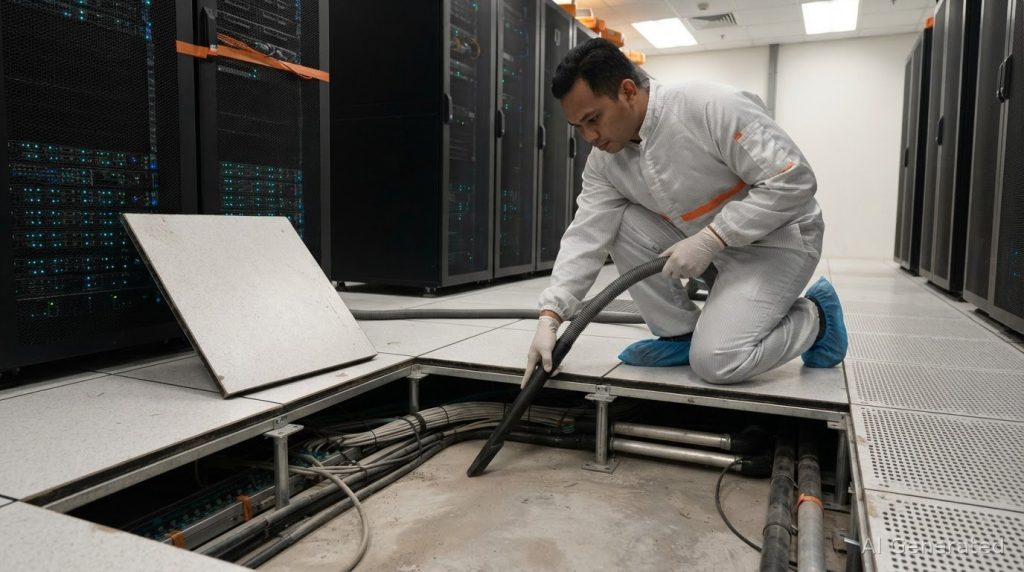
Raised floors need particular attention because dust beneath the tiles can enter the room through airflow openings. Use a HEPA vacuum to capture debris, then clean the floor surface with an appropriate anti-static method. Avoid dry mopping, which can stir up and spread contaminants. Remove perforated tiles for cleaning outside the server room to prevent moisture from reaching the subfloor.
Include support equipment, floor surfaces, and cabling in a defined contamination-control scope. Prevent tools and vacuum attachments from dragging debris across cable routes or contacting connectors. For underfloor work, limit the area opened at one time and protect exposed cabling. Overhead surfaces matter too, especially when a ceiling plenum carries return air and can redistribute settled dust.
Clean racks and equipment surfaces with controlled movements, suitable anti-static tools, and materials that won’t shed lint. Avoid disturbing dust near air intakes or using ordinary vacuum equipment that may create static. In live rooms, sequence work around operating conditions and exposed equipment. A professional data center cleaning scope can account for raised floors, racks, overhead surfaces, and support areas together.
Before equipment installation, complete a final clean after construction debris and other contaminants have been removed. Include accessible floor, rack, and overhead surfaces, then protect cleaned areas from later trades and material movement. This sequence reduces the chance of construction dust settling on newly installed equipment or entering airflow paths during commissioning.
Improper cleaning can cause static discharge, introduce moisture, or move dust into equipment openings. A static event may affect sensitive electronics; moisture near energized systems can create electrical risks, while dispersed particles can obstruct airflow. These conditions may require operational intervention and contribute to downtime.
Use anti-static tools and lint-free materials around servers, and keep cleaning chemicals from making direct contact with equipment. For raised floors, HEPA vacuuming and controlled damp cleaning help capture particles without the disturbance caused by dry mopping. Treat floors, cabling, equipment, and overhead areas as connected parts of one contamination-control plan.
Data centre cleaning from construction through operations
Cleaning requirements change as a government data centre moves from construction to commissioning and live operations. ISO 14644-1:2015 provides a particle-based framework for describing controlled-environment air cleanliness.
Cleaning Across Data Center Operations
Lifecycle cleaning is the planned control of construction debris and operational contamination throughout a facility’s stages. Dust left after building work can persist into commissioning, while later maintenance and equipment changes can introduce new particles.
During construction, cleaning removes debris before the next trade or installation activity. Before commissioning, a final clean prepares accessible spaces for equipment and testing. In an operational server room, the scope shifts to maintaining controlled conditions around installed systems. Separating these phases helps project teams assign cleaning at suitable handover points and reduces the risk of construction residue carrying into service.
Technical Cleaning for Sensitive Spaces
Technical cleaning uses controlled methods and suitable equipment for sensitive data center areas, rather than treating them like ordinary building surfaces. Raised floors, equipment zones, and air pathways serve different functions, so each needs appropriate work controls.
Underfloor spaces, for example, may contain cabling and support airflow, while rack areas hold installed equipment that must be protected. Cleaning plans should define access, work boundaries, and included surfaces. During live operations, sequencing work by area helps limit disruption and prevents debris from being transferred between spaces. Record the completed scope so facility teams can coordinate future maintenance against the same site conditions.
Cleanliness Levels and ISO Class 8
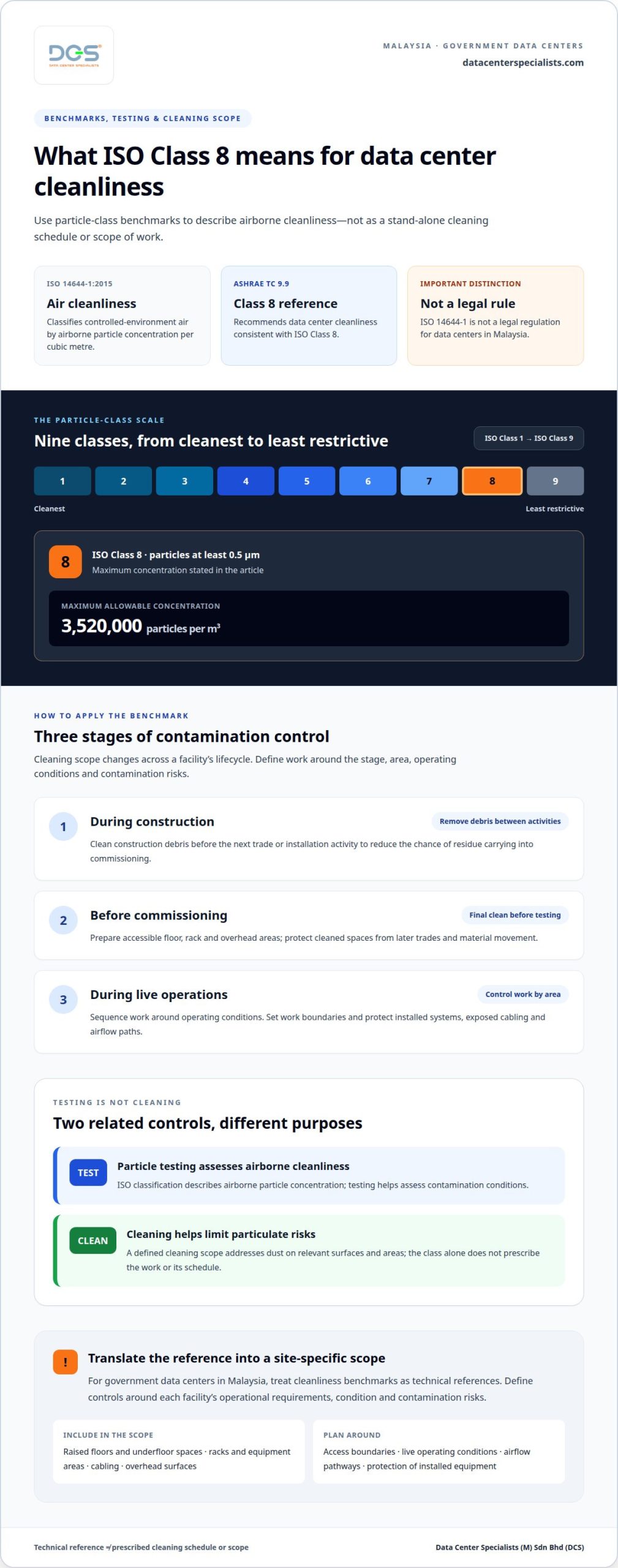
Cleanliness levels describe airborne particle concentration, giving facility teams a shared basis for discussing environmental conditions. According to the International Organization for Standardization (ISO), ISO 14644-1:2015 classifies controlled-environment air cleanliness by the maximum allowable concentration of airborne particles per cubic metre.
The standard defines nine classes, from ISO Class 1, the cleanest, to ISO Class 9, the least restrictive. For ISO Class 8, the maximum concentration for particles at least 0.5 μm in size is 3,520,000 particles per cubic metre. This classification supports a measurable specification, but it does not determine cleaning frequency or define the work scope. Distinguish the target class from the method used to maintain it.
Cleaning and Maintenance
Cleaning supports maintenance by controlling contamination in areas that affect equipment and facility operation. It matters because dust on floors, surfaces, or ventilation areas can accumulate between maintenance activities and complicate environmental control.
Integrate cleaning with operational planning, access controls, and maintenance records. A facility team can use particle testing to assess airborne conditions and cleaning records to track completed areas. The two records answer different questions: testing describes measured air cleanliness, while scope records show what work took place. For a planned cleaning scope, professional data centre cleaning can address the facility’s sensitive areas and operating requirements.
HEPA/ULPA-filtered vacuums and air scrubbers
HEPA- and ULPA-filtered vacuums capture particles during cleaning instead of returning collected dust to the room. In a data center, use them on accessible floor surfaces, rack exteriors, and underfloor spaces where contamination can affect infrastructure. Air scrubbers filter airborne particles during controlled work, helping limit their spread beyond the cleaning zone. Select equipment and filtration to suit the task and facility conditions.
Under a raised floor, vacuuming should remove settled dust without disturbing cables or damaging floor components. The cleaning team can work in a controlled area, lifting tiles carefully and directing the vacuum nozzle along accessible surfaces. Limit openings to the work area, protect exposed cabling, and replace tiles securely before moving on. This sequence helps prevent debris from transferring into adjacent operational zones.
Static control matters during vacuuming because equipment and floor materials can accumulate electrical charge. Use anti-static equipment and attachments suited to data center work; plastic attachments are often used to help minimise static generation. Ordinary vacuuming can generate static electricity that may discharge onto a server. Avoid dragging hoses across equipment, and keep nozzles clear of connectors, vents, and exposed components.
Match the method to the surface. A HEPA vacuum, for example, can collect dry dust from a raised-floor tile, while an approved anti-static cleaning chemical may suit a compatible floor surface. Apply chemicals to the cleaning material, not directly to equipment. Use damp methods only where suitable, controlling moisture so it cannot reach the subfloor or electrical components.
Air scrubbers can support work that risks releasing airborne dust, such as post-construction cleaning or removing contamination from a defined area. Position the unit to capture particles without obstructing cooling airflow or creating a new route for dust to spread. Keep its intake and exhaust clear, and coordinate operation with the facility’s air-handling arrangement.
Equipment selection affects cleaning efficiency, but work sequence matters too. First identify the surfaces and underfloor areas included. Then remove loose debris with filtered equipment before wiping compatible surfaces. Keep clean tools separate from used attachments, and avoid carrying collected dust through cleaned zones. These controls help maintain cleanliness and reduce the chance of redistributing particles.
For a government data center in Malaysia, the cleaning method should account for live equipment, floor construction, cable routes, and room airflow. HEPA/ULPA filtration, anti-static tools, and controlled air scrubbing each serve a specific purpose. Combined with careful access and surface handling, they support particle control without treating sensitive infrastructure like an ordinary building.
ASHRAE’s recommended data center cleanliness class
ASHRAE Technical Committee 9.9 recommends that data centers maintain cleanliness consistent with ISO Class 8. For government facilities, this offers a practical reference for discussing airborne particles without treating a cleanliness class as a complete operating specification. The recommendation helps teams align environmental goals, testing plans, and cleaning procedures around a recognized classification.
ISO Class 8 describes airborne particle concentration, not the cleanliness of every surface or piece of equipment. A room’s classification therefore doesn’t establish that rack exteriors, raised floors, cable routes, or overhead surfaces are free from settled dust. Facility teams should distinguish air cleanliness measurements from physical inspection and cleaning records. Each provides different evidence about the controlled environment.
ASHRAE’s 2011 data center contamination white paper references ISO 14644-1 as a cleanliness standard for data center environments. This connection helps explain why operators use ISO classes when setting environmental targets. It does not make the recommendation a Malaysian legal regulation. Government data center cleaning standards should therefore distinguish technical guidance from applicable legal or contractual requirements.
Apply the Class 8 recommendation through a defined measurement and response process. Particle testing can establish airborne conditions at selected locations, while documented observations identify contamination on surfaces or within accessible underfloor spaces. If results indicate a concern, investigate likely sources, such as construction activity, airflow pathways, or material movement. Then align cleaning controls with the affected area and operational risk.
Ventilation also supports particle control. Data center ventilation should filter out the vast majority of particulate matter, while the facility’s airflow arrangement influences where particles travel and settle. An assessment should consider both the air entering the room and areas where dust can accumulate. For example, a clean rack aisle may still be exposed to particles released from a neglected ceiling return-air plenum.
Make procedures operationally useful. Define where particle measurements are taken, how results are recorded, and what action follows a change. Use consistent locations and conditions when comparing results over time, so teams can interpret trends rather than isolated readings. Pair test records with cleaning scope and maintenance notes to support facility decisions and accountability.
The practical takeaway is to use ISO Class 8 as ASHRAE Technical Committee 9.9’s recommended cleanliness reference, then apply it alongside site-specific controls. It is a benchmark for particulate cleanliness, not a substitute for risk-based procedures, equipment protection, or facility oversight. For a mission-critical government data center, that distinction keeps the recommendation useful without overstating what the classification establishes.
What cleaning standards apply to government data centers in Malaysia?
For Malaysian government data centers, ISO 14644-1 can provide a technical reference when a facility specification sets airborne particle limits. The selected class should be read alongside the project’s own requirements and the environment being controlled. A procurement document, commissioning scope, or operational procedure can state which areas are included, how cleanliness is assessed, and what evidence is required after work.
Different classes provide different particle concentration limits. ISO Class 7 allows a maximum of 352,000 particles per cubic metre at 0.5 μm and 83,200 particles per cubic metre at 1.0 μm. ISO Class 6 allows a maximum of 35,200 particles per cubic metre at 0.5 μm and 8,320 particles per cubic metre at 1.0 μm. These values help describe a target; they do not select one for a facility.
Choose a benchmark based on the project specification and the areas being considered. An operational server room and a space under construction, for example, may have different contamination sources and control priorities. Connect the cleanliness target to the space’s purpose, equipment condition, and intended use of particle test results. Avoid applying a class without defining where it applies.
A usable specification should identify the spaces and surfaces included, such as server halls, raised-floor areas, rack exteriors, and accessible overhead surfaces. It should also state whether particle testing is part of acceptance or ongoing assessment. These details prevent a target from being mistaken for a complete cleaning procedure and help facilities and project teams align scope before work begins.
Testing records are most useful when they preserve context. Record the sampling location, relevant operating conditions, and result alongside the facility’s acceptance criteria. Cleaning records should separately identify completed areas and follow-up actions. This helps teams understand whether a result reflects the specified location and whether the work addressed the intended scope.
Particulate and gaseous contamination require different considerations. ANSI/ISA 71.04 addresses gaseous contamination, so a particle classification alone does not describe every contamination concern in a government facility. Where a project identifies additional environmental concerns, its assessment and control requirements should address them separately rather than treating one cleanliness class as a complete air-quality specification.
For government data centers in Malaysia, the practical task is to translate the chosen technical benchmark into a clear, auditable facility specification. Define the target, applicable areas, assessment method, and records needed to demonstrate completed work. This gives operations and procurement teams a shared basis for planning without implying that a cleanliness class defines every requirement.
ISO 14644-1 can serve as a technical reference for airborne particle limits, while ANSI/ISA 71.04 addresses gaseous contamination. Facility-specific requirements may be set through procurement documents, commissioning scopes, or operational procedures.
Data Center Specialists (M) Sdn Bhd (DCS)
Data Center Specialists (M) Sdn Bhd (DCS) helps data center operators translate cleanliness benchmarks into practical cleaning and facility decisions. Its Professional Data Center ISO Cleaning Services support contamination control in mission-critical environments, with work aligned to operating conditions and a defined scope. This is relevant when a government facility is setting cleaning requirements, preparing for commissioning, or reviewing contamination risks in an operational room.
When broader facility performance is part of the assessment, DCS also provides Data Center Energy Assessment, Testing, Adjusting & Balancing (TAB), and Cleanroom Performance Testing (CPT). These services address related technical considerations without treating an ISO cleanliness class as a complete cleaning specification.
Contact Data Center Specialists (M) Sdn Bhd (DCS) to discuss your facility’s cleaning requirements and technical priorities.
Turn the cleanliness benchmark into an operating plan
Make the next step operational: assign responsibility for maintaining the facility’s cleaning plan and reviewing it when site conditions change. Clear ownership helps keep procurement requirements, facility procedures, and day-to-day decisions aligned.
Data Center Specialists (M) Sdn Bhd (DCS) can discuss how your facility’s priorities translate into a practical technical scope. Bring your operational requirements and areas of concern to the conversation so it can focus on the conditions that matter to your team.
Contact Data Center Specialists (M) Sdn Bhd (DCS) to discuss a suitable next step for your government data center.
Frequently Asked Questions
What Is ISO 14644-1?
ISO 14644-1 is a standard for classifying airborne particle cleanliness in controlled environments. Its classification considers particle sizes from 0.1 microns to 5 microns, and the standard references ISO 21501-4 for airborne particle counter instrument requirements. For facility teams, this helps distinguish a measured air-cleanliness classification from surface inspection or a cleaning work record. It does not prescribe a government data center’s cleaning schedule.
How often should government data centers be cleaned, and which tasks require scheduled maintenance?
Cleaning frequency generally ranges from monthly visits to a minimum of one cleaning per year. Set the schedule around contamination sources, construction activity, particle test findings, and areas where dust could enter equipment airflow. Scheduled work can include inspecting and cleaning raised-floor spaces, rack exteriors, and overhead surfaces, alongside particle testing where required. Apply government data center cleaning standards through a documented schedule that can be adjusted when facility conditions change.
How should cleaning work be documented, audited, and reported in a government data center?
Document each work area, completed cleaning tasks, materials and equipment used, and any access or operational constraints. Record particle test locations and results separately from visual findings, so reports do not confuse measured air conditions with surface cleanliness. During an audit, compare the approved scope with completed work and note outstanding contamination or follow-up actions. Clear records help facility teams trace decisions and plan subsequent maintenance.
How do government data center cleaning standards compare with ISO 14644, ISO 27001, and Uptime Institute guidance?
ISO 14644-1 classifies airborne particle cleanliness and is a technical reference, not a legal regulation; ASHRAE recommends cleanliness consistent with ISO Class 8. The material provides no basis for comparing these with ISO 27001 or Uptime Institute guidance.
What are the requirements for cleaning contractor access, supervision, and handling of government data?
Cleaning plans should define access, work boundaries, and included surfaces. During live operations, sequence work by area, protect exposed cabling, and record the completed scope.
What qualifications, security clearances, and training must data center cleaning contractors have in Malaysia?
Technician training includes Class 100,000 HEPA/ULPA CRV.