
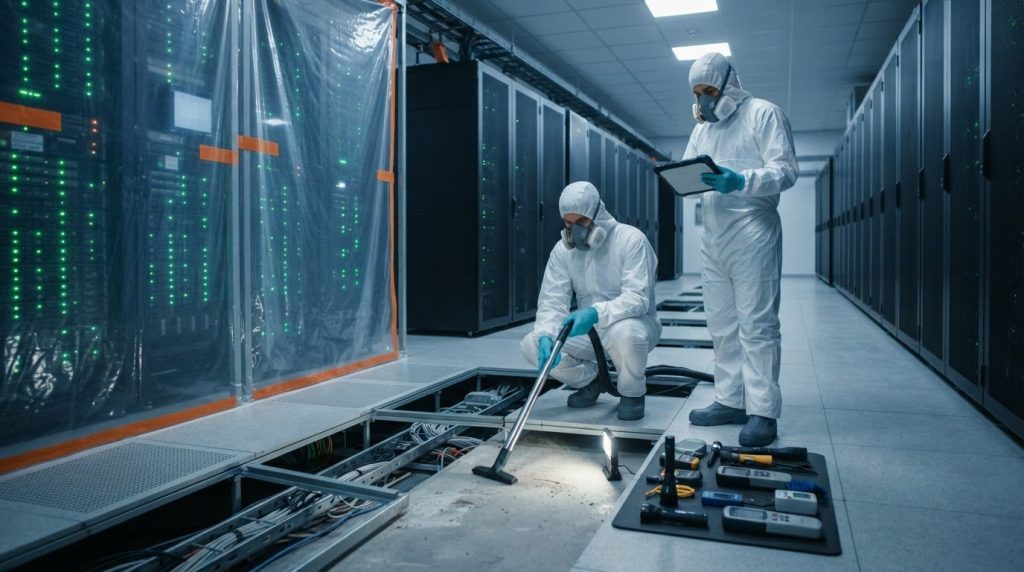
After a fire, flood, or other incident, how do you determine which areas need environmental cleanup without disrupting recovery work? Data center disaster recovery environmental cleanup starts with more than visible damage. Residues and fine particles may affect raised floors, underfloor plenums, rack surfaces, and adjacent spaces, while cleaning in the wrong sequence can create additional risks for equipment and operations.
Restoring service is an understandable priority, but environmental contamination control is distinct from IT recovery and general cleaning. A defined scope helps teams identify affected areas, coordinate access and work sequencing, and agree how completed cleaning will be reviewed.
This checklist explains how to document incident conditions, define contamination concerns, and coordinate cleaning with facility and IT recovery teams. It also outlines how to assess specialist support, including its scope, methodology, safety controls, and verification process. Use it to make informed decisions for a mission-critical facility in Malaysia, with cleanup planned around the site’s operating requirements and applicable project specifications.
Key Takeaways
- Define environmental cleanup as physical contamination control, separate from IT recovery and equipment repair.
- Use a staged assessment to identify affected zones and set a cleaning scope while authorized teams manage access and operational decisions.
- Compare specialist data center cleaning with general facility cleaning and IT recovery to understand the distinct purpose of each approach.
- Use the data center disaster recovery environmental cleanup checklist to document site conditions, work boundaries, equipment protections, and responsible contacts.
- Assess specialist support against the agreed scope, including any affected raised floors, underfloor spaces, racks, and equipment areas.
What Data Center Disaster Recovery Environmental Cleanup Covers
Environmental cleanup addresses physical contamination that may remain in a mission-critical facility after an incident. It can include identifying affected spaces, removing or controlling contaminants, and documenting the agreed work and review criteria. The scope should follow evidence and site conditions, not an assumption that every disruptive event leaves contamination.
Data center disaster recovery environmental cleanup is the assessment and physical control or removal of incident-related contamination in facility spaces. It is distinct from restoring data, repairing equipment, or recovering IT services. These activities may proceed in parallel, but they have different objectives and decision owners. An environmental cleaning team does not perform data recovery or determine whether IT systems are ready to return to service. The facility’s authorized operations and recovery teams retain control of access, equipment status, and operational decisions. For a broader overview of IT disaster recovery, distinguish service-restoration planning from physical contamination control at the facility.
Which environmental incidents can affect data center spaces?
Water intrusion may leave moisture or deposits; a fire may result in smoke-related residue; and nearby construction or repair work can introduce dust and debris. Other incidents may affect particular surfaces or materials without spreading contamination throughout a room. The presence and extent of contamination depend on the event, materials involved, airflow, and facility layout. Do not infer the full impact from the incident label alone.
Visible deposits can help identify areas for attention, but appearance alone may not establish whether adjacent surfaces, concealed spaces, or equipment areas are affected. An incident also does not automatically mean every room needs cleaning. Record observations and assess conditions against the site’s requirements before defining the work.
Which facility areas may need assessment?
Start with the known point of impact, then consider how air movement, access routes, and building openings could connect it to other spaces. Depending on the event, assessment may include raised access floors, underfloor plenums, rack exteriors, equipment areas, and overhead surfaces. A deposit on a floor, for example, does not show whether material entered the plenum or reached nearby rack surfaces.
Map affected and potentially connected areas separately. Note locations that could not be inspected, access restrictions, and whether equipment remains in operation. This gives facility and recovery teams a clearer basis for setting work boundaries without treating an uninspected area as either clean or contaminated. Contamination-control measures can also help limit further entry and spread of contaminants.
Connect each suspected source to the surfaces and spaces it could reasonably affect. DCS provides physical contamination-control cleaning for mission-critical environments, including raised floors, underfloor areas, and server racks. Let incident evidence and the project specification guide the scope and any acceptance criteria.
How Environmental Assessment Shapes Data Center Cleanup
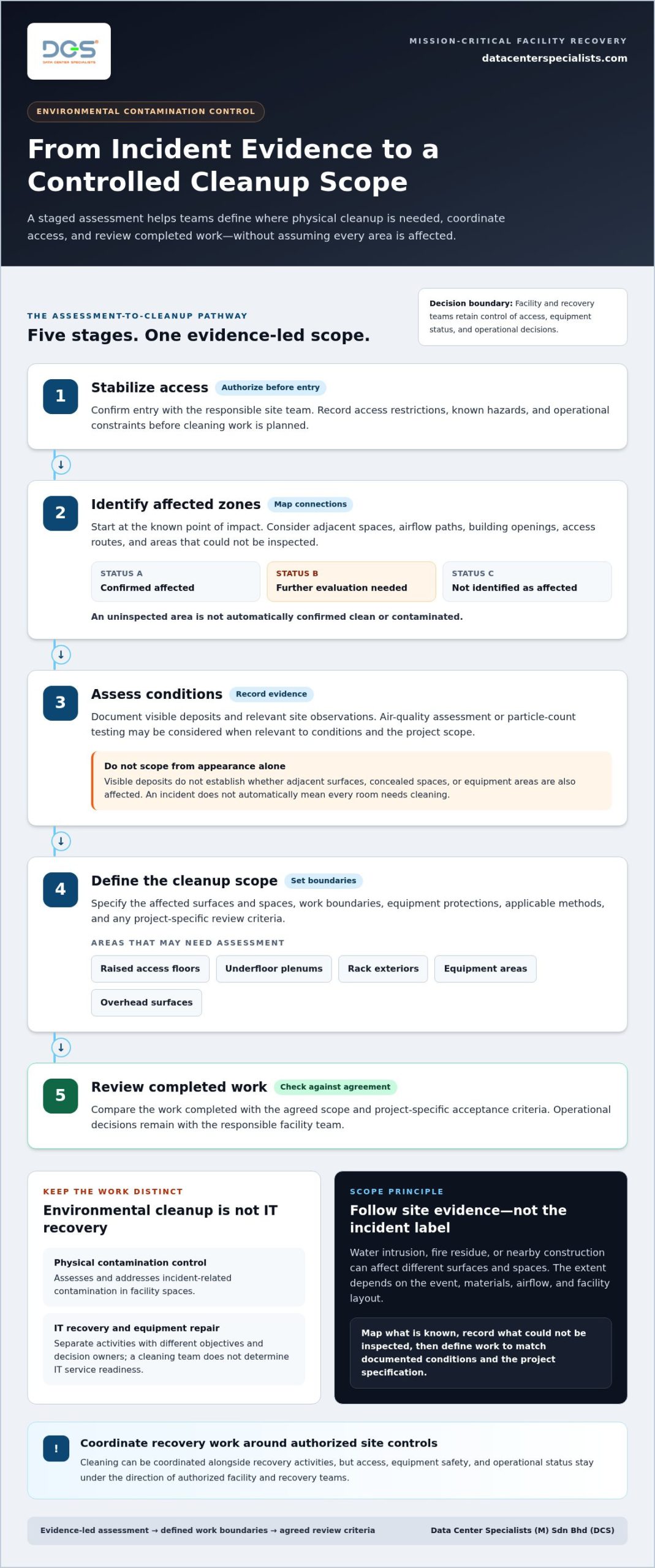
Assessment turns incident observations into a controlled work scope. It helps distinguish confirmed contamination from areas requiring further evaluation, while giving facility and recovery teams a basis for setting boundaries. Cleaning should not begin until access, operational constraints, and the intended work are understood.
Cleanup scope should follow documented site conditions, not assumptions based on an incident’s type or apparent severity. For data center disaster recovery environmental cleanup, the facility’s authorized operations and recovery teams retain responsibility for incident response, equipment safety, and operational status. Cleaning personnel should work within the access and safety controls those teams establish.
- Stabilize access: Confirm that the responsible site team has authorized entry and identified restrictions or hazards.
- Identify affected zones: Mark the incident location, adjacent spaces, connected airflow paths, and areas that could not be accessed.
- Assess conditions: Record visible deposits and other relevant observations. Use air-quality assessment or particle-count testing when the conditions and project scope make measurement relevant.
- Define the scope: Specify the surfaces and spaces to be addressed, work boundaries, equipment protections, and applicable methods.
- Review results: Compare completed work with the agreed scope and project-specific acceptance criteria. Leave operational decisions to the responsible facility team.
Map affected areas before defining the cleaning scope
Document the incident area, adjacent rooms, airflow connections, access restrictions, and inspection limitations. Classify locations as confirmed affected, requiring further evaluation, or not identified as affected. Avoid treating an uninspected area as confirmed clean. Where measurements are appropriate, select locations and criteria that answer a defined project question. A data center air quality assessment can provide measurement context, with criteria aligned to the project specification.
Set controls for live or recovering environments
Agree on access routes, work boundaries, equipment protection, and operational windows with site teams before work starts. Near IT equipment, account for ESD awareness and use methods appropriate to the environment and approved scope. Do not treat a cleaning completion record as authorization to energize equipment, resume a system, or reopen a space. Resumption criteria are facility-specific and remain with the responsible operations or recovery team.
Data Center Specialists (M) Sdn Bhd (DCS) provides physical cleaning and contamination-control services for mission-critical environments, along with air-quality assessment and particle-count testing where appropriate to the project. To discuss data center environmental assessment and cleaning, align the site evidence, work boundaries, and review criteria with the facility team before mobilization.
Compare Cleanup Approaches for a Mission-Critical Facility
Different workstreams may operate during recovery, but they do not serve the same purpose. Data center disaster recovery environmental cleanup addresses physical contamination in facility spaces. General facility cleaning typically focuses on routine building surfaces, while IT recovery restores services, applications, or data. Define the boundaries so a visible surface clean is not mistaken for a complete contamination-control scope, and cleaning is not treated as equipment repair.
Specialist cleaning versus general facility cleaning
Specialist data center cleaning is scoped around documented incident conditions and the technical environment. Work may include raised floors, underfloor areas, rack exteriors, and equipment-adjacent surfaces, with access controls, equipment protection, and contamination-focused methods coordinated with facility teams. Its purpose is to address identified environmental conditions in a mission-critical space.
General facility cleaning may suit routine building areas, but a visible wipe-down alone does not establish whether dust or residue is present beneath access flooring or around racks. Include these less visible locations where the incident assessment supports it. DCS’s professional data center cleaning focuses on physical cleaning and contamination control in mission-critical environments.
Environmental cleanup versus IT disaster recovery
Facility teams define environmental conditions, access boundaries, and physical cleaning requirements. IT teams manage their recovery workstreams, such as application restoration or data recovery, while equipment repair follows the appropriate technical process. Cleaning can support recovery planning, but it does not restore damaged hardware, recover data, or determine whether a system is ready for service.
Coordinate schedules around access permissions, equipment status, work boundaries, and handoffs. For example, facility and IT leads can agree which areas are available for cleaning and when the cleaning team must pause for inspection or technical work. The designated operations team retains authority over equipment safety and resumption decisions.
| Approach | Scope and purpose | Site coordination | Contamination focus | Useful evidence |
|---|---|---|---|---|
| Specialist data center cleaning | Physical cleaning within an agreed incident scope | Access, equipment protection, and work boundaries coordinated with facility teams | Identified surfaces and spaces, including underfloor or rack areas where applicable | Scope records, work documentation, and review against project criteria |
| General facility cleaning | Routine cleaning of building areas and surfaces | Building access and normal site controls | Typically visible or routinely maintained surfaces | Routine service records |
| IT recovery | Restoration of data, applications, and IT services | Recovery sequence, system access, and technical handoffs | Not a physical cleaning scope | IT recovery and system-status records |
Use the comparison to assign owners and handoffs, not to substitute one workstream for another. A clear scope lets facility, IT, and cleaning teams coordinate without implying that completion of one activity authorizes the next.
Data Center Environmental Cleanup Planning Checklist
A usable plan turns assessment findings into clear instructions for the cleaning team and site stakeholders. For data center disaster recovery environmental cleanup, record what is known, identify what remains uncertain, and define how completed work will be reviewed. Keep the plan specific to the incident and facility rather than relying on a generic cleaning schedule.
Before work is scoped, gather the available incident and site information:
- Incident conditions: Record the event, its known location and timing, relevant observations, and any materials or residues identified by the site team.
- Affected areas: Map rooms, raised-floor sections, underfloor plenums, racks, equipment areas, and other surfaces assessed or suspected to be affected. Distinguish confirmed findings from areas requiring further evaluation.
- Access and operations: Note entry restrictions, energized-equipment considerations, current operational status, recovery activities, and agreed work windows.
- Scope and boundaries: State which locations and surfaces are included or excluded, the cleaning methods and equipment-protection approach, and how the work area will be controlled.
- Ownership and handover: Name responsible site contacts, identify who authorizes access and resolves operational questions, and specify required work records, assessment results, and review criteria.
Where assessment or testing is part of the project, document its purpose, locations, and agreed criteria. Acceptance limits should come from the applicable project specification, not a generic target. Record limitations, such as spaces that could not be inspected, so the handover distinguishes completed work from unresolved conditions.
Questions for scoping the work
Before confirming the scope, identify which rooms, floor panels, plenum sections, racks, and surfaces are included. Clarify access restrictions, work timing, energized-equipment considerations, and concurrent recovery tasks. Agree who can approve a scope change and what evidence the facility expects at handover, such as completed-area records, observations, or results from specifically agreed testing.
When to involve a specialist
Involve specialist support when an incident may have affected concealed areas beneath raised floors, rack exteriors, or equipment-adjacent spaces, or when visible conditions alone cannot establish the extent of contamination. A specialist can translate documented findings into a physical cleaning scope and defined review process. DCS’s professional data center cleaning service addresses physical cleaning requirements in mission-critical environments.
Keep authorization for equipment access, safety controls, and return-to-operation decisions with the facility’s designated stakeholders. The cleaning handover should confirm work against the agreed scope; it should not imply that systems are safe to energize or ready for service. For a project-specific discussion, discuss your environmental cleaning scope with Data Center Specialists (M) Sdn Bhd (DCS).
How DCS Supports Data Center Environmental Cleanup
Data Center Specialists (M) Sdn Bhd (DCS) focuses on physical cleaning and contamination control for mission-critical environments. For data center disaster recovery environmental cleanup, the work should reflect documented site conditions and an agreed scope, not be treated as a general building clean. This distinction matters when access, equipment proximity, and operational constraints shape how affected areas can be addressed.
Depending on assessment findings, the scope may include raised access floors, underfloor spaces, server racks, and equipment areas. These locations can require different access arrangements and cleaning considerations. A visible deposit on one surface does not automatically define the work boundary. Use the facility’s incident information and project requirements to determine which areas are included and how results will be reviewed.
Cleaning and contamination-control scope
DCS’s professional data center cleaning is physical contamination control, not routine janitorial work. Activities are tied to identified facility areas and contamination concerns, with work boundaries and equipment protection coordinated with the site team. Relevant locations may include floor surfaces, accessible underfloor areas, rack exteriors, and equipment-adjacent spaces. The professional data center cleaning service supports defined scopes for mission-critical environments.
Where an agreed project scope calls for further technical information, related DCS capabilities include data center facility assessment, air-quality assessment, and particle-count testing. These are not automatic steps for every incident. The site specification and assessment needs determine whether they are relevant, and acceptance criteria should be established for the project rather than assumed. Interpret ISO-related language carefully: a standard or cleanliness framework is not, by itself, a site-specific cleaning scope.
Define the next step with the facility team
Prepare the incident record, known affected areas, access limits, operational status, and recovery priorities before a technical discussion. Include areas that remain uninspected and identify the site contacts responsible for access and operational decisions. This information helps clarify whether the facility needs physical cleaning, further assessment, or agreed testing, and where the work boundaries should sit.
DCS can discuss these conditions with facility stakeholders and develop a cleaning scope aligned with the documented needs of the site. The discussion should establish relevant locations, work constraints, equipment-protection requirements, and the basis for reviewing completed work. It does not replace the facility team’s authority over incident response, equipment readiness, or return-to-operation decisions.
For a technical discussion about affected areas or a project-specific cleaning scope, contact Data Center Specialists (M) Sdn Bhd (DCS) about data center cleaning.
Build Environmental Readiness Into Recovery Planning
Use decisions made during an incident to strengthen future facility planning. Once the immediate work is complete, preserve the agreed scope, access constraints, assessment records, and handover criteria with the site’s recovery documentation. This gives facility stakeholders a practical reference when reviewing contamination-control procedures or planning future maintenance, without assuming a later event will follow the same pattern.
A clear record also keeps responsibilities distinct. Facility and IT teams retain authority over operational readiness, while environmental cleaning requirements remain tied to site conditions and project criteria. That separation supports deliberate coordination if the facility needs to scope data center disaster recovery environmental cleanup again.
For mission-critical facilities, discuss site conditions and define a technically appropriate scope with the relevant stakeholders involved. Discuss your data center’s environmental cleaning requirements with DCS.
Frequently Asked Questions
What is environmental cleanup in data center disaster recovery?
It is the physical assessment and control or removal of contamination in facility spaces affected by an incident. For example, after a leak, the scope might address deposits or moisture-related contamination on affected floor surfaces and nearby infrastructure, subject to site assessment. Data center disaster recovery environmental cleanup is a facility workstream, not a method for restoring applications or recovering stored information.
Can data center cleaning take place while some equipment remains operational?
Potentially, but only when the facility’s authorized operations team has approved access, boundaries, methods, and timing. The team may permit cleaning in a defined area while restricting entry near energized equipment or active recovery work. Conditions can change, so the work plan should include a way to pause if access or equipment status changes. Address ESD awareness and equipment-protection requirements before work begins.
How do you determine which areas need cleanup after water intrusion or smoke exposure?
Use incident observations and a site assessment to identify the source area, nearby surfaces, connected spaces, and locations needing further evaluation. After water intrusion, for instance, the facility team may investigate affected floor sections and accessible areas below them. Following smoke exposure, visible residue may guide inspection, but appearance alone may not establish the full extent. Document inspection limits and use testing only when it answers a defined project question.
Does environmental cleanup include data recovery or server repair?
No. Environmental cleanup addresses physical contamination in facility spaces; data recovery, server repair, and application restoration are separate technical workstreams. A cleaning scope may need to coordinate with teams responsible for those activities, particularly when they share access routes or affected equipment areas. Keep responsibility clear in the recovery plan: the relevant IT or equipment specialists determine their technical work, while facility stakeholders authorize access and operational decisions.
When can a data center resume operations after environmental cleanup?
There is no universal time or cleaning milestone that authorizes a return to service. The facility’s responsible stakeholders determine readiness using site-specific operational, safety, and technical criteria. They may need to review completed work, relevant assessment records, equipment status, and other recovery checks before making that decision. A cleaning handover documents work against its scope; it does not certify equipment readiness or replace the facility’s approval process.
Is ISO 14644 automatically required for post-incident data center cleaning?
No. ISO 14644 should not be treated as an automatic post-incident requirement for every data center. Its relevance depends on the facility’s requirements, contract, and project specification. The standard provides cleanliness classification and related guidance, but it does not by itself establish the incident-specific cleaning scope or acceptance criteria. Agree on applicable references, measurement needs, and limits with the responsible stakeholders before using them to evaluate completed work.
What should a data center cleanup scope include?
Include the specific locations and surfaces to be addressed, access restrictions, operational constraints, agreed cleaning approach, equipment-protection measures, and responsible site contacts. State how any required assessment or testing will be documented, including locations and project-specific acceptance criteria. For example, a scope might distinguish a named raised-floor zone from adjacent areas that still require inspection. Record exclusions and unresolved findings so the handover cannot be mistaken for approval to resume operations.