

What if two particle-count reports from the same data center point to different conclusions? The difference may come from sampling conditions rather than a change in contamination. Understanding data center particle count testing standards means looking beyond the reported number to how, where and when samples were collected.
It is reasonable to ask whether a facility must meet a particular ISO class. ISO 14644-1:2015 provides a framework for classifying air cleanliness by particle concentration, but it does not automatically assign every data center a required class. The applicable target depends on the facility’s requirements and specification.
This guide explains the role and limits of relevant ISO standards, including how sampling plans and operating conditions affect results. It also covers what to review when comparing reports, from particle sizes and sampling locations to instrument calibration and facility state. When these factors are documented and kept consistent, operators can interpret findings more reliably and use them to guide proportionate contamination-control decisions.
Key Takeaways
- Data center particle count testing standards provide a framework for assessing airborne particle concentration, but each facility should define its target according to its own requirements.
- Set the testing objective first, then document sampling locations, timing, operating state and relevant environmental conditions.
- Interpret results in context. Particle size, location and operating conditions help distinguish a classification assessment from trend monitoring or an investigation.
- A written protocol, instrument checks and clear field notes make sampling more consistent and reduce avoidable reporting errors.
- Use triggers such as construction activity or changed facility conditions to decide whether a baseline assessment, targeted investigation or ongoing monitoring is appropriate.
What standards apply to data center particle count testing?
Particle count testing measures airborne particles at specified size thresholds under documented sampling conditions. A result is meaningful only when read alongside its method and context: where samples were taken, which particle sizes were measured, and the facility’s operating state. The data center particle count testing standards most often discussed include the ISO 14644 series. Using a standard as a reference does not automatically make a cleanroom classification a data center requirement.
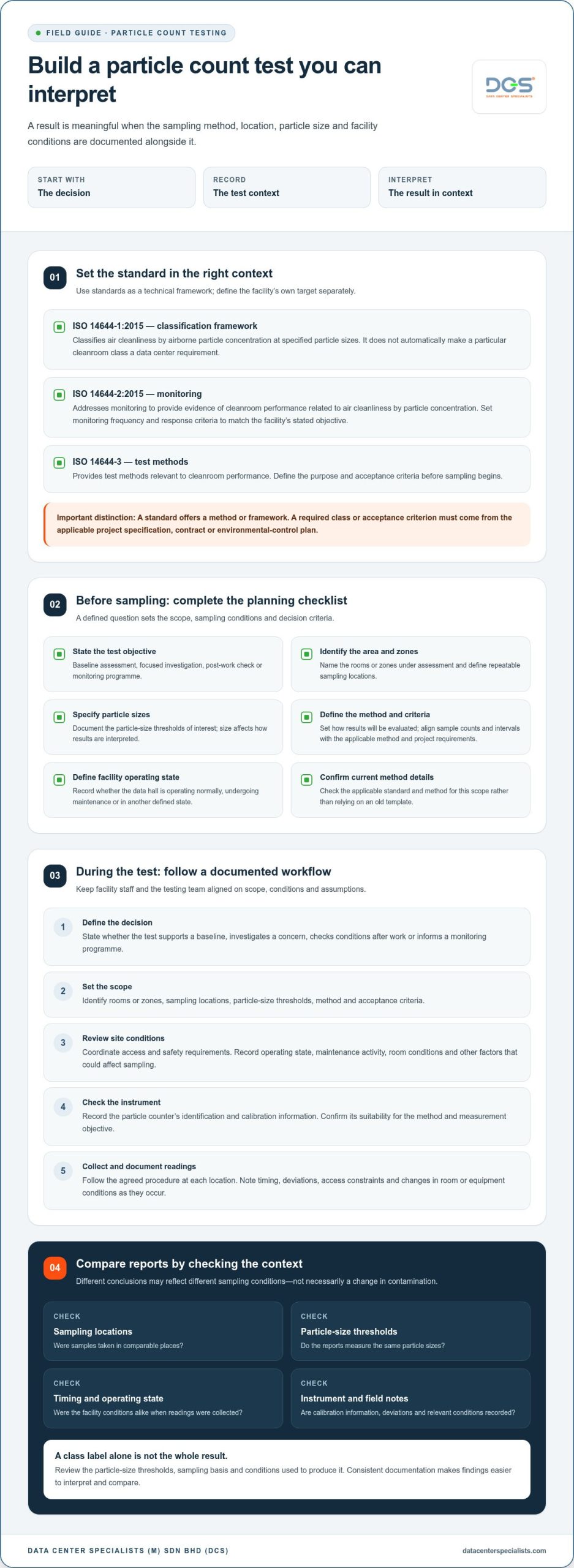
ISO 14644-1:2015 establishes a system for classifying air cleanliness by airborne particle concentration at specified particle sizes. It provides a common technical basis for describing results, not a universal pass-or-fail target for every data center. An owner may select a class or another acceptance criterion in a project specification, contract or environmental-control plan. State that selected criterion separately from the standard itself.
For a broader overview of the ISO 14644 standards, including the different parts of the series, see the linked reference. To understand how environmental testing fits into wider facility verification, watch this overview of data center commissioning:
What does ISO 14644-1 say about airborne particle classification?
Classification compares measured particle concentrations with limits for selected particle sizes. The applicable class is determined using the standard’s classification framework and prescribed sampling and evaluation conditions. A report should identify the particle-size thresholds and sampling basis, rather than give a class label without the context needed to interpret it.
The standard was developed for classifying cleanroom air cleanliness. Using it as a reference in a data center does not, by itself, establish that the facility must meet a particular class. Do not treat a commonly cited class as a universal obligation unless a specific contract, project brief or other applicable requirement calls for it.
How do ISO 14644-2 and ISO 14644-3 relate to testing?
ISO 14644-2:2015 addresses monitoring to provide evidence of cleanroom performance related to air cleanliness by particle concentration. A monitoring plan supports ongoing review over time. It is distinct from an individual classification or test event, which captures conditions during a defined sampling exercise. Set monitoring frequency and response criteria according to the facility’s stated objective.
ISO 14644-3 provides test methods relevant to cleanroom performance. For data center particle count testing, define the purpose of the work and the acceptance criteria before sampling begins. A baseline assessment, a focused investigation and recurring monitoring may require different scopes. Data Center Specialists provides specialized engineering testing to support evidence-based assessment and contamination-control decisions.
How is data center particle count testing planned and performed?
A reliable test starts with a defined question, not a particle counter switched on at a convenient location. The objective determines the scope, sampling conditions and decision criteria. A baseline assessment, a check after construction work and an investigation into a local concern may need different plans. One layout or schedule will not suit every purpose.
What should the test plan specify before sampling?
Before work begins, document the area under assessment, the reason for testing, the particle sizes of interest and how results will be evaluated. Identify sampling locations in a way that can be repeated. Record whether the data hall is operating normally, undergoing maintenance or in another defined state. Confirm the current standard and method details for the scope rather than relying on an old template.
Particle characteristics and size affect how results are understood. The US Environmental Protection Agency’s Particulate Matter (PM) Basics explains particle size and composition in general terms. In a data center assessment, keep technical interpretation focused on the defined particle thresholds and the facility’s contamination-control objective.
What is a practical testing workflow?
Use a documented sequence so facility staff and the testing team share the same scope and assumptions:
- Define the decision. State whether the test supports a baseline, investigates a concern, checks conditions after work or informs a monitoring programme.
- Set the scope. Identify the rooms or zones, sampling locations, particle-size thresholds, method and acceptance criteria. Establish sample counts and intervals against the applicable method and project requirements rather than choosing them by habit.
- Review site conditions. Coordinate access and safety requirements, then record operating state, maintenance activity, room conditions and any other factors that could affect sampling.
- Check the instrument. Record the particle counter’s identification and calibration information. Confirm that the instrument and its calibration status are suitable for the method and measurement objective.
- Collect and document readings. Follow the agreed procedure at each location. Note timing, deviations, access constraints and changes in room or equipment conditions as they occur.
- Report and follow up. Present results with their sampling context, identify limitations and relate findings to the stated decision criteria. Recommend further assessment when the evidence supports it.
How can teams make repeat measurements comparable?
Repeatability depends on more than returning to the same room. Use identifiable locations and consistent sampling conditions when the objective allows, and retain the same method basis when comparing results. If equipment operation, maintenance activity, access or room conditions differ, record the change. Do not treat readings taken under different conditions as directly equivalent without considering those differences.
A complete test record helps operators distinguish a genuine change from a change in method or conditions. Data Center Specialists’ specialized engineering testing supports structured particle count assessment and informed contamination-control decisions.
How should operators interpret particle count results?
A particle counter provides evidence about airborne particle concentration at the sampled locations and times. It does not, on its own, identify where particles came from, whether equipment has been affected or what corrective action is necessary. Interpret readings against the facility’s stated specification, baseline and assessment objective, with sampling conditions visible in the report.
When using the data center particle count testing standards as a reference, apply classification and acceptance criteria within their defined scope. Do not treat a result as a universal pass or fail unless the relevant standard, contract or facility specification establishes the criterion. The same reading may have a different operational meaning in a routine trend review than in a targeted investigation.
What does a particle count result represent?
Reports generally show airborne particle concentration for specified size channels, with the measurement basis and units stated. Read each channel alongside its location and sampling conditions. An airborne measurement describes what the instrument detected in the sampled air. It is not a complete diagnosis of contamination or a direct measure of settled dust on equipment, floors or surfaces.
Keep different types of evidence distinct. A particle count can be considered alongside visual inspection, surface conditions, maintenance records or other air quality assessment findings when a question requires a wider view. These sources are not interchangeable. Each describes a different aspect of the environment.
| Result type | What it helps show | Interpretation focus |
|---|---|---|
| Classification result | Whether sampled air meets a defined particle concentration criterion for the stated classification basis. | Confirm the applicable specification, particle sizes, locations and sampling conditions. |
| Monitoring trend | How readings change across monitoring events. | Compare like-for-like data and note changes in operating state, timing or method. |
| Investigation finding | Whether a targeted area or event warrants further assessment. | Review local readings alongside maintenance, construction and operational context. |
When should a result prompt further investigation?
Start with the facility’s own reference points. Compare a reading with its agreed baseline, acceptance criteria and previous measurements collected under comparable conditions. An unexpected, persistent or spatially concentrated change may warrant attention, particularly when it relates to the assessment objective. The reading still does not establish a cause by itself.
For example, a local increase recorded after nearby maintenance or construction activity may justify reviewing the work area, access routes and timing of the sample. First confirm that differences in sampling conditions do not explain the variation. Then decide whether repeat measurements, a focused inspection or a broader contamination assessment would answer the outstanding question.
Use the findings to select a proportionate next step rather than assuming every elevated reading calls for the same response. Data Center Specialists’ specialized engineering testing supports technical assessment of measured conditions and their relevance to contamination-control decisions.
How can a testing protocol reduce human error?
A written protocol gives the testing team a consistent reference for preparation, sampling and recordkeeping. Without one, staff may interpret location labels differently, omit operating context or record measurements in inconsistent formats. These gaps complicate comparisons and can lead to conclusions that the evidence does not support. A protocol reduces avoidable variation, but it cannot eliminate human error or replace technical judgement.
Align the procedure with the project scope and applicable method. The data center particle count testing standards relevant to an assessment can inform its technical basis, while the facility’s specification defines its objectives and decision criteria. Make responsibilities explicit so instrument checks, measurements, field notes and review are not left to assumption.
Which process controls improve sampling consistency?
Use a controlled plan with clearly identified locations and a defined sampling sequence. Assign responsibility for equipment checks, readings and records. Before sampling, confirm the instrument identification and relevant calibration information against the method requirements. Make the location plan easy to follow on site, especially where similar rooms, aisles or equipment areas could be confused.
- Identify each location consistently. Use stable room and area labels that can be matched to the plan and report.
- Record conditions as they occur. Note operating state, access constraints, nearby maintenance or construction activity, and any departure from the planned procedure.
- Capture exceptions immediately. Contemporaneous field notes are more reliable than reconstructing events after the team has left the area.
- Keep records traceable. Associate readings with the location, time, particle-size channels, instrument identification and the person responsible for the measurement.
These controls make repeat measurements more useful. If a follow-up reading differs, the record allows reviewers to check whether sampling conditions changed before interpreting the result as an environmental change.
How should teams review reports and deviations?
Before release, review the report for completeness and internal consistency. Check units, particle-size channels, location labels and instrument details against the field record. Flag deviations from the plan, describe what happened and explain how the difference limits or affects interpretation. Do not present data as if the planned conditions were followed when they were not.
Review anomalies independently where practical, particularly before using an unexpected result to justify operational action. Compare the finding with documented criteria and relevant context, such as maintenance or construction records. A deviation may warrant repeat sampling or a focused assessment, but it is not proof of a specific contamination source without supporting evidence.
Use the protocol as a decision-quality control, not as a guarantee of error-free testing. For a structured technical assessment, request specialized engineering testing from Data Center Specialists to support reliable interpretation and proportionate contamination-control decisions.
When should a data center commission particle count testing?
Commission testing when it will answer a defined operational question or provide evidence for a facility decision. The trigger may be a project milestone, a change in environmental conditions or a need to establish or review a contamination-control baseline. The appropriate scope depends on the question. There is no single testing frequency that suits every facility.
Which facility conditions may justify an assessment?
Testing can be useful during commissioning or after construction, when operators need to assess conditions before handover or occupancy. It may also be appropriate after changes to equipment, maintenance activities, airflow arrangements or other conditions that could affect airborne particles. These are reasons to consider an assessment, not automatic evidence that contamination is present.
Unexplained readings, visible dust or a change in environmental conditions may also prompt a focused investigation. First clarify the decision the result must support. Is the aim to document a baseline, examine a specific area after work or understand an unexpected change? That distinction helps keep the assessment proportionate and avoids collecting measurements without a defined use.
How should the assessment scope match the objective?
A baseline assessment documents conditions across selected areas at a defined point in time. An investigation focuses on a reported concern, relevant locations and surrounding context. Ongoing monitoring follows a planned approach to observe changes over time. Make the basis for comparison clear, especially if facility conditions or sampling methods change between events.
Apply the data center particle count testing standards relevant to the agreed objective, while keeping the facility’s acceptance criteria distinct from the standard. A test after construction, for example, should focus on the areas and conditions the project team needs to assess. It should not be assumed to represent every operating condition the facility will encounter later.
How can testing inform contamination control?
Use particle readings as one input to a broader decision, not as an automatic instruction to clean or evidence of a particular fault. If findings indicate that physical contamination may need attention, assess the relevant equipment areas, raised floors or underfloor spaces. A targeted data center cleaning service can form part of a suitable response when the assessment supports that action.
Keep testing scope and follow-up connected: define the question, collect evidence suited to it, then decide whether further inspection, monitoring or contamination-control work is warranted. Data Center Specialists provides specialized engineering testing for mission-critical environments. Discuss your facility’s objective with the team to determine an appropriate particle count assessment scope.
Make particle data useful to your next facility decision
Set a clear purpose for the next assessment before commissioning it. A defined question helps facility teams align on the scope, the evidence they need and how findings will inform contamination-control planning. Keep that objective visible as conditions change, so future measurements support decisions rather than become isolated records.
The data center particle count testing standards provide a technical reference, while the facility’s own requirements shape how results are applied. Data Center Specialists provides particle count testing and technical services for mission-critical environments, supporting operators who need measured conditions to inform practical next steps.
Whether you are planning a baseline, responding to a change or reviewing an existing testing approach, a focused technical discussion can help clarify the assessment objective and scope. Discuss a data center particle count assessment with our technical team and take a considered next step toward better-informed contamination control.
Frequently Asked Questions
Which ISO standard is used for data center particle count testing?
ISO 14644-1:2015 is the reference commonly used when an air-cleanliness classification is part of the assessment. In a testing brief, identify the edition and the purpose of applying it, rather than using a broad phrase such as “ISO compliant” without defining the intended scope. This helps align the test request, assessment criteria and use of the results.
Does every data center need to meet ISO Class 8?
No. Before setting ISO Class 8 as an acceptance target, review the facility’s project documents, customer commitments and applicable equipment or operational requirements. Confirm that the criterion applies to the particular space and assessment being commissioned. This avoids carrying a class target into a scope simply because it appears in a template or a specification written for a different environment.
What does an airborne particle counter measure?
It records airborne particle counts in selected size ranges from the air drawn into its sensing system. The output is numerical, not a description of particle material or identity. For practical review, check that the reported size ranges match the assessment brief and that the display or export format is understood before comparing records. A particle counter is not a chemical-analysis instrument.
How often should particle count testing be performed in a data center?
There is no single interval suitable for every site. Set a review schedule through the facility’s environmental monitoring or contamination-control plan, then reconsider it when the assessment objective or operating risk changes. For example, a new project phase may justify revisiting the plan, while a stable monitoring programme may follow its established schedule. Record the rationale so future reviews have a clear basis.
Can particle count testing be performed while a data center is operating?
Yes, if the agreed scope and access arrangements suit the live environment. Coordinate the work with operations so sampling does not obstruct controlled access or interfere with facility activities. Avoid changing equipment settings solely to prepare for testing unless the approved test plan calls for it. The report should make clear which operating mode the measurements represent.
What should a data center particle count report include?
Check that the report can be traced back to the approved scope and that its acceptance basis is explicit. A result presented only as a class label may be difficult to assess if the reader cannot see how it relates to the project requirement. Review the report with the facility’s technical owner before using it for handover, procurement acceptance or contamination-control planning.
Does a particle count prove that contamination is causing equipment problems?
No. Treat the reading as one diagnostic input, not a fault diagnosis. If equipment problems are reported, coordinate the particle data review with the relevant operations or engineering investigation, including checks of fault timing and affected areas. Draw a causal conclusion only when the wider evidence supports it. This prevents a numerical reading from being used to justify corrective work that may not address the actual issue.