

Could cleaning work intended to protect a data center create risk if it is not planned around live operations? Facility teams are right to be cautious. Mission critical facility cleaning is contamination control, not routine janitorial work. The scope, equipment and work sequence must reflect the areas being cleaned and the facility’s operating conditions.
That distinction matters when deciding whether work should include raised floors, underfloor plenums, rack and equipment areas, or overhead surfaces. Each area has different contamination, access and operational considerations. Cleaning in an operational facility must be coordinated to avoid unnecessary disruption.
This guide explains what professional data center cleaning covers, how it differs from general facility cleaning, and how to build a practical scope around site conditions. It outlines key planning considerations, including contamination sources, access, suitable methods and coordination with facility teams. Use these steps to assess your site and prepare a focused technical discussion with a specialist.
Key Takeaways
- Define mission critical facility cleaning as physical contamination control, with a scope distinct from routine housekeeping.
- Map potential contamination points across raised floors, underfloor plenums, rack areas and other zones based on actual site conditions.
- Plan live-site work with agreed controls, coordination and a site-specific risk review. Do not assume operations can continue unchanged.
- Set cleaning frequency and acceptance criteria according to observed contamination, operational risk and facility requirements, not a universal interval.
- Use the guidance in this article to prepare a cleaning scope that reflects your data center’s needs and operating conditions.
What Mission-Critical Facility Cleaning Means in a Data Center
Mission-critical facility cleaning is the controlled physical removal of dust, particles and other residues from data center spaces where contamination could affect equipment or facility operations. The goal is not simply to make surfaces look clean. It is to manage contamination in and around equipment through a defined scope, appropriate methods and coordination with site operations.
Particles can settle on surfaces, collect around equipment or enter areas that influence airflow. Residues from construction, maintenance or material handling may also remain after work is complete. Their significance depends on their location and condition, and how close they are to sensitive equipment. A cleaning plan should respond to observed conditions and facility risks, rather than assume every data center needs the same tasks.
A data center’s arrangement of IT equipment, power and cooling systems also affects how people access and work around critical spaces. The Data Center Overview provides a general introduction to these components. Cleaning decisions, however, must be based on the actual site layout and operating requirements.
How specialist cleaning differs from routine janitorial work
Routine housekeeping generally addresses cleanliness in occupied spaces. Specialist cleaning focuses on contamination control in zones near critical infrastructure. That difference affects how work is planned: access may need to be controlled, work sequences agreed with facility teams, and equipment and airflow paths considered before cleaning begins.
The scope should state which areas are included, what conditions are being addressed and how work will be carried out. Appearance alone is not a sufficient measure of completion. A clean-looking surface does not show whether concealed or equipment-adjacent areas have been assessed or addressed.
Which data center areas may fall within the cleaning scope?
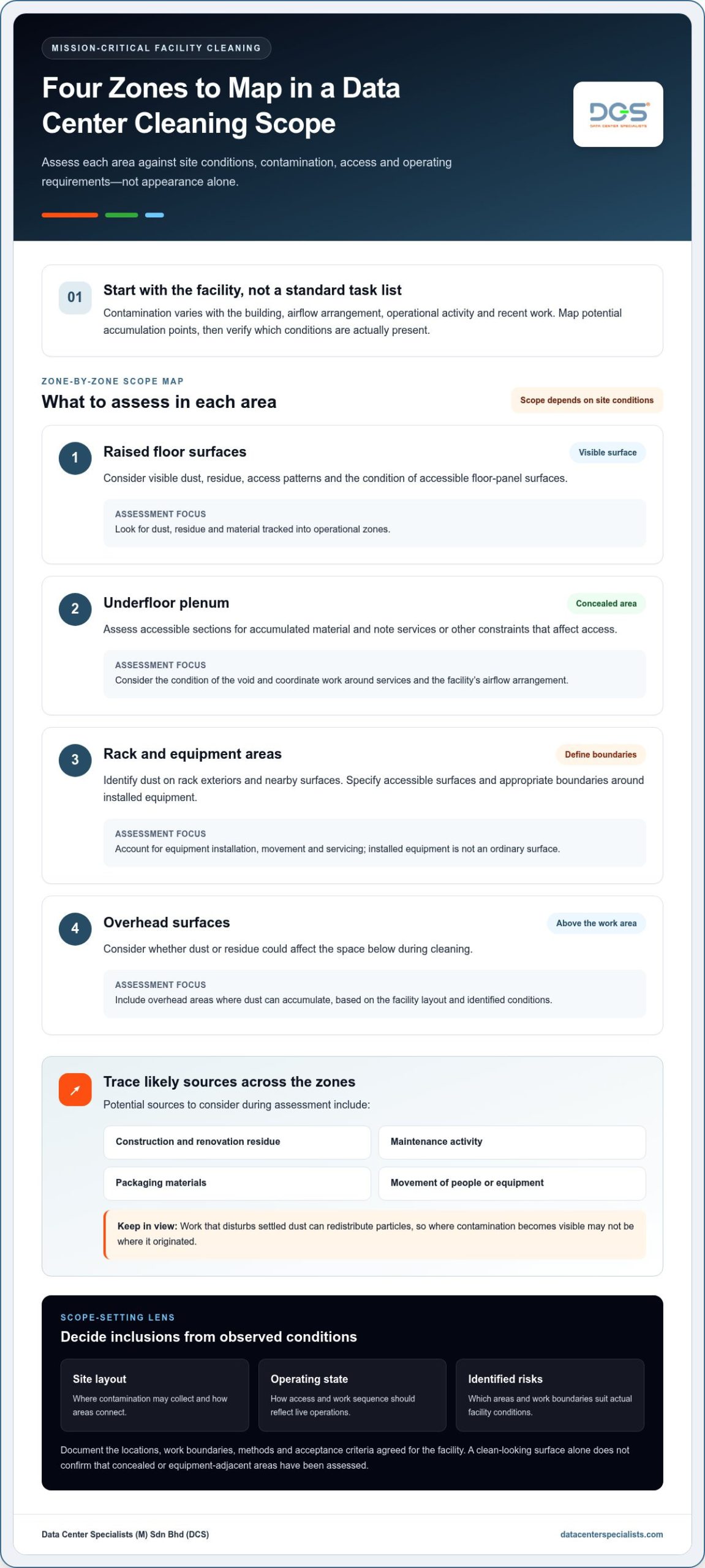
Depending on site conditions and the agreed scope, work may include raised access floor panels and their surfaces, underfloor plenums, rack exteriors and accessible equipment areas, and overhead surfaces where dust can accumulate. These zones differ in access, exposure and relationship to facility systems, so each inclusion should be deliberate.
- Raised floors: Consider visible dust, access patterns and the condition of accessible surfaces.
- Underfloor plenums: Assess whether contamination is present and how work can be coordinated around services.
- Rack and equipment areas: Define accessible surfaces and appropriate boundaries around installed equipment.
- Overhead surfaces: Consider whether dust or residue could affect the space below during work.
Data Center Specialists’ professional data center cleaning addresses physical contamination in mission-critical environments, including raised-floor, underfloor and server-rack areas. The right combination of work areas depends on the facility’s layout, operating state and identified risks.
Keep the technical basis clear. A referenced standard and a cleaning specification are not interchangeable. A standard may provide a framework for a particular cleanliness consideration, while the project specification defines the locations, work boundaries, methods and acceptance criteria agreed for that facility. Citing an ISO standard does not automatically determine every cleaning task. Establish the intended outcome and document how it will be assessed before work begins.
Where Contamination Accumulates Across Mission-Critical Facilities
Contamination rarely follows a uniform pattern across a data center. Its location and extent depend on the building, airflow arrangement, operational activity and recent work. A useful assessment maps potential accumulation points by zone, then checks which are present instead of assuming every facility has the same conditions.
Common sources include construction and renovation residue, maintenance activity, packaging materials, and the movement of people or equipment. Work that disturbs settled dust can also redistribute particles, so the area where contamination becomes visible may not be where it originated. Airflow paths and access routes help guide inspection, but they do not replace direct assessment of site conditions.
Raised floors, underfloor plenums and equipment areas
A raised access floor presents two distinct cleaning considerations: the exposed floor surface and the concealed void beneath it. Dust on panels may be readily visible, while material in an underfloor plenum can go unnoticed during routine observation. Because the void may contain services and form part of the facility’s airflow arrangement, assess its condition and access requirements before defining the work.
Rack exteriors and nearby surfaces may also collect dust, particularly where equipment is installed, moved or serviced. Define the boundaries carefully. Cleaning should address agreed, accessible surfaces using methods appropriate to the operating environment. Installed equipment should not be treated as an ordinary surface.
- Floor surfaces: Look for visible dust, residue and signs of material tracked into operational zones.
- Underfloor areas: Assess accessible sections for accumulated material and note services or other constraints that affect access.
- Rack surroundings: Identify dust on exterior surfaces and adjacent areas while establishing clear equipment boundaries.
This zone-based approach distinguishes visible conditions from concealed accumulation. The Uptime Institute on Data Center Cleaning also discusses the specialist nature of cleaning in data center environments. For contamination-control planning, DCS’s data center cleaning services address raised-floor, underfloor and server-rack areas according to facility conditions and scope.
Overhead surfaces and contamination pathways
Ceilings, cable pathways and other overhead surfaces can accumulate settled material, but their relevance varies by room layout and maintenance history. Work above equipment may disturb deposits and allow particles to move into areas below. Construction activity, ceiling access or changes to services can therefore justify closer inspection, especially when work is near operational equipment.
Air movement can carry particles between zones or influence where they settle. Consider supply and return paths, containment arrangements and locations where airflow patterns may be interrupted. These observations help focus inspection, but do not establish contamination levels on their own. Where measurement would inform the assessment, the data center air quality assessment guide provides relevant context.
Record the location, observed condition and likely source of contamination before setting priorities. This gives facility teams a clearer basis for deciding what belongs in the work scope and for considering data center contamination prevention as part of ongoing environmental control.
Can Mission-Critical Cleaning Be Planned Around Live Operations?
Yes, live-site cleaning can be planned, but it requires controls tailored to the facility and work area. Mission critical facility cleaning should proceed with an agreed scope, clear access arrangements and coordination with the operations team. A site-specific risk review helps determine the work sequence and controls, but cannot guarantee that operations will remain unaffected. If site conditions change, review the plan before work continues.
Pre-work coordination and operational controls
Before work begins, identify the facility stakeholders responsible for approving access and coordinating affected zones. Define boundaries, restrictions, work windows and the process for raising operational concerns. Agree how the team will respond if conditions differ from the plan, such as a newly restricted area or a change in nearby maintenance activity. Clear coordination gives operations staff visibility without assuming every site follows the same procedure.
Use a sequence that takes the work from planning through closeout:
- Review the scope: Confirm the zones, surfaces and tasks included, along with exclusions and site-specific risks.
- Coordinate access: Align personnel access, movement routes and work timing with facility operations and applicable site controls.
- Prepare the work area: Confirm boundaries, equipment suitability and communication arrangements before cleaning starts.
- Execute by agreed zones: Follow the planned sequence, keep activity within defined boundaries and coordinate any required pauses.
- Review and close out: Record completed areas, exceptions and relevant observations, then communicate them to the designated facility stakeholders.
Cleaning practices around live equipment
Methods and equipment should match the defined task, surfaces and operating environment. ESD awareness is part of that planning: personnel should follow the facility’s applicable controls and avoid materials or practices that conflict with them. Establish practical separation between cleaning activity and sensitive equipment, and define boundaries before work starts. Do not assume every rack, component or surface is suitable for the same treatment.
During execution, keep the operations contact informed about progress and any unexpected condition that could affect the scope or sequence. For example, if access to an agreed area is blocked or an observation suggests a different risk than anticipated, pause that task and follow the agreed escalation process. Reassess the situation rather than extending the work informally.
At closeout, distinguish work completed from areas that could not be accessed or tasks that changed. Record observations that may need facility review, without treating them as proof of a wider equipment or environmental issue. Data Center Specialists’ professional data center cleaning provides physical contamination control in mission-critical environments, with work scoped around facility conditions and operational requirements.
How to Define Cleaning Scope, Frequency, and Acceptance Criteria
A useful cleaning plan translates observed conditions into defined work, not a generic schedule. For mission critical facility cleaning, set the scope against the facility’s operating state, contamination sources, access constraints and intended outcome. Decide what will be cleaned, what is excluded and how completion will be assessed before work begins.
Factors that shape a risk-based cleaning plan
Consider whether the facility is operational, undergoing maintenance or approaching construction handover. Review visible contamination, access and movement patterns, and recent activity such as equipment installation or building work. These factors can affect both the zones selected and the sequence. Operational maintenance cleaning and post-construction or handover cleaning have different purposes, so define them separately rather than treating them as one recurring task.
Set frequency based on evidence gathered at the site, such as inspection findings and changes in activity or conditions. Applying a fixed interval to every facility can overlook areas that need attention and include work without a clear basis. Reassess the plan when operating conditions or contamination sources change.
Use zone-level questions to shape scope
Compare observed conditions with operational context before assigning work. The questions below help facility teams define where assessment or cleaning may be appropriate. They do not assume every zone is contaminated.
| Facility zone | Observed condition to record | Operational consideration | Assessment question |
|---|---|---|---|
| Raised floor | Visible dust, residue or tracked material | Access and nearby operational activity | Which panels and surfaces are in scope? |
| Underfloor plenum | Accumulated material in accessible areas | Services, access limits and airflow context | What areas can be assessed safely and included? |
| Rack surroundings | Dust on accessible exteriors or adjacent surfaces | Equipment boundaries and sensitive components | Which surfaces can be addressed without extending into equipment? |
| Overhead surfaces | Settled dust or residue following site activity | Potential disturbance above operational zones | Is overhead work relevant to the identified condition? |
What to document in a cleaning scope
Document the areas, boundaries, exclusions, access arrangements and work sequence. Include applicable site requirements and identify the operations contact responsible for coordination. If you are preparing a scope for construction handover, the data center cleaning specifications guide can inform how handover requirements are recorded.
Keep the cleaning specification distinct from verification or testing. The specification describes the agreed work and intended condition; verification explains how completion will be checked, if an inspection or measurement approach has been agreed. Define acceptance criteria before work starts, including the locations and assessment method where applicable. A cited standard should not be treated as a complete project scope or automatic acceptance rule.
Document completed areas, exceptions and relevant observations. These records can help facility teams review future priorities and refine later assessments, but they do not guarantee a particular environmental or operational outcome. To discuss a facility-specific cleaning scope, contact Data Center Specialists about data center cleaning.
How Data Center Specialists Supports Mission-Critical Facility Cleaning
Data Center Specialists (DCS) is a Malaysia-based specialist in physical cleaning and contamination control for data centers and other mission-critical environments. Its professional ISO-standard cleaning work is planned around facility conditions and operating requirements rather than applied as a generic routine. The objective is a defined scope that addresses relevant contamination while respecting site access and operational constraints.
Areas within one facility can have different access conditions, contamination sources and operational sensitivities. A raised-floor zone, an underfloor plenum and a rack area should not automatically be treated as identical work areas. The scope should identify where cleaning is required, what boundaries apply and how the work relates to the facility’s current state.
DCS cleaning scope for critical facility environments
DCS’s mission-critical cleaning services include raised-floor, underfloor and server-rack cleaning. The combination is determined by the site assessment and agreed requirements, not by assuming every area needs the same treatment. Professional ISO-standard cleaning describes the service approach; it does not mean a particular ISO standard automatically prescribes every method or task for every data center.
For example, a facility discussion may distinguish visible floor surfaces from accessible areas beneath the floor, then define which rack exteriors and adjacent surfaces fall within the work boundary. Equipment limits, access arrangements and the site’s operating state inform how these areas are addressed. The scope can also identify exclusions and areas requiring separate coordination, so expectations are clear before work begins.
DCS provides specialist cleaning and contamination-control services for mission-critical environments. For facility teams, the practical starting point is a technical discussion focused on the actual environment: what has been observed, where contamination may be present, and which locations warrant assessment or cleaning. This helps translate operational concerns into a defined work scope without promising a particular performance outcome.
Plan the next step with a facility-specific discussion
Prepare information that will make the discussion specific. Useful material may include access restrictions, operating schedules, known contamination concerns, recent construction or maintenance activity, facility layouts and applicable site procedures. Available documentation can clarify area boundaries and help identify dependencies, such as work that must be coordinated with facility operations.
With this context, facility owners, operators, consultants and contractors can discuss whether an assessment is appropriate, which zones should be considered and how the cleaning scope should reflect operational requirements. The technical discussion can also identify what needs further observation before finalising the work plan.
For a facility-specific discussion about mission critical facility cleaning, discuss your facility requirements with Data Center Specialists.
Make Contamination Control Part of Facility Planning
Give contamination control a clear place in your facility’s planning process. Assign responsibility for reviewing site conditions, recording relevant changes and deciding when the cleaning scope needs another review. Construction, equipment movement or changes to operational arrangements can alter the conditions on which an earlier assessment was based.
This ongoing attention keeps mission critical facility cleaning connected to how the data center is actually operated. Instead of relying on an unchanged routine, use facility observations and operational input to inform the next decision. A focused technical discussion can help turn current concerns into a practical assessment or scope for your site.
Discuss your mission-critical facility cleaning requirements with Data Center Specialists to plan a practical next step for your site.
Frequently Asked Questions
Is mission-critical facility cleaning different from regular commercial cleaning?
Yes. Facility teams need a clearly defined task and technical familiarity with data center environments. In a procurement brief, specify that the work concerns data center spaces, identify who approves access, and distinguish it from routine cleaning handled under a separate contract. This helps clarify responsibilities, such as who moves floor panels and who is responsible for the area beneath them.
Can a data center be cleaned while equipment remains operational?
Sometimes, subject to facility approval and the specific task. Identify how work will be divided into manageable areas, such as a room or aisle, and what needs to be completed before the team moves to the next area. Agree who can pause or resume the task, and how the operations team will be notified if the work boundary changes.
How often should a mission-critical facility be cleaned?
Set the review cadence by zone rather than assuming the whole facility needs identical attention. An area used for frequent equipment installation may warrant a different review from a space with little access. Use maintenance and project records to identify when a cleaning review is due, then adjust priorities if observed conditions or planned work change. Avoid adopting a recurring interval without a site-based reason.
What happens if dust is found beneath a raised access floor?
Record the precise location before deciding what action is appropriate. Note the aisle or nearby reference point, the panels involved and whether the observation is close to an access route or service area. This helps the facility team assess the finding and determine the next step without treating one observation as representative of the entire floor void. Follow site procedures for access and avoid interfering with installed services.
Does ISO 14644 prescribe one cleaning method for every data center?
No. A reference to ISO 14644 alone does not tell a cleaning team exactly which tools or sequence to use at a particular site. In a project brief, state the specific cleanliness objective being referenced and separately describe the work method and how the result will be reviewed. This makes the requirement clearer for operations and procurement, especially when comparing proposals that use the phrase “ISO cleaning.”
Which areas are typically considered in a data center cleaning assessment?
An assessment can also consider transition and support spaces that influence how material enters operational areas. For example, a staging location used for unpacking equipment or a route used to move construction materials may merit review if site observations suggest a contamination pathway. Include these spaces only when they are relevant to facility conditions; their presence does not automatically mean they belong in every cleaning scope.
Can ordinary cleaning equipment be used in a live data center?
Review equipment for suitability before it enters the work area. Check its condition, attachments, consumables and maintenance history, then confirm that its use aligns with site controls and the task specification. Avoid improvising with tools or materials intended for unrelated environments. Documenting approved equipment in the work plan also helps keep methods consistent when work is divided among multiple areas.
How can facility teams evaluate a mission-critical cleaning scope?
Translate the scope into a reviewable work package. Mark included locations on an approved floor plan, identify who provides access and who accepts completed work, and define how changes will be authorised. Make exclusions explicit rather than leaving them open to interpretation. This gives operations, engineering and procurement a shared basis for reviewing the proposed work and resolving scope questions before they affect scheduling or site coordination.