

Could an ISO cleanliness class tell you how a data center must be cleaned and operated? Not by itself. For Malaysian operators, understanding cleanroom ISO standards Malaysia means separating the framework for classifying airborne particles from the site-specific controls needed to manage contamination.
A cleanliness class offers a measurable reference, but it does not automatically set the right target for a data center or define a complete cleaning and operating specification. That distinction matters when facility teams translate standards language into procurement documents, maintenance procedures and performance requirements.
This guide explains the purpose and scope of relevant ISO 14644 parts, including classification, monitoring and testing, and how they may inform data center contamination control. It also outlines what to include in a practical project specification, from the areas and conditions in scope to the performance evidence required. You’ll see how professional assessment and testing can help establish a site-specific basis for decisions, without treating an ISO class as a substitute for operational planning.
Key Takeaways
- Identify which ISO 14644 parts apply to your facility, and distinguish classification from monitoring, testing, design and operational guidance.
- Use cleanroom ISO standards Malaysia as a reference point, not as a complete data center cleaning or operating specification.
- Translate standards into a site-specific brief by defining the purpose, scope, operating conditions, acceptance criteria, evidence and ownership.
- Separate design and handover criteria from recurring contamination-control requirements for an operational facility.
- Use professional cleaning and performance assessment to address areas such as raised floors, underfloor spaces and rack environments within a facility-specific programme.
Cleanroom ISO Standards for Data Centers in Malaysia
Cleanroom standards provide documented frameworks for defining and assessing selected characteristics of controlled environments. In data centers, they can help teams specify an airborne-particle target or plan a performance assessment. They do not automatically require a facility to meet a particular cleanroom class. The rationale should come from the facility’s risks, operating objectives, project requirements and the specific spaces being assessed.
An ISO class describes a defined air-cleanliness classification. It is not an operational cleaning specification. The class alone does not say which surfaces to clean, how often to clean them, what methods to use or how to control contamination during live operations. Those details belong in a separate, site-specific programme.
This distinction is central to applying cleanroom ISO standards Malaysia data center projects. Particle levels in room air are one part of contamination control. Dust beneath raised floors, construction debris, surface deposits and possible chemical or corrosive contaminants may require separate assessment and controls. Define the issue first, then select the appropriate standard, measurement approach and operational response.
What ISO 14644-1 classifies
ISO 14644-1:2015 addresses classification of air cleanliness by particle concentration. It provides a defined way to describe an air-particle condition for a specified space and context. The result is a classification, not a complete facility operating plan. The ISO 14644 Standards overview introduces the broader series, but project teams should consult the applicable standard text when setting requirements.
For example, a project may identify a room or zone for particle classification, then separately define sampling conditions and what the result is intended to demonstrate. Avoid copying a class label into a tender without specifying the space, operating state and required evidence. Check particle-limit tables against the applicable edition before using them.
Why Malaysian data center teams need context
For Malaysian operators, the useful question is not simply, “Which class should we specify?” Start with the facility requirement: is the objective a design reference, a handover acceptance criterion, an investigation of contamination or ongoing operational oversight? The answer determines the areas in scope, assessment conditions, documentation and responsibilities.
Contractual, sector and project requirements can differ. Review the documents governing the specific development or operation, and do not assume ISO classification is universally required by Malaysian law. A clear brief states what is being classified or assessed and why.
Then distinguish the evidence from the controls. A particle count can inform understanding of airborne conditions, while a cleaning procedure defines work on physical surfaces and spaces such as raised floors, underfloor areas and rack environments. Neither is a complete contamination-control strategy. Broader controls may also need to address how contaminants enter, move through or accumulate in the facility.
When testing is appropriate, define its scope and purpose before work begins. Cleanroom Performance Testing supports facility-specific performance assessment, while professional data center cleaning addresses physical contamination in mission-critical areas. Keep the standard’s classification role distinct from the methods and procedures selected for the site.
Which ISO 14644 Standards Relate to Cleanroom Classification and Control?
The ISO 14644 series covers distinct aspects of cleanroom and associated controlled-environment work. For a data center project, the relevant parts depend on what the team needs to define or verify: an air-cleanliness classification, a monitoring approach, test methods, facility design considerations or operational controls. Treating the series as one blanket requirement can lead to specifications that cite a standard without explaining what the facility must demonstrate.
Specify the applicable edition and exact scope in procurement, testing and handover documents. A standards reference is not, by itself, evidence of certification or regulatory compliance.
How the ISO 14644 parts differ
Each part has a distinct role. Understanding those differences helps teams connect a project objective to the right reference without turning a class, test or procedure into a broader claim than it supports.
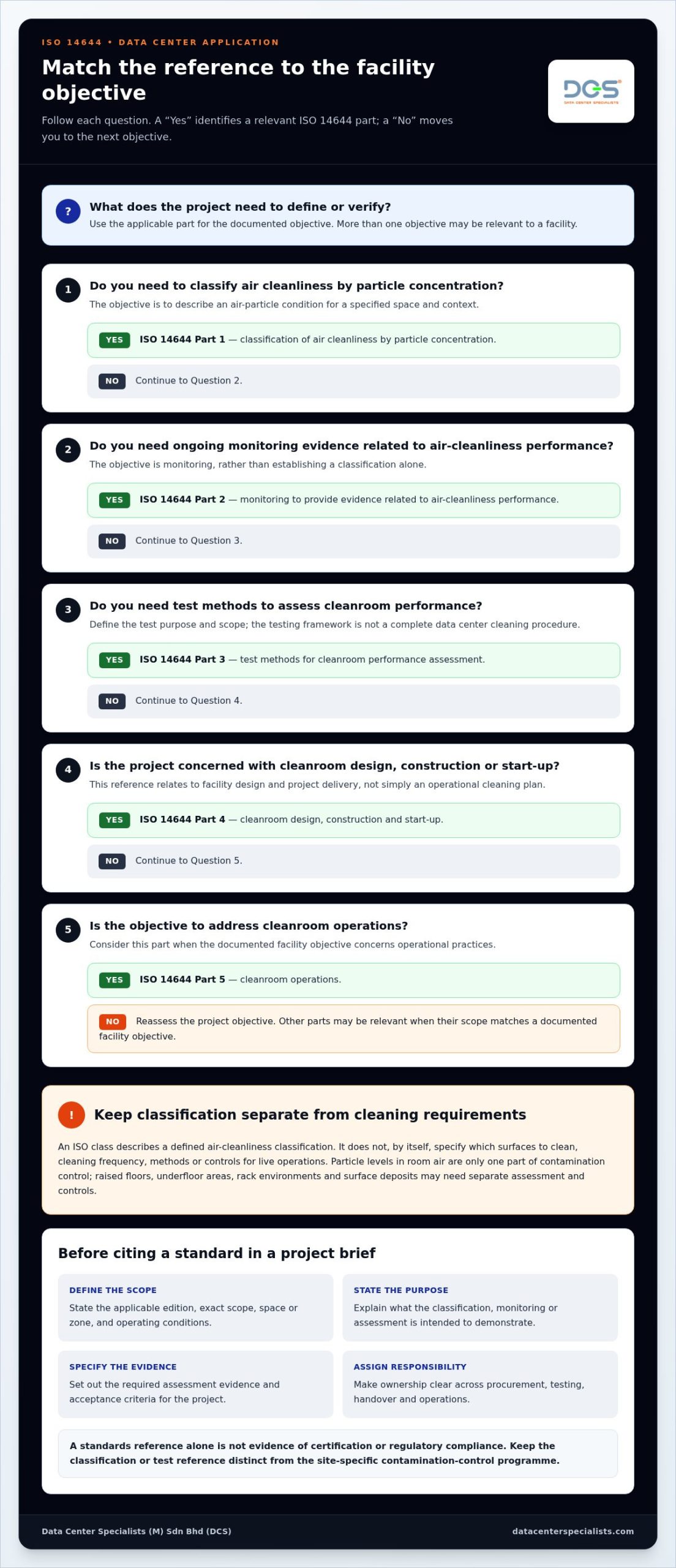
- Part 1 (ISO 14644-1:2015) addresses classification of air cleanliness by particle concentration.
- Part 2 (ISO 14644-2:2015) addresses monitoring to provide evidence related to air-cleanliness performance.
- Part 3 (ISO 14644-3:2019) covers test methods used to assess cleanroom performance. It provides a testing framework, not a complete data center cleaning procedure.
- Part 4 (ISO 14644-4:2022) relates to cleanroom design, construction and start-up.
- Part 5 (ISO 14644-5:2025) addresses cleanroom operations.
These parts are not interchangeable. A project focused on airborne-particle classification may draw on different references from a new-build design brief or an operational monitoring plan. Other parts of the series may be relevant when their scope matches a documented facility objective. Their existence does not make them automatically applicable to every data center.
How to read a standard against project documents
Review each reference as a technical requirement, not just a label. Check its edition, scope, defined terms and any stated acceptance criteria. Then ensure the facility area, operating state and expected evidence are clear to the designer, contractor, operator and testing team.
Resolve ambiguity before procurement or handover. For instance, a document that names a cleanliness class but omits the applicable conditions or assessment evidence may leave teams with different interpretations of acceptance. Similarly, a test reference should not be read as a cleaning method unless the project separately specifies the work and controls required.
For cleanroom ISO standards Malaysia projects, maintain a traceable link between each cited part and the purpose it serves. Define the assessment boundary, required records and responsible party in the project documentation. Where testing is required, cleanroom performance testing can form part of a facility-specific assessment. This helps teams distinguish a test result from certification, and both from broader regulatory compliance.
Does an ISO Cleanroom Class Automatically Set Data Center Cleaning Requirements?
No. An ISO cleanroom class does not, by itself, prescribe every cleaning task in a data center. It describes a defined airborne-particle cleanliness classification. Facility procedures must separately state how physical areas are managed, what work is performed and how the outcome is assessed. Treating a class label as a complete cleaning specification leaves important operational decisions unresolved.
Classification and cleaning specifications answer different questions: one describes an air-cleanliness condition, while the other defines the work and controls used to manage contamination at a site. Both may inform a facility programme, but neither should be assumed to replace the other.
What a class can establish, and what it cannot
A classification provides a defined way to express airborne cleanliness for a specified space and assessment context. It does not automatically define the cleaning scope for every surface, raised-floor void, underfloor plenum, rack or overhead area. Nor does the class alone determine cleaning frequency, methods, access controls or how operations are protected during work.
Put those decisions into facility documentation. State the areas included, operating conditions, contamination-control objectives, acceptance criteria and evidence required. For example, a room-level particle criterion and a requirement to remove construction residue beneath access flooring address different conditions. Make both boundaries explicit in the project specification when both matter.
Why data center conditions affect the control approach
Cleaning scope and controls should reflect the facility’s physical layout, contamination sources and operating constraints. Work beneath raised access floors may involve different exposure and access planning from cleaning rack exteriors or accessible overhead surfaces. In a live environment, coordinate the scope with facility operations so planned work does not create avoidable disruption or introduce contaminants into sensitive areas.
Include electrostatic discharge (ESD) awareness in the planning where equipment and the work environment make it relevant. This does not mean there is one universal ESD cleaning protocol. Specify the site’s applicable precautions, responsibilities and work boundaries, and align them with operational controls. Consider whether the concern is airborne particles, deposited dust, construction residue or another contamination source. Match the assessment and response to the risk being addressed.
- Define the physical scope: Identify the rooms, underfloor spaces, racks and other surfaces included or excluded.
- Set work conditions: Record access requirements, operational coordination and relevant ESD precautions for the planned activity.
- State how outcomes will be judged: Specify evidence or inspection criteria appropriate to the objective.
For cleanroom ISO standards Malaysia projects, avoid using an air class as shorthand for all contamination controls. A documented, site-specific plan connects the facility objective to practical procedures and assessment evidence. Professional data center cleaning can address physical contamination across defined mission-critical areas as part of that broader approach.
How Should Malaysian Teams Turn ISO References into a Clear Facility Specification?
A useful specification connects each standards reference to a defined facility decision. For cleanroom ISO standards Malaysia projects, do not copy a class or part number into a tender without stating why it applies, which areas it covers and how the requirement will be evaluated. A clear brief gives designers, contractors, operators and assessors a shared basis for planning and handover.
Build the specification in sequence:
- Define the purpose. State whether the requirement supports design, handover, an investigation or recurring operational control.
- Set the boundaries. Identify the rooms, zones, surfaces or systems included, and list relevant exclusions.
- Describe the operating state. Specify the conditions under which assessment or work will take place, including the facility state relevant to the project objective.
- Set criteria and evidence. Name the applicable standard edition, project-defined acceptance criteria and records needed to demonstrate the result.
- Assign ownership. Identify who reviews results, manages exceptions and approves changes to the requirement.
Keep design and handover criteria distinct from recurring operational contamination-control needs. A new-build acceptance requirement may apply at a defined project stage, while ongoing procedures need to address routine facility conditions, work planning and records over time. Combining both in one vague clause can leave teams uncertain about whether a requirement applies once, periodically or when conditions change.
Set the scope and acceptance criteria
Be precise about locations and conditions. A requirement for an equipment room, for example, may not automatically include its underfloor plenum, rack surfaces or overhead areas. State the applicable edition and any project-specific thresholds or inspection criteria explicitly. Assign a project role to review evidence, document exceptions and manage changes, so interpretation does not shift between procurement and handover.
For Malaysian projects, distinguish a contractual or design reference from a legal obligation. Do not assume an ISO classification is universally required by Malaysian law. Review the project’s applicable approvals, contract documents and sector requirements, then record which requirements govern the facility and who is responsible for interpreting them.
Choose evidence that matches the question
Choose measurements and records based on the objective. Particle assessment may help characterize airborne conditions; cleaning records can document work performed in defined areas; performance testing can provide evidence against stated criteria. These forms of evidence address different questions. A single test result should not be treated as proof of every aspect of contamination control, including surface cleanliness or the effectiveness of ongoing procedures.
Specify what evidence will be collected, under what conditions, how exceptions will be handled and who will review the findings. A defined scope helps technical teams select a proportionate assessment without implying broader compliance than the evidence supports. For facility-specific testing, discuss cleanroom performance testing requirements with Data Center Specialists.
How DCS Supports ISO-Related Data Center Cleaning and Performance Assessment
Applying a standard in a mission-critical IT environment takes more than citing a class or arranging a measurement. Teams need to connect the documented objective with the physical spaces involved, site conditions and evidence required. Data Center Specialists provides professional data center cleaning, contamination control and Cleanroom Performance Testing in Malaysia.
ISO references can inform assessment objectives, but they do not prescribe DCS cleaning methods or establish that a facility is certified or compliant. The scope and methodology are developed around the facility’s conditions and project requirements.
Connect cleaning scope with facility conditions
A practical scope identifies where contamination may accumulate and what constraints apply. Depending on the facility, work may cover raised access floors, underfloor spaces, server rack environments and other defined areas. Construction residue, operational dust and access restrictions can call for different planning. Document boundaries, relevant precautions and coordination requirements before work begins, particularly in operational spaces.
DCS professional data center cleaning addresses physical contamination in mission-critical environments. The work scope is defined for the facility, rather than presented as a method mandated by an ISO classification. This aligns the planned cleaning activity with the site’s contamination-control objectives and operating conditions.
Use performance testing when evidence is needed
Cleaning and testing answer different questions. A cleaning record can document work completed in specified areas; performance testing can assess defined environmental conditions against an agreed scope. The objective should guide what is assessed and how findings are interpreted. A test result is evidence for that scope, not automatic proof of certification or compliance across every aspect of facility operations.
DCS Cleanroom Performance Testing supports facility-specific assessments when testing evidence is needed. Define the area, operating conditions and intended use of results before setting the assessment scope. This aligns testing with project objectives without treating it as a substitute for operational procedures or contamination-control planning.
For cleanroom ISO standards Malaysia discussions, DCS helps operators, consultants and project teams connect requirements to the physical environment and the evidence they need. A technical discussion can clarify whether the priority is a cleaning scope, performance assessment or both. Contact Data Center Specialists to discuss your site conditions and technical scope.
Turn the Specification into a Practical Next Step
Use your next project review to test whether the written requirement can guide real decisions. Can the facility team identify the areas covered, the evidence expected and the person responsible for reviewing results? If not, resolve those gaps before procurement, handover or assessment begins. A precise brief helps align technical, operational and procurement teams without treating an ISO reference as a substitute for site-level planning.
For teams applying cleanroom ISO standards Malaysia, connect the documented objective with an assessment or physical contamination-control scope that reflects facility conditions. Data Center Specialists works in mission-critical IT environments through professional data center cleaning and Cleanroom Performance Testing, helping teams define relevant work and assessment boundaries.
Bring your project requirements, current documentation and key operational considerations into a technical discussion. Discuss your data center cleaning or performance assessment requirements with DCS, and move forward with a clearer basis for planning.
Frequently Asked Questions
Is ISO 14644 mandatory for data centers in Malaysia?
Not as a general requirement for every facility. Whether ISO 14644 applies to a Malaysian data center depends on documented obligations for that facility, which may arise from project specifications, contracts, sector expectations or other applicable requirements. For an active project, compare the cited standard with approval conditions and contractual schedules, then have technical and compliance stakeholders determine which provisions apply. Avoid describing a voluntary reference as a statutory duty.
Can a data center be classified using ISO 14644?
Yes, where classification serves a stated facility objective. It need not cover every room or the entire site. ISO 14644-1 provides a framework for air-cleanliness classification by particle concentration. A project team might assess a defined technical area, then record why that boundary was selected and how it relates to the intended use. Confirm the space designation and assessment conditions with the responsible engineer before applying a result elsewhere.
Does an ISO 14644 class certify a data center as clean?
No. A class result is not a certificate for the whole facility. It supports only the claim bounded by the assessment and its records. It does not establish, for example, that equipment surfaces are free of deposits, underfloor areas were cleaned or maintenance controls were followed. Keep reports tied to the locations and conditions they cover, and avoid using a room-level result as a general cleanliness claim in handover or procurement records.
What is the difference between ISO 14644 classification and cleanroom performance testing?
Classification identifies the category being claimed; performance testing provides measurement evidence for a defined assessment. A handover team may use a planned test to evaluate a specified condition, while an investigation may use testing to examine a particular concern. The report should state its purpose and applicable edition. This helps prevent results from being compared or interpreted beyond the locations and conditions represented by the assessment.
Do ISO cleanroom standards specify how often a data center must be cleaned?
No universal cleaning interval should be assumed from an ISO class. Set review timing through the facility’s contamination-control programme, then reconsider it when conditions change, such as after construction work, a maintenance intervention or a change in observed contamination. Record why the schedule was selected and review findings over time. This supports a defensible operational decision without implying that classification alone dictates a cleaning calendar.
What information should a Malaysian data center include when referencing an ISO standard?
For cleanroom ISO standards Malaysia projects, identify the standard and edition, intended use, affected area, assessment conditions, acceptance basis, evidence format and the role responsible for approval and records. Use controlled document references and state how revisions will be handled. Before issuing a tender or accepting handover evidence, align the wording with project documents and obtain technical and compliance review appropriate to the facility.