
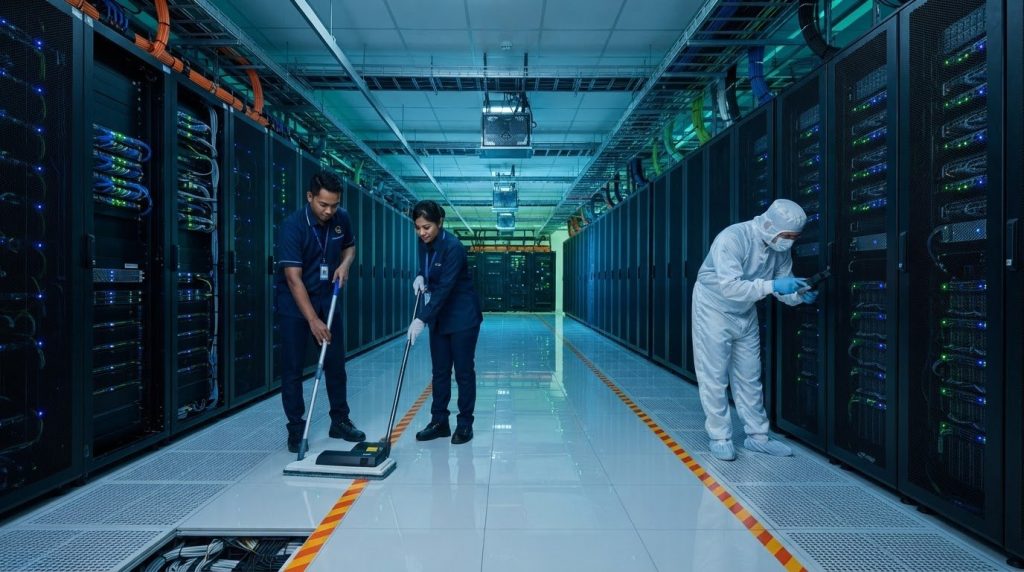
Could a routine cleaning task create an operational risk if it reaches equipment or airflow areas? If you’re asking, can my in-house cleaning team clean our server room, the answer depends on the task, staff training and the controls in place. In-house staff can handle defined housekeeping activities, but cleaning racks, raised floors, underfloor plenums and other contamination-sensitive areas calls for specialist methods.
Existing staff can take on suitable routine tasks, provided their boundaries are clear. This helps prevent accidental contact with equipment, disturbance of contaminants or unauthorized access to controlled areas. A room that looks clean may still have fine particles along its airflow path.
This article explains which tasks an in-house team may support, where specialist contamination control matters, and how to document scope, access and operational coordination. It also covers when visible dust, construction residue or contamination in concealed areas warrants professional assessment. With clear limits and oversight, internal housekeeping can complement specialist data center cleaning while supporting equipment protection and continuity.
Key Takeaways
- Whether can my in-house cleaning team clean our server room depends on the task, staff competence, authorization and site procedures.
- Keep routine housekeeping within approved boundaries. Treat work near equipment, cabling or airflow paths as a technical-scope decision.
- Assign clear responsibilities so staff know which tasks are approved in-house and which need specialist expertise.
- Define access, equipment-contact and material limits before work begins, including who to notify if conditions change.
- Escalate underfloor concerns, post-work debris and contamination in concealed or technical areas for professional assessment.
Can an in-house cleaning team clean a server room? Start with the task
Yes, an in-house team may handle approved, low-intervention housekeeping. Whether a particular task is suitable depends on staff competence, authorization and site procedures. If you’re asking, can my in-house cleaning team clean our server room, assess the work itself rather than relying on the room’s size or a general cleaning routine. Tasks near equipment, cabling, airflow paths or concealed spaces need tighter controls.
Routine tidiness and physical contamination control are different objectives. Housekeeping keeps approved areas orderly. Technical cleaning manages particles and debris without disturbing equipment or disrupting operations. Even a small room may contain sensitive systems and restricted areas.
The video below shows a server-room rebuild and in-house setup. Use it as general context, not as a cleaning procedure for an operational facility.
What counts as routine server-room housekeeping?
Routine housekeeping should be limited to low-intervention tasks the facility has explicitly approved. For example, assigned staff may remove waste from an authorized area if they can do so without touching racks, equipment, cables or other controlled surfaces. The task must also stay within the person’s access permissions and site safety procedures. Generic cleaning habits are not a substitute for facility-specific instructions.
Why a server room is not an ordinary office
Racks, dense cabling, active equipment and managed airflow make familiar tasks more consequential. Dust and other particles can enter equipment through the airflow path, while careless movement around racks or cables can create avoidable operational risk. A server room has environmental requirements that distinguish it from typical office space, including the need for specialized cooling.
Housekeeping keeps approved areas orderly; technical contamination-control cleaning manages particulate contamination in the room and its technical spaces using controlled methods. This distinction helps facility teams assign work according to risk, not simply appearance.
Before assigning a task, define the permitted area, whether staff may move anything, and which materials or methods the site allows. If the procedure does not clearly authorize the work, pause and refer it to the responsible facility or operations lead. Do not improvise around live equipment.
Room dimensions alone are a poor guide to task suitability. A compact server room may contain sensitive equipment and restricted airflow paths, so an in-house team’s role should stay within its approved scope. For work extending into technical areas, professional data center cleaning can complement internal housekeeping through a defined, coordinated scope.
Which server-room cleaning tasks should stay within specialist scope?
The boundary is not simply “inside” or “outside” the room. Consider whether a task touches equipment, changes access to technical spaces or could disturb contamination along the cooling-air path. Visible, accessible areas may be suitable for approved housekeeping, but racks, equipment surfaces, cabling and sensitive finishes need a task-specific assessment. A familiar cleaning method is not automatically appropriate in a mission-critical environment.
Keep raised-floor tiles, underfloor plenums, overhead areas and concealed spaces within technical scope unless the facility has assessed and authorized the work. Lifting a tile or reaching above equipment may expose hidden debris, services or airflow routes. Plan access to these areas with authorized operations personnel, who can determine access requirements and operational constraints.
Tasks that require technical assessment before work
Treat rack interiors, equipment surfaces and areas immediately around operating hardware as controlled work zones. The same applies if a task could disturb cabling, airflow barriers or other installed components. Underfloor and overhead access is not an extension of visible floor cleaning. It may reveal contamination or infrastructure that requires a defined method and coordination with the people responsible for operations.
- Cleaning or wiping equipment, rack surfaces or cable-management areas
- Opening raised-floor tiles or entering an underfloor plenum
- Reaching overhead spaces, cable trays or concealed surfaces
- Using any method that could move particles toward equipment or alter a controlled area
These are triggers for assessment, not a generic work procedure. Before authorizing the task, confirm its scope, access permissions, operational coordination and stop-work point through site procedures.
Why ESD and particulate controls affect the method
Electrostatic discharge, or ESD, is a sudden transfer of static electricity. In an electronic environment, an uncontrolled discharge can threaten sensitive components, even if no visible damage appears. Tools and materials therefore need to suit the surface, contamination type and operating context. Do not assume a cloth, vacuum, chemical or technique is appropriate without site-specific technical approval.
The Uptime Institute discussion of data center cleaning reinforces why this work differs from ordinary cleaning: equipment, methods and protocols must be considered together. A visibly clean surface also does not establish that fine particles are controlled throughout a technical area.
The more a cleaning task can affect equipment, airflow or concealed infrastructure, the greater the competency and controls it requires. Facility managers can use this principle to decide whether approved internal staff can do the work, an operations review is needed, or a specialist scope should be defined.
If a task extends to racks, raised floors or underfloor areas, professional data center cleaning can complement internal housekeeping. Keep the task boundary clear and coordinate the work with facility operations.
In-house team or specialist cleaner: how should responsibilities compare?
Can my in-house cleaning team clean our server room? The practical answer depends on the task and the controls around it. Internal staff may know the room, access arrangements and site procedures, but familiarity alone does not establish competence for technical cleaning. A clear responsibility model lets facility teams retain suitable housekeeping tasks while assigning technical work to people with the relevant methods and authorization.
Use this comparison to set initial boundaries, then apply the facility’s own procedures and operating conditions:
| Task scope | Required familiarity | Controls | Escalation owner |
|---|---|---|---|
| Approved housekeeping in accessible areas | Knowledge of site access rules and the assigned area | Documented task limits, authorization and supervision | Facility manager or designated site lead |
| Work near racks, cabling or operating equipment | Task-specific technical understanding and awareness of operational constraints | Defined scope, approved method and coordination with operations | Authorized operations or technical lead |
| Raised-floor, underfloor, overhead or concealed-area cleaning | Familiarity with the area’s infrastructure and contamination-control needs | Planned access, suitable methods and operational coordination | Facility operations, with specialist support as required |
| Persistent or unexplained contamination | Ability to assess contamination beyond routine housekeeping | Defined assessment and controlled cleaning scope | Facility manager and specialist cleaning team |
When an in-house team may be appropriate
Internal staff may perform low-risk work when procedures document the permitted area and task, personnel are trained and authorized, and supervision is assigned. Keep the work to accessible areas and outside the scope of operating equipment or concealed infrastructure. Site management should determine suitability based on the specific room, task and operating conditions, rather than applying a general rule across every facility.
When specialist support is the more suitable route
Escalate contamination affecting racks, equipment areas, raised floors, underfloor spaces or overhead surfaces. Do the same when dust returns after routine housekeeping, its source is unclear, or the affected area extends beyond the team’s documented scope. Specialist cleaning can be defined around the facility’s requirements, with professional data center cleaning addressing technical areas as a complement to internal operations.
Visible dust is a useful observation, but it does not identify the contamination’s source, location or appropriate removal method. The Data Center Cleaning Standards and Best Practices discussion highlights why area-specific controls and trained personnel matter. Record what was observed and where, then have the responsible operations lead determine whether the approved housekeeping scope still applies.
Assign responsibility by risk and capability, not by who happens to be available. This keeps internal teams involved without treating technical cleaning as an extension of routine room upkeep.
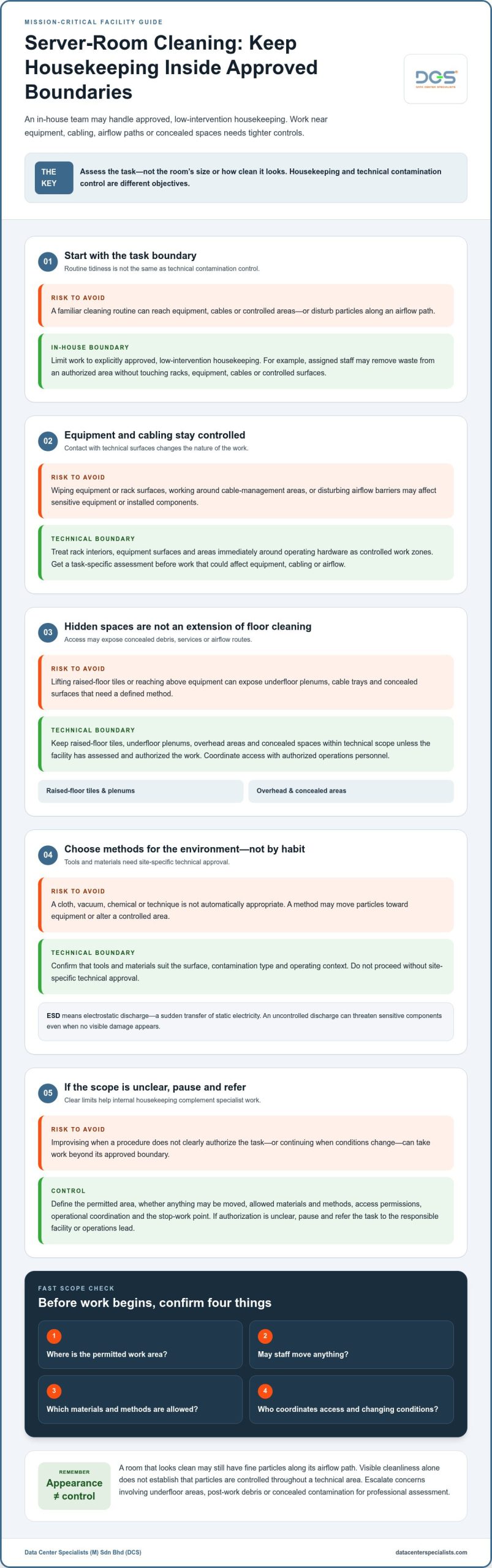
Managing In-House Cleaning in Active Server Rooms
In an active server room, cleaning needs the same operational discipline as other work near critical infrastructure. A short, documented workflow helps prevent scope drift, unauthorized access and interference with ongoing operations. It also tells staff what to do if they find a condition outside the approved task.
Use these steps before and during any approved in-house cleaning activity:
- Define the scope. Identify the area and task, including what must remain untouched.
- Authorize personnel. Assign an operations owner to approve access, staff and permitted actions.
- Coordinate timing. Align the activity with site operations so it does not conflict with planned work or access needs.
- Supervise the task. Confirm staff stay within the approved boundaries and stop if conditions change.
- Record completion. Log the work, observations, personnel and any escalation or scope change.
Set authorization, scope, and operational controls
Before work begins, the operations owner should approve the work area, access arrangements and exact task. Document prohibited actions, such as handling equipment, moving cables or changing room infrastructure. Specify which materials and methods site procedures permit. Staff should know whom to notify and how to stop work if they encounter unexpected contamination, an obstruction or an unsafe condition. No one should improvise beyond the authorization.
Coordinate the activity with data center operations, not just the cleaning schedule. A task may overlap with maintenance, equipment access or other work in the room. The responsible operations lead can account for those conditions and decide whether the planned activity should proceed, change scope or be deferred. This matters especially when access arrangements or environmental conditions could be affected.
Record findings and escalate beyond routine housekeeping
A completion record should make the work traceable without overstating what was done. Note the area, approved task, personnel, observations and any variation from the original scope. If staff encounter dust in a technical or concealed area, record its location and do not extend the task without approval. Escalate the finding to the responsible facility or operations lead for assessment.
Set housekeeping frequency according to observed conditions, operational activity and site risk rather than adopting a universal schedule. Recurring contamination, debris after work in the room or an increase in observed dust may justify reassessing the task scope or requesting specialist assessment. The review should establish whether routine housekeeping remains suitable, not automatically authorize more intrusive cleaning.
If your team is asking, can my in-house cleaning team clean our server room, use the documented scope and escalation route to answer for each task. Where the work requires technical contamination control, Data Center Specialists’ professional data center cleaning can complement internal operations through a defined scope.
When a server room needs professional data center cleaning
Escalate when contamination reaches technical areas or falls outside the team’s approved housekeeping scope. Dust or debris around racks, equipment, raised floors, underfloor plenums or overhead surfaces may need assessment because these areas can form part of the room’s airflow path or contain concealed infrastructure. Post-work debris and contamination with an unclear source are also reasons to pause routine cleaning and define a technical scope.
These conditions do not automatically mean work must stop across the entire room. They do mean the affected area and proposed response should be reviewed with the facility’s operations team. Internal staff can share site knowledge and coordinate access, while specialist cleaning addresses physical contamination in technical spaces using an agreed scope and methodology.
- Dust or debris on racks, equipment areas or nearby technical surfaces
- Concerns beneath raised-floor tiles or within an underfloor plenum
- Residue or particles following construction, maintenance or other work
- Contamination that persists, returns or cannot be clearly located
If the question is “can my in-house cleaning team clean our server room,” these triggers help identify when the answer needs to move beyond routine housekeeping. Record what was observed and where, then have the authorized facility lead decide whether specialist assessment is appropriate. Do not extend an internal task into technical areas simply because contamination is visible.
What a professional cleaning discussion should define
Start by identifying the affected zones and the contamination concern. Clarify whether the room is operational, which access boundaries apply, and how the work must be coordinated with facility procedures. The cleaning methodology should reflect the environment and the agreed project specification. A specification describes the work selected for that project; it should not be presented as proof that a standard mandates one particular cleaning method.
A clear scope also distinguishes physical contamination control from general room tidiness. Data Center Specialists provides professional cleaning for server-room, rack, raised-floor and underfloor areas, with the work defined around the facility’s needs. An assessment can help establish whether the issue is limited to accessible surfaces or extends into technical or concealed spaces.
Coordinate specialist work with the facility team
Plan specialist work with the people who understand the room’s access controls, operational requirements and site procedures. Operations staff can identify restricted areas, coordinate access and communicate conditions that may affect the agreed scope. The cleaning team can then work within those controls rather than relying on assumptions about the facility.
This coordinated approach lets internal staff continue suitable housekeeping while technical cleaning is handled as a defined contamination-control activity. It also provides a clear point for reviewing observations and deciding whether further assessment is needed. Data Center Specialists’ professional server-room cleaning service supports facility teams when the required work extends beyond routine housekeeping.
For contamination in technical or concealed areas, discuss an assessment or cleaning scope with Data Center Specialists. Describe the affected zones and operational requirements so the work can be considered in context.
Set the boundary before the next cleaning task
Use your next housekeeping review to identify where approved in-house work ends and technical cleaning begins. This gives staff a practical basis for deciding can my in-house cleaning team clean our server room for a specific task, rather than relying on assumptions or appearance. If the work reaches beyond routine housekeeping, document the concern and agree on the next step with facility operations.
Data Center Specialists provides professional ISO-standard data center cleaning for server rooms, racks, raised floors and underfloor areas. This physical contamination-control work can complement your internal team’s approved responsibilities while addressing technical cleaning requirements through a defined scope.
Discuss the affected area and operational requirements with Data Center Specialists to define a suitable assessment or cleaning scope. Discuss professional data center cleaning and give your team a clear, coordinated path forward.
Frequently Asked Questions
Is it safe for in-house cleaners to dust server racks?
Only if the exact task is authorized, covered by site procedures and assigned to personnel with suitable training and supervision. Dusting may involve more than an exposed outer panel: vents, cabling and rack interiors can be close to operating equipment. Do not extend an approved surface task to these areas by assumption. If dust is present on or inside equipment, leave it undisturbed and refer the condition to the responsible facility team.
Can our regular cleaning staff vacuum a server room floor?
Use only floor-cleaning equipment and methods that the facility has approved for the specific area. A method suitable for an accessible walkway may not be suitable near equipment or on a raised floor. Permission to clean an exposed surface does not imply permission to lift floor tiles. Site procedures should specify the approved area, equipment, access restrictions and the person responsible for questions or exceptions.
How often should an in-house team clean a server room?
There is no universal schedule for every facility. Set frequency through the site’s documented cleaning program, taking account of observed conditions, operational requirements and changes such as work that may introduce debris. Compare inspection notes over time: recurring dust in the same location may call for a scope review rather than simply more frequent routine cleaning. Keep assigned checks within staff members’ authorized responsibilities.
What should we do if staff find dust under a raised floor?
Stop at the approved task boundary and report the finding to the responsible operations or facilities lead. Do not lift additional tiles or try to remove the dust unless that work has been assessed and authorized. Record the location and what was observed without disturbing nearby infrastructure. The facility team can then determine access and operational implications and whether a specialist assessment is appropriate.
Do in-house cleaners need ESD training before entering a server room?
Requirements should match the person’s assigned task and the facility’s procedures. Entry alone does not authorize someone to handle equipment, approach rack interiors or clean technical surfaces. A staff member approved to remove waste from a designated area has a different scope from someone assigned to work near electronics. Facility management should define role-specific training and authorization, then keep each task within that person’s approved competency.
Does ISO 14644 prescribe how our staff must clean a server room?
Do not treat ISO 14644 as a universal work instruction for staff. ISO 14644-1:2015 classifies air cleanliness by particle concentration; it does not, by itself, define every facility’s cleaning task or method. A project specification and site procedures can set the applicable work scope. Keep those documents distinct, and do not present a selected cleaning methodology as a requirement of the standard.
Can we use our in-house team for routine cleaning and a specialist for deeper work?
Yes. A facility can assign suitable housekeeping internally while defining a separate specialist scope for technical contamination-control work. Make the handover clear. For example, internal staff can report dust near equipment, while the operations lead decides whether the area needs further assessment. Document who approves access, what triggers escalation and how changes to the planned scope are handled. This shared model lets internal site knowledge inform specialist work.
What information should we record after server-room cleaning?
Record enough to show what work took place and flag issues for operations: the approved task and location, personnel, completion time, observations, and any interruption or scope change. For example, note that a task stopped after staff saw debris near a floor opening, then identify who received the report. Follow the facility’s recordkeeping and access-control procedures, and leave out sensitive details that are not needed for operational follow-up.