
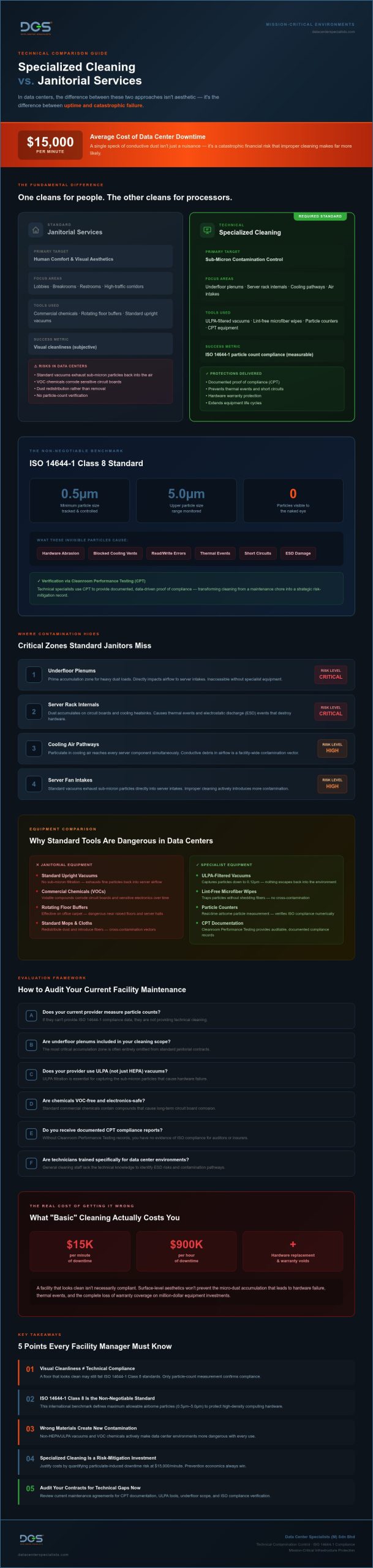
With the average cost of data center downtime now reaching $15,000 per minute, a single speck of conductive dust isn’t just a nuisance; it’s a catastrophic financial risk. You’ve likely invested millions in high-density hardware, yet the most significant threat to your 100% uptime goal often remains invisible. When evaluating specialized cleaning vs janitorial options, it’s vital to recognize that a floor that looks clean isn’t necessarily a floor that meets ISO 14644-1:2015 standards. Surface-level aesthetics won’t prevent the micro-dust accumulation that leads to hardware failure.
We understand the pressure of maintaining these rigorous environments while justifying operational costs. This article provides the technical clarity you need to protect your mission-critical infrastructure. You’ll discover the specific differences between general maintenance and specialized contamination control, including how to align your facility with international IT benchmarks. We’ll provide a clear framework to help you secure the specialized expertise required to ensure continuous operational success and long-term hardware reliability.
Key Takeaways
- Understand the fundamental differences in specialized cleaning vs janitorial services to move beyond surface-level aesthetics toward deep technical decontamination.
- Identify why ISO 14644-1 Class 8 is the non-negotiable cleanliness benchmark for protecting high-density hardware and ensuring warranty compliance.
- Learn how improper cleaning materials, such as standard janitorial chemicals and non-HEPA vacuums, can trigger electrostatic discharge or circuit board corrosion.
- Establish a clear framework to justify specialized maintenance costs by quantifying the risk of particulate-induced downtime and equipment failure.
- Discover how to audit your current facility maintenance contracts to identify technical gaps that threaten mission-critical uptime.
Defining the Scope: Specialized Cleaning vs Janitorial Services
A common misconception in facility management is that all cleaning services are created equal. This assumption often leads to catastrophic hardware failures and unbudgeted downtime. When comparing specialized cleaning vs janitorial services, the distinction lies in the target. One cleans for people; the other cleans for processors. Janitorial work focuses on human comfort and visual aesthetics, while specialized cleaning is a rigorous technical decontamination process designed to protect high-density computing assets.
The “broom and mop” approach is the primary enemy of a data center. Standard cleaning tools often redistribute dust rather than removing it. In a mission-critical environment, even a single quarterly cleaning using improper techniques can introduce enough particulate matter to trigger a thermal event or a short circuit. Specialized services move beyond the surface to ensure that microscopic threats are neutralized before they reach your server intakes.
The Janitorial Approach: Visual Cleanliness
General janitorial services prioritize high-traffic areas like lobbies, breakrooms, and restrooms. Their success metric is visual hygiene. To achieve this, they utilize standard commercial-grade chemicals, rotating floor buffers, and upright vacuums. These tools are effective for office carpet but dangerous in a server hall. Standard vacuums lack the filtration to capture sub-micron particles, often exhausting them back into the air where they are sucked into server fans. Additionally, the chemicals used in general cleaning often contain high levels of volatile organic compounds (VOCs) that can corrode sensitive circuit boards over time.
The Specialized Approach: Contamination Control
Specialized cleaning focuses on the management of sub-micron particulate matter that is invisible to the naked eye. This process targets hidden areas, specifically the underfloor plenums and server rack internals where dust naturally accumulates. Adhering to ISO 14644-1 ensures that air particulate levels remain within safe thresholds for IT equipment. This isn’t just about removing dirt; it’s about maintaining a controlled environment.
Technicians in this field use specialized equipment, such as ULPA-filtered vacuums and lint-free micro-fiber wipes, to prevent cross-contamination. Implementing ISO 14644-1 data center cleaning protocols is a non-negotiable requirement for hardware longevity. These specialized procedures ensure that the cooling air moving through your DCS Smart Racks is free from conductive debris. By focusing on technical decontamination rather than just visual shine, specialized services act as a strategic partner in maintaining your facility’s 100% uptime goal.
Technical Standards: ISO 14644-1 vs. General Surface Hygiene
The distinction between specialized cleaning vs janitorial services becomes most apparent when you measure what’s left behind. In a standard office, “clean” is a subjective visual assessment. In a mission-critical environment, cleanliness is a measurable technical state defined by international standards. Relying on general surface hygiene in a server room ignores the microscopic threats that directly impact hardware life cycles. True decontamination requires meeting specific particulate thresholds that standard janitorial teams aren’t equipped to measure or maintain.
ISO 14644-1: The Particle Count Benchmark
The global benchmark for data center cleanliness is ISO 14644-1 Class 8. This standard dictates the maximum allowable concentration of airborne particles per cubic meter of air. Specifically, technical specialists focus on sub-micron particles ranging from 0.5µm to 5.0µm. While these particles are invisible to the naked eye, they are large enough to cause hardware abrasion, block cooling vents, and cause read/write errors in legacy disk drives.
Implementing rigorous data center dust control protocols is the only way to ensure your facility remains within these limits. Verification is just as critical as the cleaning itself. Technical specialists utilize Cleanroom Performance Testing (CPT) to provide documented proof of compliance. This data-driven approach transforms cleaning from a maintenance chore into a strategic risk-mitigation tool, protecting you from the High Cost of “Basic” Cleaning which often results in unlogged particulate-induced failures.
Equipment and Chemistry: Specialized Tooling
Standard industrial vacuums are effectively dust-redistribution machines in a data center. They lack the specialized filtration required to trap sub-micron debris. Specialized teams exclusively use ULPA or HEPA-filtered vacuums that capture 99.97% of particles at 0.3 microns. Using a standard vacuum in a server hall often exhausts more dust than it collects, pushing contaminants directly into the airflow of high-density racks.
The chemistry involved is equally specialized. Janitorial services frequently use ammonia-based or high-VOC cleaners that can lead to “silver corrosion” on circuit boards. Specialized decontamination requires:
- Anti-Static (ESD) Agents: These maintain the integrity of dissipative floor finishes without building up a static charge.
- Lint-Free Microfibre: Standard rags shed fibers that create new contamination risks. Only specialized, non-shedding materials are acceptable for server racks.
- Deionized Water: This prevents mineral buildup on sensitive surfaces during deep cleaning cycles.
Effective contamination control isn’t just about the tools; it’s about the expertise of the operators. While general staff follow a checklist, technical specialists are trained to navigate live IT environments safely. To ensure your facility meets these rigorous standards, consider scheduling a professional Cleanroom Performance Testing (CPT) to benchmark your current cleanliness levels.
The High Cost of “Basic” Cleaning in Mission-Critical Environments
Choosing between specialized cleaning vs janitorial services often comes down to a misunderstanding of risk. While a general cleaning crew might offer a lower line-item cost, the technical hazards they introduce can lead to millions in losses. Standard janitorial practices aren’t designed for live IT environments; they’re designed for lobbies. In a data center, the wrong vacuum, the wrong chemical, or even an untrained hand near a rack can trigger an immediate outage.
Electrostatic Discharge (ESD) is perhaps the most significant “invisible” threat. Standard commercial vacuums and plastic-bristle brooms generate massive static charges during use. Without specialized ESD-safe equipment, a cleaning technician can inadvertently discharge thousands of volts into a server rack. This doesn’t always cause an immediate crash. It often results in “latent defects,” where components are weakened and fail weeks later without an obvious cause. Specialized teams eliminate this risk by using grounded equipment and dissipative cleaning agents.
Particulate Matter and Hardware Reliability
In high-density environments like those using DCS Smart Racks, the margin for error is non-existent. Micro-dust accumulation is a silent killer of hardware. When these sub-micron particles enter a server, they settle on internal components and heat sinks. Micro-dust acts as a thermal insulator on heat sinks, trapping heat against sensitive silicon and preventing efficient cooling.
As heat builds up, server fans must spin at higher RPMs to maintain safe operating temperatures. This doesn’t just increase your energy consumption and PUE; it accelerates mechanical wear on the fans themselves. Over time, this leads to hardware throttling and eventual failure. Specialized decontamination ensures these particles are removed before they can settle, maintaining the thermal efficiency of your cooling infrastructure.
Chemical Off-Gassing and Corrosion
The air in a data center is constantly recirculated, meaning any chemical introduced stays in the environment. Standard janitorial cleaners often contain high levels of volatile organic compounds (VOCs). These gases can react with the humidity in the room to cause “silver corrosion” or “whisker” growth on circuit boards. This chemical interference is a primary driver for preventing server hardware failure through strict contamination control.
Standard floor waxes present another technical hurdle. Many commercial waxes are non-conductive and can act as an insulator between the floor tile and the copper grounding grid. This breaks the path to ground, allowing static to build up on the floor surface. Specialized maintenance utilizes ESD-safe finishes that preserve the electrical integrity of your raised floor system. By avoiding these “basic” cleaning mistakes, you protect your facility from the human error and chemical risks that non-specialized crews simply aren’t trained to recognize.
How to Evaluate Your Facility’s Cleaning Requirements
Determining your facility’s specific needs requires moving beyond visual inspections. You must quantify the risks based on your specific operational profile. A facility housing financial transactions or hyperscale cloud workloads operates under a different risk threshold than a standard server room. When analyzing specialized cleaning vs janitorial service levels, start by identifying the technical gaps in your current maintenance schedule. A baseline particle count test is the most objective way to begin this process.
The Criticality Audit
Consider the nature of your data and the frequency of hardware turnover. Hyperscale and enterprise environments often face “rack and stack” cycles that generate significant amounts of construction dust and packing fibers. If your facility sees frequent equipment changes, a standard cleaning schedule is likely insufficient. You must also evaluate the effectiveness of your underfloor cleaning data center strategy. The underfloor plenum acts as the lungs of your facility. If it’s contaminated, your servers are breathing debris. High-risk zones like ceiling voids and cable trays also require periodic inspection since they act as reservoirs for stagnant particulate matter.
Selecting a Specialist Partner
A technical partner should be viewed as a guardian of your uptime, not a vendor of a commodity service. Verify that any potential partner holds ISO 14644-1 certification and provides documented training records for their technicians. They must demonstrate a deep understanding of Cleanroom Performance Testing (CPT) to provide verifiable data on air cleanliness levels. This data-driven approach is the only way to ensure compliance with international standards.
Review your existing maintenance contracts for technical specificity. If your server room cleaning is bundled with general office janitorial work, you’re likely paying for a surface-level service that lacks the necessary rigor. The inherent differences in specialized cleaning vs janitorial standards mean that bundling these services often leads to technical oversight. Specialized cleaning should always be a separate line item with its own technical Key Performance Indicators (KPIs). This separation ensures that the high-stakes requirements of the data hall aren’t diluted by the lower standards of general office maintenance. To begin your transition toward a verifiably clean environment, request a comprehensive Cleanroom Performance Testing (CPT) assessment to establish your facility’s baseline particulate count.
Strategic Decontamination: The Data Center Specialists (DCS) Advantage
Selecting a partner for your critical environment requires looking beyond the surface. While the specialized cleaning vs janitorial debate highlights the technical risks of improper maintenance, the real solution lies in choosing a strategic partner that understands the physics of a data hall. DCS doesn’t just clean; we provide a comprehensive Data Center Professional ISO Cleaning Service tailored to the high-stakes requirements of Malaysia’s mission-critical infrastructure. We bridge the gap between general maintenance and technical facility management by treating every server room as a controlled laboratory environment.
Our approach transitions your facility from reactive janitorial cycles to a proactive decontamination strategy. We recognize that high-density environments, particularly those utilizing DCS Smart Racks, have zero tolerance for particulate accumulation. By integrating Cleanroom Performance Testing (CPT) into our workflow, we provide the empirical data necessary to prove your environment meets ISO 14644-1 Class 8 standards. This evidence-based methodology ensures that your hardware operates within the strict environmental parameters required by equipment manufacturers for warranty compliance.
A Holistic Technical Approach
What sets DCS apart is our ability to combine decontamination with advanced technical infrastructure solutions. We don’t view cleaning in isolation. Instead, we integrate it with services like Testing, Adjusting & Balancing (TAB) and a Data Center Energy Assessment to optimize your facility’s overall health. This holistic view allows us to identify how dust accumulation in underfloor plenums might be impacting your airflow efficiency and PUE. DCS has served as a protective guardian for Malaysia’s mission-critical IT environments since our establishment in 2008, setting the benchmark for technical decontamination. We act as an extension of your facility team, ensuring that every square inch of your data hall supports 100% uptime.
Securing Your Uptime Excellence
The transition to professional-grade maintenance provides more than just a clean room; it delivers unwavering reliability and peace of mind. By removing the variables associated with untrained crews and improper equipment, you eliminate the leading causes of accidental downtime. Our technicians are meticulously trained to navigate live IT environments, ensuring that your operations continue without interruption during the decontamination process.
Don’t leave your hardware longevity to chance. The cost of a single particulate-induced failure far outweighs the investment in a technical cleaning program. Take the first step toward securing your facility’s future by conducting a professional audit of your current environmental standards. You can Consult with a DCS Specialist today to schedule a baseline assessment and discover how our specialized expertise can safeguard your mission-critical uptime.
Securing Your Mission-Critical Future
Maintaining a data center requires more than just removing surface dust; it demands a rigorous adherence to technical standards that general maintenance cannot provide. The choice between specialized cleaning vs janitorial services isn’t merely a budgetary decision. It’s a strategic move to eliminate the invisible particulate risks that threaten your hardware’s lifespan. By prioritizing ISO 14644-1 Class 8 compliance, you ensure that your facility remains a high-performance environment capable of supporting the most demanding computing workloads.
Our team brings seasoned expertise through rigorous ISO 14644-1 Specialist Training and proprietary DCS Smart Infrastructure Solutions. We provide national technical support across Malaysia, acting as your strategic partner in operational continuity. Don’t let sub-micron contamination compromise your 100% uptime goal. Take the proactive step to safeguard your infrastructure today. Request a Professional ISO Decontamination Audit and gain the technical clarity required to protect your mission-critical assets. Your facility’s reliability is the foundation of your success, and we’re here to ensure it remains unshakeable.
Frequently Asked Questions
What is the main difference between specialized cleaning and janitorial services?
The primary difference lies in the technical objective and methodology. Janitorial services focus on human comfort and visual hygiene in common areas. Specialized cleaning is a technical decontamination process targeting sub-micron particles that threaten hardware. When comparing specialized cleaning vs janitorial providers, look at the equipment used. Specialists utilize ULPA-filtered vacuums and ESD-safe chemicals; whereas, janitors use standard tools that often redistribute dust into the airflow of your servers.
Is ISO 14644-1 compliance mandatory for all data centers?
While not a government-mandated law in most regions, ISO 14644-1 Class 8 is the non-negotiable industry benchmark for mission-critical uptime. Most hardware manufacturers tie equipment warranties to these air cleanliness standards. Adhering to this standard is essential for enterprise facilities and hyperscalers that require documented proof of environmental control. Without verifiable compliance through Cleanroom Performance Testing (CPT), you risk unlogged hardware degradation and potential warranty claim denials.
Can regular office cleaning chemicals damage server hardware?
Yes, standard commercial-grade chemicals often contain high levels of volatile organic compounds (VOCs) and ammonia. These substances can off-gas in sealed data halls, leading to “silver corrosion” on sensitive circuit boards. Specialized decontamination requires specific non-conductive, low-VOC agents that won’t interfere with IT components. Using the wrong chemistry can also damage anti-static floor finishes, breaking the grounding path and increasing the risk of catastrophic electrostatic discharge (ESD) events.
How often should a mission-critical facility undergo specialized cleaning?
The frequency depends on your facility’s criticality and the volume of hardware turnover. We typically recommend a deep technical decontamination of underfloor plenums and server racks at least once every quarter. High-traffic facilities or those undergoing frequent “rack and stack” cycles might require more frequent attention to manage construction dust. Regular Cleanroom Performance Testing (CPT) helps establish a data-driven schedule by monitoring real-time particle accumulation trends in your specific environment.
Why is underfloor cleaning considered a specialized task?
The underfloor plenum acts as the primary airflow delivery system for your servers. It’s a high-risk zone where dust settles and eventually gets pulled into server intakes. Cleaning this area requires technical knowledge of cable management and grounding systems to avoid accidental disconnections or static build-up. Only specialists trained in critical environment maintenance should handle underfloor tasks to ensure that the cooling air remains free from conductive debris and sub-micron contaminants.
What equipment is required for ISO-standard data center cleaning?
ISO-standard cleaning requires specialized tooling designed for technical environments. This includes ULPA or HEPA-filtered vacuums that capture 99.97% of particles at 0.3 microns. Technicians must also use lint-free micro-fiber wipes and anti-static (ESD) cleaning agents. Standard industrial vacuums are unsuitable because they lack the necessary filtration, often exhausting fine dust back into the room. Specialists also utilize particle counters to provide verifiable data during the decontamination process.
How do I know if my current cleaning crew is causing hardware risks?
You can identify risks by auditing your crew’s equipment and documentation. If your current team uses standard upright vacuums, plastic brooms, or ammonia-based cleaners, they’re likely introducing contamination. Lack of documented ISO 14644-1 compliance or the absence of Cleanroom Performance Testing (CPT) results are significant red flags. If you notice visible dust accumulation on server rack intakes, your current specialized cleaning vs janitorial strategy is failing to protect your hardware.
Does specialized cleaning help with data center energy efficiency?
Specialized cleaning directly impacts energy efficiency by optimizing airflow performance. When underfloor plenums and heat sinks are free from dust, cooling systems operate more effectively. This reduces the workload on server fans and CRAC units, leading to a lower Power Usage Effectiveness (PUE) ratio. Integrating cleaning with a Data Center Energy Assessment or Testing, Adjusting & Balancing (TAB) provides a comprehensive view of how contamination control translates into measurable savings.