
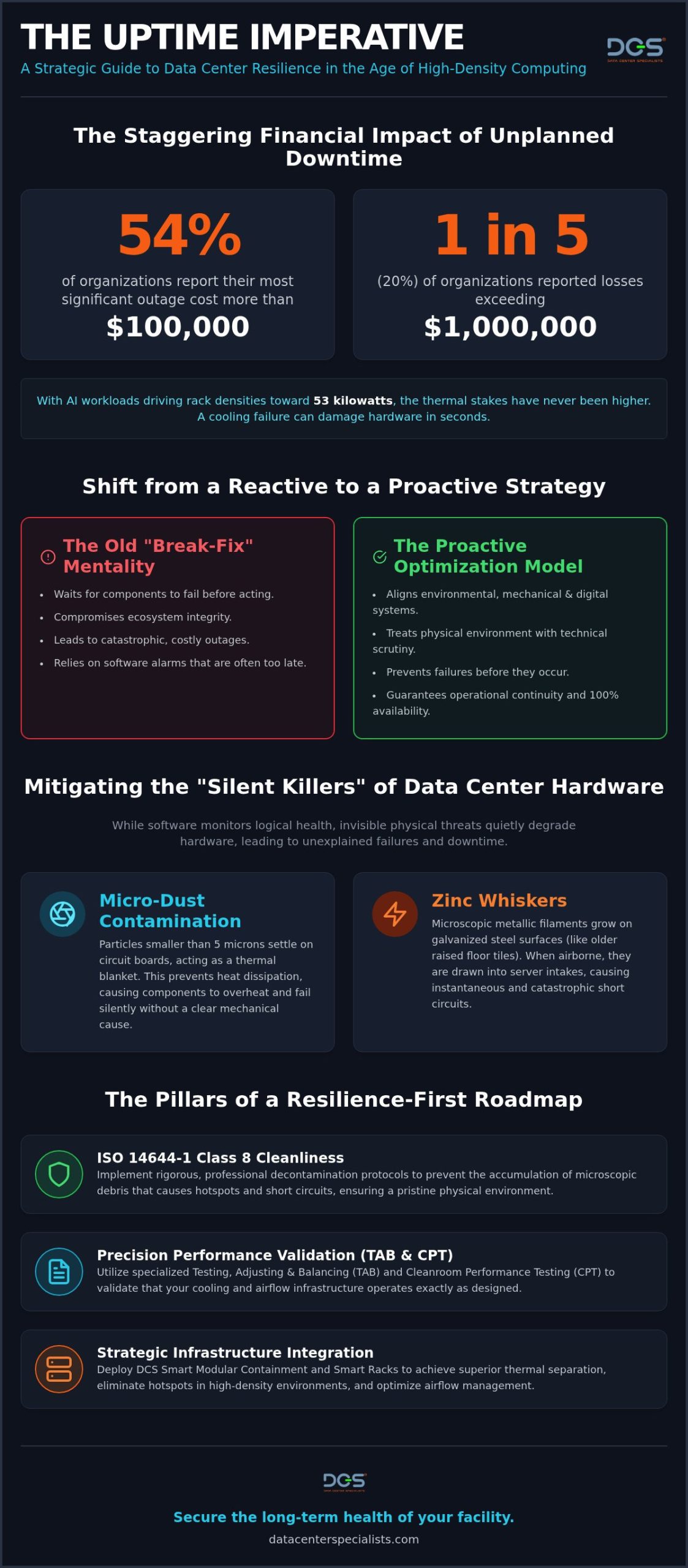
Recent industry data confirms that 54% of organizations saw their most recent significant outage cost more than $100,000, while one in five reported losses exceeding $1 million. In an era where AI-driven infrastructure pushes rack densities toward 53 kilowatts, the margin for error has vanished. You recognize that maintaining a mission-critical facility requires more than just software monitoring; it demands a rigorous commitment to physical environment integrity. Achieving true data center uptime optimization is no longer about reacting to alarms; it’s about mastering the invisible variables that threaten your hardware.
We understand the pressure of managing unexplained hardware failures in high-density racks and the constant struggle against inefficient cooling. This strategic guide details the technical and environmental protocols necessary to eliminate downtime risks and maximize reliability. You’ll discover how to meet ISO 14644-1 Class 8 cleanliness standards, implement precision Testing, Adjusting & Balancing (TAB), and leverage DCS Smart Modular Containment to protect your assets. We’ll outline exactly how these specialized interventions reduce unplanned outages, extend hardware lifespan, and significantly improve your Power Usage Effectiveness (PUE).
Key Takeaways
- Shift from reactive maintenance to a proactive strategy that aligns mechanical and digital systems for absolute operational continuity.
- Master data center uptime optimization by maintaining ISO 14644-1 Class 8 cleanliness standards to prevent micro-dust from causing silent hardware failures.
- Validate cooling performance through specialized Testing, Adjusting & Balancing (TAB) and Cleanroom Performance Testing (CPT) to ensure infrastructure operates as designed.
- Integrate DCS Smart Modular Containment and DCS Smart Racks to achieve superior thermal separation and eliminate hotspots in high-density IT environments.
- Develop a resilience-first roadmap that combines regular energy assessments with scheduled decontamination to secure the long-term health of your facility.
Defining Data Center Uptime Optimization in the Age of High-Density Computing
Modern data center uptime optimization transcends simple software monitoring or hardware redundancy. It represents the proactive alignment of environmental, mechanical, and digital systems to guarantee 100% availability. Relying on a traditional “break-fix” mentality is often the primary catalyst for mission-critical outages. When you wait for a component to fail before intervening, you’ve already compromised the integrity of the entire ecosystem. True optimization has evolved from basic redundancy into a predictive model for operational sustainability. This shift requires a disciplined approach to facility management that treats the physical environment with the same technical scrutiny as the network layer.
Uptime optimization functions as a holistic discipline that encompasses everything from precise contamination control to meticulous airflow management.
To gain a deeper perspective on infrastructure reliability standards, watch this overview of facility classifications:
The Economic Impact of Unplanned Downtime
Outages aren’t just technical glitches; they’re financial catastrophes. Recent 2026 data indicates that 54% of organizations face costs exceeding $100,000 for a single significant event, while one in five reports losses over $1 million. Beyond the immediate loss of revenue, the reputational damage can be irreversible for service providers. With AI and GenAI workloads now driving rack densities toward 53 kilowatts, the thermal stakes have never been higher. A cooling failure in these high-density environments leads to hardware damage within seconds. Improving your Power Usage Effectiveness (PUE) isn’t just a sustainability goal. It’s a reliability metric. Efficient energy use reduces the thermal stress on your components, directly extending their operational lifespan.
Beyond Tier Standards: Operational Excellence
Designing a facility according to high-level Data center tiers provides a strong foundation, but it doesn’t guarantee performance. Even a Tier IV facility can fail if it lacks a rigorous maintenance roadmap and expert oversight. Real data center uptime optimization requires shifting from reactive monitoring to proactive infrastructure hygiene. Utilizing a Data Center Professional ISO Cleaning Service ensures your environment remains compliant with ISO 14644-1 standards. This level of care prevents the accumulation of microscopic debris that causes hotspots and short circuits. It’s the difference between a facility that looks reliable on paper and one that actually delivers 100% uptime in a high-stakes computing environment.
Mitigating the Silent Killers: Contamination Control and Airflow Precision
Physical contaminants act as silent saboteurs within the data hall. While software monitoring tracks logical health, micro-dust accumulation quietly degrades hardware performance. These particles, often smaller than 5 microns, settle on Printed Circuit Board Assemblies (PCBA), acting as a thermal blanket that prevents heat dissipation. This leads to “silent” failures where components overheat and fail without a clear mechanical cause. Effective data center uptime optimization requires a meticulous approach to environmental hygiene. You must eliminate these microscopic threats before they compromise your infrastructure.
Zinc Whiskers present an even greater danger to operational continuity. These microscopic metallic filaments grow on galvanized steel surfaces, such as the underside of older raised floor tiles. When disturbed, they become airborne and are sucked into server intakes, causing instantaneous short circuits. Remediation requires specialized vacuuming and chemical treatment to meet ISO 14644-1 Class 8 standards. Establishing a regular decontamination schedule is the only way to ensure these metallic contaminants don’t reach critical IT equipment.
The Science of Micro-Dust and Server Reliability
Standard air filters can’t capture every particle. Micro-dust that bypasses filtration creates high-resistance paths on sensitive electronics. This contamination forces server fans to spin faster, increasing energy consumption and mechanical wear. Don’t mistake general janitorial services for a solution. Standard cleaning introduces more contaminants than it removes through improper chemicals and non-HEPA equipment. Professional decontamination involves specialized tools and anti-static agents designed specifically for high-density IT environments.
Airflow Management as a Reliability Strategy
Precision airflow is the foundation of Data Center Cooling Optimization. Stagnant air pockets and bypass airflow create localized hotspots that trigger server throttling. In many facilities, cable congestion in underfloor spaces acts as a physical barrier to cool air delivery. Clearing these obstructions and performing deep underfloor cleaning ensures that your HVAC systems operate at peak efficiency. Combining contamination control with airflow balancing creates a dual-layered defense that is central to long-term data center uptime optimization.
Ensuring your facility remains within strict environmental thresholds is a strategic investment in reliability. To maintain these critical standards, consider partnering with an expert for a comprehensive facility audit.
The Role of Technical Testing: CPT and TAB in Reliability Engineering
Design topology establishes the potential for reliability, but only rigorous field-level validation guarantees it. Many facilities fail to reach their theoretical uptime because their mechanical systems are out of sync with actual heat loads. Technical testing serves as the bridge between engineering intent and operational reality. Integrating these rigorous testing protocols is a cornerstone of effective data center uptime optimization, ensuring that your investment in high-end hardware isn’t undermined by invisible mechanical failures.
Testing, Adjusting & Balancing (TAB) ensures air is delivered in the correct volume to the correct location at the correct pressure. This process is essential for ensuring HVAC systems deliver the designed cooling capacity to every rack. Without this precision, even the most advanced cooling units can’t prevent localized thermal events. Specialized HEPA filter leak testing is also required in high-specification server rooms to ensure the filtration barrier remains uncompromised.
Testing, Adjusting & Balancing (TAB) Explained
TAB involves the systematic measurement and adjustment of air distribution throughout the facility. It identifies “blind spots” in cooling infrastructure that standard monitoring software often misses. This level of precision is a key driver for data center uptime optimization. For example, sensors might report a safe average room temperature while specific rack inlets suffer from air starvation due to improper damper settings. By balancing these flows, you eliminate hotspots and reduce energy expenditure by preventing over-cooling in non-critical areas. The result is balanced rack temperatures and a measurable reduction in the stress placed on your cooling plant.
Cleanroom Performance Testing (CPT) for IT Environments
Cleanroom Performance Testing (CPT) acts as a vital validation tool for mission-critical environmental health. It’s not enough to perform periodic cleaning; you must verify that your contamination control strategy actually works. CPT provides the empirical data required to prove your facility maintains the necessary standards for high-density computing.
- Particle count testing: This measures the concentration of airborne particles to verify compliance with ISO 14644-1 Class 8 thresholds.
- Pressure differential testing: This prevents external contaminants from entering the white space by ensuring the room maintains proper positive pressure.
- Airflow visualization: By using “smoke tests,” technicians map real-world air movement around server racks. This reveals bypass airflow or recirculation issues that purely digital models might overlook.
Strategic Infrastructure: Modular Containment and Intelligent Rack Systems
Digital monitoring tools provide a window into your facility’s health, but they can’t fix a fundamentally flawed physical environment. Effective data center uptime optimization requires a commitment to structural thermal separation. Without physical isolation, your cooling units are often fighting against “recirculation,” where hot exhaust air mixes with the cold supply. This mixing forces HVAC systems to over-work, driving up energy costs and increasing the risk of mechanical failure. By implementing rigorous containment strategies, you ensure every watt of cooling is delivered exactly where it’s needed.
Comparing Hot Aisle and Cold Aisle containment is essential for maximizing thermal separation. Cold Aisle Containment (CAC) encloses the cold air supply, while Hot Aisle Containment (HAC) captures the exhaust. Both approaches aim to reduce Power Usage Effectiveness (PUE) by creating a predictable thermal environment. This physical isolation is particularly critical as AI-driven infrastructure pushes rack densities toward 53 kilowatts. At these levels, even a minor mixing of air streams leads to immediate server throttling or hardware damage. Physical barriers are the only way to maintain the pressure differentials required for high-density cooling.
DCS Smart Modular Containment: A Technical Overview
One of the primary challenges in data center uptime optimization is upgrading existing facilities. DCS Smart Modular Containment provides a scalable solution for these “brownfield” environments. These systems allow for the rapid deployment of thermal barriers without the need for extensive construction or operational downtime. Because they’re modular, they adapt to changing rack configurations as your density increases. This flexibility prevents the creation of stagnant air pockets and ensures your cooling infrastructure remains efficient even as you scale your compute capacity. Installing these systems without interrupting mission-critical operations is a hallmark of strategic facility management.
The Evolution of DCS Smart Racks
Intelligent rack systems have moved beyond simple enclosures to become active participants in reliability engineering. DCS Smart Racks integrate advanced sensors and management tools directly into the cabinet. This provides granular visibility into cabinet-level environmental metrics that room-level sensors often miss. When these racks are paired with a professional ISO cleaning regimen, you achieve total environment control. This synergy supports high-density computing by optimizing airflow paths and ensuring micro-dust doesn’t settle on sensitive components. It’s a comprehensive approach that protects your hardware and ensures long-term operational continuity.
If you’re ready to modernize your cooling infrastructure and protect your high-density assets, explore our DCS Smart Modular Containment solutions today.
Developing a Resilience-First Maintenance Roadmap
Establishing a resilience-first maintenance roadmap requires moving beyond generic checklists. A disciplined data center uptime optimization strategy relies on a tiered schedule of physical and technical interventions. This cadence ensures that physical degradation never outpaces your digital monitoring capabilities. You must cultivate a culture of hygiene that treats the data hall as a high-precision laboratory rather than a warehouse. Every technician entering the white space should understand that even minor contamination directly impacts infrastructure reliability.
A strategic schedule typically includes the following milestones:
- Quarterly: Perform particle count testing and high-level surface decontamination to maintain ISO 14644-1 standards.
- Bi-annually: Execute deep underfloor cleaning and airflow obstruction audits to ensure cooling efficiency.
- Annually: Conduct a full Data Center Energy Assessment alongside comprehensive TAB and CPT validation.
The Data Center Energy Assessment
Energy efficiency and reliability are two sides of the same coin. By using thermal imaging and comprehensive energy audits, you’ll identify “low-hanging fruit” for immediate uptime improvement. These assessments reveal hidden failure points, such as overloaded circuits or failing CRAC units, before they trigger a critical alarm. This data allows you to develop an ROI-based roadmap for infrastructure upgrades. It ensures your capital expenditure is directed where it most impacts operational continuity and reduces your Power Usage Effectiveness (PUE).
Partnering for Operational Continuity
Maintaining hyperscale reliability in Malaysia requires a partner who understands both national standards and the unique challenges of local environmental factors. Specialized expertise in CPT, TAB, and ISO-standard cleaning isn’t optional; it’s a prerequisite for mission-critical success. You need a strategic partner that acts as a protective guardian of your technical environment. Partnering with a single-source provider for both hardware solutions, like DCS Smart Racks, and technical services ensures a cohesive defense against downtime.
Successful data center uptime optimization isn’t a final destination. It’s a continuous process of technical vigilance, meticulous maintenance, and precision engineering. By integrating these physical and environmental strategies, you secure the peace of mind that comes from knowing your infrastructure is truly resilient.
Securing Your Infrastructure for the Future of High-Density Computing
Operational continuity is the result of meticulous environmental control and technical precision. By prioritizing ISO 14644-1 standard compliance and integrating modular infrastructure, you protect your hardware from the silent threats of contamination and thermal stress. Validating your facility through specialized TAB and CPT testing ensures your mechanical systems perform as engineered. This proactive approach to data center uptime optimization transforms your facility from a reactive environment into a resilient, high-performance asset.
Expertise matters when the stakes are this high. Our team provides Malaysia-wide service coverage backed by deep specialized TAB and CPT technical expertise. We act as your strategic partner in maintaining mission-critical reliability. Take the first step toward a more stable and efficient facility. Consult with our specialists to optimize your data center uptime today and gain the peace of mind that comes from professional environmental stewardship. Your infrastructure deserves the highest standard of care.
Frequently Asked Questions
What is the difference between specialized data center cleaning and standard janitorial services?
Specialized cleaning utilizes HEPA-filtered vacuums and anti-static agents specifically designed to meet international ISO standards. Standard janitorial services often use mop buckets and non-filtered vacuums that introduce moisture and redistribute micro-dust into the air. Our Data Center Professional ISO Cleaning Service focuses on sub-floor and rack-level decontamination. This technical approach is essential for data center uptime optimization as it prevents the hardware failures associated with microscopic particulate accumulation.
How often should a mission-critical data center undergo ISO-standard cleaning?
Most facilities require a deep decontamination of sub-floor and surface areas at least once per year. High-density environments or halls with frequent hardware rotations often benefit from quarterly or bi-annual schedules. Regular cleaning maintains the ISO 14644-1 Class 8 threshold required for optimal server health. Consistent scheduling ensures that micro-dust doesn’t reach critical levels, protecting your long-term operational continuity and reducing the risk of sudden equipment failure.
What are the primary benefits of Testing, Adjusting & Balancing (TAB) for server rooms?
TAB ensures that air distribution systems deliver the exact cooling capacity required by your actual IT load. The primary benefit is the elimination of localized hotspots that digital monitoring software often misses. By balancing air pressure and volume, TAB reduces energy consumption and prevents cooling units from over-working. This technical validation is a fundamental component of data center uptime optimization, ensuring your HVAC infrastructure operates at peak efficiency.
Can modular containment systems be installed in an active data center without downtime?
DCS Smart Modular Containment is specifically designed for rapid deployment in live “brownfield” environments. The installation process utilizes pre-engineered components that fit existing rack rows without requiring structural changes or power interruptions. This allows facility managers to improve thermal separation and cooling efficiency while maintaining 100% availability. It’s a strategic solution for upgrading legacy halls to support modern, high-density AI and GenAI workloads without operational risk.
How does micro-dust accumulation impact Power Usage Effectiveness (PUE)?
Micro-dust acts as a thermal insulator on server components, forcing internal fans to run at higher speeds to maintain safe temperatures. This increased fan activity raises the total power draw of the IT equipment. Additionally, clogged air intakes force the cooling plant to work harder to overcome airflow resistance. Removing these contaminants through professional cleaning directly lowers your facility’s energy consumption and improves your overall PUE rating by reducing mechanical strain.
What is ISO 14644-1 and why is it relevant for data center uptime optimization?
ISO 14644-1 is the international standard for cleanrooms and controlled environments, specifically measuring airborne particulate concentrations. Data centers typically target Class 8 compliance to protect sensitive electronics from conductive or corrosive dust. Adhering to this standard is a core pillar of data center uptime optimization. It provides an empirical benchmark for environmental hygiene, ensuring your facility remains a safe and reliable space for high-density computing assets.
What happens if a data center fails a Cleanroom Performance Test (CPT)?
A failed CPT indicates that particulate levels or pressure differentials have exceeded safe thresholds for mission-critical hardware. This failure serves as an early warning sign of potential hardware failure or cooling inefficiency. In such cases, we recommend a targeted Data Center Professional ISO Cleaning Service to remediate the contamination. Following the cleaning, a re-test is performed to validate that the environment has returned to ISO Class 8 compliance and is safe for operation.
How do DCS Smart Racks contribute to infrastructure reliability?
DCS Smart Racks integrate intelligent management and environmental sensors directly at the cabinet level. This allows for granular monitoring of temperature and airflow precisely where the hardware resides. By providing real-time data on the rack’s micro-climate, these systems enable faster response to thermal issues. They work in tandem with modular containment to ensure that high-density loads receive the dedicated cooling needed to prevent thermal throttling and unplanned outages.