
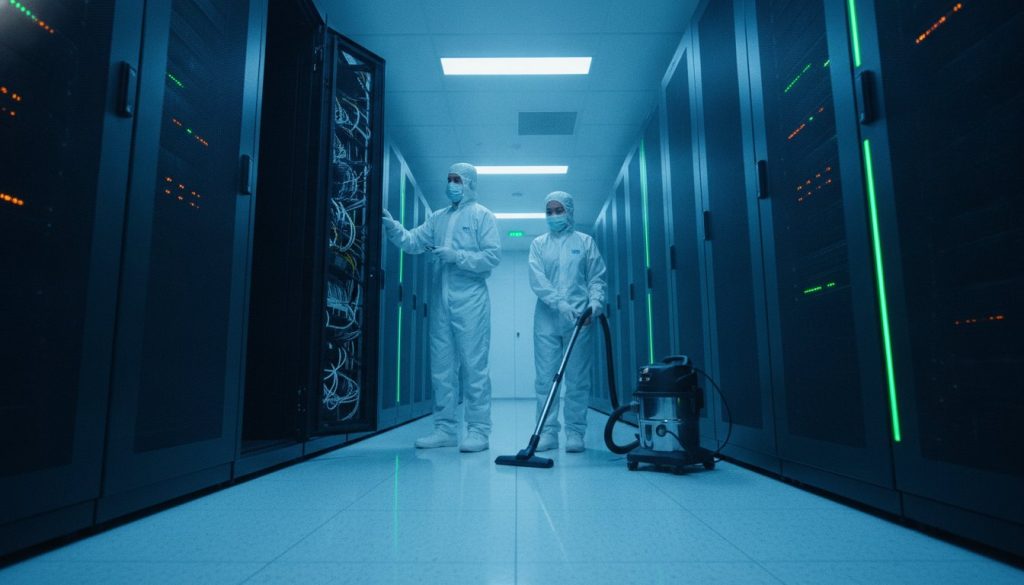
Your “visibly clean” facility might be hosting a microscopic threat capable of voiding warranties from major manufacturers like NVIDIA or Cisco. While a room may look spotless to the naked eye, silent hardware failures often stem from sub-micron particulates that general janitorial services simply aren’t equipped to handle. You know that maintaining mission-critical uptime in Malaysia requires more than just power redundancy; it demands a precise, scientific approach to ISO 14644-1 data center cleaning to ensure environmental integrity.
Mastering these technical requirements is the only way to move from subjective cleanliness to verified, measurable reliability. We’ll help you understand the ISO 14644-1:2015 standard to eliminate contamination risks and ensure mission-critical uptime by meeting the rigorous ISO Class 8 thresholds recommended by ASHRAE. This guide explores specific particle count limits, provides a framework for maintaining a particulate-free environment, and explains how to secure undeniable proof of compliance for your stakeholders. It’s time to protect your infrastructure with the disciplined precision that your high-density computing assets require.
Key Takeaways
- Understand why ISO 14644-1:2015 is the global benchmark for air cleanliness and why “visibly clean” is no longer sufficient for modern IT halls.
- Identify the specific particulate thresholds for ISO Class 8 to ensure your facility meets the stringent requirements set by major hardware OEMs.
- Develop a comprehensive ISO 14644-1 data center cleaning strategy covering subfloor, raised floor, and high-level zones to mitigate the risk of latent hardware failure.
- Recognize the direct correlation between micro-dust accumulation and increased Power Usage Effectiveness (PUE) caused by compromised cooling efficiency.
- Leverage Cleanroom Performance Testing (CPT) to secure the documented evidence of environmental integrity required for stakeholder assurance and technical audits.
The Role of ISO 14644-1 in Data Center Management
ISO 14644-1 is the definitive international framework for classifying air cleanliness by particle concentration. Originally developed for pharmaceutical and semiconductor cleanrooms, the ISO 14644 standards have been integrated into the data center industry as IT hardware has become increasingly sensitive to microscopic pollutants. Transitioning from generic server room maintenance to a rigorous protocol for ISO 14644-1 data center cleaning isn’t just about appearances. It’s a strategic move to protect multi-million RM investments in high-density infrastructure across Malaysia.
The industry has evolved significantly from the days of “broom and bucket” cleaning. Modern IT halls are now treated as controlled environments where every cubic meter of air is accounted for. Major hardware manufacturers like NVIDIA, Dell, and Cisco now explicitly state that their equipment must operate within ISO Class 8 environments. Failing to maintain these standards can lead to denied warranty claims and increased insurance premiums. When a hardware failure occurs, insurers often investigate the environmental conditions to determine if negligence or inadequate contamination control played a role in the downtime.
Why General Janitorial Services Fail IT Environments
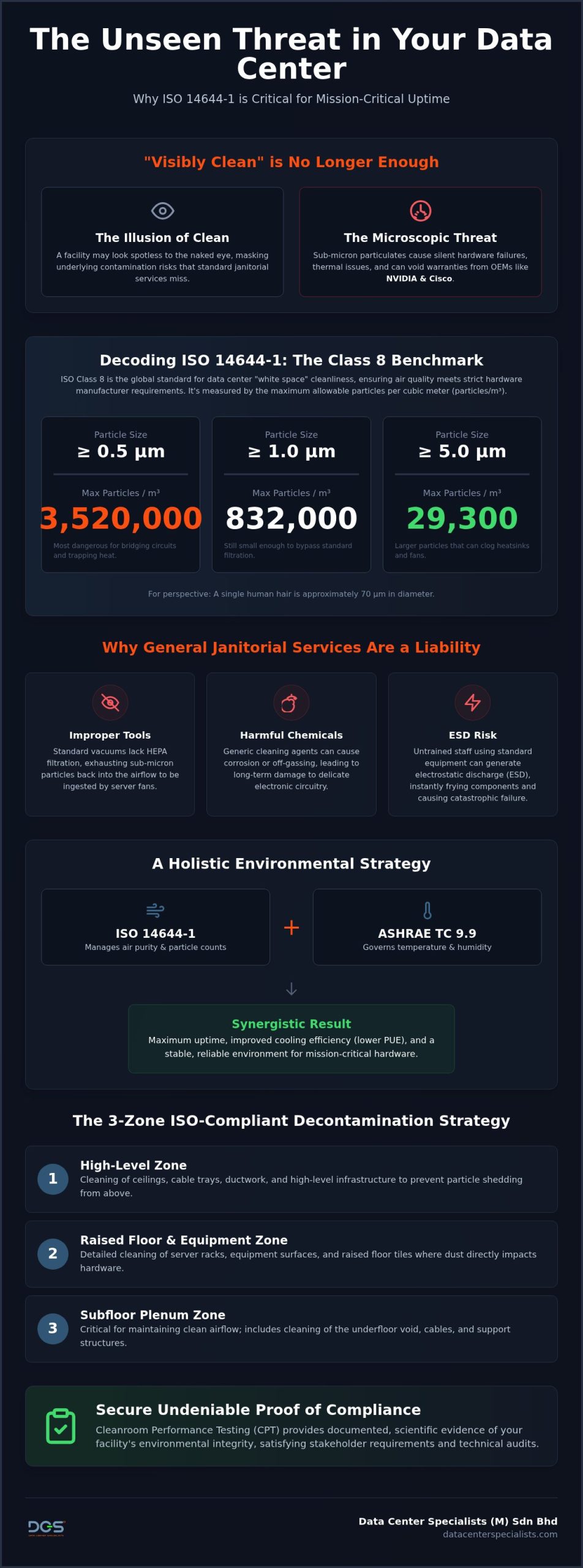
Standard cleaning crews use tools and chemicals that are dangerous in a mission-critical hall. Traditional vacuums lack the ultra-fine HEPA filtration required to trap sub-micron particles; instead, they exhaust these contaminants back into the airflow where they’re sucked into server fans. Generic cleaning agents can cause corrosion or off-gassing that damages delicate circuitry over time. Most importantly, general staff lack training in Electrostatic Discharge (ESD) protocols. One wrong move with a standard mop or cloth can generate a static charge that fries a server’s motherboard instantly, leading to catastrophic failure that was entirely preventable. Understanding the critical differences in specialized cleaning vs janitorial approaches is essential for any facility manager responsible for mission-critical infrastructure.
ISO Standards vs. ASHRAE TC 9.9 Guidelines
While ISO 14644-1 focuses on particle counts, ASHRAE TC 9.9 provides the framework for temperature and humidity. These two standards are deeply linked. High humidity can cause particles to clump and bridge circuits, while low humidity increases the risk of ESD. Effective ISO 14644-1 data center cleaning ensures that air quality remains high enough so that your cooling systems don’t have to work harder to push air through dust-clogged heat sinks. The synergy between ISO 14644-1 and ASHRAE TC 9.9 creates a holistic environment where thermal stability and air purity work together to maximize mission-critical uptime.
Decoding Particulate Classes: What Clean Actually Means
Air cleanliness is measured on a logarithmic scale ranging from ISO Class 1 to ISO Class 9. For data center operators, understanding where your facility sits on this spectrum is the difference between operational stability and unexpected hardware failure. While Class 1 represents the pinnacle of cleanroom technology, the global benchmark for “white space” environments is ISO Class 8. This standard ensures that airborne contamination remains below levels that could compromise the delicate mechanical and electrical components of modern servers.
Adhering to a consistent regimen of ISO 14644-1 data center cleaning allows managers to quantify their environment’s health with scientific accuracy. In specialized cases, such as high-density GPU clusters or optical labs, operators may need to target ISO Class 7 or even Class 6. These stricter environments require significantly more robust filtration and more frequent technical decontamination to prevent microscopic interference with high-speed data transmission and sensitive optical components.
Understanding Particle Concentration Limits
The math behind the ISO 14644-1:2015 standard is precise and non-negotiable. For a facility to achieve an ISO Class 8 rating, it must contain no more than 3,520,000 particles per cubic meter of air at the 0.5 micron size. At the 1.0 micron level, the limit drops to 832,000, and for 5.0 micron particles, the threshold is just 29,300. These 0.5 micron particles are particularly dangerous because they’re small enough to bypass standard filters but large enough to bridge the microscopic gaps on a printed circuit board. When these particles settle, they act as an insulator, trapping heat directly against the silicon and forcing internal fans to spin at higher RPMs. This leads to premature bearing failure and a measurable increase in power consumption across the hall.
Class 8 vs. Class 9: The Critical Difference
It’s easy to assume that if a room feels comfortable for humans, it’s safe for hardware. However, ISO Class 9, which represents typical office air, is often ten times more contaminated than the Class 8 standard. While visible dust is a nuisance, the “unseen” threat of micro-dust is what causes “silent” hardware failures. These particulates accumulate inside power supplies and heat sinks, creating a layer of “dust felt” that chokes airflow. If you’re unsure if your facility meets these metrics, a professional Cleanroom Performance Testing (CPT) can provide the empirical data needed to validate your environment. Transitioning from Class 9 to Class 8 isn’t just a cleaning task; it’s a fundamental shift in how you manage the air that keeps your mission-critical assets running.
Beyond Aesthetics: The Science of Contamination Failure
“It looks clean” is perhaps the most dangerous assumption a facility manager can make. In a mission-critical hall, the contaminants you can’t see pose the greatest risk to your infrastructure. Micro-contamination acts as a thermal blanket, settling onto sensitive components and insulating them against the very cooling systems designed to protect them. When dust clogs heat sinks, internal temperatures spike, forcing server fans to run at higher RPMs. This doesn’t just lead to premature fan bearing wear; it causes a measurable increase in Power Usage Effectiveness (PUE) as your cooling plant works harder to compensate for reduced airflow efficiency.
Implementing a rigorous schedule for ISO 14644-1 data center cleaning is a technical necessity for managing these “silent” failures. Beyond thermal insulation, particulate accumulation can lead to electrical tracking and parasitic leakage. Over time, these microscopic layers create conductive paths across circuit boards, leading to intermittent signal errors or total system crashes that are notoriously difficult to diagnose. Protecting your hardware requires moving beyond superficial sweeping to a scientific decontamination protocol.
Zinc Whiskers and Conductive Contaminants
Zinc whiskers represent one of the most catastrophic threats to modern IT environments. These microscopic, needle-like structures grow from the underside of older electroplated floor tiles and are easily disturbed by foot traffic or air turbulence. Once airborne, they’re pulled into server intakes where they settle on PCBs, causing immediate short circuits. In Malaysia, our high-humidity environment accelerates this risk. Moisture acts as a catalyst, increasing the conductivity of settled dust and promoting the rapid corrosion of metal surfaces. Without specialized underfloor decontamination, these conductive filaments can bypass even the most advanced filtration systems.
Chemical Contamination and Gaseous Threats
Particulates aren’t the only concern. Data centers located in industrial or high-density urban areas across Malaysia often face gaseous threats like sulfur dioxide and chlorine. These chemicals react with the copper and silver used in modern server components, leading to “creeping” corrosion that eats away at connectors and solder joints. This chemical degradation is often invisible until a component fails during a routine reboot or failover test. Combining specialized air filtration with ISO 14644-1 data center cleaning ensures that both physical and chemical residues are neutralized before they can compromise your mission-critical uptime. Don’t wait for a hardware alert to address your air quality; proactive environmental management is the only reliable safeguard against these invisible threats.
Implementing an ISO-Compliant Decontamination Strategy
Achieving a particulate-free environment requires a disciplined, multi-tier strategy that addresses every zone within the facility. Standard cleaning routines fail because they treat the data center like an office, ignoring the hidden reservoirs of dust in subfloor voids and high-level cable trays. A professional ISO 14644-1 data center cleaning protocol follows a methodical three-tier approach: subfloor plenum decontamination, raised floor surface cleaning, and high-level infrastructure wiping. This comprehensive coverage ensures that air moved by CRAC units remains pure as it travels to the cold aisle, preventing the redistribution of settled contaminants into server intakes.
Establishing a preventative maintenance schedule is essential for long-term reliability. Depending on foot traffic and construction activity, most Malaysian facilities require a deep technical clean at least twice per year to maintain ISO Class 8 status. This schedule creates a robust audit trail, providing stakeholders and insurers with documented proof of environmental due diligence. By moving from reactive cleaning to a scheduled decontamination framework, you eliminate the “silent” accumulation of particulates that leads to intermittent hardware errors.
Step 1: The Particulate Matter Survey
Precision begins with data. Use calibrated laser particle counters to establish a baseline of air quality across multiple sampling points. In Malaysia, focus on ingress hotspots such as loading bays, man-trap entries, and areas adjacent to CRAC units where external pollutants often bypass filtration. A baseline survey establishes the quantitative starting point required to customize the decontamination scope for your specific facility. This empirical data allows you to identify which zones require immediate intervention and which are maintaining their target class.
Step 2: Specialized Decontamination Protocols
Execution requires technical equipment designed for critical environments. Use HEPA-filtered vacuums capable of trapping 99.97% of particles down to 0.3 microns to ensure that micro-dust isn’t simply exhausted back into the hall. Apply antistatic (ESD) wiping to the exterior of server racks and patch panels using specialized micro-fiber cloths and non-conductive cleaning agents. Focus heavily on the underfloor plenum; removing debris from this area is the only way to ensure clean airflow delivery. This specialized ISO 14644-1 data center cleaning process prevents the buildup of conductive residues and thermal insulators on your mission-critical assets.
Step 3: Verification and CPT Certification
The final stage is formal validation through Cleanroom Performance Testing (CPT). Post-cleaning testing verifies that the particle counts have returned to ISO Class 8 levels or better. Third-party validation is crucial for mission-critical uptime; it provides an unbiased report that satisfies technical audits and OEM warranty requirements. Upon completion, a formal CPT report is issued, serving as your facility’s certificate of health. Secure your facility’s reliability and compliance by engaging a professional Cleanroom Performance Testing (CPT) service to validate your environment today.
Partnering with DCS for ISO 14644-1 Excellence
DCS serves as the strategic partner for facilities requiring absolute environmental integrity across Malaysia. Our approach to ISO 14644-1 data center cleaning integrates scientific measurement with deep technical expertise. We don’t just clear dust; we manage the microscopic risks that threaten your infrastructure’s health. By providing specialized decontamination services to hyperscalers, financial institutions, and enterprise-level facilities, we ensure that your mission-critical assets operate within the strict parameters required for OEM warranty compliance and insurance eligibility.
Reliability in a technical environment is the result of disciplined processes and specialized knowledge. We provide the peace of mind that comes from knowing your facility is managed by seasoned experts who understand the high stakes of the industry. Our Data Center Professional ISO Cleaning Service is designed to eliminate contamination at the source, protecting your multi-million RM hardware investments from the silent failures discussed throughout this guide.
Our Technical Infrastructure Focus
We provide a comprehensive suite of services that goes far beyond surface-level hygiene. Our team integrates Cleanroom Performance Testing (CPT) with essential technical maintenance, including Testing, Adjusting & Balancing (TAB) and detailed Data Center Energy Assessments. This holistic view allows us to identify how airflow patterns and thermal management intersect with particulate distribution. By utilizing infrastructure solutions like DCS Smart Modular Containment and DCS Smart Racks, we help you create a physical environment that naturally resists contamination. Our national coverage ensures that critical IT environments throughout Malaysia have access to the highest standards of technical maintenance and hygiene.
Get Started with a Contamination Audit
Taking the first step toward ISO compliance begins with an empirical understanding of your current air quality. Request a professional contamination audit to evaluate your facility’s particle concentration levels and identify potential ingress points for pollutants. This evaluation provides the data-driven roadmap needed to achieve ISO Class 8 certification and secure long-term uptime protection. Our experts will guide you through the results, helping you establish a preventative maintenance schedule that satisfies both technical audits and stakeholder requirements. Secure your infrastructure’s future by choosing a partner that prioritizes precision and operational continuity at every stage. Contact Data Center Specialists for an ISO 14644-1 Compliance Audit and ensure your facility meets the global benchmark for technical excellence.
Securing the Future of Your Mission-Critical Infrastructure
Maintaining a particulate-free environment isn’t an optional aesthetic choice; it’s a fundamental requirement for operational continuity. You’ve seen how microscopic contaminants bypass standard filtration and trigger silent hardware failures that void expensive warranties. Transitioning to a professional ISO 14644-1 data center cleaning framework allows you to replace guesswork with scientific certainty. By adhering to ISO Class 8 thresholds, you protect your cooling efficiency and extend the lifespan of your high-density computing assets.
DCS stands as your strategic partner in this high-stakes environment. We bring specialized Cleanroom Performance Testing (CPT) and ISO-compliant cleaning expertise to hyperscale and enterprise facilities across Malaysia. Our technical team understands that mission-critical uptime depends on the precision of your environment. Don’t leave your facility’s health to chance or unqualified janitorial staff. Take the lead in infrastructure protection and ensure your hall meets the world’s most rigorous air quality benchmarks.
Request a Professional ISO 14644-1 Contamination Audit today to secure your facility’s reliability and proof of compliance.
Frequently Asked Questions
What is the most common ISO class for data centers?
ISO Class 8 is the industry standard for data centers and is recommended by ASHRAE TC 9.9. For a facility to meet this level, airborne particle concentration must stay below 3,520,000 particles per cubic meter for particles 0.5 µm and larger. While specialized labs might require Class 7 or Class 6, Class 8 provides the necessary balance of air purity and cost-efficiency for most enterprise IT halls across Malaysia.
How often should a data center be cleaned to ISO 14644-1 standards?
Most facilities require a deep ISO 14644-1 data center cleaning at least twice per year to maintain compliance. High-traffic environments or halls with frequent hardware rotations may need quarterly maintenance. Establishing a regular schedule prevents the “silent” accumulation of micro-particulates that lead to hardware failure. Regular testing ensures that your facility doesn’t drift out of its target classification between scheduled technical cleaning cycles.
Can general janitors clean a server room if supervised?
No, general janitorial staff lack the specialized equipment and technical literacy required for critical environments. Standard cleaning agents can cause off-gassing or corrosion, while non-HEPA vacuums redistribute fine dust into the airflow. Professional teams are trained in Electrostatic Discharge (ESD) protocols to prevent catastrophic motherboard failures. Entrusting your infrastructure to uncertified staff creates significant risks for hardware reliability and the mission-critical uptime your stakeholders expect. For a detailed breakdown of why this distinction matters, review the key differences between specialized cleaning vs janitorial services for data centers.
What is Cleanroom Performance Testing (CPT)?
Cleanroom Performance Testing (CPT) is a technical evaluation used to scientifically verify that an environment meets its target ISO classification. It involves using calibrated laser particle counters to measure airborne contamination at specific sampling points across the facility. This testing provides the documented proof required for audits and stakeholder assurance. CPT isn’t just a measurement; it’s a validation of your facility’s environmental health and long-term operational integrity.
What are zinc whiskers and why are they dangerous for servers?
Zinc whiskers are microscopic, needle-like structures that grow from electroplated steel surfaces, particularly the underside of older floor tiles. They’re dangerous because they’re conductive and easily become airborne through air turbulence or foot traffic. Once inside a server, they settle on circuit boards and cause immediate short circuits. In Malaysia’s high-humidity conditions, the risk of conductive failure from these filaments is significantly higher without specialized underfloor decontamination.
How does dust accumulation affect Power Usage Effectiveness (PUE)?
Dust accumulation acts as a thermal insulator on heat sinks and power supplies, forcing internal server fans to work harder. This increased mechanical load raises the power consumption of individual units, which directly increases your facility’s Power Usage Effectiveness (PUE). By performing regular ISO 14644-1 data center cleaning, you ensure that air flows freely through components, reducing the cooling load and optimizing your overall energy efficiency and sustainability metrics.
Is ISO 14644-1 cleaning required for equipment warranties?
Yes, major original equipment manufacturers (OEMs) like Cisco, NVIDIA, and Dell-EMC now specify that hardware must operate in ISO Class 8 environments. Failure to maintain these air quality standards can lead to the denial of warranty claims if hardware failure is attributed to environmental contamination. Providing documented proof of regular ISO-standard cleaning is often a prerequisite for maintaining valid support contracts for your mission-critical computing assets.
What equipment is used in ISO-standard data center cleaning?
Professional teams use specialized equipment designed for critical environments, such as HEPA-filtered vacuums that trap particles down to 0.3 microns. Antistatic (ESD) micro-fiber cloths and non-conductive, low-residue cleaning agents are essential to prevent chemical damage or static discharge. Technicians also utilize calibrated laser particle counters to monitor air quality in real-time. This specialized kit ensures that contaminants are removed rather than redistributed throughout your facility’s technical white space.