
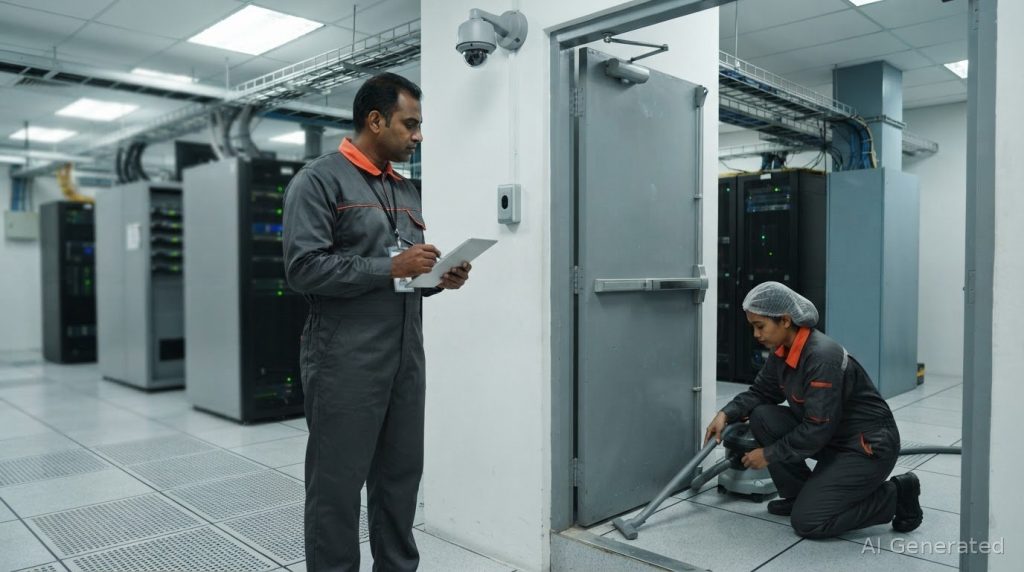
Cleanliness is part of a site’s security picture, not just its appearance. A physical security audit evaluates whether protection measures work together and are documented, while assessing conditions that could affect access, visibility or risk detection. Understanding how cleanliness impacts physical security audits means looking beyond tidy surfaces: clutter, debris and poorly maintained areas can obstruct sightlines or create places where a threat may go unnoticed.
For data centre operators, cleanliness supports clear visibility of entrances, restricted areas, equipment spaces and the procedures that govern them. It does not replace access controls, surveillance or alarms, but it can affect how effectively those measures are inspected and maintained.
This article explains what a physical security audit covers and how cleanliness relates to its scope, routine checks, site policies and risk identification. It also distinguishes general housekeeping from contamination control in mission-critical environments.
Key Takeaways
- Assess whether physical security controls work together, are documented, and reflect the facility’s current risks.
- Include entrances, restricted areas, visibility, lighting, access records, surveillance, and alarms in recurring checks.
- Review security policies and access permissions as staff, contractors, equipment, and operational conditions change.
- Treat cleanliness and housekeeping as practical risk-check factors: clutter and debris can obstruct visibility or conceal hazards.
- Use professional data centre cleaning and contamination control to support orderly, inspectable mission-critical spaces.
1. Physical security audits and recurring checks
A physical security audit uses visual inspection to assess whether an organization’s existing security measures work together and are documented. It also establishes a maturity profile: the site’s actual condition across access control, environmental safeguards, equipment security, media handling, and clean desk practices. For data centres, cleanliness affects whether inspection routes, entrances, equipment areas, and potential hiding places remain visible.
Cleanliness-related audit requirements differ by industry because each organization protects different assets and faces different operational risks. A data centre assessment may focus on restricted equipment areas, clear sightlines, and debris near loading docks; an office review may emphasize visitor reception and sensitive papers. ISO 45001 is a standard relevant to occupational health and safety, according to the International Organization for Standardization.
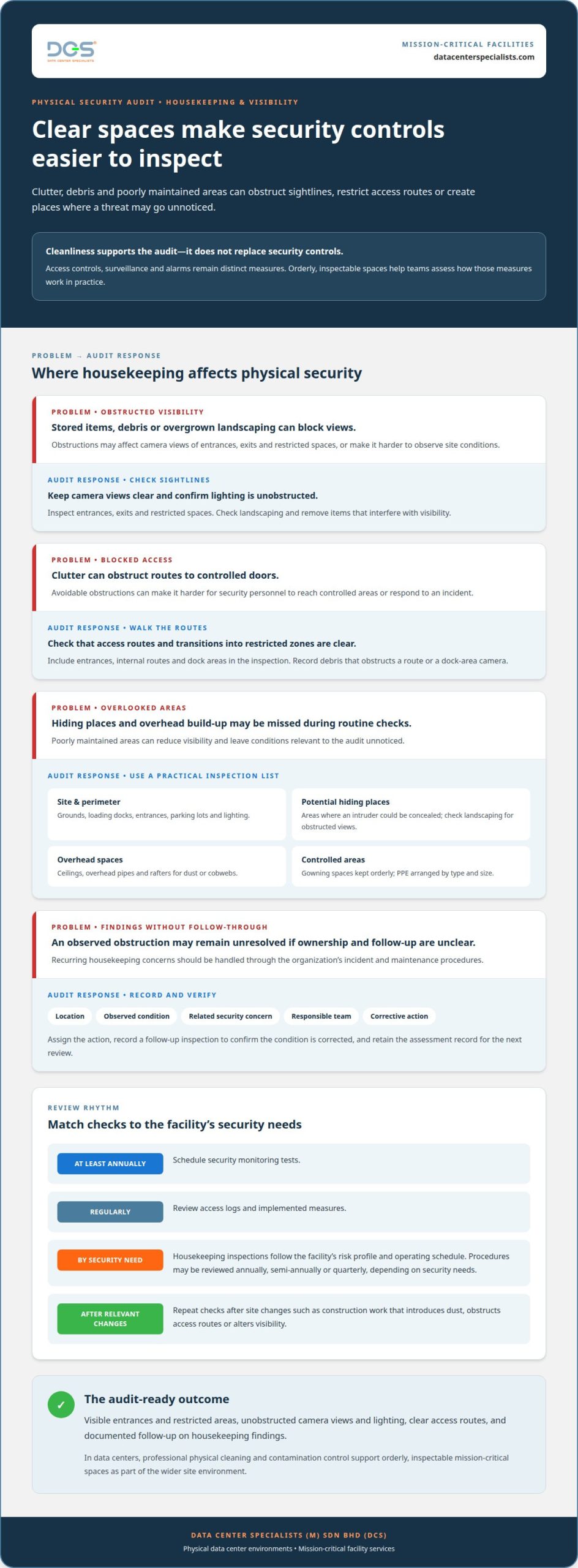
Schedule security monitoring tests at least annually, and review access logs and implemented measures regularly. Housekeeping inspections can follow the facility’s risk profile and operating schedule; review procedures annually, semi-annually or quarterly, depending on security needs. Repeat checks after relevant site changes, such as construction work that introduces dust, obstructs access routes or alters visibility.
Clean sightlines help staff and surveillance systems observe entrances, exits, and restricted spaces. Keep camera views clear of stored items, accumulated debris, and overgrown landscaping; confirm that lighting remains unobstructed. Clear access routes also help security personnel reach controlled doors and respond to an incident without navigating avoidable obstructions.
A practical housekeeping checklist covers site grounds, dock areas, entrances, parking lots, lighting and places where intruders could hide. Check landscaping for obstructed views, then inspect ceilings, overhead pipes and rafters for dust or cobwebs. In controlled areas, assess whether gowning spaces are orderly and personal protective equipment is arranged by type and size.
Record each finding with its location, observed condition, related security concern, responsible team and corrective action. For example, document debris obstructing a dock-area camera, assign its removal and record a follow-up inspection to confirm the view is clear. Escalate recurring findings through the organization’s incident and maintenance procedures, then retain the assessment record for the next review.
Personnel screening is a separate control from site inspections. For this audit, focus on recording and addressing physical access violations and housekeeping concerns through the relevant site procedures.
For the physical-security audit, review whether access-control measures and incident escalation procedures address issues identified during site inspections. Assign cleanliness findings to the appropriate facilities or security process.
2. Physical security audit purpose and scope
A physical security audit evaluates how effectively a site protects people, information, equipment and critical production areas. It identifies vulnerabilities in controls against human-origin threats, including intrusion, theft, malicious acts and unauthorised access. For a data centre, assess whether protection measures form an integrated system rather than treating each door or camera as an isolated control.
An independent review typically combines document examination with an on-site inspection. The reviewer examines security procedures, then compares them with actual conditions. For example, they may check whether a restricted equipment room’s access control matches its documented entry process. This comparison can reveal gaps between policy and practice, such as an approved visitor process that staff do not consistently follow.
Define the scope around the facility’s assets, boundaries and operating arrangements. Identify sensitive areas, including equipment rooms, loading areas, control spaces and locations containing critical production systems. Map entrances, exits, windows, internal routes and transitions between public and restricted zones. This gives the assessment a practical basis for examining how an unauthorised person might enter or move through the site.
Review the security measures protecting those locations as a coordinated system. Examine fences, gates, security airlocks, locks, badges, cameras, alarms and intervention procedures. Testing should establish whether each control performs its intended role and whether failures are detected and escalated. For example, a camera covering a door has limited value if its image is obstructed or no response procedure addresses an alarm.
Documentary review adds another layer. Compare access permissions with job functions, check how visitor and contractor movements are recorded, and review procedures for keys, badges and exceptions. Then compare records with observed practices. A written restriction on equipment-room access does not demonstrate effective protection if the assessment finds unmanaged access exceptions or unclear responsibility for approving entry.
The audit should provide a clear account of findings, vulnerabilities and corrective priorities. Separate immediate control failures from longer-term improvements, such as revising access procedures or moving an obstruction that affects camera coverage. A useful report connects each finding to the asset or risk involved, identifies the responsible function and describes the supporting evidence.
Set boundaries before fieldwork begins. Clarify which buildings, external areas, systems, records and operating periods are included, then record exclusions. This prevents an assessment of one entrance from being mistaken for a review of every access route. Revisit the scope when site layout, equipment placement, contractors or operating procedures change, since those changes can introduce new vulnerabilities.
That conclusion is stronger when it reflects both the site and its supporting evidence. NIST SP 800-82r3 provides guidance on operational technology security; it does not define a security audit using the wording below. A physical security audit is typically an inspection and evaluation of a business’s physical security measures by an independent party. An assessment can compare documented controls with observed conditions and report whether safeguards operate as intended. The scope should remain tied to the facility’s actual assets, boundaries, and operating arrangements, so recommendations address the risks found rather than generic assumptions.
3. Security policies and risk identification
A security policy turns a facility’s risk assessment into assigned controls, procedures and responsibilities. For a data centre, define which areas hold sensitive equipment, who may enter and how exceptions are approved. Then connect each control to a named owner. This makes the security posture assessable: the audit can compare written measures with access control records and observed conditions.
In Malaysia, address workplace cleanliness and physical security through documented procedures aligned with requirements applicable to the facility and its sector. The audit should identify relevant occupational-safety, fire-safety and industry requirements, then record the responsible owner and evidence for each control. This avoids treating one generic checklist as sufficient for every workplace.
Risk identification should account for the facility’s layout and changing operations. Assess whether fences, gates, security airlocks and restricted areas match the risk level of the assets they protect. Consider site-specific factors, such as nearby public transport, major roads or exposure to natural hazards. A loading entrance beside a public route, for example, may need different access procedures from an internal staff corridor.
Review access rights when personnel, contractors or service providers change roles or leave. Confirm that former users’ permissions are removed, access cards and keys are recovered, and exceptions have documented approval and expiry conditions. Visitor logs and escort procedures can help show who entered a sensitive area and why. Compare records with actual entry practices to identify gaps between policy and operation.
Include housekeeping findings in the risk process when they affect a control or asset. A trolley stored in front of a camera can compromise its view; boxes beside a badge-controlled door can obstruct access or conceal tampering. Record the location, observed condition, affected security measure and corrective owner. Distinguish an isolated issue from a recurring condition that indicates a gap in maintenance or accountability.
Obstructed exits can delay evacuation, while blocked fire equipment can impede access during an emergency. Clutter covering cameras, alarms, access readers or security lighting can also reduce visibility or interfere with control checks. Include these conditions in the audit and assign corrective action through the facility’s safety and security procedures.
Close the loop by prioritizing findings according to the asset exposed and the likely consequence. Assign actions to personnel with authority to address the cause, not just remove the visible obstruction. For example, repeated storage near an exit may require a designated storage area and updated staff training. Track completion in the risk register, then verify that the control remains effective during a later review.
4. What cleanliness standards are included in physical security audits?
A physical security audit examines whether cleaning and housekeeping practices support the facility’s security controls. Visual neatness alone does not prove protection. Auditors assess written procedures, assigned responsibilities, inspection records and conditions affecting access or visibility. In a data centre, examples include dust near racks, debris along access routes and materials positioned beneath cameras.
In Malaysia, set cleanliness criteria according to the facility’s documented procedures, operational risks and applicable workplace requirements. Separate routine housekeeping from contamination control in critical spaces. A clear corridor may address an access concern, while dust beneath a raised floor may call for a distinct review of equipment-area conditions.
Define the audit criteria before inspecting the site. Specify which areas are included, what condition is acceptable, who records findings and how corrective work is tracked. For example, a facility procedure can require a visual inspection after work in a server room, while a contamination-control plan sets additional assessment steps for rack areas.
For critical environments, translate general expectations into observable checks. Inspectors can record whether:
- Cleaning procedures identify covered areas, responsible personnel, methods, and records.
- Raised-floor panels, underfloor plenums, rack surfaces, and overhead areas are assessed for dust or construction debris.
- Access routes, security devices, and camera sightlines remain clear after cleaning or material movement.
- Cleaning tools and supplies are removed from restricted equipment areas when work is complete.
- Findings include the location, condition, assigned action, and follow-up evidence.
Keep standards distinct from work specifications. ISO 14644 addresses cleanroom classification, while a facility’s cleaning method and acceptance criteria should be defined for its own environment. For example, a data centre may use a visual check for a work area and separately specify particle assessment where its operational plan requires it. Do not treat a cleanroom classification as a universal cleaning procedure.
In a live data centre, housekeeping controls must account for operational risk. Record the work area, coordinate access and follow approved procedures before handling floor panels. Cleaning beneath a raised floor, for instance, requires attention to panel handling and the underfloor environment. The audit should compare the method and records with the facility’s documented process.
Use findings to refine the facility’s written criteria. If dust repeatedly appears near a rack row, record the location and review the work method, access conditions and inspection schedule. Linking recurring observations to specific corrective actions makes follow-up traceable during later assessments.
Supplement routine controls with documented checks of cleaning and maintenance. Verify whether CIHR criterion 29 applies to the facility and whether it addresses these activities under the Operational Security Standard on Physical Security before citing it as an audit requirement. Audit records can show whether activities follow the facility’s documented requirements and whether findings receive follow-up.
Keep gowning areas clean and organize personal protective equipment by type and size. Include these conditions in the review when gowning areas are within the facility’s scope, recording any departure and its follow-up through the established process. This makes expectations observable alongside checks for access routes, equipment areas and security visibility, without treating spotless surfaces as proof of broader protection.
5. How do clutter and poor housekeeping create security risks?
Clutter changes how people move through a facility and how security measures function. A stack of cartons beside a restricted door can hide damage, obstruct a camera’s view or give an unauthorised person cover. In a data centre, loose packaging near equipment areas can also obscure labels and make inspections of racks or nearby surfaces less effective.
Blocked routes create operational and security problems at the same time. Materials in corridors can slow staff movement during an incident and make it harder to reach doors, alarms or other controls. Poorly arranged deliveries near a loading area may also blur the distinction between approved storage and unattended items, complicating checks on who brought them in.
Housekeeping affects surveillance by changing sightlines. Dust, stored equipment or temporary materials can obstruct cameras covering entrances and restricted spaces. An item beneath a camera may create a concealed area; dust on a lens can reduce image clarity. Include camera coverage in housekeeping reviews, especially after maintenance, deliveries or construction activity changes the layout.
Unsecured cabinets and untidy cabling can expose equipment or make tampering harder to detect. The National Institute of Standards and Technology (NIST) advises that equipment cabinets should be locked when they are not required for operation or safety, and wiring should be neat and contained within cabinets or under floors. A cable outside its intended route, for example, may be mistaken for temporary work and escape prompt review.
In a mission-critical environment, debris also raises contamination concerns. Dust from packaging or construction can accumulate around racks, on equipment surfaces or beneath raised floors. That condition does not by itself indicate a security breach, but it can mask signs of disturbance and complicate visual inspection. Distinguish contamination findings from security incidents, then record any condition affecting access, equipment visibility or control inspection.
Reduce these risks through clear storage boundaries and consistent close-out checks. After deliveries or maintenance, confirm that packaging is removed, doors and cabinets are secured, camera views remain unobstructed and cables are returned to their designated routes. Record exceptions with a location, responsible team and corrective action. A recurring obstruction should prompt a review of storage arrangements or work procedures, not just repeated removal of the visible item.
For data centres, professional cleaning of raised-floor and rack areas can support inspection by controlling physical contamination in sensitive spaces. Schedule the work around operational requirements, and define the areas and access controls involved before activity begins. Treat the resulting condition as one input to security reviews, alongside access records, surveillance checks, and documented incident procedures.
Data Center Specialists (M) Sdn Bhd (DCS)
Data Center Specialists (M) Sdn Bhd (DCS) supports operators addressing physical cleanliness and contamination concerns in mission-critical environments. When dust, construction debris or recurring housekeeping findings affect equipment areas or audit observations, professional cleaning can help restore inspectable conditions while respecting operational requirements.
DCS provides Professional Data Center ISO Cleaning Services for data centre environments, alongside Data Center Energy Assessment, Testing, Adjusting & Balancing (TAB) and Cleanroom Performance Testing (CPT). These services address different facility needs. Professional cleaning is the relevant next step when physical contamination or cleanliness findings call for specialist attention.
Data centre owners, facility managers and operations teams can contact Data Center Specialists (M) Sdn Bhd (DCS) to discuss cleanliness-related audit findings and facility requirements.
Make audit readiness part of facility change control
Use the next audit cycle to connect facility changes with the controls they may affect. A new rack layout, construction activity, revised storage arrangement or change in cleaning access can alter sightlines and conditions around sensitive equipment. Include security and housekeeping impacts in change reviews, then assign an owner to confirm that documented controls still match the operating environment.
This makes how cleanliness impacts physical security audits an ongoing operational consideration, rather than a finding addressed only during a scheduled review. Record relevant changes, retain follow-up evidence and bring unresolved issues into the next assessment discussion. This helps facility teams maintain a consistent view of risk as spaces and work practices evolve.
For support with mission-critical facility requirements, contact Data Center Specialists (M) Sdn Bhd (DCS) to discuss your needs. A considered next step can help your team turn audit observations into practical improvements.
Frequently Asked Questions
What is a physical security audit?
A physical security audit is a structured review of how a facility protects people, equipment, information and restricted spaces. It examines whether documented controls match conditions on site. For example, an auditor may compare an access procedure with how a visitor is actually received and escorted. The findings help management identify control gaps, assign corrective actions and retain evidence for later review.
How does cleanliness affect physical security audit findings?
Understanding how cleanliness impacts physical security audits means recognizing that housekeeping can affect what an auditor can see and test. Dust on a camera lens, stored items obscuring an access reader or debris near a cabinet can prompt findings about visibility, inspection or access. In a data centre, recording the exact location and operational context helps teams distinguish a housekeeping issue from evidence of equipment disturbance.