

In hyperscaler facility maintenance, a missed handoff between teams can be as important as a missed task. Electrical, mechanical, cooling and environmental systems are interdependent. Work that appears routine in isolation may affect other systems if its timing, dependencies or change controls are not coordinated.
The challenge is to set priorities as loads increase, cooling requirements change, and inspections, testing and specialist work compete for safe operating windows. A checklist can show that tasks were completed without showing whether the maintenance programme addresses the facility’s most consequential risks.
This guide explains how to organize maintenance around asset criticality, operational risk and coordinated work planning. It covers how to align activities with operating controls, account for changing cooling requirements, and identify when technical assessment or specialist support can help. The focus is a practical, risk-based programme for hyperscale environments in Malaysia, built around the facility’s actual systems and operating conditions.
Key Takeaways
- Map maintenance scope around connected electrical, cooling and facility systems, not isolated trades.
- Use asset criticality and operational impact to prioritize planned work and guide risk-based hyperscaler facility maintenance.
- Compare reactive, calendar-based and risk-based approaches to understand their different strengths and limitations.
- Build a maintenance plan from an asset baseline, documented dependencies, accountable roles and regular review.
- DCS provides preventive maintenance, energy assessment, TAB and CPT to complement facility operating controls in Malaysia.
What hyperscaler facility maintenance must protect as sites scale
Facility maintenance coordinates work to preserve the performance of critical infrastructure. In a hyperscale data center, that means managing inspections, preventive tasks and technical assessments across interconnected building systems, while aligning each activity with operational priorities and change controls. The objective is not simply to complete tasks, but to understand how an intervention could affect connected assets.
Scale increases the planning challenge. A decision involving an electrical component, cooling path or environmental control may have consequences elsewhere if systems share dependencies or support the same operating area. Workloads also change, which can shift how infrastructure is used and where facility teams need to focus. Effective hyperscaler facility maintenance therefore starts with the facility’s actual configuration, criticality and operating plan, rather than assuming every asset carries equal risk.
Coordinated maintenance supports operational continuity by aligning planned work with asset dependencies, redundancy and approved operating controls. It cannot eliminate every risk or guarantee uninterrupted service. This coordination distinguishes facility maintenance from IT hardware support and routine building janitorial work. The focus is physical infrastructure and its operating conditions, not server repair, software, databases or general cleaning.
How hyperscale operations change maintenance priorities
Isolated decisions are inadequate when systems are interdependent. For example, an intervention on electrical infrastructure may affect the equipment or cooling systems it supports. Work on cooling equipment may change conditions in the spaces it serves. Environmental systems also matter because their performance contributes to the conditions in which infrastructure operates. Map these relationships to the site’s design instead of treating the examples as universal procedures.
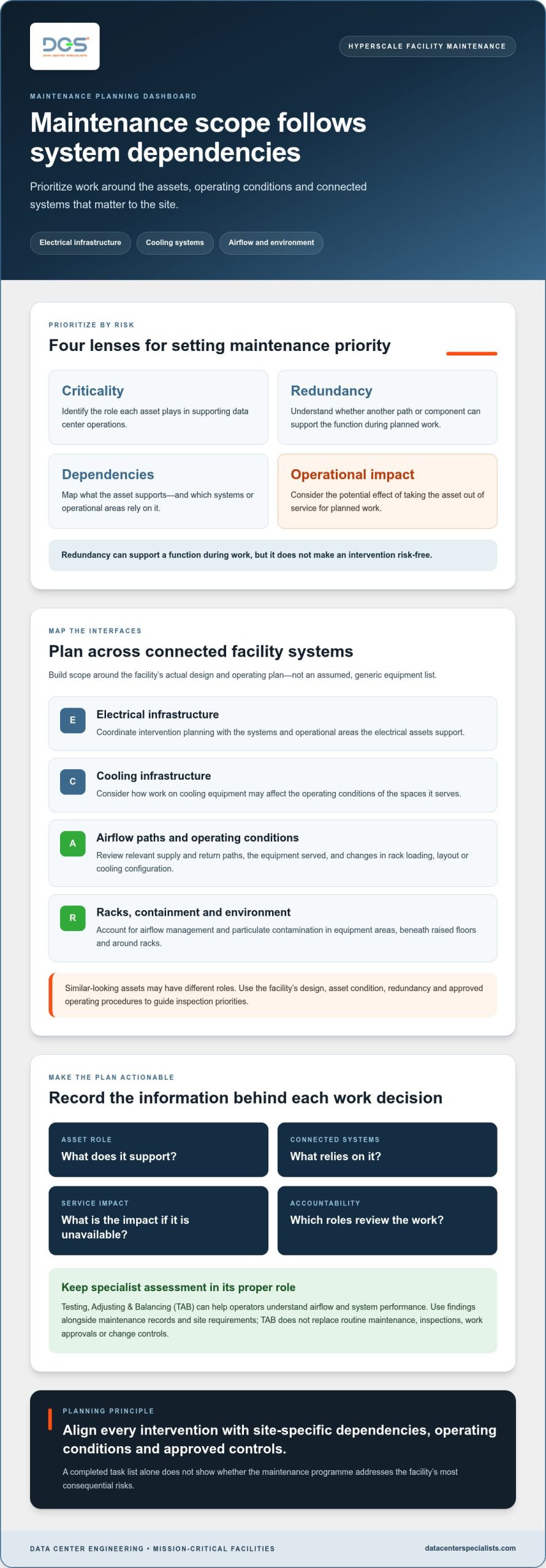
Prioritize work by considering asset criticality, available redundancy and operational dependencies together. Redundancy describes whether another path or component can support the function during planned work, but it does not make an intervention risk-free. A useful planning record identifies what an asset supports, what relies on it, the potential operational impact of taking it out of service, and which internal roles need to review the work.
What facility maintenance covers, and what it does not
Facility scope may include physical infrastructure inspections, preventive maintenance tasks, operating-condition reviews and specialist assessments. The relevant assets and methods depend on the facility’s design and operating plan. For example, assessing airflow or system balance can help operators understand how infrastructure is performing, but it does not replace the facility’s procedures, approvals or change controls.
Keep responsibilities distinct. Facility maintenance addresses the physical systems and environment supporting data center operations. It does not mean software administration, database maintenance, IT helpdesk support or general janitorial work. For a coordinated programme, operators can align their work with data center preventive maintenance and document how each intervention fits approved operating controls.
The term hyperscale computing and architecture describes the broader context of large-scale, distributed computing. For facility teams, the practical task is to connect maintenance decisions to the specific systems and dependencies at each site. A clear asset baseline and defined scope make that coordination actionable as infrastructure and workload requirements change.
Which systems and interfaces belong in a hyperscaler maintenance programme?
A useful maintenance scope follows the facility’s system relationships, not a generic equipment list. Map the electrical, cooling and environmental assets that support each operational area, then record how work on one system could affect another. This makes the programme specific to the site and helps teams plan inspections and specialist assessments around actual dependencies.
Electrical, cooling and airflow interfaces
Electrical infrastructure supplies systems that support data center operations, while cooling infrastructure manages heat from the IT environment. Maintenance planning for these systems must be coordinated: an intervention on one asset may affect the capacity or operating conditions of connected systems. Use the facility’s design, asset condition, redundancy and approved operating procedures to set inspection priorities. Do not assume that similar-looking assets have identical roles.
Airflow is part of this relationship. Changes in rack loading, equipment layout or cooling configuration can alter how air moves through an area. A review should consider relevant supply and return paths, operating conditions and the equipment they serve, rather than treating a cooling asset as an isolated item.
Testing, Adjusting & Balancing (TAB) provides a specialist assessment of system performance and balance. It can help inform decisions about airflow and system operation, but it does not replace routine maintenance, asset inspections or the operator’s work approvals. Use the findings alongside maintenance records and site-specific operating requirements.
Environmental conditions, racks and containment
Particulate contamination and airflow management are environmental considerations, not separate housekeeping concerns. Dust in equipment areas, beneath raised floors or around racks may be relevant to contamination control. The appropriate response depends on the space, its condition and the facility’s procedures. For further detail on controlling these risks, consult this data center contamination prevention guide.
Rack density and containment configuration also influence the environment around IT equipment. Rack arrangement and containment can shape airflow paths, so a layout change may affect cooling distribution and where operational teams should focus their observations. Include these interfaces in maintenance planning, especially when workloads or equipment configurations change. The goal is to understand the effects on the surrounding system, not to assume one arrangement suits every facility.
For hyperscaler facility maintenance, connect each asset group to its dependencies, condition information and planned work controls. This structure helps facility teams identify when specialist support is appropriate. DCS provides data center maintenance services for mission-critical environments, with preventive maintenance informed by facility conditions and operational priorities.
Reactive repairs versus risk-based hyperscaler facility maintenance
Reactive repairs address faults after they occur. Preventive work schedules tasks in advance, while risk-based planning uses asset function, condition and operational consequence to decide where attention matters most. A robust programme may use all three approaches: planned maintenance reduces reliance on fault response, while risk-based planning helps direct limited work windows toward assets with greater potential impact.
| Approach | How it works | Key trade-off |
|---|---|---|
| Reactive response | Work begins after a fault or abnormal condition is identified. | Can be necessary for unexpected issues, but offers less opportunity to plan work around dependencies. |
| Calendar-based preventive work | Tasks are scheduled according to established time intervals or operating plans. | Creates a predictable structure, but identical intervals may not reflect differences in asset condition or criticality. |
| Risk-based prioritization | Work priority reflects asset function, dependencies, condition information and consequences of failure. | Requires reliable asset knowledge and review as operating conditions change; it does not remove all risk. |
Planned maintenance is work arranged and controlled before intervention. Emergency repair is a response to a fault that has already disrupted or threatens facility operation. Neither planned work nor a risk-based strategy eliminates the possibility of failure. The practical aim is to make maintenance decisions deliberately while preserving the operator’s authority over operational risk.
How to prioritize maintenance by criticality and risk
Assess each asset in context. Establish its function, which systems or areas depend on it, what condition information is available and what the consequence of failure could be. Then consider how redundancy and the current operating state affect the planned intervention. This provides a reasoned basis for prioritization without imposing a universal score or maintenance interval on every asset.
Review priorities when configuration or operating conditions change. New workloads, equipment changes, recurring condition findings or revised operating plans may alter an asset’s role. Record the reason for each priority decision so facility, engineering and operations teams understand why the work is scheduled when it is.
How to manage maintenance work in a live facility
Planned work still needs controlled windows. Before starting, align the scope with site procedures, approvals and the operating team’s assessment of current conditions. Define the affected assets, dependencies, work boundaries, responsibilities and communication points. Agree how the work will be managed if conditions change, and confirm the handback requirements with relevant parties before work begins.
Specialist interventions also need clear boundaries. Testing, Adjusting & Balancing (TAB), for example, assesses system performance and balance. Coordinate it with routine maintenance and site controls rather than treating it as a replacement for them. The TAB technical service guide provides further context on this specialist work.
DCS provides data center maintenance services that complement an operator’s internal controls through preventive maintenance and technical assessment informed by facility conditions and operational priorities.
How to build a hyperscaler facility maintenance plan
A useful plan turns asset information into controlled work, clear accountability and repeatable review. Build it around the facility’s configuration and operating constraints, then update it as equipment, workloads or condition findings change. This gives teams a practical basis for deciding what needs attention, who owns the decision and how the work will be recorded.
- Establish the asset baseline. Create an inventory of relevant electrical, cooling and environmental systems using available drawings, asset records and operating documentation. Confirm the information with the teams responsible for those systems, and note gaps that could affect planning.
- Group assets by function and dependency. Organize equipment into meaningful groups, such as systems supporting a particular operational area. Record upstream and downstream relationships, redundancy considerations and the consequences of taking an asset out of service. This helps expose work that may require coordination across teams.
- Set priorities using site evidence. Consider asset function, condition findings, maintenance history and the facility’s risk assessments. Include operational constraints, such as approved work windows and current system configuration. Use these inputs to determine which work needs closer attention, rather than applying identical priorities to every asset.
- Define work scopes and owners. Separate routine preventive tasks from specialist testing or assessment. For each work package, identify the responsible role, affected assets, required approvals, interfaces with other work and how the team will confirm completion. Keep the scope aligned with site procedures and operating controls.
- Record results and review the plan. Document completed work, observations, exceptions and follow-up actions. Assign responsibility for each action and track its status through the facility’s established process. Review the plan when findings, configuration or operating needs change.
Establish an asset baseline and work priorities
An inventory alone is not enough. Link each asset group to the function it supports and the operational teams that depend on it. Compare current condition information with maintenance history and site risk assessments. If records are incomplete, make the information gap visible so it can inform review and planning. Then distinguish recurring preventive tasks from specialist assessment scopes, which may require different expertise, preparation and reporting.
Review findings and adapt the maintenance programme
Inspection results should inform the next planning cycle. A recurring observation may justify closer review of an asset or its dependencies, while a workload or configuration change may require teams to revisit priorities and work sequencing. Record the decision and its rationale, not just task completion.
If energy performance is relevant to planning, a specialist assessment can help identify where further investigation may be useful. The data center energy assessment guidance explains how this assessment can contribute to facility analysis. TAB may also inform investigation of system performance where appropriate.
Data Center Specialists (M) Sdn Bhd (DCS) provides preventive maintenance and technical assessments for mission-critical facilities. Its data center maintenance services can complement internal operating controls with specialist work aligned to facility conditions and operational priorities.
How DCS supports hyperscaler facility maintenance in Malaysia
Hyperscaler facility maintenance depends on more than a task schedule. Facility teams need a clear view of physical conditions, system performance and the interfaces that shape operational priorities. Data Center Specialists (M) Sdn Bhd (DCS) is a Malaysia-based mission-critical facility specialist serving customers nationally. DCS provides preventive maintenance and technical assessment to complement an operator’s internal procedures and decision-making.
A specialist approach across maintenance and technical assessment
DCS preventive maintenance supports the physical upkeep of mission-critical facilities, with work informed by facility conditions and operational priorities. It can be coordinated with the operator’s asset records, work approvals and change controls. The facility team retains responsibility for operational decisions, while DCS provides specialist maintenance support.
Different technical services address different questions. A data center energy assessment examines facility energy performance as an input to operational evaluation. Testing, Adjusting & Balancing (TAB) focuses on system performance and balance, including airflow considerations where relevant. Cleanroom Performance Testing (CPT) is a separate service for assessing cleanroom performance. These assessments are not interchangeable with routine preventive maintenance, and they do not replace the operator’s operating controls.
Findings can help facility teams decide what requires further investigation. An energy assessment may inform a review of energy performance, while TAB may help assess system balance. DCS also provides data center maintenance services as part of a coordinated approach to physical facility work. No assessment or maintenance activity can guarantee uninterrupted operation or predetermined savings.
When to involve a mission-critical facility specialist
Consider specialist input when system interfaces are complex, facility conditions have changed, or recurring findings need technical review. A shift in rack configuration or cooling requirements may also make airflow or containment assessment relevant. DCS provides contamination control, airflow and cooling optimization, rack and containment solutions to support facility requirements in these areas.
Specialist support works alongside the facility team, not in place of it. Operators retain responsibility for site procedures, approvals, work windows and decisions about operational risk. Define the assessment or maintenance scope, relevant facility information and how the work will align with internal controls.
DCS works with data center owners, operators, consultants and facility managers in Malaysia on preventive maintenance and technical assessments. To discuss a facility maintenance requirement, outline the facility concern and the systems involved.
Make your next maintenance decision deliberate
Choose a planning question your team can act on: which asset relationship, recurring finding or changing facility condition needs closer review? Use it to focus discussion, align operational stakeholders and decide whether a technical assessment could clarify priorities. A clear starting point makes maintenance planning more useful without treating every asset or work package the same.
For complex sites, hyperscaler facility maintenance is an ongoing process of reviewing facility information and adapting planned work as conditions change. Data Center Specialists (M) Sdn Bhd (DCS) has supported mission-critical facility needs since 2008. Bring your maintenance concern or assessment objective to a technical discussion, and consider how it fits your facility’s operating controls.
Contact DCS to discuss your facility maintenance requirements. Share the systems involved and the operating priorities your team needs to address.
Frequently Asked Questions
What does hyperscaler facility maintenance include?
It includes the physical upkeep and assessment of infrastructure that supports data center operations, with scope determined by the site’s assets and operating plan. This may cover electrical and cooling equipment, environmental conditions, inspections, preventive tasks and specialist evaluations. For example, a facility may maintain a cooling system alongside a review of airflow conditions in the area it serves. Software administration and database support are separate activities.
How is hyperscale data center maintenance different from standard facility maintenance?
Hyperscale maintenance must account for the scale and interdependence of infrastructure, not simply a larger number of routine tasks. An intervention affecting a shared system may have implications across multiple operational areas, so planning needs to reflect asset relationships, redundancy and change controls. Hyperscaler facility maintenance also needs to adapt as workloads and equipment configurations change, rather than relying on assumptions that remain fixed after commissioning.
How can operators reduce the risk of maintenance work disrupting live operations?
Reduce risk by treating each intervention as controlled work with a defined boundary. Before starting, identify affected equipment, confirm approvals and work windows through site procedures, and agree responsibilities with the operations team. Document the expected operating state and how the system will be handed back. If conditions differ from the plan, pause and follow the facility’s escalation process rather than extending the work informally.
How should a hyperscaler prioritize preventive maintenance?
Prioritize work according to each asset’s role and the operational consequence if it fails or becomes unavailable. Review condition reports, previous findings, maintenance history and dependencies, then consider whether alternative capacity changes the exposure during planned work. A component with recurring observations may warrant closer technical review than an asset without concerning findings. Document the resulting priorities and revisit them as facility conditions change.
When should a data center use Testing, Adjusting & Balancing (TAB)?
Consider TAB when operators need a specialist assessment of system performance and balance, such as during an investigation into airflow conditions or after relevant system changes. It can provide useful information for technical decisions, but it is not a substitute for routine maintenance or operational approval. Define the question the assessment should address and share relevant system context so the findings can be interpreted against facility requirements.
Can facility maintenance support energy and cooling optimization?
Yes. Maintenance findings can help teams identify conditions that merit further review, while an energy assessment can evaluate facility energy performance and TAB can assess system balance. For example, an operator investigating a change in cooling performance can compare maintenance observations with assessment findings before deciding on corrective action. These services inform decisions; outcomes depend on facility conditions, system design and how recommendations are evaluated and implemented.
How often should hyperscale data center maintenance be reviewed?
Review the programme on a planned basis and whenever a meaningful change affects its assumptions. Relevant triggers include new equipment, workload shifts, altered system configuration, recurring inspection findings or changes to operating constraints. Confirm that asset records, priorities, responsibilities and work scopes still reflect the facility as operated. Set review timing through the operator’s governance process rather than applying one interval to every site.