
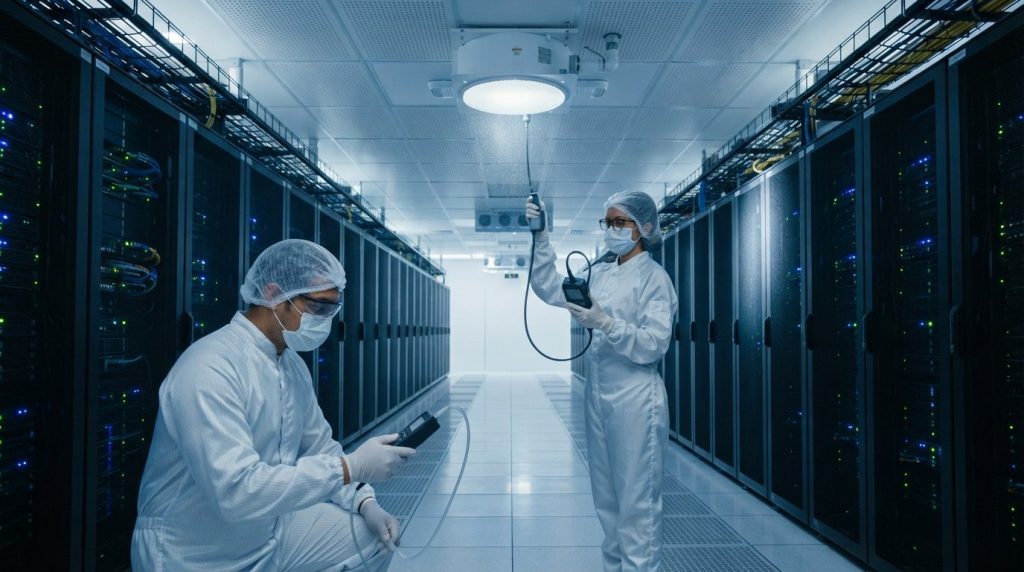
A single sub-micron particle, invisible to the naked eye, can trigger the intermittent server reboots and hardware latencies that haunt even the most sophisticated facilities. You understand that maintaining uptime requires more than just power redundancy; it demands total control over the environment where your hardware breathes. However, many facility managers find it difficult to distinguish between general air quality and the rigorous standards required for ISO 14644-1 certification. Relying on standard janitorial measures often leaves critical equipment vulnerable to the silent killers of the data centre, such as zinc whiskers and microscopic particulate matter. Professional cleanroom air quality testing data center protocols are the only way to verify that your environment actually meets the requirements for mission-critical operation.
This guide demonstrates how specialized testing protects your assets from environmental failure while ensuring strict compliance with international standards. We’ll provide a technical roadmap for ISO particle limits and the specific methodology used for HEPA filter validation. You’ll learn how to verify that your cooling infrastructure isn’t introducing contaminants into the white space, giving you the precision and data needed to safeguard operational continuity. By following these industry-leading practices, you can move beyond uncertainty and establish a baseline of environmental health that supports long-term hardware reliability.
Key Takeaways
- Understand the critical distinction between ambient indoor air quality and the specialized filtration standards required for ISO 14644-1 compliance.
- Identify the specific particle count thresholds for Class 8 environments to ensure your facility meets global benchmarks for mission-critical hardware protection.
- Utilize professional cleanroom air quality testing data center protocols to detect microscopic contaminants that trigger intermittent server reboots and hardware latency.
- Learn how in-situ HEPA filter leak testing serves as a primary defense against outdoor pollutants entering the white space through the cooling infrastructure.
- Establish a clear roadmap for remedial action by integrating Cleanroom Performance Testing (CPT) into your existing preventive maintenance schedule.
The Role of Cleanroom Air Quality Testing in Data Centres
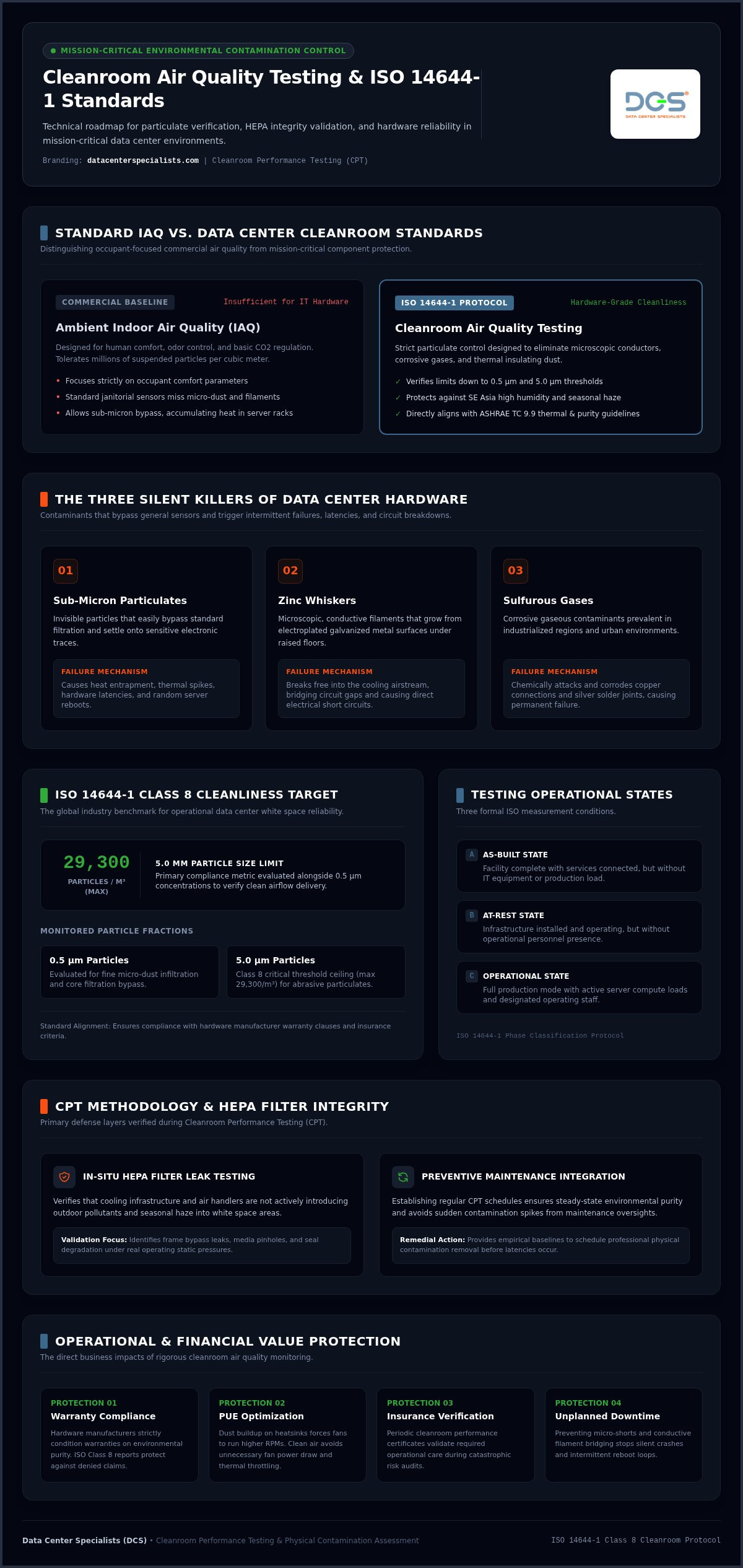
Ambient indoor air quality (IAQ) in a standard commercial setting prioritizes occupant comfort and CO2 levels. In contrast, mission-critical environments require a significantly higher tier of environmental control defined by cleanroom classification standards. While a general office might tolerate millions of particles per cubic meter, high-density server racks demand the precision of ISO 14644-1. This is especially true across Southeast Asia. High ambient humidity and recurring seasonal haze in regions like Kuala Lumpur and Johor can introduce corrosive pollutants into the cooling stream, making standard filtration insufficient for long-term hardware survival.
Beyond General Janitorial: Why Specialized Testing Matters
General environmental labs often lack the specialized equipment to detect the “silent killers” of IT hardware. Micro-dust, gaseous contaminants, and zinc whiskers are frequently missed by standard air quality sensors. Utilizing a dedicated cleanroom air quality testing data center protocol allows facility managers to identify these risks before they manifest as intermittent hardware reboots or permanent circuit damage. Common contaminants identified during professional testing include:
- Sub-micron particulates: These bypass standard filters and settle on sensitive electronic traces, leading to heat entrapment.
- Zinc whiskers: Microscopic conductive filaments that grow from galvanized surfaces and cause short circuits.
- Sulfurous gases: Corrosive elements common in industrial areas that attack copper connections and silver solder.
This level of scrutiny aligns with ASHRAE TC 9.9 thermal guidelines. It emphasizes that maintaining the right temperature is irrelevant if the air carrying that thermal energy is laden with conductive or abrasive particles. Professional Cleanroom Performance Testing (CPT) identifies these contamination sources early, supporting operational continuity by validating your filtration’s actual performance against theoretical specifications.
The Financial Impact of Poor Air Quality
The cost of regular air quality monitoring is a fraction of the expense associated with unplanned downtime. Contaminants do more than just cause reboots. They accumulate on heat sinks and internal components, forcing fans to work harder. This increases fan wear and negatively impacts your Power Usage Effectiveness (PUE), creating a direct drain on operational budgets. Furthermore, air purity links directly to server warranty compliance and insurance requirements.
Most hardware manufacturers explicitly cite environmental purity in their warranty terms. Failing to maintain ISO Class 8 standards can lead to denied claims during a major hardware failure. Integrating CPT into your data center maintenance cycle ensures you meet insurance requirements, protect your capital investment, and maintain the steady-state environment required for high-density computing.
ISO 14644-1 Standards and Particle Count Thresholds
ISO 14644-1 is the definitive global benchmark for controlled environments. It provides a structured framework for measuring air cleanliness by particle concentration. While general indoor air quality standards focus on human health and comfort, ISO 14644-1 protects sensitive electronic components from physical degradation. For most operational data centres, ISO Class 8 is the industry-standard target for maintaining hardware reliability.
Achieving compliance requires understanding specific thresholds. Testing focuses on two primary particle sizes: 0.5 microns and 5.0 microns. Professional cleanroom air quality testing data center services verify these metrics during different operational stages. For Class 8, the limit for 5.0 µm particles is 29,300 per cubic meter. Measurements are typically taken in three states: “As-Built” (empty room), “At-Rest” (equipment installed but idle), or “Operational” (full load with personnel). Testing in the “Operational” state is the most challenging but provides the most accurate view of real-world risks, as it accounts for turbulence caused by high-velocity cooling fans and particles shed by technicians.
ISO Class 8 vs. Class 5: Which Does Your Facility Need?
Most legacy facilities operate at Class 8. However, pre-commissioning phases or specialized labs often aim for Class 5, which is 1,000 times cleaner than Class 8. Under ISO 14644-1 standards, the maximum allowable concentration for Class 8 is 3,520,000 particles per cubic meter for particles ≥0.5 µm. If you’re managing a new build, refer to the ISO 14644 Handover Checklist to ensure construction debris hasn’t compromised your baseline. A professional cleanroom air quality testing data center assessment can help determine if your current filtration can support a stricter class.
ASHRAE TC 9.9 vs. ISO 14644-1
Particulate testing is only one side of the coin. ASHRAE TC 9.9 recommendations often incorporate ISO 14644-8 to address gaseous contamination. This is vital in regions with high industrial pollution or seasonal haze. Engineers monitor copper and silver corrosion rates on test coupons to detect corrosive gases like hydrogen sulfide. High corrosion rates often signal that your filtration isn’t capturing acidic gases, which can be as damaging as physical dust. To maintain total environmental control, facility managers should combine particulate counts with gaseous assessments. If you’re noticing hardware failures despite low particle counts, a comprehensive contamination assessment may be necessary to identify the root cause.
Critical Component: HEPA Filter Leak Testing
HEPA filters represent the final line of defense against external particulate ingress. Simply installing a high-efficiency filter isn’t enough to guarantee a compliant environment. You must verify that the entire housing assembly is airtight and the media is intact. Professional cleanroom air quality testing data center protocols include HEPA leak testing to identify bypass air that circumvents the filter media. Common failure points often include degraded gasket seals, misaligned frames, or microscopic pinholes in the media caused during transport or installation. Without rigorous testing, these gaps allow unfiltered air to stream directly into your mission-critical space.
In-Situ Integrity Testing Methodology
Professional testing utilizes an aerosol photometer and a challenge agent, typically Polyalphaolefin (PAO). Technicians introduce the PAO aerosol upstream of the filter bank to create a known concentration. They then scan the entire downstream face and the perimeter seals with a calibrated probe. This process detects the exact percentage of the challenge agent that “leaks” through. For technical environments, the standard acceptance criterion is typically less than 0.01% of the upstream concentration. If a leak is detected, it indicates that unfiltered air is entering the white space, potentially carrying the micro-dust and conductive particles that lead to hardware failure. Aerosol photometers provide real-time data, allowing for immediate identification and potential sealing of minor leaks during the assessment.
Maintenance and Replacement Cycles
Timing your tests is critical for maintaining ISO 14644-1 compliance and operational peace of mind. You should perform integrity testing immediately after a new installation, following any major HVAC repairs, or as a component of your annual CPT. Filter health is also intrinsically linked to Testing, Adjusting, and Balancing (TAB). A clogged or leaking filter disrupts static pressure and airflow distribution, which can lead to hot spots in high-density racks and increased energy consumption.
Don’t wait for a formal audit to check your filtration health. Warning signs often include visible dust accumulation on the “clean” side of the air handler or erratic particle count spikes during routine monitoring. If your pressure drop across the filter bank remains unusually low, it might actually signal a major bypass leak rather than a clean filter. Regular validation ensures that your cooling system remains a tool for protection rather than a source of contamination. If you’re unsure of your current filtration status, a professional specialized engineering assessment can provide the technical clarity needed to prevent hardware-related downtime.
Professional Testing Methodology and CPT Procedures
A valid Cleanroom Performance Test (CPT) requires more than a cursory walkthrough with handheld sensors. It demands a methodical sampling plan based on the total floor area and the specific configuration of critical zones. Unlike general office environments, a professional cleanroom air quality testing data center protocol focuses on the areas where hardware is most vulnerable. This includes the air intakes of high-density racks and the discharge points of cooling units. In regions like Kuala Lumpur or Cyberjaya, where high ambient humidity can influence particle suspension, this localized data is essential for an accurate risk profile.
Measuring Airborne Particle Concentrations
Technicians deploy calibrated laser particle counters to capture real-time data at various sampling points. These locations aren’t chosen at random; they’re determined by a grid system that ensures every square meter of the white space is validated. Special attention is paid to potential “hot spots” where particulate accumulation is highest, such as stagnant corners or areas with high technician traffic. The objective is to document the exact count of particles ≥0.5µm per cubic metre to verify that the facility operates within its designated ISO class. This data provides the empirical evidence needed for compliance audits and hardware warranty protection.
Pressure and Airflow Validation
Maintaining positive pressure is a fundamental requirement for contamination control. It creates a physical barrier that prevents external dust from migrating into the data hall through door gaps or cable penetrations. Professional CPT includes measuring pressure differentials between the white space and adjacent corridors. If the pressure isn’t high enough, your facility remains at risk from the outdoor haze and pollutants common in Southeast Asian industrial hubs. For a deeper understanding of how differential pressure validation protects your clean zones, refer to this technical reference on cleanroom pressure testing for critical facilities. This validation is directly linked to effective Data Center Airflow Management.
Airflow visualization testing, or smoke testing, further refines this assessment. By using non-toxic smoke tracers, engineers can identify stagnant zones where heat and particles might accumulate despite high cooling capacity. These visualizations often reveal turbulence that isn’t apparent through digital monitoring alone. If you’re seeing inconsistent thermal patterns or unexplained hardware alerts, it’s time to consult with a mission-critical specialist for a CPT assessment to ensure your environment meets the highest standards of purity and performance.
Implementing a Cleanroom Performance Testing (CPT) Strategy
Effective contamination control isn’t a one-time event; it’s a continuous cycle of validation and improvement. By integrating CPT into your Data Center Preventive Maintenance schedule, you transform air quality monitoring from a reactive fix into a predictive tool. This strategic approach relies on the synergy between precise air testing and Professional ISO Cleaning. While testing identifies the presence and size of particles, specialized cleaning physically removes the sources of contamination from underfloor plenums and rack surfaces. If a testing cycle reveals a failure to meet ISO Class 8 standards, your remedial action plan must include a root-cause analysis to determine if the breach stems from filtration failure, poor pressure management, or inadequate cleaning protocols.
Frequency of Testing: Risk-Based Assessment
Standard industry practice suggests annual testing as a baseline for stable environments. However, certain risk factors necessitate a semi-annual or quarterly approach. Facilities located in industrial hubs across Selangor or Johor must account for seasonal haze and local pollutants that can overwhelm standard air handlers. Additionally, the age of the facility and the frequency of technician traffic inside the white space influence particulate accumulation. Post-construction testing is mandatory before any hardware migration to ensure construction dust hasn’t settled in the cooling paths. Pre-commissioning testing is a non-negotiable requirement for hyperscale facilities to validate environmental baselines before critical loads are energized. Poor pressure management is a common root cause of particulate breaches; understanding the principles of cleanroom pressure testing can help facility managers proactively address this risk before it escalates into a compliance failure.
The DCS Advantage in Technical Testing
Evaluating a service provider for mission-critical facilities requires looking beyond basic certifications. You need a partner that understands the specific challenges of the Malaysian data centre landscape, including high ambient humidity and particulate spikes. A professional cleanroom air quality testing data center assessment from Data Center Specialists provides more than just a pass or fail result. We deliver comprehensive technical reports that translate raw particle data into actionable facility improvements, such as airflow adjustments or targeted cleaning interventions.
Our team brings 16 years of industry experience to every assessment, acting as a seasoned guardian of your technical environment. We don’t just count particles; we help you interpret what those counts mean for your hardware’s lifespan and your facility’s PUE. Whether you’re managing a legacy server room or a state-of-the-art colocation hall, our methodology ensures you remain in full compliance with ISO 14644-1. Contact Data Center Specialists today for a professional Cleanroom Performance Testing assessment to secure your operational continuity and hardware reliability.
Securing Hardware Reliability Through Technical Precision
Environmental control is the foundation of mission-critical uptime. By transitioning from general janitorial oversight to rigorous ISO-standard protocols, you move beyond guesswork and into the realm of technical certainty. This guide has detailed how strict particle count thresholds and HEPA integrity testing serve as your primary defense against the sub-micron contaminants that lead to hardware degradation. Implementing a professional cleanroom air quality testing data center strategy ensures your facility remains a safe harbor for high-density computing, even in challenging industrial environments across Malaysia.
As an established partner with 16 years of mission-critical experience, Data Center Specialists provides the specialized engineering expertise required to maintain ISO 14644-1 compliance. We deliver comprehensive technical infrastructure solutions that protect your hardware from silent failure while optimizing operational performance. Don’t leave your facility’s air quality to chance. Contact Data Center Specialists for a professional Cleanroom Performance Testing (CPT) Assessment and gain the technical clarity needed to safeguard your infrastructure. We’re ready to help you achieve a cleaner, more reliable operational environment.
Frequently Asked Questions
What is the standard ISO class for an operational data centre?
ISO Class 8 is the globally recognized standard for operational data centres according to ISO 14644-1. This classification limits the concentration of particles ≥0.5 microns to 3,520,000 per cubic metre. While some facilities aim for Class 7 during pre-commissioning, Class 8 provides the necessary balance between environmental purity and operational cost. Maintaining this standard ensures that sensitive electronic components are protected from conductive dust and heat-trapping particulates.
How often should HEPA filter leak testing be performed in a server room?
HEPA filter integrity testing should occur immediately after installation, following any significant HVAC repairs, or as part of your annual Cleanroom Performance Testing (CPT) cycle. Regular validation is essential because filter media can develop pinholes or gasket seals can degrade over time. In high-stakes environments, annual testing ensures that your primary defense against outdoor contaminants remains functional. This frequency helps identify bypass air issues before they lead to hardware failure.
What causes high particle counts in an operational data centre?
High particle counts are often caused by technician traffic, unsealed cable penetrations, or inadequate cleaning of underfloor plenums. External factors like construction activity or seasonal haze also contribute if the filtration system has bypass leaks. High-velocity cooling fans can further agitate settled dust, keeping it suspended in the airflow. Professional cleanroom air quality testing data center services help pinpoint these specific sources by analyzing particle distribution patterns across the white space.
Can air quality testing be done in a live data centre without downtime?
Yes, professional Cleanroom Performance Testing is designed to be non-invasive and can be conducted in live, operational environments without interrupting services. Technicians use calibrated laser particle counters and handheld probes that don’t interfere with server hardware or airflow management. Testing in an operational state is actually preferred by many facility managers because it provides the most accurate data regarding real-world contamination risks while personnel and equipment are active.
What is the difference between air quality testing and particle count testing?
General air quality testing focuses on human comfort factors like CO2 levels, humidity, and standard indoor pollutants. In contrast, particle count testing is a specialized technical assessment governed by ISO 14644-1 standards. It measures the exact concentration of microscopic particulates, such as 0.5-micron and 5.0-micron particles, that directly impact hardware reliability. Cleanroom-grade testing is far more rigorous than standard office air quality monitoring and requires specialized, calibrated instrumentation.
How does outdoor haze in Malaysia affect indoor data centre air quality?
Outdoor haze introduces high concentrations of fine particulates and corrosive gases like sulfur dioxide into the local atmosphere. If a facility’s filtration is compromised or positive pressure isn’t maintained, these contaminants migrate into the white space. This ingress can cause copper and silver corrosion on circuit boards or lead to physical particulate buildup on heat sinks. Regular cleanroom air quality testing data center protocols are vital in Malaysia to ensure that filtration systems effectively mitigate these seasonal risks.
What equipment is used for professional cleanroom performance testing?
Specialists utilize several high-precision tools, including calibrated laser particle counters for real-time particulate data and aerosol photometers for HEPA filter leak detection. Differential pressure gauges measure the positive pressure between rooms, while anemometers or capture hoods validate airflow velocities. For visualization, non-toxic smoke generators are used to map airflow patterns. This specialized equipment suite allows engineers to provide a comprehensive technical assessment that standard janitorial or HVAC tools cannot replicate.
What should I do if my facility fails an ISO 14644-1 audit?
If a facility fails an audit, you should immediately conduct a root-cause analysis to identify the contamination source. This often involves checking for HEPA filter bypass leaks, validating room pressure, and assessing the cleanliness of underfloor plenums. Remedial action typically includes professional ISO data center cleaning followed by a re-test. Engaging a specialist for Testing, Adjusting & Balancing (TAB) can also help resolve airflow issues that may be contributing to high particle concentrations.