
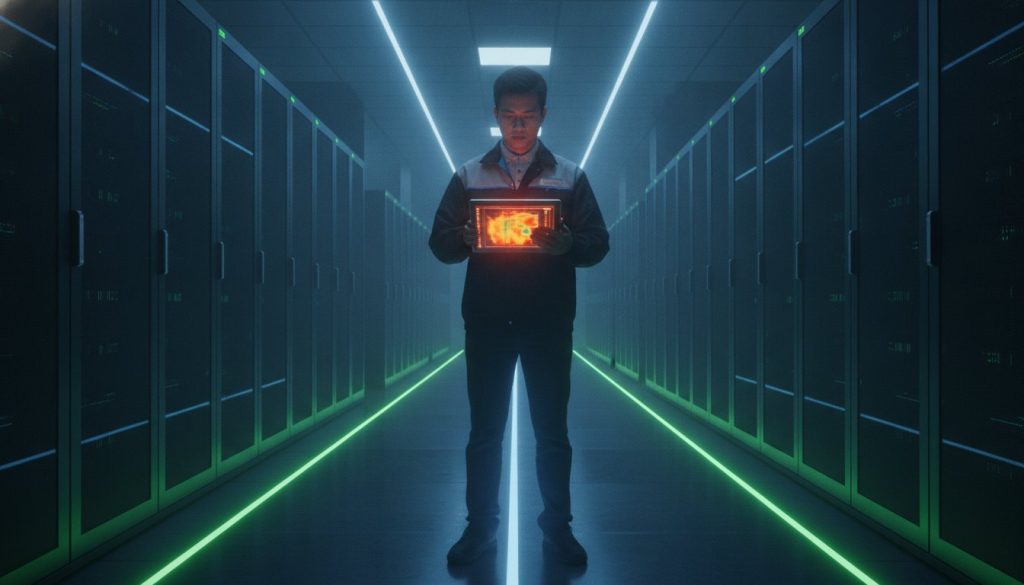
With AI-optimized servers projected to account for 31% of data center power consumption in 2026, the margin for operational inefficiency has effectively vanished. As global data center electricity consumption climbs toward an estimated 565 terawatt-hours this year, facility managers face a volatile environment of rising costs and tightening regulations. You understand that maintaining a competitive edge requires more than just keeping the equipment running; it demands a surgical approach to infrastructure management that prioritizes precision over guesswork.
You’re likely grappling with the difficulty of identifying hotspots in high-density racks or the frustration of inaccurate PUE reporting that fails to satisfy rigorous sustainability targets. This guide empowers you to master the technical criteria and strategic frameworks necessary to select a data center energy assessment partner capable of delivering measurable PUE reduction and unwavering reliability. We’ll explore the transition from surface-level software audits to deep engineering exercises focused on airflow physics, Testing, Adjusting & Balancing (TAB), and international compliance. By the end, you’ll have a clear roadmap for infrastructure upgrades that eliminate thermal risks and secure long-term operational continuity.
Key Takeaways
- Understand why a modern data center energy assessment must evolve beyond simple PUE calculations to protect hardware longevity in high-density environments.
- Discover the critical role of thermal imaging and multi-level airflow analysis in identifying hidden hotspots before they cause critical system failures.
- Learn to evaluate potential partners based on technical certifications like Cleanroom Performance Testing (CPT) and their proven experience with hyperscale infrastructure.
- Identify high-ROI optimization strategies, ranging from simple airflow redirection to the deployment of DCS Smart Modular Containment for total thermal isolation.
- Develop a holistic framework for efficiency that integrates energy audits with Testing, Adjusting & Balancing (TAB) to ensure ISO-standard operational reliability.
The Strategic Necessity of a Data Center Energy Assessment
In 2026, the scope of a data center energy assessment has shifted from a basic compliance check to a critical engineering requirement. It’s no longer sufficient to monitor utility bills or rely on surface-level metrics. High-density AI workloads demand a granular understanding of how every watt of power translates into thermal load. When cooling systems operate at sub-optimal levels, hardware longevity suffers immediately. Excess heat doesn’t just inflate operational costs; it accelerates component degradation and significantly increases the risk of catastrophic hardware failure. You must view energy efficiency as the primary guardian of your equipment’s lifespan.
To visualize the impact of these technical evaluations, consider how specialized tools identify hidden savings and operational risks:
Beyond PUE: Measuring Real Operational Efficiency
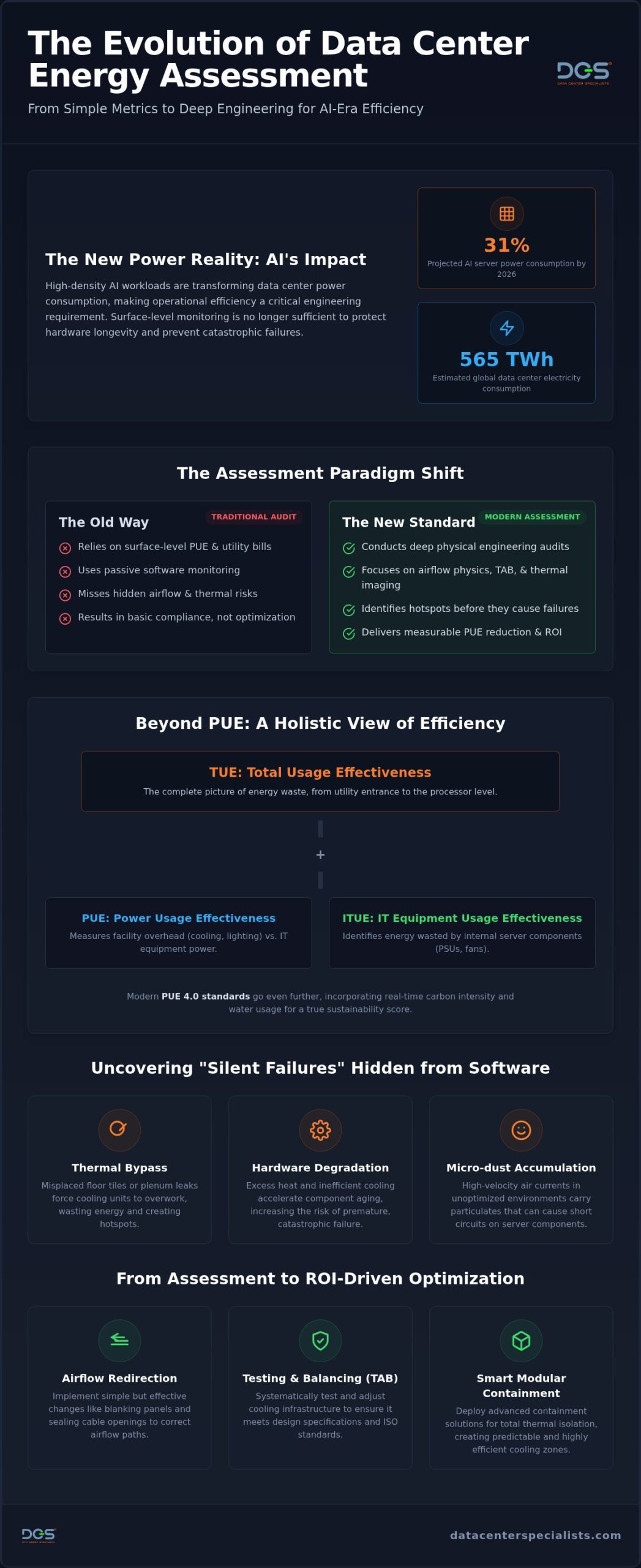
Traditional Power Usage Effectiveness (PUE) metrics often mask deep-seated inefficiencies within the IT stack itself. While PUE measures the ratio of total facility power to IT equipment power, it doesn’t account for how effectively that IT power is actually utilized. In 2026, PUE 4.0 standards have evolved to incorporate real-time carbon intensity and water usage effectiveness into a single, unified efficiency score. Professional assessments now prioritize the following advanced metrics:
- IT Equipment Usage Effectiveness (ITUE): This identifies the energy wasted by internal server components, such as inefficient power supply units or internal fans.
- Total Usage Effectiveness (TUE): A holistic metric that combines PUE and ITUE to provide a complete picture of energy waste from the utility entrance down to the processor level.
Passive monitoring tools often fail to capture these nuances because they lack the physical context of airflow physics. A software dashboard might show stable temperatures while a physical assessment reveals turbulent air patterns that are quietly driving up energy consumption.
Risk Mitigation and Zero-Downtime Objectives
A professional data center energy assessment uncovers “silent failures” that standard monitoring software cannot detect. For instance, a misplaced floor tile or a leaking ceiling plenum might not trigger a software alarm, but it creates a thermal bypass that forces cooling units to overwork. This inefficient airflow often leads to micro-dust accumulation. High-velocity air currents in unoptimized environments carry particulates into sensitive server components, creating conductive bridges that lead to short circuits. Implementing a rigorous data center contamination prevention strategy alongside your energy assessment is essential to neutralizing these invisible threats before they escalate into hardware failures.
Ensuring the assessment process itself adheres to ISO standards for critical environments is paramount. A structured evaluation identifies exactly where to implement high-impact solutions, such as DCS Smart Modular Containment, to achieve total thermal isolation. This proactive approach turns abstract sustainability goals into a concrete roadmap for ROI-driven operational stability. Justifying the cost of specialized technical audits becomes straightforward when you calculate the financial impact of a single hour of avoided downtime.
Core Components of a Professional Technical Evaluation
A high-level data center energy assessment is a physical engineering audit that goes far beyond what software sensors can detect. While dashboards provide a baseline, they often fail to account for the complex physics of airflow and pressure within the white space. A professional evaluation serves as a forensic investigation into the facility’s thermal health, identifying exactly where energy is being wasted and where hardware is at risk. It requires a meticulous examination of the physical environment, from the sub-floor plenum to the ceiling returns.
Thermal Assessments and Airflow Dynamics
Thermal assessments utilize advanced thermography to create a comprehensive map of heat distribution across high-density racks. This process isn’t merely about finding hot spots; it’s about understanding the “delta-T” or temperature difference between intake and exhaust. High-resolution infrared imaging reveals thermal anomalies that suggest internal server fan failures or poor rack sealing. When these patterns are mapped, they often highlight two primary culprits of energy waste: bypass air and recirculation.
Bypass air occurs when conditioned cold air escapes through unsealed floor grommets or gaps in the rack, returning to the cooling units without ever passing through a server. Conversely, recirculation happens when hot exhaust air loops back into the server intake, forcing internal fans to spin faster and cooling units to lower their set points unnecessarily. Professionals use pressure differential testing to ensure the underfloor plenum is correctly pressurized. This ensures that cold air is delivered exactly where it’s needed with enough force to penetrate the highest-density equipment. A thorough data center thermal assessment goes beyond average room temperature readings to pinpoint the rack-level hotspots that silently throttle AI nodes and shorten hardware lifespan.
Integration with Testing, Adjusting & Balancing (TAB)
Testing, Adjusting & Balancing (TAB) is the critical bridge between the theoretical design of your HVAC system and its actual performance. Many facilities suffer from over-provisioned cooling because the air volumes aren’t balanced to match the IT load. TAB technicians measure the airflow from every floor grille and compare it against the heat load of the adjacent racks. This allows for the precise adjustment of fan speeds and damper positions to eliminate “dead zones” where air stagnates.
The implementation of professional testing adjusting and balancing services directly improves cooling ROI by allowing operators to raise chilled water set points without risking hardware failure. Once the air is balanced, the cooling plant doesn’t have to work as hard to maintain the same environmental conditions. This technical precision is essential for facilities aiming to lower their PUE while maintaining the strict environmental standards required by hyperscale clients. To ensure your facility’s infrastructure is operating at its peak, it’s vital to partner with experts who provide a data center technical evaluation that includes these physical airflow corrections.
Finally, the power chain itself must be analyzed from the UPS down to the rack-level PDU. Inefficient power conversion and unbalanced electrical loads create parasitic heat that adds to the cooling burden. A truly comprehensive assessment identifies these electrical losses, ensuring that every watt entering the facility is used as effectively as possible.
Criteria for Selecting an Energy Assessment Partner in Malaysia
Selecting a partner for a data center energy assessment in Malaysia requires a procurement strategy that prioritizes technical depth over generic auditing certifications. While many general building auditors offer energy reviews, they often lack the specialized knowledge required to navigate the high-stakes environment of a mission-critical facility. You need a strategic partner that understands the delicate balance between aggressive thermal management and unwavering operational continuity. A misstep during the audit process can lead to more than just inaccurate data; it can jeopardize the very uptime you’re trying to protect.
The Importance of Specialized Data Center Knowledge
Generalist auditors typically focus on lighting and basic office HVAC systems. They often fail to account for the specific humidity and temperature tolerances of modern IT hardware, which require much tighter control ranges. A seasoned specialist brings a protective mindset to the white space, ensuring that the assessment process doesn’t introduce risks like static discharge or airborne contamination. It’s vital to evaluate whether a partner can integrate data center cleaning services Malaysia alongside their technical audits. This synergy is essential because accumulated particulate matter acts as an insulator on heat sinks. This forces internal server fans to work harder and skews your energy efficiency data, making a cleaning-aware audit much more accurate.
Verification of Instrumentation and Standards
Precision in a data center energy assessment is only as reliable as the tools used to gather the data. Demand proof that all instrumentation, from high-resolution thermal imagers to the flow hoods used for Testing, Adjusting & Balancing (TAB), is calibrated to international metrology standards. Your partner should demonstrate strict adherence to ISO 14644-1 standards, particularly when conducting Cleanroom Performance Testing (CPT) as part of the audit. This level of rigor ensures that your facility meets the stringent requirements of hyperscalers and financial institutions, where even minor deviations in air quality or pressure can lead to hardware degradation. Facilities transitioning from a construction phase should also reference a structured post-construction data center cleaning ISO handover checklist to verify that all decontamination protocols are completed before energy baselines are established.
Finally, scrutinize the depth of the final report. A professional partner moves beyond presenting raw data and simple PUE calculations. They provide a clear, prioritized list of engineering recommendations that translate findings into a roadmap for infrastructure upgrades. With 16 years of industry experience, a qualified expert has the seasoned perspective needed to identify which changes, such as the deployment of DCS Smart Racks, will yield the highest ROI. Ensure your partner has a proven track record of delivering these results within the Malaysian market, where local climate factors play a significant role in cooling efficiency.
From Assessment to Optimization: Implementing ROI-Driven Changes
The true value of a data center energy assessment lies in the transition from raw data to decisive action. Once the technical audit has identified the physical and electrical inefficiencies within your facility, you must prioritize interventions based on their projected Return on Investment (ROI) and impact on uptime. This phase isn’t merely about cutting costs; it’s about re-engineering the environment to support the increasingly dense workloads of 2026. Effective optimization begins with “quick wins” that address immediate airflow leaks before moving toward structural hardware enhancements.
Immediate improvements often involve low-cost physical adjustments. Installing floor grommets and blanking panels prevents bypass air from escaping the plenum or circulating through empty rack spaces. These simple barriers ensure that the cold air you’ve already paid to condition actually reaches the server intakes. While these steps are foundational, achieving deep PUE reduction requires a more sophisticated approach to thermal isolation.
Modular Containment and Airflow Management
Containment is the most effective method for eliminating the mixing of hot and cold air streams. Based on your assessment findings, you’ll typically choose between Hot Aisle and Cold Aisle containment. Hot Aisle containment is often superior for high-density environments as it captures heat at the source, allowing the rest of the facility to remain at a comfortable ambient temperature. However, Cold Aisle containment remains a popular choice for brownfield sites where existing infrastructure limits ducting options.
Implementing DCS Smart Modular Containment provides maximum thermal isolation, significantly reducing the load on your CRAC and CRAH units. By creating a physical seal around the equipment, these systems allow you to raise chilled water set points and reduce fan speeds without risking hardware failure. This structural optimization ensures that your cooling plant operates at peak efficiency, directly lowering your facility’s energy footprint.
Hardware Upgrades: DCS Smart Racks
As AI and High-Performance Computing (HPC) workloads become more prevalent, traditional room-level cooling often fails to keep pace with the heat generated by modern GPU clusters. DCS Smart Racks address this by integrating intelligent cooling and monitoring directly at the rack level. These units are specifically designed to support the extreme power densities required for AI processing while maintaining ISO-standard environmental conditions. DCS Smart Racks utilize integrated cooling and intelligent sensors to prevent localized hotspots in dense clusters, ensuring that AI-driven heat loads don’t compromise adjacent hardware.
Optimization is an iterative process. By establishing a post-assessment baseline, you can track the impact of every change, from floor grommets to modular containment. This multi-year roadmap for PUE reduction ensures that your facility remains compliant with evolving international efficiency standards while maintaining the zero-downtime reliability your clients demand. If you’re ready to move from analysis to action, explore our specialized data center optimization solutions today.
Leveraging DCS Expertise for Mission-Critical Efficiency
DCS (M) Sdn Bhd stands as a seasoned industry leader with 16 years of specialized experience in the Malaysian critical environment sector. We’ve evolved beyond the role of a traditional vendor to become a strategic partner for hyperscalers and financial institutions. Our mission focuses on the protective guardianship of your technical infrastructure, ensuring that every efficiency initiative strengthens rather than compromises operational continuity. With national service coverage across Malaysia, our specialized engineers possess the seasoned perspective required to navigate the unique challenges of tropical climate cooling and high-density power demands.
A Holistic Engineering Perspective
True efficiency isn’t achieved through isolated adjustments. DCS applies a unified strategy that bridges the gap between environmental cleanliness, mechanical performance, and hardware configuration. We understand that a layer of micro-dust on a heat sink can negate the benefits of a sophisticated cooling upgrade. By combining our Data Center Professional ISO Cleaning Service with rigorous Testing, Adjusting & Balancing (TAB), we ensure your facility operates at its theoretical peak performance. This holistic view allows us to identify common energy leaks that generic auditors often miss, such as unsealed cable penetrations or turbulent air pockets within the ceiling plenum.
Our experience with diverse infrastructure lifecycles allows us to recommend the most impactful interventions for your specific site. Whether your facility requires the surgical precision of DCS Smart Racks for AI clusters or the broad thermal isolation provided by DCS Smart Modular Containment, our recommendations are always rooted in empirical data. We prioritize long-term uptime assurance, treating each data center energy assessment as a foundational step toward achieving ISO-standard reliability and measurable PUE reduction.
Getting Started with Your Assessment
Initiating a professional data center energy assessment begins with a disciplined consultation phase. We work closely with your facility team to define the scope, identifying critical zones and specific pain points like recurring hotspots or inaccurate sensor data. This ensures the evaluation is tailored to your unique architecture and business objectives. During the on-site technical evaluation, our engineers utilize calibrated instrumentation to conduct a thorough forensic audit of your thermal and power chains. You can expect a methodical process that respects your operational protocols while gathering the granular data needed for a successful optimization roadmap.
The final deliverable is an actionable engineering report that prioritizes upgrades based on their ROI and risk-mitigation value. We provide the clarity needed to satisfy stakeholders and meet evolving sustainability mandates without guesswork. Secure your facility’s future by partnering with an expert that understands the high stakes of mission-critical environments. Contact DCS for a comprehensive data center energy assessment and take the first step toward a more resilient, efficient infrastructure.
Securing Future-Ready Operational Continuity
The transition toward high-density AI workloads in 2026 leaves no room for thermal inefficiency or unverified metrics. A professional data center energy assessment is the only definitive way to bridge the gap between theoretical design and actual performance. By prioritizing physical airflow physics, Testing, Adjusting & Balancing (TAB), and ISO-standard contamination control, you transform your facility into a resilient, high-performance environment. This technical rigor doesn’t just lower your PUE; it actively protects your hardware investment and ensures the zero-downtime reliability your clients demand.
Don’t leave your facility’s efficiency to chance. Partner with a strategic leader that brings 16+ years of experience in Malaysia and a proven zero-downtime track record serving hyperscale environments. As ISO 14644-1 compliant specialists, we provide the meticulous forensic analysis needed to uncover hidden savings and secure your infrastructure’s future. Request a Specialized Data Center Energy Assessment from DCS to begin your optimization journey today. We look forward to helping you achieve a sustainable, high-efficiency roadmap that stands the test of time.
Frequently Asked Questions
How long does a typical data center energy assessment take?
A standard data center energy assessment typically requires three to five business days for the on-site technical evaluation, though the duration varies based on total facility square footage and rack density. Following the physical audit, our engineers spend approximately ten to fourteen days performing complex airflow modeling and data analysis. This meticulous approach ensures that the final engineering report provides actionable recommendations rather than just raw data, allowing you to prioritize infrastructure upgrades effectively.
Will the energy assessment cause any downtime for my IT equipment?
No, a professional technical evaluation is designed to be entirely non-invasive and will not cause any downtime for your IT equipment. DCS engineers utilize specialized, non-contact instrumentation like high-resolution thermal imagers and ultrasonic flow meters to gather data without interrupting power or airflow. Our 16 year track record of zero downtime service across Malaysia demonstrates our commitment to protecting your mission critical operations while identifying deep seated inefficiencies within the white space.
How often should a mission-critical facility undergo an energy audit?
Mission critical facilities should undergo a comprehensive energy audit at least once every twelve months to account for evolving IT loads and hardware refreshes. Facilities supporting high density AI clusters or undergoing significant expansions may require more frequent evaluations to prevent the formation of new thermal hotspots. Regular assessments ensure that your cooling infrastructure remains balanced and that your facility stays compliant with the latest international efficiency and sustainability standards.
What is the difference between a general energy audit and a data center energy assessment?
A general energy audit typically focuses on building wide lighting and comfort level HVAC systems, which lack the technical depth required for server environments. In contrast, a data center energy assessment focuses on the complex physics of airflow, pressure differentials, and the power chain from the UPS to the PDU. It incorporates specialized metrics like ITUE and addresses critical factors such as sub-floor contamination and Testing, Adjusting & Balancing (TAB) to ensure hardware longevity.
Can an energy assessment help in achieving green building certifications in Malaysia?
Yes, a professional assessment is a foundational requirement for achieving Malaysian green building certifications, such as the Green Building Index (GBI) Data Centre Tool. Our evaluations provide the documented proof of PUE reduction and resource efficiency required by the National Energy Efficiency Action Plan (NEEAP 2.0). By demonstrating measurable improvements in energy and water usage effectiveness, facilities can qualify for various green incentives while meeting emerging Ministry of Investment, Trade and Industry (MITI) guidelines.
What specific data points are collected during a DCS energy assessment?
DCS engineers collect a wide array of mission critical data points, including Power Usage Effectiveness (PUE), Delta-T (temperature difference) across server intakes, and underfloor pressure differentials. We also integrate Cleanroom Performance Testing (CPT) to measure airborne particle counts in accordance with ISO 14644-1 standards. This holistic data set allows us to identify thermal bypass, recirculation issues, and parasitic electrical losses that contribute to energy waste and hardware degradation across your entire infrastructure.
How does an assessment help in managing high-density rack cooling?
Assessments identify the specific thermal anomalies that lead to hardware failure in high density environments. By mapping heat distribution at the rack level, we can determine if your current cooling delivery is sufficient for GPU heavy workloads. Recommendations may include deploying DCS Smart Racks with integrated cooling or implementing DCS Smart Modular Containment to isolate hot exhaust air. These targeted solutions allow you to increase rack density without risking localized hotspots or system throttling.
What is the typical ROI period for energy optimization recommendations?
The ROI period for energy optimization varies depending on the scale of the implementation. “Quick win” solutions like installing floor grommets or blanking panels often deliver a full return on investment within three to six months through immediate cooling savings. More structural changes, such as DCS Smart Modular Containment, typically see an ROI within 12 to 24 months. These upgrades not only reduce utility costs but also extend the operational lifespan of your expensive IT hardware.