
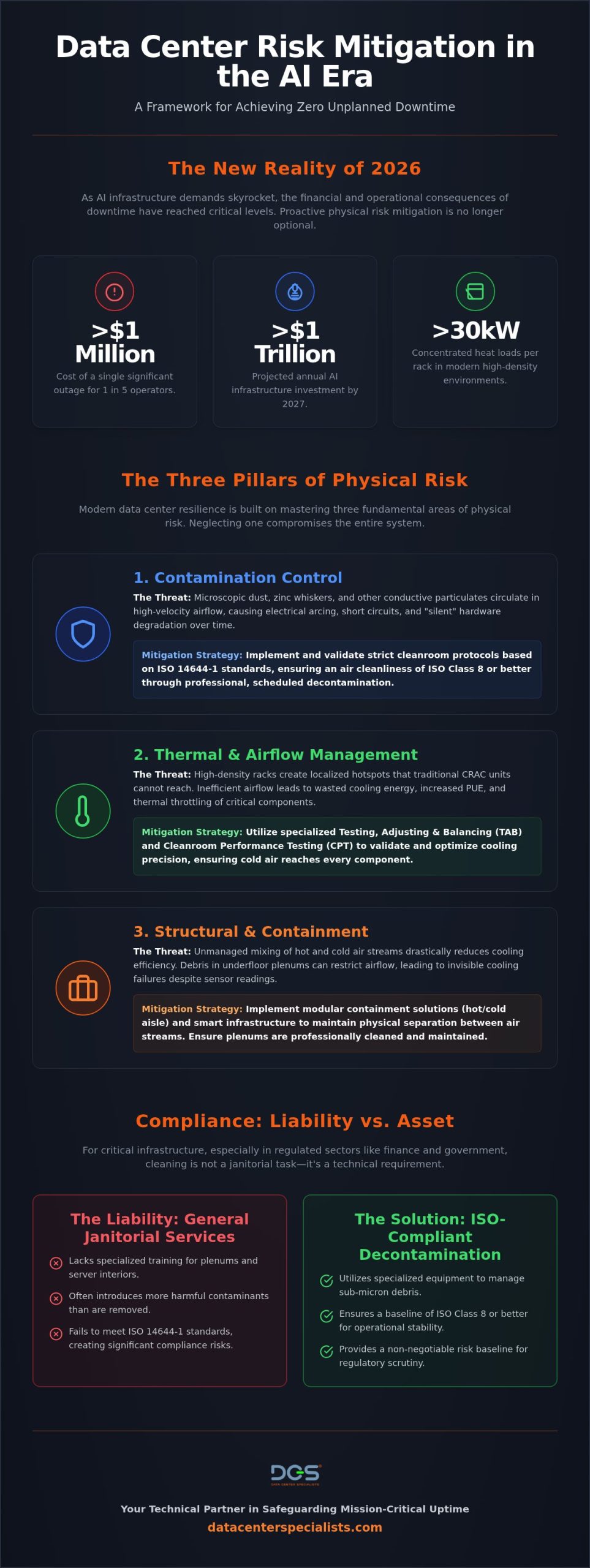
One in five data center operators reported that their most recent significant outage cost over $1 million according to Uptime Intelligence data from June 2026. You’re likely aware that even a microscopic lapse in environmental control can escalate into a catastrophic systemic failure. As annual investment in AI infrastructure is projected to exceed $1 trillion by 2027, the margin for error has effectively vanished. Implementing robust data center risk mitigation strategies is no longer just a best practice; it’s a fundamental requirement for the operational continuity of your facility.
You’ll master the specialized technical and operational frameworks necessary to protect mission-critical uptime against evolving environmental and systemic threats. We’ll examine how precision airflow engineering and strict adherence to the ISO 14644-13:2026 standards for surface cleanliness prevent the unexplained hardware failures that plague high-density environments. This guide provides a strategic roadmap for achieving zero unplanned downtime. We’ll also explore how to optimize your Power Usage Effectiveness (PUE) and extend hardware lifespan through meticulous contamination control. DCS approaches these challenges as a strategic partner, ensuring your infrastructure remains resilient in an increasingly demanding landscape.
Key Takeaways
- Adapt your facility to the high-density demands of 2026 AI infrastructure by implementing advanced data center risk mitigation strategies that prioritize thermal stability.
- Recognize the critical role of ISO 14644-1 standards in preventing systemic failures caused by micro-particulate contamination and arcing.
- Validate your environmental controls through specialized Testing, Adjusting & Balancing (TAB) and Cleanroom Performance Testing (CPT) to ensure cooling precision.
- Reduce PUE and eliminate hotspots by utilizing modular containment and smart infrastructure to maintain physical separation between air streams.
- Establish a reliable operational baseline through structured technical assessments and scheduled professional decontamination to safeguard mission-critical uptime.
The Evolving Landscape of Data Center Risk in 2026
The transition to AI-driven workloads has rendered traditional cooling models obsolete. By 2026, relying on historical weather patterns for HVAC planning has become a significant operational liability. We’ve moved beyond simple cooling; we’re now managing concentrated heat loads that can frequently exceed 30kW per rack. Effective data center management now requires a decisive shift from ‘reactive repair’ to ‘predictive technical maintenance’. This transition is essential to maintain the 99.999% uptime expected by modern enterprise clients.
Modern data center risk mitigation strategies are built upon three critical pillars of physical risk: Contamination, Thermal, and Structural. Ignoring any of these pillars invites systemic failure. Contamination involves the microscopic particulates that cause electrical arcing. Thermal risk centers on the precision of airflow and heat rejection. Structural risk focuses on the physical integrity of the rack and containment systems. DCS serves as the technical partner to execute these physical mitigations, ensuring that your facility meets the rigorous demands of the current era.
AI and the Rise of High-Density Rack Risks
AI server deployments have surged, and as of September 2026, 76% of new AI server deployments are expected to be liquid-cooled. However, air-cooled components in high-density racks still face unprecedented stress. Increased power draw creates localized hotspots that traditional CRAC units can’t always reach. High-velocity airflow is often used to compensate, but this creates a secondary risk: the rapid distribution of conductive particulates. These particulates settle on sensitive components, leading to ‘Silent Failure’ where hardware degrades over time without triggering immediate alarms. Mitigating this risk requires precision airflow and strict ISO hygiene protocols.
Regulatory and Compliance Risks in Malaysia
Operating within Malaysia requires strict adherence to national standards for critical infrastructure. For financial institutions and government agencies, ISO 14644-1 certification isn’t optional; it’s a non-negotiable risk baseline. Many facilities still rely on general janitorial services, but this creates a liability rather than a solution. Standard cleaning crews lack the specialized training to handle underfloor plenums or server rack interiors. They often introduce more contamination than they remove. DCS provides specialized ISO cleaning and technical testing to ensure your facility remains compliant and operational under the highest regulatory scrutiny.
Contamination Control: The ISO 14644-1 Mitigation Strategy
While digital security often takes center stage in discussions surrounding the NIST Cybersecurity Framework, physical environment integrity remains the foundation of operational resilience. Micro-particulates represent a persistent, physical threat that can bypass the most sophisticated software defenses. These microscopic particles don’t simply settle; they circulate within high-velocity air streams, eventually accumulating on sensitive circuitry. This leads to electrical arcing and the growth of “zinc whiskers,” which are conductive filaments that can cause immediate short circuits. Implementing data center risk mitigation strategies that prioritize contamination control is essential to prevent these “silent” hardware failures.
Adhering to ISO 14644-1 standards is no longer an optional benchmark; it’s a non-negotiable risk baseline for 2026. This international standard classifies air cleanliness by particle concentration, providing a measurable metric for facility health. For mission-critical environments, maintaining an ISO Class 8 or better environment ensures that the hardware operates within the manufacturer’s specified tolerances. Relying on standard janitorial services is a significant liability, as they lack the specialized equipment and protocols to manage sub-micron debris without introducing more contaminants into the air stream.
The Hidden Risk of Underfloor Contamination
The underfloor plenum serves as the primary artery for cooling in many facilities, yet it’s often the most neglected area. Debris left from construction or general wear restricts airflow, creating “invisible” cooling failures where sensors report adequate output but racks remain starved of cold air. In older facilities, galvanized steel components can undergo a process that releases zinc whiskers into the air stream. Professional Data Center Professional ISO Cleaning Service protocols involve specialized underfloor decontamination that removes these conductive hazards before they reach your server intakes. This level of precision is vital for maintaining the structural and operational integrity of the plenum.
Server Rack and Internal Component Hygiene
Risk mitigation must extend to the rack level. Server intakes act as high-powered vacuums, pulling in any suspended particulates. There’s a fundamental difference between surface-level dusting and deep-environment decontamination. Using specialized HEPA-filtered vacuums is mandatory to ensure that captured particles aren’t simply redistributed back into the room. Establishing a professional cleaning frequency based on your rack density is vital. Higher power draws require more frequent intervention to manage the increased particulate attraction caused by static and airflow. We recommend a structured schedule that scales with your operational load to ensure hardware longevity.
Thermal and Airflow Risk Mitigation: TAB and CPT Protocols
Thermal management represents the second pillar of physical resilience. While contamination control protects the hardware’s surface, thermal precision protects its internal logic. Comprehensive data center risk mitigation strategies must include rigorous Testing, Adjusting & Balancing (TAB) alongside Cleanroom Performance Testing (CPT) to ensure that cooling infrastructure performs as designed. Without these protocols, even the most advanced cooling systems can suffer from bypass airflow. This occurs when cold air escapes the intended path and mixes with hot exhaust, leading to inefficient cooling and localized hotspots that threaten uptime.
DCS conducts detailed Data Center Energy Assessments to identify these thermal leaks and “ghost” power consumption points. These assessments reveal where energy is being wasted by over-cooling some areas while others remain dangerously close to thermal thresholds. By identifying these gaps, operators can move from estimated performance to verified operational efficiency. It’s a fundamental step in reducing your Power Usage Effectiveness (PUE) while extending the lifespan of your high-density AI infrastructure.
The Role of TAB in Eliminating Hotspots
TAB involves the systematic evaluation of HVAC and hydronic systems to verify that air and water flows meet the design specifications. This process is essential for balancing air pressure across high-density rows, preventing the pressure imbalances that cause cooling starvation in specific racks. Through TAB, technicians identify fan failures and duct leaks that might otherwise remain undetected until a critical alarm is triggered. TAB is the science of ensuring every watt of cooling reaches its target. By precisely adjusting dampers and fan speeds, we ensure uniform cooling across the entire facility, regardless of varying rack densities.
CPT: Validating the Cleanroom Environment
Cleanroom Performance Testing (CPT) serves as the ultimate validation of your facility’s environmental integrity. While TAB focuses on the mechanics of airflow, CPT focuses on the quality and containment of that air. This includes particle count testing protocols that are essential for mission-critical IT health, ensuring that the environment remains within ISO 14644-1 parameters. CPT also involves HEPA filter leak testing to prevent external contaminant ingress and monitoring pressure differentials. Maintaining positive pressure zones is a vital risk mitigation tactic; it ensures that when doors are opened, air flows out of the white space rather than drawing unfiltered air in. Integrating these testing protocols into your broader data center risk mitigation strategies allows for a proactive rather than reactive stance on environmental health. DCS utilizes CPT to provide the documented proof of compliance required by high-stakes risk audits.
Structural Mitigation: Containment and Smart Infrastructure
Structural integrity is often mistaken for the building’s exterior resistance to natural disasters, yet the most immediate risks reside within the rack rows. Physical architecture plays a decisive role in data center risk mitigation strategies by preventing the mixing of hot and cold air streams. When these streams merge, the result is thermal inefficiency and increased stress on cooling units. Implementing DCS Smart Modular Containment creates a physical barrier that isolates exhaust air, allowing for a more predictable and stable thermal environment.
By 2030, power consumption from AI data centers is forecasted to increase by 175% from 2023 levels. This surge makes the separation of air streams a financial and operational necessity. Reducing your Power Usage Effectiveness (PUE) isn’t just about sustainability; it’s about reclaiming power capacity for high-density AI hardware. Modular systems provide the scalability required to expand without compromising the existing cooling profile. Precision matters here. Even small leaks in your containment can lead to significant energy loss.
Modular Containment as a Thermal Firewall
Modular containment acts as a thermal firewall by preventing the “short-cycling” of cold air. This occurs when chilled air returns to the cooling unit before it ever reaches the server intakes, wasting energy and reducing chiller capacity. By installing DCS Smart Modular Containment, you create a fail-safe environment where cooling is delivered precisely where it’s needed. These systems are highly customizable, making them ideal for brownfield data centers where legacy layouts often complicate modern airflow management. This structural intervention reduces the load on your cooling plant and provides a buffer against sudden thermal spikes.
DCS Smart Infrastructure Solutions
Edge deployments and high-density clusters require a more localized approach to risk. DCS Smart Racks integrate intelligent monitoring directly into the housing, providing real-time data on temperature, humidity, and airflow at the rack level. This specialized hardware significantly reduces human-error risks, such as leaving rack doors open or misconfiguring internal baffles. As we navigate the density requirements of 2026, modularity ensures that your facility can adapt quickly to new hardware generations. Scalability speed is often the difference between successful growth and operational stagnation. Integrated sensors provide the data needed to make informed adjustments before a hotspot becomes a failure.
To safeguard your facility’s structural integrity, explore our DCS Smart Modular Containment solutions.
Implementing a 5-Step Risk Mitigation Framework
Successful risk management requires a decisive transition from theoretical planning to physical execution. A structured framework ensures that no component of the environment is left to chance, moving beyond the limitations of financial insurance into the realm of physical reliability. Implementing comprehensive data center risk mitigation strategies involves a cyclical process of assessment, intervention, and validation. Precision is the guardian of uptime. By following a methodical roadmap, operators can neutralize environmental threats before they manifest as systemic failures.
The Audit Phase: Identifying Vulnerabilities
Begin by scheduling a baseline Technical Infrastructure Assessment to uncover hidden operational gaps. This phase must include professional thermal imaging to detect hotspots and particle count tests to verify air quality. Evaluating your current airflow efficiency and PUE metrics provides a data-driven starting point for all subsequent interventions. Reviewing maintenance logs is equally critical; look for “hidden” recurring issues like minor sensor drifts or frequent fan speed fluctuations. These often serve as early warning signs of larger mechanical stresses. This diagnostic approach allows you to prioritize high-risk zones that require immediate technical attention.
The Execution Phase: Partnering for Reliability
Choosing the right partners is the most significant factor in the success of your mitigation roadmap. Selecting specialized technical partners over general contractors ensures that your facility is managed with the precision required for mission-critical environments. Integrating DCS Smart Racks into your strategy provides localized monitoring that general infrastructure cannot match. These intelligent solutions offer real-time environmental data, reducing the likelihood of human-error risks. Integrating these services into your operational roadmap is simplified by consulting The Definitive Guide to Data Center Cleaning Services in Malaysia (2026), which outlines the specific protocols required for national compliance.
Follow this 5-step framework to establish a resilient operational baseline:
- Step 1: Baseline Technical Infrastructure Assessment. Conduct a comprehensive Data Center Energy Assessment to map thermal leaks and power waste.
- Step 2: ISO-Standard Decontamination Schedule. Establish a recurring Data Center Professional ISO Cleaning Service to maintain air cleanliness and surface integrity.
- Step 3: Annual TAB and CPT Validation. Perform Testing, Adjusting & Balancing (TAB) and Cleanroom Performance Testing (CPT) to verify that HVAC systems meet design specifications.
- Step 4: Modular Containment Upgrades. Deploy DCS Smart Modular Containment in critical high-density zones to physically separate air streams and eliminate bypass airflow.
- Step 5: Iterative Monitoring and Audits. Utilize continuous monitoring and annual energy efficiency audits to adapt to changing AI density requirements.
Securing the Future of Mission-Critical Uptime
The landscape of 2026 demands a shift from basic maintenance to precise technical environmental control. You’ve learned that true resilience is found at the intersection of rigorous ISO-standard hygiene and precision airflow balancing. By adopting a structured 5-step framework, you move beyond the risks of high-density AI workloads and toward a state of verified operational integrity. Implementing these data center risk mitigation strategies is essential for any facility aiming for zero unplanned downtime and optimized PUE in an increasingly demanding market.
DCS stands ready as your strategic partner to execute the physical mitigation portion of your corporate risk plan. Our ISO 14644-1 Certified Technicians utilize specialized underfloor cleaning equipment to ensure your plenum remains a conduit for cooling, not a source of contamination. With national support across Malaysia, we provide the specialized skills needed to navigate the complexities of modern infrastructure. Request a Professional Technical Infrastructure Assessment from DCS today to validate your facility’s resilience. Your path to a more reliable, efficient data center begins with precision.
Frequently Asked Questions
What are the most common data center risk mitigation strategies?
Comprehensive strategies include environmental contamination control, thermal management through TAB and CPT, and structural containment. Operators also prioritize energy assessments to identify systemic waste and hardware vulnerabilities. These data center risk mitigation strategies move beyond digital security to protect the physical layer. By integrating modular infrastructure like DCS Smart Racks, facilities can isolate high-density risks and ensure consistent uptime across the entire national footprint.
How does ISO 14644-1 impact data center risk management?
ISO 14644-1 provides the international benchmark for air cleanliness by particle concentration. It’s a non-negotiable metric for risk management because it quantifies the presence of microscopic conductive debris. Maintaining an ISO Class 8 environment significantly reduces the probability of electrical arcing and component degradation. DCS utilizes these standards during every Data Center Professional ISO Cleaning Service to provide documented proof that the environment meets manufacturer specifications for sensitive IT hardware.
Why is airflow balancing (TAB) considered a risk mitigation tool?
Testing, Adjusting & Balancing (TAB) is a preventive measure that ensures cooling delivery matches the thermal load of each rack. It mitigates the risk of hotspot formation by verifying that HVAC and hydronic systems operate at design specifications. Without regular TAB, pressure imbalances can lead to cooling starvation in high-density zones. This technical validation prevents fan failures and duct leaks from escalating into significant outages, ensuring every watt of cooling is effectively utilized.
Can professional cleaning prevent server hardware failure?
Yes, professional cleaning is a primary defense against silent hardware failures caused by particulate accumulation. Specialized protocols remove conductive dust and zinc whiskers that cause catastrophic short circuits and arcing. Unlike general janitorial services, a Data Center Professional ISO Cleaning Service uses HEPA-filtered vacuums to capture sub-micron particles without redistributing them. This meticulous decontamination extends the lifespan of internal components and maintains the environmental integrity required for mission-critical reliability.
What is the difference between hot aisle and cold aisle containment for risk?
Cold aisle containment encloses the supply air to ensure only chilled air reaches server intakes, while hot aisle containment isolates exhaust air to prevent it from mixing with the room’s ambient supply. Both methods mitigate the risk of bypass airflow and thermal mixing. DCS Smart Modular Containment allows for precise physical separation, which lowers the load on cooling units. The choice depends on the specific facility architecture and the density of the existing server hardware.
How often should a data center undergo a thermal risk assessment?
Facilities should ideally conduct a Data Center Energy Assessment and thermal audit annually. However, any significant change in rack density or the introduction of AI-centric hardware should trigger an immediate re-evaluation. Regular assessments identify ghost power consumption and emerging hotspots before they threaten uptime. This iterative auditing process is a core component of effective data center risk mitigation strategies, allowing for proactive adjustments to cooling infrastructure as operational loads evolve.
What are the risks of using general janitorial services in a server room?
General janitorial services pose a significant liability because they lack the specialized training and equipment required for sensitive IT environments. Standard cleaning methods often introduce more contaminants by using non-HEPA vacuums or improper chemicals. They also risk accidental cable disconnections or equipment damage. DCS provides technicians trained specifically in ISO standards and underfloor cleaning protocols. This specialized expertise ensures that decontamination occurs without compromising the delicate balance of a mission-critical facility.
How does modular containment improve data center uptime?
Modular containment improves uptime by creating a predictable thermal environment and reducing the strain on cooling infrastructure. It prevents short-cycling, where chilled air returns to the cooling unit without cooling the hardware. By physically isolating air streams, modular systems like DCS Smart Modular Containment provide a buffer against sudden thermal spikes. This structural intervention allows for fail-safe cooling redundancy and ensures that even during peak loads, mission-critical equipment remains within safe operating temperatures.