
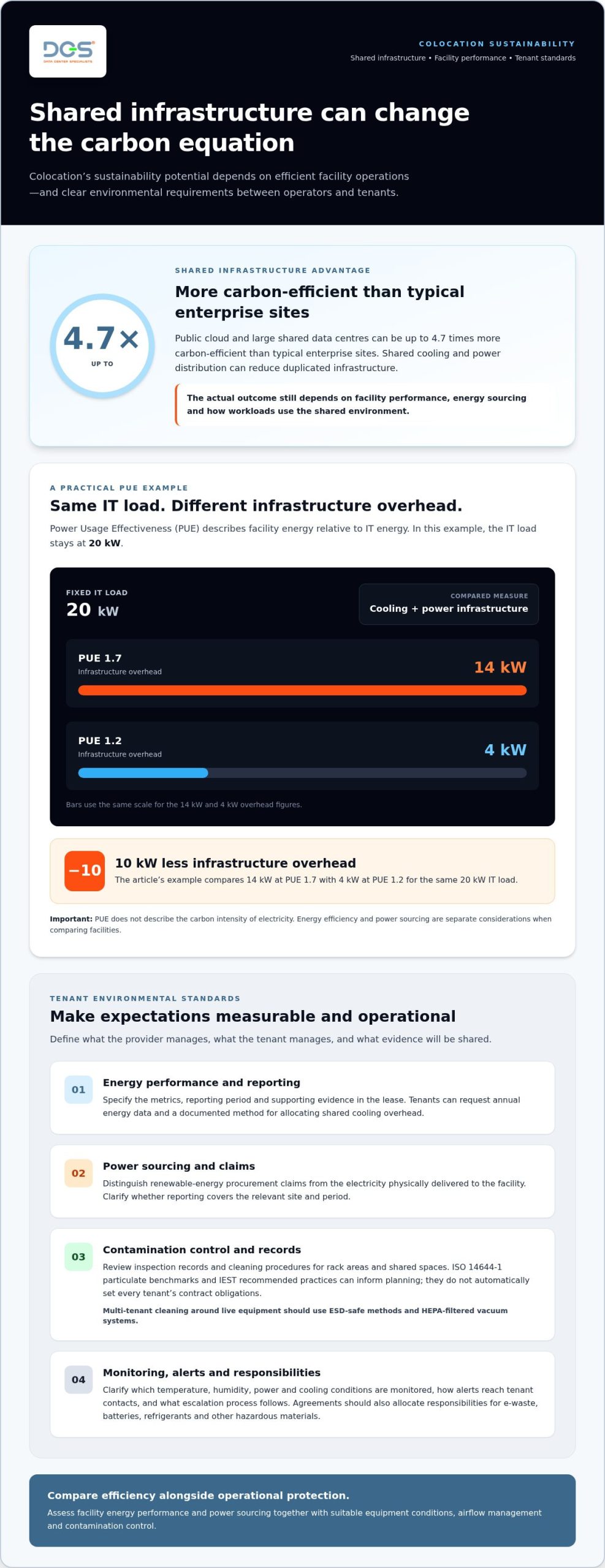
Shared infrastructure can make colocation more carbon-efficient: public cloud and large shared data centres can be up to 4.7 times more carbon-efficient than typical enterprise sites. Effective colocation tenant environmental standards build on that advantage by setting expectations for energy efficiency, power sourcing, cooling, and contamination control. The result depends not just on the facility, but on how its operator and tenants manage their shared environment.
That sustainability potential is compelling, but environmental performance must be assessed alongside operational protection. A lower energy footprint matters only if the facility also maintains suitable conditions for live IT equipment, manages airflow, and controls dust and other contaminants without disrupting tenant workloads.
This article explains how shared infrastructure, facility efficiency, and tenant requirements shape colocation sustainability. It also outlines the environmental protections and operational considerations to assess when evaluating a facility in Malaysia, including energy performance, renewable power, thermal conditions, airflow, and contamination control.
Key Takeaways
- Assess sustainability across facility energy performance, power sourcing, and the efficiency of shared cooling infrastructure.
- Define environmental expectations in the colocation agreement, including how energy use and environmental performance are reported.
- Use particulate-control practices and documented inspections to help protect equipment and support audit readiness.
- Align equipment operating conditions with applicable thermal guidance and the requirements of the installed hardware.
- Coordinate equipment installation, airflow management, and blanking panels with facility procedures to reduce cooling disruption.
What Makes Colocation Data Center Sustainability Possible?
Colocation sustainability depends on shared facilities, efficient power and cooling, and clearly defined tenant requirements. Any costs or penalties for exceeding environmental or capacity limits depend on the charges and remedies stated in the lease. Clear colocation tenant environmental standards link operational controls with enterprise sustainability objectives.
Customer Sustainability Requirements
Enterprise sustainability requirements set expectations for a provider’s energy performance, power sourcing, and reporting. They matter because tenants need to connect facility operations with their own environmental objectives. Tenants can request energy-efficiency and power-procurement terms in lease agreements. Before signing, define the metrics, reporting period, and required evidence. This gives operations and procurement teams a shared basis for evaluating performance and makes colocation tenant environmental standards measurable and relevant to the facility.
Colocation Sustainability Benefits
Colocation sustainability benefits arise when shared infrastructure serves workloads more efficiently than separate enterprise facilities. Public cloud and large shared data centres can be up to 4.7 times more carbon-efficient than typical enterprise sites. Shared cooling and power distribution can reduce duplicated infrastructure, while tenants retain control of their hardware and storage. For rack-level setups, deploying dedicated solutions from providers such as RackPower helps optimize power delivery and protection within critical infrastructure. Consolidating workloads can support efficiency, but assess actual facility performance and energy sourcing.
Power Usage Effectiveness (PUE) helps illustrate infrastructure overhead. In one example, a 20 kW IT load at PUE 1.7 requires 14 kW for cooling and power infrastructure. At PUE 1.2, that overhead is 4 kW, a 10 kW reduction. PUE describes facility energy relative to IT energy, not the carbon intensity of electricity. For Malaysian tenants, both measures matter when comparing facilities and evaluating operational impact.
Translate sustainability goals into operational requirements before contract negotiations. Specify whether they concern energy efficiency, renewable procurement, reporting, or a combination. For example, a tenant may request annual energy data and a documented method for allocating shared cooling overhead. Providers can then explain their reporting and operational constraints. This helps teams weigh sustainability alongside uptime, workload growth, and capacity needs.
Google, Microsoft, and Amazon have each committed to 100% renewable energy operations, demonstrating how power procurement features in corporate sustainability targets. Distinguish a provider’s renewable-energy claims from the electricity physically delivered to its facility. Ask how procurement information is represented in reporting and whether the data covers the relevant site and period. Clear definitions support consistent ESG calculations across facilities.
Retail colocation data centres are described as serving customers with capacity below 250 kW. Hundreds of customers can share cooling in cabinets and cages. Cleaning in multi-tenant data centers should use ESD-safe methods and HEPA-filtered vacuum systems to work around live equipment. By contrast, an organization operating an in-house data center owns its infrastructure hardware and systems. These are distinct facility arrangements and ownership models.
Industry stakeholders and frameworks across the broader market are increasingly introducing data centre sustainability guidelines, requiring annual energy disclosure reporting and establishing frameworks to incentivise efficient operations. Venture capital and private equity investment in sustainable data centre technologies have also increased significantly in recent years as national efficiency standards evolve.
Environmental protections
Environmental protection in a colocation data center combines particulate control, monitoring, equipment safeguards, and documented operating procedures. Tenants should clarify which controls the provider manages and which responsibilities remain with their own teams.
For contamination control, ISO 14644-1 provides particulate benchmarks relevant to controlled environments, while IEST recommended practices offer a reference for contamination-control planning. These references can inform facility procedures, but they don’t automatically define every tenant’s contract obligations. For example, teams can review inspection records and cleaning procedures for rack areas and shared spaces.
Monitoring and alert arrangements are usually set out in the provider’s operating procedures and the tenant agreement. Clarify which temperature, humidity, power, and cooling conditions are monitored, how alerts reach tenant contacts, and what escalation process follows an alarm.
For Malaysian facilities, distinguish environmental management certification from building energy guidance when reviewing ISO 14001 or MS 1525. Ask the provider which standards or certifications apply to the facility, what scope they cover, and what documentation supports that claim; don’t assume a certificate sets every tenant’s equipment limits.
The agreement and site procedures should allocate tenant responsibilities for e-waste, batteries, refrigerants, and other hazardous materials. Before removing or replacing equipment, identify the approved handling route, storage rules, access requirements, and documentation process. For example, coordinate battery removal with facility operations instead of leaving removed units in a cage or shared area.
If tenant equipment exceeds an agreed environmental or power limit, the provider’s response should follow the contract and operating procedures. These may specify notification, corrective action, load restrictions, or charges. The agreement determines the applicable steps and consequences.
Before signing, review the facility’s controls. Request relevant environmental procedures, descriptions of monitoring and escalation, inspection records, and the applicable certification scope. Compare the stated limits with equipment requirements, then clarify contract responsibilities for reporting, waste handling, and corrective actions. This can reveal gaps before workloads depend on the facility.
Dust beneath raised floors or around live hardware can affect airflow and contamination control. A documented data center cleaning programme can support consistent inspection and control practices in operational environments.
Energy performance can also inform environmental review. The page states that liquid cooling systems can reduce overall facility energy consumption by 30-40% compared with traditional air cooling. Ask whether the facility uses liquid cooling and what energy measures apply to the areas serving your equipment. Power usage effectiveness, or PUE, offers another comparison point: a data centre’s PUE approaches 1 as the facility becomes more efficient. Google and Facebook have claimed PUE levels as low as 1.1 for their data centers, while a PUE of 3.0 indicates a relatively inefficient data centre. These figures provide context, not a guarantee of performance at a particular facility.
The page states that initial energy-efficiency improvements can reduce overall consumption by 15-25%. Ask the provider how it tracks energy performance and whether the reported figures apply to the whole facility or a defined scope. Colocation providers may maintain SOC 2, HIPAA, and PCI DSS certifications that address controls including physical access and environmental protections. Review the scope of any certification rather than treating its existence as proof that every environmental condition suits your equipment. Together, these questions can help you assess both facility controls and energy performance before relying on the site.
What environmental standards apply to colocation tenants in Malaysia?
For Malaysian colocation tenants, practical requirements are set by the facility agreement, site rules, and equipment specifications. A standard named in a provider’s documents does not automatically define every tenant obligation. Read each reference alongside its stated scope, affected areas, and applicable procedures. The key is to identify which requirements govern tenant equipment and which apply to shared facility infrastructure.
During contract review, create a requirements schedule that separates provider-controlled systems from tenant-controlled equipment. Record the applicable environmental criteria, responsible party, evidence of compliance, and process for approving changes. This distinction prevents tenants from assuming the provider manages conditions inside every cabinet, or providers from assuming tenants manage shared areas.
Colocation tenant environmental standards are most useful when translated into operational responsibilities, rather than left as broad contract language. For example, assign responsibility for maintaining tenant equipment specifications, coordinating installation work, and documenting deviations. Align these duties with facility access rules and change-control procedures so engineering teams can apply them consistently during routine work and upgrades.
Review any certification or standard cited in procurement documents, checking its stated scope and relevance to the contracted space. Keep the certificate or technical specification with the agreement, and note whether it covers the facility, a particular process, or a defined environmental condition. This avoids treating a general reference as proof that every tenant-specific requirement has been addressed.
Before service begins, hold a technical review with procurement, IT, and facility operations. Resolve practical questions such as who approves rack changes, who maintains records, and how exceptions are documented. Capture decisions in the contract schedule or site procedure, not just meeting notes. For example, a tenant adding equipment should follow the agreed approval process before modifying its installation.
Keep the resulting documents together as a controlled operational record. A useful set includes the executed agreement, tenant-specific schedules, current equipment requirements, applicable facility procedures, and approved change records. Assign an owner to update the record when hardware or contractual terms change. This gives audit and operations teams a traceable basis for reviewing responsibilities, without relying on informal interpretations of standards.
The applicable standards or certifications are those cited in the provider’s documents and relevant to the contracted space. Check each one’s stated scope and whether it covers the facility, a specific process, or a defined environmental condition.
What temperature and humidity ranges must colocation tenants maintain for IT equipment?
ASHRAE TC 9.9 is a reference for data center thermal guidance, but tenant limits depend on equipment requirements and the facility’s agreed operating envelope. Set the applicable temperature and humidity conditions through the equipment specifications, provider procedures, and colocation agreement, rather than treating one range as universal.
Start with the hardware manufacturer’s environmental requirements. Review the specifications for each server, storage system, and network device, then compare them with the provider’s documented conditions at equipment intake. If a rack contains devices with different requirements, use the most restrictive applicable limits when planning placement and monitoring.
Room-level temperature may not reflect conditions at a server inlet. Airflow, rack loading, cable obstructions, and neighbouring equipment can create local variations. For example, a sensor near a cold-air supply may record a different condition from one at the intake of a high-load rack. Agree with facility operations on measurement locations and which readings trigger notification.
Humidity also needs careful interpretation. Relative humidity changes with air temperature, so interpret a reading alongside its location and operating conditions. Equipment specifications and facility controls should define the acceptable envelope. Avoid relying on a single room sensor to represent every cabinet, particularly where airflow paths or equipment loads vary.
Use a documented monitoring and response plan. Before installation, establish:
- Which temperature and humidity measurements apply to the tenant space.
- How alarms are communicated to tenant and facility operations contacts.
- Who investigates excursions and records corrective actions.
These details connect thermal guidance to operational decisions. If an alarm occurs, the response may include reviewing sensor readings, checking airflow paths, and coordinating with facility staff before changing equipment load. Record the event and resolution so recurring patterns can inform rack placement or capacity planning.
Malaysia’s warm, humid climate makes facility cooling and moisture control important operational considerations, but permitted conditions for tenants still come from equipment specifications and the site agreement. For a new deployment, compare each device’s requirements with the facility’s stated operating envelope before shipping hardware. Revisit the comparison when equipment changes, loads shift, or cooling arrangements are modified.
Keep agreed limits, sensor locations, escalation contacts, and equipment specifications in one operational record. This gives procurement, IT, and facilities teams a consistent reference during installation and incident response. If rack surfaces or equipment areas need physical contamination control, plan the work so it does not obstruct airflow or disturb live operations.
There is no single temperature and humidity range that applies universally. Use equipment specifications and the facility’s documented operating envelope to determine the applicable limits.
What rules govern tenant equipment installation, airflow management, and blanking panels in colocation facilities
Installation rules protect shared infrastructure and keep tenant equipment compatible with facility operations. Before delivery, submit equipment dimensions, rack position, power requirements, cable routes, and service access needs through the provider’s approval process. The facility can assess placement against cage layout, power allocation, cooling design, and security procedures.
Coordinate installation with facility operations. A server with its intake facing an exhaust path can draw heated air, while a blocked return path can disrupt cooling around neighbouring racks. Align equipment orientation with the room’s hot- and cold-aisle arrangement. Route cables through approved pathways and avoid blocking perforated floor tiles, vents, or cabinet openings.
Blanking panels close unused rack spaces and help prevent hot exhaust air from recirculating into equipment intakes. Install panels where empty rack openings would otherwise create a direct bypass between hot and cold sides. For example, in a partially populated cabinet without panels, cooled supply air can escape through empty spaces instead of passing through active servers.
Airflow control depends on more than panels. Cable bundles, open rack gaps, poorly positioned equipment, and misplaced floor tiles can all alter pressure and air distribution. Dust and debris in cages, beneath raised floors, and inside hot- or cold-aisle containment can also disrupt pressure balance and cooling efficiency. Keep equipment areas and airflow paths clear, and coordinate changes with the operator.
Use a deployment review to prevent avoidable airflow problems:
- Provide the provider with equipment and power details before delivery.
- Confirm rack orientation, cable routing, and access requirements.
- Fit blanking panels around installed equipment and close unused openings.
- Record rack changes and report altered airflow or cooling observations.
These controls become especially important when adding equipment to an existing cabinet. A new server can change intake demand and exhaust behaviour, even if it fits physically. Review the proposed location and power allocation with facility operations before installation. After commissioning, check that cables, panels, and equipment positions match the approved arrangement.
Containment design also affects how supply and exhaust air remain separated. Coordinate tenant changes with the facility’s containment configuration, rather than modifying doors, curtains, or barriers independently. A containment assessment can help operators evaluate airflow separation and identify installation conditions that warrant engineering review.
For recurring hotspots or uneven rack temperatures, document equipment positions, airflow obstructions, and recent changes. A structured review gives facility teams a practical basis for adjusting rack layouts and maintaining consistent cooling across shared areas.
Data Center Specialists (M) Sdn Bhd (DCS): Professional Data Center ISO Cleaning Services
Data Center Specialists (M) Sdn Bhd (DCS) provides Professional Data Center ISO Cleaning Services for contamination control in mission-critical environments. This service is relevant when dust, construction residue, or debris around racks and equipment could compromise cleanliness or obstruct airflow. Cleaning plans account for site procedures, tenant separation, access controls, and the need to protect operational equipment.
For colocation operators and facility teams, professional cleaning supports environmental controls alongside monitoring and airflow management. DCS also provides a Data Center Energy Assessment, Testing, Adjusting & Balancing (TAB), and Cleanroom Performance Testing (CPT) to address relevant facility requirements.
Contact DCS to discuss professional data center cleaning for your facility.
Put Environmental Requirements Into Practice
Turn colocation environmental standards into an operating framework that procurement, facility operations, and IT teams can apply consistently. Document responsibilities, approval processes, monitoring expectations, and change controls so equipment additions and facility work remain coordinated. Review the framework when workloads or rack layouts change, and keep relevant records accessible to teams responsible for continuity.
Where facility conditions need technical attention, Data Center Specialists (M) Sdn Bhd (DCS) provides Professional Data Center ISO Cleaning Services, Data Center Energy Assessment, and Testing, Adjusting & Balancing (TAB). These services address physical contamination control, energy performance assessment, and airflow or system balancing in mission-critical environments.
Discuss your facility requirements and operational priorities with DCS. Contact Data Center Specialists (M) Sdn Bhd (DCS) to explore a suitable next step for your site.
Frequently Asked Questions
What Does the Future Hold for Sustainable Colocation?
Sustainable colocation is projected to expand, with the global sustainable colocation services market expected to grow over 15% annually through 2030. For tenants, the practical focus will be whether efficiency and power-sourcing commitments remain measurable as workloads grow. During renewal or expansion planning, compare updated energy and environmental reporting with earlier facility records, and account for how additional capacity may affect shared infrastructure and sustainability targets.
What environmental risks should colocation tenants consider, including flooding, smoke, condensation, and cooling failure?
Tenants should consider how dust and debris can disrupt airflow and cooling, and clarify how temperature, humidity, power, and cooling are monitored and how alarms are escalated. The material gives no specific guidance on flooding, smoke, or condensation.