

What if two data center maintenance proposals with similar totals covered very different operational risks? A data center maintenance budget proposal template 2026 should make those differences visible by linking each facility need to planned work, assumptions, and approval controls. A total alone can’t show whether critical systems, maintenance intervals, or site-specific conditions have been accounted for.
Facility and procurement teams often face the same challenge: maintenance scopes vary, while operational risks don’t always map clearly to budget line items. Unstated assumptions can lead to approval delays, scheduling conflicts, or disputes over what was included. A credible proposal gives reviewers a consistent basis for assessing the work, not just its price.
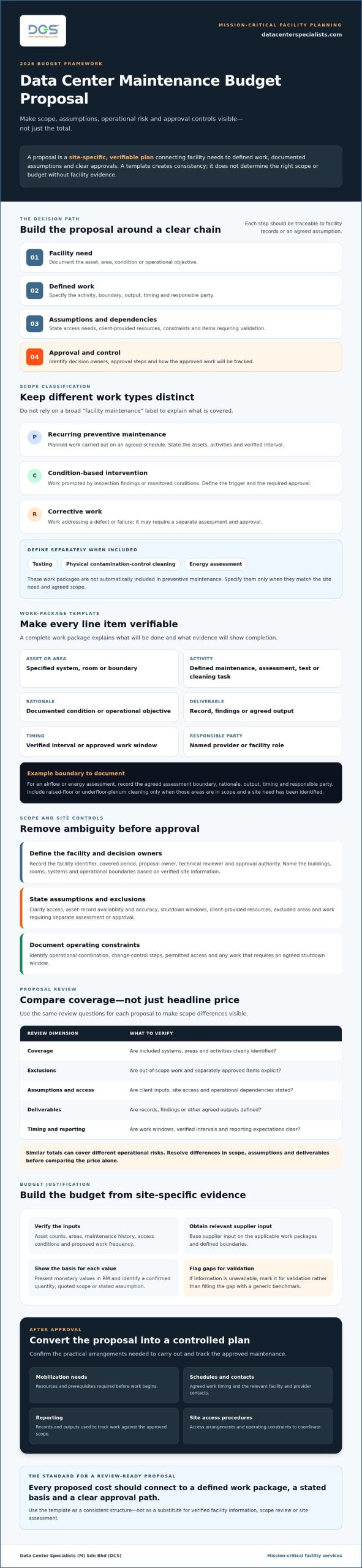
This guide provides a reusable structure for mission-critical facilities, from defining assets and work packages to documenting exclusions, schedules, dependencies, and budget review controls. It also explains how to compare proposals using scope, deliverables, risk coverage, and Malaysia-specific planning inputs, including RM budgeting, without relying on unsupported cost benchmarks. Use the framework to prepare a proposal decision-makers can scrutinize, approve, and track against the planned maintenance.
Key Takeaways
- Use the data center maintenance budget proposal template 2026 to connect documented facility needs with defined work, assumptions, approvals, and review controls.
- Break the scope into verifiable work packages, with clear activities, rationale, deliverables, timing, and responsible parties.
- Compare proposals by coverage, exclusions, access requirements, and reporting, not by headline price alone.
- Build the budget justification from site-specific evidence. A template cannot determine the appropriate spend without it.
- Turn approved work into a controlled plan by confirming mobilization needs, schedules, contacts, reporting, and site access procedures.
What a data center maintenance budget proposal template 2026 must clarify
A maintenance budget proposal is a scoped plan that identifies the work being proposed, the basis for its cost, and the approvals needed to proceed. A data center maintenance budget proposal template 2026 provides a consistent structure, but it cannot establish the right scope or budget without site-specific evidence. Treat it as a starting point for documenting decisions, not a replacement for a facility assessment.
Keep three work types distinct. Recurring preventive maintenance follows an agreed schedule. Condition-based interventions respond to inspection findings or monitored conditions. Corrective work addresses a defect or failure and may require separate assessment and approval. Identify testing, physical contamination-control cleaning, and energy assessment as defined work packages too. Don’t present them as automatically included in preventive maintenance. For context, data center management spans ongoing infrastructure operations and planning. DCS’s data center maintenance services may be relevant where the facility’s requirements align with the proposed scope.
Define the facility, planning period, and decision owners
Start with fields for the facility identifier, covered period, proposal owner, technical reviewer, and approval authority. Record the buildings, rooms, systems, and operational boundaries included, based on verified site information rather than assumed configurations. Document relevant constraints, including permitted access, operational coordination, change-control steps, and any work requiring an agreed shutdown window. These details show reviewers where the proposal applies and who must authorize or coordinate the work.
Separate scope, assumptions, and exclusions
For each requested service, specify the physical or technical areas covered and what is outside scope. State assumptions about access, the availability and accuracy of asset records, shutdown windows, and resources the client is expected to provide. Identify items that require a separate assessment or approval. Clear boundaries help prevent a reviewer from assuming that an inspection, test, cleaning activity, or corrective task is included when it hasn’t been specified.
Support every quantity, schedule, and cost with verified information. Check asset counts, areas, maintenance history, access conditions, and proposed work frequency against facility records and a site review. Obtain supplier input for the relevant work packages. Present monetary values in RM and identify their basis, such as a confirmed quantity, quoted scope, or stated assumption. If information is unavailable, mark it for validation instead of filling the gap with a generic benchmark. This makes the proposal easier to assess and revise before approval.
Build the Data Center Maintenance Proposal Around a Verifiable Scope
Build each proposal around defined work packages, not broad labels such as “facility maintenance.” A complete work package identifies an activity, a clear boundary, a deliverable, and evidence of completion. This gives technical reviewers and procurement teams a consistent way to check what is included and what completion means.
The data center maintenance budget proposal template 2026 should distinguish scheduled preventive maintenance from assessment, testing, physical cleaning, and corrective work. Include each activity only when it matches the facility’s condition, operating objectives, and agreed scope. For example, raised-floor or underfloor-plenum cleaning belongs in the proposal only when those areas are included and a site need has been identified. Don’t imply that an assessment or corrective task is automatically covered by a preventive maintenance line item.
| Asset or area | Activity | Rationale | Deliverable | Timing | Responsible party |
|---|---|---|---|---|---|
| Specified system or area | Defined maintenance, assessment, test, or cleaning activity | Documented condition or operational objective | Record, findings, or agreed output | Verified interval or approved window | Named provider or facility role |
| Airflow or energy assessment boundary | Assessment within the agreed boundary | Site-specific performance question | Assessment findings and recommendations, if included | Coordinated with facility operations | Assigned technical lead and site contact |
Map work packages to systems and operating conditions
List critical systems only when they are part of the requested scope. Identify the specific rooms, equipment, or operational boundaries involved, including racks, raised floors, or underfloor plenums where relevant. For airflow or energy work, state what is being assessed and what coordination with facility operations is needed. This prevents a proposal from implying access to systems or areas that haven’t been reviewed and agreed.
Specify deliverables and evidence for each activity
Define the records expected for each package, such as completed checklists, inspection findings, observations, or recommendations where applicable. State who reviews the records, how questions or exceptions are handled, and what evidence confirms the agreed activity was completed. Set acceptance criteria for the specific scope. Avoid applying universal pass conditions where none have been agreed.
For scope examples, review data center maintenance services. If professional data center cleaning is relevant, define it separately as physical contamination-control work, with its own boundaries and deliverables. Confirm the proposed scope against facility conditions and operating requirements before seeking approval.
Compare Maintenance Proposals by Assumptions, Deliverables, and Risk
A fair comparison starts with the work promised, not the total at the bottom of the proposal. The data center maintenance budget proposal template 2026 can give each bidder the same response structure, helping reviewers spot differences in scope, evidence, and operational assumptions before assessing commercial terms.
Make proposals comparable before reviewing commercial terms
Give every bidder the same scope schedule, facility information, response format, and clarification process. Ask each to identify included work, quantities, timing, deliverables, and responsible parties. Flag missing asset quantities, undefined responsibilities, and boundaries that don’t match the requested scope. Keep optional activities separate from the base proposal so different work packages aren’t treated as equivalent.
| Comparison area | What to verify |
|---|---|
| Scope alignment | Are the same systems, areas, activities, and planning period covered? |
| Deliverables | Are records, findings, recommendations, and completion evidence defined where applicable? |
| Assumptions | Are asset information, access, operating conditions, and client-provided resources stated? |
| Exclusions | Are omitted activities and items requiring separate assessment or approval explicit? |
| Access and coordination | Are access conditions, operational impacts, and required coordination described? |
| Reporting and escalation | Does the proposal explain how findings, exceptions, and unresolved issues will be reported and escalated? |
An apparently lower proposal may cover fewer assets, omit a defined deliverable, assume easier access, or exclude work another bidder has included. That difference doesn’t by itself establish better or worse value. Clarify the gap, align the scope where possible, and compare revised proposals on an equivalent basis instead of treating different coverage as the same service at a lower cost.
Test whether risk and technical assumptions are visible
Check whether each bidder explains relevant risks, dependencies, access conditions, and potential operational impacts. For contamination-related work, confirm which spaces and surfaces are included, then review the facility’s contamination-control needs. For energy-related scope, establish the assessment boundary, the operating information required, and any coordination with facility operations. These questions help determine whether the proposed approach fits the site, not just whether it looks complete on paper.
Review evidence requirements and escalation processes alongside commercial terms. Ask how observations will be documented, who receives findings, and what happens when work identifies an issue outside the agreed scope. Don’t assign arbitrary scores or rely on generic benchmarks. Evaluate technical suitability, operational fit, defined deliverables, and proposal terms together. If you’re establishing maintenance scope, review Data Center Specialists’ data center maintenance services as a reference for a technical discussion.
Justify the 2026 Maintenance Budget Without Unsupported Cost Claims
A template can organize a proposal, but it can’t determine an appropriate maintenance budget without site-specific evidence. For a defensible data center maintenance budget proposal template 2026, connect each requested allocation to a documented need, a defined work package, its assumptions, and an approval decision. Use verified facility records and assessment findings, not generic prices, assumed savings, or unsupported risk-reduction percentages.
Budget confidence depends on traceable scope and verified assumptions.
Document the basis for each requested allocation
Use this sequence to show how needs become approved work:
- Record the need. Cite its source, such as an inspection finding, asset record, maintenance history, or approved operating requirement.
- Define the proposed work. State the activity, asset or area covered, deliverable, and relevant boundary.
- Identify the basis and assumptions. Link quantities and timing to verified information. Mark any provisional allowance clearly and state what must be validated before approval.
- Explain dependencies. Document access requirements, operational coordination, or timing constraints that affect delivery. Describe the consequence of deferring work only when facility evidence supports it.
- Submit for review. Present the rationale, supporting records, and requested approval together so reviewers can trace the decision.
Keep confirmed work separate from provisional items. If an asset count, access condition, or proposed intervention hasn’t been verified, identify it as an open assumption instead of presenting it as a confirmed requirement. This makes uncertainty visible and gives the approver a clear basis for requesting further assessment or adjusting the proposal.
Set review controls for approval and change
Identify the budget owner, technical reviewer, approval route, and documents required for review. Define how changes will be handled if site conditions differ from the assumptions, additional findings emerge, or work is deferred. Record the reason, scope impact, supporting evidence, decision, and approving party before updating the plan. This creates an auditable record and helps prevent informal changes from altering the approved scope.
Once proposal requirements are established, discuss site-specific scope with Data Center Specialists. Its data center maintenance services can be considered against the facility’s documented needs and proposed work packages.
Turn the Approved Proposal into a Controlled Maintenance Plan
Approval is the handoff from budget intent to operational execution. Convert the accepted scope into a mobilization plan that confirms work windows, dependencies, access arrangements, contacts, and reporting expectations before activities are scheduled. Reconcile each approved task with the facility’s operating procedures and site-specific access controls. A budget line alone doesn’t authorize access or resolve operational coordination.
Convert approval details into operational controls
Assign accountable owners for site coordination, access, technical review, and approval of scope changes. Confirm proposed work windows and dependencies with facility operations before scheduling. Specify mobilization requirements, required site information, reporting recipients, and how findings will be communicated. Keep a record of completed work, observations, open actions, and approved changes so the maintenance plan remains traceable to the authorized proposal.
Set a review cadence that fits the approved work and the facility’s governance process. At each review, reconcile planned and completed activities, examine findings and unresolved actions, and document changes to scope or timing. Carry deferred items forward with their rationale and decision status. Use these records to inform the next budget cycle, updating assumptions when asset information, operating conditions, or facility priorities change.
Use specialist support where the scope requires it
Include specialist work only when site conditions and operating objectives support it. Depending on the documented need, this may include professional data center cleaning for physical contamination control, Testing, Adjusting & Balancing (TAB), Cleanroom Performance Testing (CPT), or an energy assessment. Define the boundary, deliverable, schedule, and coordination requirements for each activity. Review proposed outcomes against the agreed scope rather than assuming a guaranteed result.
Data Center Specialists provides data center preventive maintenance, professional data center cleaning, TAB, CPT, and energy assessment services. If you’ve established the facility requirements and need to discuss how specialist work may fit the approved scope, contact DCS for a maintenance discussion.
Make Your 2026 Maintenance Proposal Ready for Approval
A defensible maintenance budget connects documented facility needs to defined work, clear assumptions, and accountable approvals. Use the data center maintenance budget proposal template 2026 to structure that evidence, compare proposals on equivalent scope, and carry approved activities into a controlled plan. Support the requested budget with site records and assessment findings, not generic cost benchmarks.
Founded in 2008, Data Center Specialists provides data center preventive maintenance and specialist facility services. If you’ve established your requirements and need to discuss a site-specific scope, discuss your data center maintenance requirements with DCS. A clear, evidence-based proposal is a practical foundation for sound maintenance planning.
Frequently Asked Questions
What should a data center maintenance budget proposal include?
Include the facility and planning period, proposal and approval owners, defined work packages, assumptions, exclusions, schedule, deliverables, and budget basis. Each package should identify the asset or area, activity, rationale, timing, responsible party, and evidence of completion. Separate recurring preventive maintenance from assessments, testing, physical cleaning, and corrective work. This structure helps reviewers see what is covered, what requires separate approval, and what information supports each allocation.
How do you prepare a data center maintenance budget for 2026?
Prepare it by connecting verified facility needs to proposed activities and approval controls. Review asset records, maintenance history, inspection findings, and operating requirements, then define the work and its boundaries. Confirm quantities, timing, access conditions, and supplier input before assigning costs in RM. Mark unverified items as provisional rather than treating them as confirmed scope. The data center maintenance budget proposal template 2026 provides a structure for this process, not a substitute for site assessment.
How can facility managers compare data center maintenance proposals?
Give each bidder the same facility information, scope schedule, response format, and clarification process. Compare whether proposals cover the same assets, activities, deliverables, assumptions, exclusions, access needs, and reporting arrangements. Ask how findings and out-of-scope issues will be documented and escalated. A lower total may reflect less coverage or different assumptions, so clarify gaps and separate optional work before comparing commercial terms. Evaluate technical suitability and operational fit as well as price.
What is the difference between preventive and corrective maintenance budgeting?
Preventive maintenance budgeting covers planned, recurring activities for specified systems according to an agreed scope and schedule. Corrective maintenance budgeting addresses a known defect or failure and may depend on assessment findings, repair scope, and separate approval. Keep these categories distinct so scheduled work isn’t mistaken for a commitment to resolve every fault. State how additional findings will be recorded, assessed, and authorized before corrective work proceeds.
Can one maintenance proposal template work for every data center?
One template can provide consistent fields, but it can’t define the right scope for every facility. Data centers differ in systems, asset records, operating conditions, access controls, maintenance history, and work priorities. Use a common structure for comparison, then tailor its work packages and assumptions to verified site information. Don’t assume that a service, schedule, quantity, or acceptance criterion suitable for one facility applies to another without review.
How should a data center maintenance budget account for assessments and testing?
List assessments and testing as defined work packages when they address an identified facility need. State the assessment boundary, purpose, required operational coordination, expected records, and responsible parties. For example, don’t assume an energy assessment or Testing, Adjusting & Balancing (TAB) is part of routine preventive maintenance unless the proposal explicitly includes it. Define how findings will be reviewed and whether any resulting corrective work requires separate assessment and approval.
What information should operators provide before requesting a maintenance proposal?
Provide the facility identifier, planning period, relevant buildings or areas, asset information, available maintenance records, known findings, and the work being considered. Explain operating constraints, access controls, change procedures, coordination requirements, and potential work windows. Identify decision owners and the required proposal format or supporting documents. If records or quantities are incomplete, flag the gaps. This allows the proposer to state assumptions clearly and identify what needs verification before scope and budget are finalized.