

What if the cooling upgrade with the strongest projected return does little to address the constraint actually limiting your data center? For operators considering cooling optimization Malaysia, the challenge is not a lack of options. It is separating cooling energy from other facility loads, identifying whether the issue is airflow, capacity or control, and building a business case without relying on unverified savings.
A credible comparison starts with facility-specific evidence. A change that suits one site may not suit another, and operational adjustments must protect reliability and continuity. Before comparing containment, airflow improvements or other interventions, establish a baseline and make the assumptions behind each estimate visible to engineering, operations and finance teams.
This article provides a practical ROI framework for assessing cooling improvements using consistent technical and financial inputs. You will learn how to distinguish symptoms from likely causes, compare options without treating projected savings as guaranteed, and document energy, implementation and payback assumptions for review. It also explains how an energy assessment, airflow measurements and Testing, Adjusting & Balancing can inform next steps, from targeted investigation to a controlled implementation plan.
Key Takeaways
- Establish a representative cooling baseline before changing controls, airflow arrangements or equipment. Separate cooling performance from other facility loads where the available data allows.
- Use assessment findings to identify the actual constraint, then compare operational adjustments, airflow balancing, containment or equipment changes only where they fit the site.
- Evaluate cooling optimization Malaysia options with consistent energy, cost and operating assumptions. Treat savings and payback as estimates to validate, not guaranteed outcomes.
- Use a structured ROI worksheet to record the baseline, intervention, dependencies, operational effects and post-implementation validation measures.
- Turn the preferred option into a controlled implementation plan with assigned responsibilities, required approvals, reliability safeguards and clear acceptance criteria.
Why cooling optimization matters for data centers across Malaysia
Cooling optimization improves heat removal and airflow performance while maintaining the operating conditions required by IT equipment. It matters because cooling decisions affect facility energy use, equipment reliability and operational resilience, as well as the case for future investment. For a broader overview of energy-efficient facility strategies, see this explanation of a green data center.
Cooling optimization is the measured improvement of heat removal and air distribution to meet IT operating requirements. It is not simply the addition of cooling capacity. Added capacity may not resolve a distribution problem, while airflow or control changes may be unsuitable if the actual constraint is insufficient capacity.
A short video introduces one cooling technology that may be relevant in some facility designs:
Which operational symptoms justify a cooling review?
Recurring hotspots, uneven rack inlet conditions or concerns about available cooling capacity warrant investigation. Treat these as signals, not diagnoses. A hotspot could relate to airflow obstruction, bypass air, poor distribution, control settings, changing IT load or equipment performance. Site measurements and operating records are needed to establish the cause before selecting an intervention.
Adding cooling capacity without a diagnosis can increase energy use while leaving a rack airflow or distribution issue unresolved. A structured data center energy assessment can help establish facility-specific evidence before an upgrade is selected.
Why facility context matters in Malaysia
Malaysia is not one uniform operating environment. Assess ambient conditions using verified weather and facility data, rather than assuming a national average describes conditions at a particular site. Review the data hall layout, IT load distribution, operating schedules, cooling system configuration and available operating history. These factors shape both the likely constraint and the practical options.
For an ROI decision, connect the technical finding to measurable outcomes: energy use, equipment operating conditions, resilience considerations and the proposed investment’s dependencies. Record assumptions clearly and validate them with site evidence. This gives engineering, operations and finance teams a defensible basis for deciding whether to investigate further, adjust existing systems or plan an equipment change.
Build a reliable cooling baseline before comparing improvements
A credible ROI comparison starts with a representative picture of current performance. Record conditions before adjusting controls, changing airflow arrangements or modifying cooling equipment. Otherwise, a later change in temperature or energy use may be difficult to attribute to the intervention rather than to a shift in IT load, operating schedule or other facility conditions.
A cooling baseline links observed performance to documented operating conditions, so proposed changes can be assessed against a known starting point. Use evidence from the specific site rather than assumptions about how a typical facility performs.
What should the cooling baseline measure?
Build a consistent record across relevant data hall zones and operating states. Depending on available instrumentation and facility data, capture:
- Rack inlet conditions and temperature distribution across representative areas.
- Airflow patterns that may indicate bypass, recirculation or uneven delivery.
- Cooling equipment operating status, control settings and relevant schedules.
- Available energy data, distinguishing IT load from total facility consumption and cooling-related loads where metering permits.
Document measurement locations, collection periods, operating states, instrumentation and known data limitations. A single reading may miss variation between zones or changes associated with load and schedules. Sampling methods, measurement periods and acceptable thresholds require facility-specific technical review. Do not assume they apply uniformly across sites.
How can operators identify the likely constraint?
Compare the measured condition with design intent and current operating requirements before recommending corrective action. Investigate possible airflow bypass, hot-air recirculation, distribution imbalance, control settings and cooling capacity constraints. These factors can interact, so a warm rack inlet does not by itself establish the root cause.
Where available, relate the findings to equipment status, operating records and energy data from the same period. Note changes in IT load, operating schedules or system configuration that could affect the comparison. This helps distinguish a persistent performance issue from a temporary operating condition and gives later savings estimates a traceable basis.
A structured data center energy assessment can help operators establish and interpret facility-specific evidence before selecting improvements. Keep the baseline and its limitations available for engineering, operations and finance review. Those records support a consistent comparison of proposed interventions.
Compare cooling optimization options against the actual facility problem
Once measurements point to a likely constraint, compare interventions against that finding rather than treating upgrades as a standard package. The relevant question is not only which option may reduce energy use, but whether it addresses the diagnosed issue without compromising IT operating conditions, maintainability or continuity.
Use a consistent comparison record. Note the supporting evidence, dependencies, operational risks and how results will be verified. The options below are candidates to assess, not default recommendations.
| Intervention | Consider when evidence indicates | Dependencies and risks to review | Validation focus |
|---|---|---|---|
| Operational adjustments | Controls, setpoints or schedules may not align with current operating conditions. | Confirm approved operating limits, control interactions and change-management requirements. | Compare operating conditions and energy data before and after under comparable conditions. |
| Testing, Adjusting & Balancing (TAB) | Measured airflow or distribution is uneven or inconsistent with design intent. | Review system configuration, access and the effect of adjustments on connected areas. | Recheck airflow distribution and relevant rack inlet conditions. |
| Containment | Evidence suggests mixing between supply and return air is affecting cooling delivery. | Assess room layout, rack arrangement, service access and operational requirements. Containment is not suitable by default for every hall. | Verify airflow separation and operating conditions after implementation. |
| Equipment changes | Baseline findings indicate a capacity or equipment performance limitation. | Assess integration, commissioning, maintenance, implementation constraints and continuity safeguards. | Confirm system performance against agreed operating and acceptance criteria. |
When should operators assess airflow balancing or containment?
Consider TAB when measurements show airflow imbalance or distribution that differs from design intent. Data center airflow balancing should be guided by site evidence and followed by verification. Assess hot aisle cold aisle containment Malaysia options against the room layout, rack configuration and operational needs. DCS modular containment is one option to evaluate, not a universal remedy.
When might controls or cooling equipment require review?
Review control sequences and equipment operation when the baseline points to control or capacity limitations. Document dependencies, maintenance implications, commissioning or verification needs, and how changes will be managed to protect operational continuity. Do not attribute projected energy savings to an option until the facility has defined how performance will be measured and compared.
For each candidate, record the diagnosed problem, evidence, expected operational effect, implementation constraints and validation method. This keeps technical suitability and reliability alongside energy implications in the investment decision.
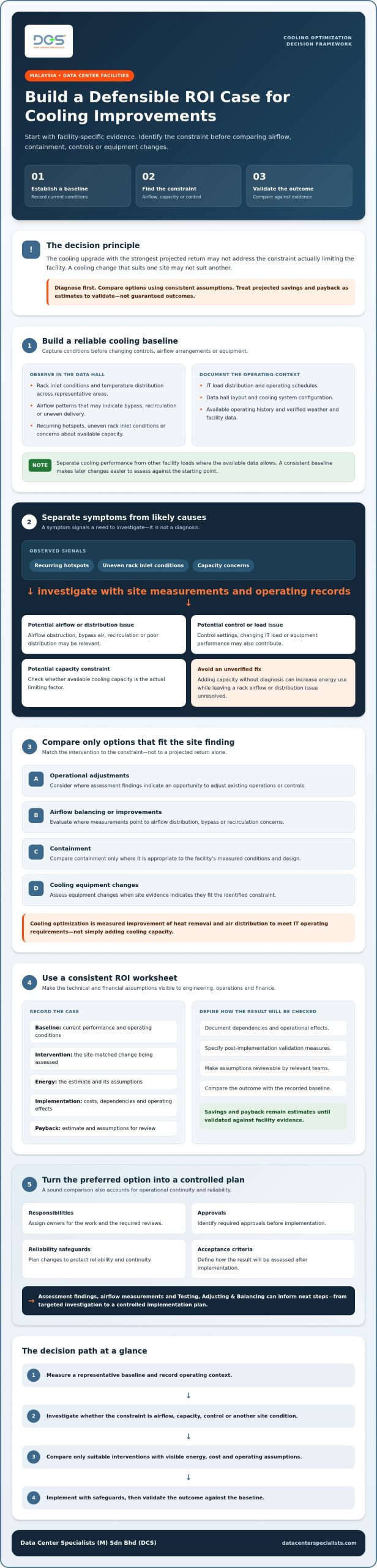
Use this ROI template for cooling optimization Malaysia projects
Use one worksheet for each proposed intervention so engineering, operations and finance teams can compare options on the same basis. Keep measured values separate from estimates, state each assumption, and use the same evaluation period and facility-approved energy and cost inputs for every option. Do not present projected savings as guaranteed outcomes.
Cooling upgrade ROI depends on verified baseline data, clearly stated assumptions and confirmed implementation costs. If an input is uncertain, label it and identify how it can be verified before approval.
What inputs belong in the cooling optimization worksheet?
Record the source, measurement period, limitations and responsible reviewer alongside each entry. Include:
- Baseline: relevant energy use, cooling system operating conditions, IT load context, schedules and measured performance.
- Intervention: the diagnosed constraint, proposed scope, equipment or control changes, dependencies and implementation requirements.
- Financial inputs: facility-approved capital and operating costs in RM, plus the approved energy cost basis used for comparison.
- Operational effects: expected effect on reliability, maintenance, access, continuity and required approvals.
- Validation: post-change measurement points, acceptance criteria, review owner and method for comparing results with the baseline.
Keep observed data distinct from modeled or estimated values. For example, a measured cooling load and an estimated future reduction should not appear as equally certain inputs. Note changes in IT load, operating schedules or other conditions that may affect the comparison.
How should operators compare payback and operational risk?
Calculate simple payback only when the facility has approved the implementation cost and projected annual net savings. State the calculation basis clearly: payback period equals implementation cost divided by estimated annual net savings. Define net savings using the facility’s approved energy and operating cost inputs, and disclose any exclusions. If the result depends on unverified savings, show it as a scenario, not a commitment.
Compare financial results alongside operational disruption, reliability exposure, maintenance implications and dependencies such as commissioning, integration or access constraints. An option with an attractive modeled payback may still require further investigation if its risks or assumptions remain unresolved. Use the same evaluation period and calculation method across options to support a fair decision.
For further context on establishing facility-specific evidence, review the data center energy assessment guide. Data Center Specialists offers data center energy assessments to help operators evaluate facility conditions before selecting improvements.
Review DCS data center energy assessment services to see how an assessment can support an auditable ROI review.
Turn the Malaysia cooling optimization assessment into an implementation plan
Convert assessment findings into a sequence of decisions, not a single upgrade order. Prioritize each action by the strength of its supporting evidence, expected operational value, implementation dependencies and risk. An observed airflow imbalance may justify further investigation or balancing, while a suspected capacity limitation may require design review before equipment changes are considered.
What should a phased implementation plan include?
Separate operational investigations from work that requires design, procurement or commissioning. For each phase, document the issue being addressed, the person responsible, required approvals, dependencies, operating safeguards and escalation responsibilities. Coordinate proposed work with facility operations so changes are authorized and planned to protect mission-critical service continuity.
Before intervention, agree on measurement points and acceptance criteria. Specify how the team will verify system response and what conditions require a pause, adjustment or escalation. After implementation, repeat relevant measurements under conditions comparable to the baseline, including IT load and operating state where the data allows. Record differences and limitations. If conditions are not comparable, qualify the result rather than attributing all change to the intervention.
How can DCS support a facility-specific review?
Data Center Specialists offers data center energy assessments, cooling optimization, airflow management and Testing, Adjusting & Balancing (TAB). DCS also supplies and implements modular containment solutions. Evaluate these against the facility’s measured conditions, layout and operational requirements rather than treating them as a default fix.
A data center energy assessment can support the evidence-gathering stage before operators select and compare improvements. TAB and airflow management may help assess distribution issues and verify relevant conditions, while containment may be considered where site findings support it. Operators comparing hot aisle vs cold aisle containment in Malaysia should review rack layout, cooling configuration and operating requirements before selecting an approach.
Keep the final decision record with the baseline, assumptions, approvals, safeguards and post-change results. This gives engineering, operations and decision-makers a traceable basis for refining the plan or considering further work.
Make the next cooling decision evidence-led
A defensible investment decision starts with a clear distinction between what the facility has measured and what it has estimated. Use a representative baseline to identify the constraint, compare relevant interventions, and document the assumptions behind energy, cost and payback calculations. This makes cooling optimization Malaysia specific to the facility while keeping reliability and operational continuity central to the decision.
Implementation should follow the evidence: assign responsibilities, define safeguards and acceptance criteria, then verify results against the baseline under comparable conditions. If the findings point to airflow distribution, TAB may support investigation and validation. Containment is another option to assess against site conditions, not a default solution.
Data Center Specialists offers data center energy assessments and cooling optimization, with related technical services including TAB and modular containment solutions. Discuss a cooling optimization assessment with DCS to review the evidence and next steps for your facility.
Frequently Asked Questions
What is data center cooling optimization?
Data center cooling optimization is a facility-specific process for improving heat removal, airflow distribution and cooling operation while maintaining required IT operating conditions. It begins with evidence about the data hall, equipment and current performance, then evaluates suitable interventions. These may include operational adjustments or airflow balancing, depending on the findings. Optimization does not automatically mean replacing cooling equipment. Verify the cause of a problem before selecting an intervention or estimating its energy and financial effects.
How can a data center in Malaysia reduce cooling energy use?
Start by establishing a measured baseline and identifying where energy is used and where airflow or cooling performance is constrained. Then compare operational adjustments, balancing, containment, control changes or equipment modifications against site evidence. Use the facility’s actual operating conditions and approved cost assumptions. Avoid applying generic savings estimates to a specific site, since facility layouts, cooling configurations and operating profiles differ.
How do you calculate the ROI of data center cooling improvements?
Use verified baseline data, documented intervention costs, an agreed evaluation period and facility-approved assumptions about operational effects. Compare projected performance with the existing operating condition, and include implementation dependencies and risks. Show the calculation method and label estimates separately from measured values. After implementation, validate results against the baseline under comparable conditions. Generic industry savings or payback periods are not reliable forecasts for an individual facility.
Which cooling optimization measures should operators compare first?
Compare measures that address the constraint identified by assessment rather than ranking upgrades in the abstract. If evidence indicates airflow imbalance, operators might assess balancing. If controls or capacity appear to limit performance, those systems may warrant review. Containment may also be considered where site conditions support it. Evaluate energy implications alongside reliability, maintainability, implementation requirements and any further testing or commissioning needed.
Can hot-aisle or cold-aisle containment improve data center cooling?
Containment can help manage airflow when the room layout, rack arrangement, cooling design and operating conditions make it suitable. It is not a universal remedy, so assess existing airflow and operational requirements before selecting a solution. Define how performance will be verified, and consider access, maintenance, installation dependencies and effects on facility operations. Treat containment as one option to evaluate against measured site conditions, not simply as a product choice.
How often should data center cooling performance be assessed?
Set the assessment frequency according to facility risk, operational changes, maintenance plans and available monitoring. Revisit performance when IT load, room configuration, cooling controls or observed conditions change, then establish a review schedule appropriate to the site. There is no universal interval that fits every facility. Document the baseline, subsequent changes, measurement method and findings so future reviews can be compared consistently and emerging issues investigated.