

Contamination can threaten operational continuity before a fault becomes visible. Preventing data center downtime through contamination control means limiting unwanted particles and residues, managing how they move between areas and surfaces, and monitoring conditions for changes that could affect equipment.
Reliable data center operation depends on more than maintaining servers and cooling systems. Dust, construction debris, and other contaminants can travel through equipment areas and raised-floor spaces, settling on surfaces or moving with airflow. Understanding these pathways helps teams focus inspections where contamination could create operational risk.
This article explains what contamination means in a data center, how it can spread between areas, and how environmental monitoring helps identify changing conditions. It also outlines how a structured approach supports facility operations, from assessing particle levels to maintaining clean equipment and underfloor spaces. The aim is to help operators and facility managers make informed decisions to reduce contamination-related risks to continuity.
Key Takeaways
- Distinguish contamination by its source and potential effect on equipment, surfaces, and facility operations.
- Trace how particles can move between raised floors, racks, and other areas through people, equipment, and airflow.
- Use environmental monitoring to spot changing conditions and focus inspections where they matter most.
- Consider construction debris and accumulated dust as risks that require deliberate control, not routine visual checks alone.
- Use assessment findings to shape cleaning priorities and maintain a more controlled operational environment.
Contamination as the presence of an unwanted element
In a data center, contamination means an unwanted substance or condition is present. It may be a solid, liquid, or unwanted energy source. A fibre beside a rack, a fluid mark near a cable route, or unexpected vibration from nearby work are distinct examples. Whether the element is dangerous depends on its location and interaction with facility systems.
Classify findings by material and context before deciding what action is appropriate. Dry particles on a non-operational surface differ from residue near an air intake. Moisture beside electrical equipment needs a different assessment from packaging fibres on a delivery route. Record the material and exact location so teams can assess exposure without treating every observation as an immediate equipment fault.
A contaminant’s presence alone does not define its operational risk. Compare a fine deposit on an access tile with residue on a component surface. Ask whether the material could reach sensitive equipment, interfere with a process, or affect system operating conditions. Documented inspections help distinguish an observed condition from a suspected source or consequence.
What contamination-control standards and regulations apply to data centers in Malaysia? Facility teams should follow applicable project specifications, operating procedures, and requirements established for their facility. ISO 14644 concerns cleanroom classification and testing; its relevance depends on the facility scope, and it should not be described as a general data-center cleaning mandate.
For a practical assessment, identify the material, record the affected zone, and consider nearby systems and recent activities. Residue close to an electrical assembly, for example, merits a different review from dust on a storage surface. This record supports a reasoned response and helps operations teams prioritize inspection.
What cleaning methods and schedules are appropriate for data center floors, racks, and equipment? Use physical cleaning methods suited to each surface and its operating conditions, with controls for live equipment and electrostatic discharge risks. Set schedules based on inspection findings, particle trends, work activity, and site-specific risks rather than applying the same interval to every area.
Cleaning should address the observed condition without creating a new operational hazard. Before work near a rack, define the affected area and coordinate access with facility operations. Choose equipment and procedures suited to the material and surface. After cleaning, inspect the treated area and record the result to establish a baseline for comparison.
This evidence-based approach supports preventing data center downtime through contamination control. It connects each finding with its location, exposure pathway, and appropriate response. For example, recurring residue along one route can prompt a review of nearby activity and inspection priorities. This makes follow-up more useful than relying on a visual check alone.
Cross-contamination between surfaces and environments
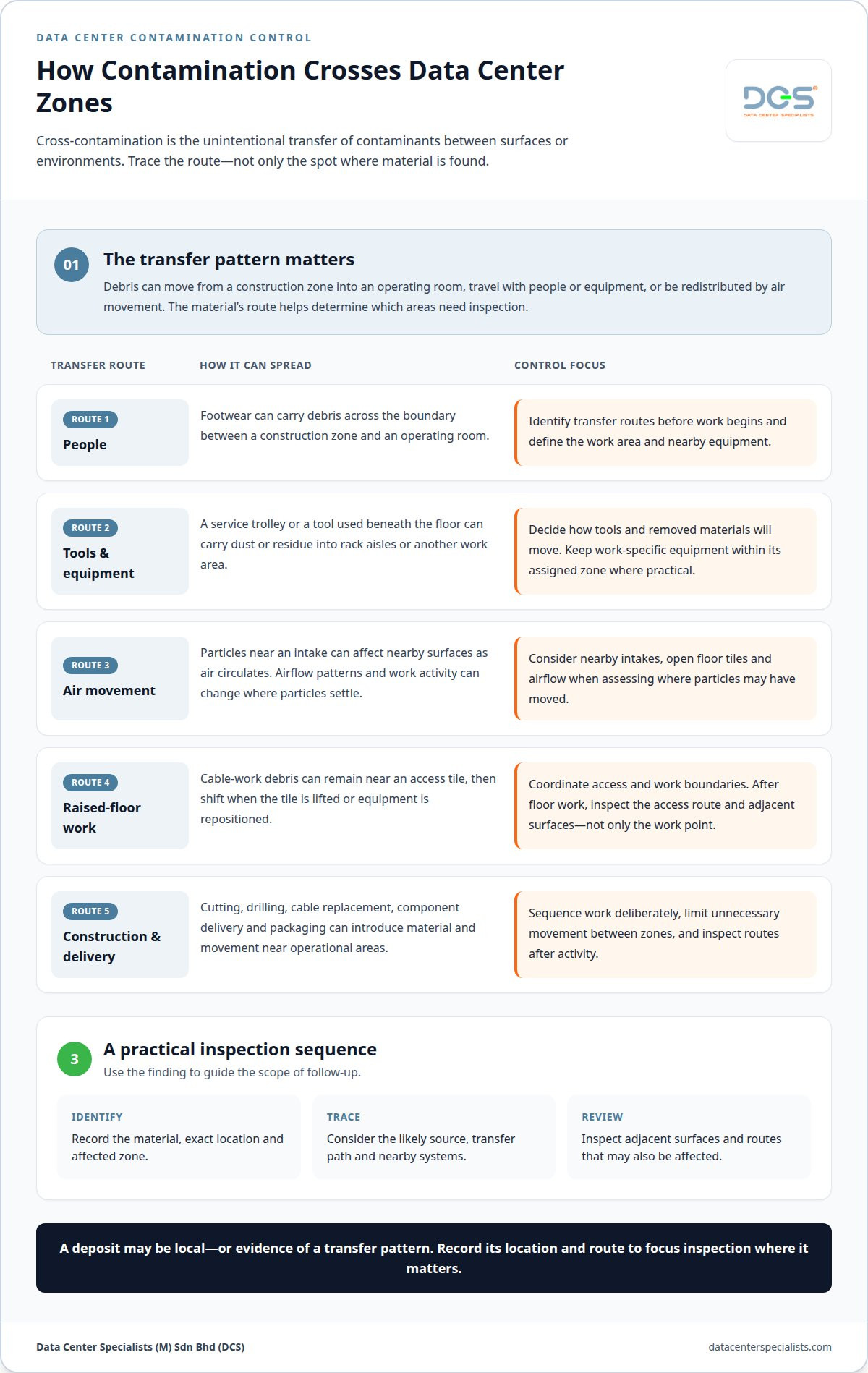
Cross-contamination is the unintentional transfer of contaminants between surfaces or environments. In a data center, material can move from a construction zone into an operating room. Footwear, a service trolley, or a reused tool can carry debris across that boundary. The transfer may be subtle, but it can spread contamination beyond its original source.
Raised-floor spaces show how movement can connect different areas. Debris from cable work may remain near an access tile, then shift when the tile is lifted or equipment is repositioned. Dust on a trolley can reach rack aisles during maintenance. Track the material’s route, not just the surface where it first appears.
Air movement can also redistribute particles. A dusty area near an intake may affect nearby surfaces as air circulates through the room. Open floor tiles, airflow patterns, and work activity can change where particles settle. Debris released during cable installation, for example, may later appear on rack exteriors or floors.
People and equipment create practical transfer routes. A tool used beneath the floor can carry residue to another work area if it is moved without inspection. Packaging brought from a construction space can shed fibres near racks. Maintenance teams should identify these routes before work begins and avoid moving materials unnecessarily between clean and active zones.
Control starts with separation and clear work sequencing. Define the work area, identify nearby equipment, and decide how tools and removed materials will be moved. Keep work-specific equipment within its assigned zone where practical. After floor work, inspect the access route and adjacent surfaces rather than assuming debris remains at the work point.
Cleaning activity itself needs controlled handling. Careless movement of dry debris can redistribute particles instead of removing them. Select methods suited to the surface and operating conditions, and manage collected material so it does not re-enter the room. For live operations, coordinate access and work boundaries with facility staff before touching floor tiles or equipment areas.
Construction and maintenance need particular attention because both introduce materials and movement. Cutting, drilling, cable replacement, and component delivery can create routes between work zones and operational areas. When contamination is found, record its location, likely source, and affected path. This helps teams distinguish a local deposit from a transfer pattern that calls for broader inspection.
Facility teams can strengthen these controls through professional data center cleaning that addresses affected surfaces and spaces. Pair removal with source control, work-area separation, and follow-up inspection. That approach helps limit repeated transfer between floors, racks, and service routes, while giving operators clearer evidence for refining contamination-control practices.
When assessing a transfer route, consider the contaminant’s form as well as the surface where it is found. Radioactive contamination can occur on surfaces or within solids, liquids, gases, and the human body when radioactive substances are present unintentionally or undesirably. The potentially affected area may therefore extend beyond an exposed surface. Consider the material and environment involved when tracing a transfer path.
Environmental contamination and monitoring
Environmental monitoring helps teams identify changing conditions and assess their operational significance. Interpret readings alongside equipment requirements, system status, and external conditions.
Air Quality Limits and Monitoring Costs
Air-quality limits are facility criteria for temperature, humidity, and airborne particles. ASHRAE guidance depends on equipment class, while ISO 14644 addresses cleanroom classification and testing rather than setting universal data-center limits. Define monitoring thresholds against the facility design and equipment requirements. Monitoring, filtration, and cleaning costs depend on coverage, sampling scope, filter needs, access, and affected areas; pricing is provided after a quotation request.
Filtration and HVAC Controls
Filtration and HVAC controls manage airborne particles and maintain intended environmental conditions. Select filters suited to the system design and conditions at outdoor-air intakes. Include filter condition and bypass gaps in planned inspections. Review pressure drops and airflow performance during maintenance, since clogged or poorly fitted filters can affect system operation. Particle measurements can help determine whether filtration changes address observed conditions.
Dust Control During Work
Dust control during construction and maintenance starts with planning the work method and timing. Where project sequencing allows, schedule high-dust tasks before sensitive equipment is installed or commissioned. Define housekeeping requirements and air-quality checks in the work plan, then review results at agreed hold points. At live sites, coordinate task timing with operations and record any readings that change during the work.
Pressure, Sealing, and Airflow Management
Pressure relationships and airflow management help limit uncontrolled particle entry. Maintain the facility’s established pressure strategy and seal unused penetrations that compromise it. Confirm that doors, dampers, and airflow paths work as intended. Positive pressure is useful only when supported by the system design and controlled openings, so verify performance with suitable facility measurements.
In Malaysia, consider humidity, coastal salt exposure where relevant, and haze-related particles at outdoor-air intakes. Their significance depends on site conditions and intake exposure, so compare outdoor observations with internal monitoring. Use the results to inform inspection and filter-maintenance priorities.
For an alert or suspected incident, verify the sensor reading, review related equipment trends, and identify the affected zone. Notify operations and document the time and system conditions. Inspect using procedures that avoid disturbing material. After corrective action, repeat the relevant measurement and record whether conditions have returned to the facility’s established criteria.
Environmental monitoring can help scientists detect contamination activities early, before they become too detrimental. Review observations alongside the operating conditions already being monitored, so a change is considered in context rather than treated as an isolated reading. Clear records can support follow-up when conditions shift and help teams decide whether further assessment is appropriate.
Environmental contaminants can be chemical, biological, or physical agents. Keep these categories in mind when defining what monitoring is intended to identify, and relate observations to the facility’s equipment, operations, and exposure conditions. If a result suggests a change, compare it with relevant system status and external conditions, then decide whether inspection, filtration, cleaning, or work controls need review. This connects monitoring to practical decisions without treating every variation as evidence of contamination.
Examples of contamination
Contamination includes materials that enter a facility unintentionally or remain after a task. Specific examples help teams distinguish unusual findings from conditions that need investigation.
Forms of Contamination
Examples include zinc whiskers, soldering residues, cleaning-agent traces, and particles from packaging materials. Each has a different origin and needs a context-specific assessment. Zinc whiskers are fine metallic filaments that can develop on zinc-plated surfaces. Their presence inside an equipment enclosure warrants attention to nearby electrical assemblies.
Residues can remain after equipment repair or component handling. Traces of soldering materials near a serviced circuit board, for instance, differ from ordinary surface dust. Liquid cleaning product left on a panel is another distinct finding. Record the material’s appearance and location, then compare them with work records and equipment condition.
Some findings are not loose particles. Discolouration on a metal surface may indicate a chemical reaction or material change. Adhesive residue around a label can collect fibres and complicate inspection. Packaging fragments inside a newly delivered cabinet may indicate incomplete preparation before installation. Each finding gives teams a specific lead to investigate.
Use a consistent inspection record to separate observation from diagnosis. Note the surface, material, nearby component, and relevant maintenance activity. Photograph the finding where site procedures permit. Do not label a deposit corrosive or conductive without evidence. Accurate descriptions help technical teams select suitable testing or handling methods.
Equipment Failures and Downtime
Contaminants can cause equipment problems when their properties interfere with electrical, mechanical, or material interfaces. Conductive filaments may bridge closely spaced conductors, while residues can affect contact surfaces. Liquid intrusion can also prompt protective shutdowns. The outcome depends on the contaminant and the component it reaches.
A metallic filament inside an electrical enclosure, for example, calls for a different response from adhesive residue on an external panel. Teams should identify the affected component and follow equipment and site procedures before removal. Uncontrolled wiping or handling could spread material or disturb a sensitive assembly.
Contaminants can also complicate diagnosis. Residue discovered during a repair could relate to earlier maintenance, incoming equipment, or a component condition. Compare the finding with service records and the equipment’s reported symptoms. Preserve relevant evidence before cleaning if an investigation requires it.
After addressing a finding, document the affected equipment and action taken. Confirm that relevant surfaces or components have been inspected before returning them to normal operation. This creates a traceable maintenance record and helps teams identify recurring material-specific concerns without assuming every deposit has the same cause.
Meaning of contamination
Contamination means an unwanted element is present in an environment or material. In a data center, that could mean dust on a rack, moisture near electrical equipment, or residue on a floor tile. The term describes presence, not necessarily immediate damage. Its significance depends on where it appears and how it interacts with equipment, airflow, and operations.
Classify contaminants by their form and likely effect. Solid examples include fibres, particles, and construction debris. Liquids include water or other unwanted fluids. Chemical residues may remain on a surface after work, and biological material can also be introduced. These categories help teams describe observations precisely instead of treating every finding as the same problem.
An unwanted substance becomes an operational concern when its location or behaviour creates an exposure pathway. A particle on an access route may remain isolated, while material near an intake may be drawn toward equipment. Moisture beside an electrical assembly calls for a different response from dry residue on an unused surface. Record what was found, where it appeared, and what activity was nearby.
Contamination can also refer to an unwanted energy source that interferes with a process. For facility teams, this broader definition reinforces the need to assess conditions, not just visible dirt. A deposit may coincide with airflow changes, for example, while fluid intrusion can affect nearby surfaces. The material, source, and surrounding system together shape the response.
Use a consistent description when documenting an inspection. Note whether the finding is particulate, liquid, chemical, biological, or another unwanted condition. Identify the affected zone, nearby equipment, and possible route of entry. Then separate observation from interpretation: “dust on the tile” records evidence, while “dust carried from installation work” suggests a possible source that needs assessment.
This distinction helps prioritize work without assuming every deposit presents the same risk. Consider a fibre on a removable packaging surface compared with debris beside an air intake. The second location may warrant closer examination because air movement can affect where material travels. Use operational context, inspection findings, and monitoring data to decide what needs attention first.
In practice, contamination control combines identification, source management, removal, and follow-up. Removing a deposit addresses material already present, while controlling the entry route helps reduce recurrence. After installation work, for example, inspect the work zone and nearby surfaces. Record findings and compare them with later observations to see whether the source persists.
For a structured review of physical contamination in critical spaces, arrange a data center cleaning assessment that considers affected surfaces, equipment areas, and operational conditions.
Data Center Specialists (M) Sdn Bhd (DCS): Professional Data Center ISO Cleaning Services
Data Center Specialists (M) Sdn Bhd (DCS) provides Professional Data Center ISO Cleaning Services for mission-critical environments that need a controlled, facility-specific response to contamination. The service is relevant when inspections identify dust or debris on raised floors, beneath access floors, around racks, or after construction and equipment installation.
Effective cleaning takes account of operating conditions, affected surfaces, and the risk of disturbing particles near live equipment. It supports contamination-control plans by addressing accumulated material and helping operators identify areas for closer monitoring. When airflow or environmental concerns accompany contamination findings, a Data Center Energy Assessment or Testing, Adjusting & Balancing (TAB) can address related facility questions.
For a technical discussion about cleaning needs in your data center, contact Data Center Specialists (M) Sdn Bhd (DCS).
Make Contamination Control Part of Operational Planning
Use inspection findings to guide the next operational review. Assign responsibility for tracking recurring contamination, recording work-related observations, and escalating changes that could affect critical areas. This turns isolated findings into useful maintenance information and helps teams set priorities based on facility conditions.
A disciplined approach to preventing data center downtime through contamination control depends on consistent follow-through. Review whether corrective actions addressed the source, not just the visible deposit. Then use later inspections and monitoring results to decide whether controls need adjustment. This gives facility managers a practical basis for coordinating engineering, operations, and project teams.
For data center operators assessing contamination risks or planning professional cleaning, Data Center Specialists (M) Sdn Bhd (DCS) can discuss the facility’s requirements and suitable next steps. Contact Data Center Specialists (M) Sdn Bhd (DCS) to arrange a technical discussion. A clear assessment can help your team make informed decisions and strengthen operational planning.
Frequently Asked Questions
What contaminants pose the greatest risks to data centers, including dust, salt, and corrosive gases?
The highest-risk contaminants are those that reach sensitive equipment or affect cooling and electrical connections. Dust can collect near air intakes, while salt particles in coastal environments can contribute to corrosion. Corrosive gases may attack exposed metals and contacts over time. Assess each risk in light of the site’s surroundings, air intake locations, equipment materials, and observed signs such as residue or discolouration.
How can data centers monitor airborne particles and gaseous contamination?
Use particle-count testing to measure airborne particles at selected locations, such as air intakes and rack inlets, then compare readings over time. For gaseous contaminants, use monitoring methods suited to the gases of concern; corrosion coupons can also help identify corrosive exposure. Log sampling locations, operating conditions, and nearby work so teams can interpret changes and target follow-up inspections.