

Malaysia’s 2026 Budget commits to a carbon tax on energy, expected to be introduced in 2026 and initially focused on the iron and steel and energy sectors. For teams securing budgets for critical environment services in 2026, the practical priority is to account for possible energy-cost pressure alongside inflation and investment needed for the energy transition.
Facility leaders know that reliable operations depend on disciplined planning, not just a single annual allowance. Energy use, cooling performance, maintenance needs and infrastructure priorities all shape the budget required to protect critical environments and sustain operations.
This article explains how carbon tax, inflation and energy transition investment can shape Malaysian budgets, and how to build a defensible forecast for critical environment services. It outlines the cost drivers to assess, ways to prioritize operational needs and how energy performance can inform budget decisions, so finance and engineering teams can plan with greater clarity.
Key Takeaways
- Build a budget around service scope, energy exposure, maintenance needs and transition priorities, rather than relying on a single year’s spend.
- Compare in-house and outsourced delivery by operational coverage, specialist capability, accountability and the resources each model requires.
- Set service-level agreements around measurable work, reporting, escalation and operational requirements, with uptime targets aligned to facility risk.
- Present finance teams with a clear link between proposed spending, continuity risks, energy performance and the consequences of deferring work.
- Identify how underfunding can affect maintenance, contamination control and cooling performance, then prioritize the services that protect reliable operations.
4. How should organizations calculate the budget for critical environment services?
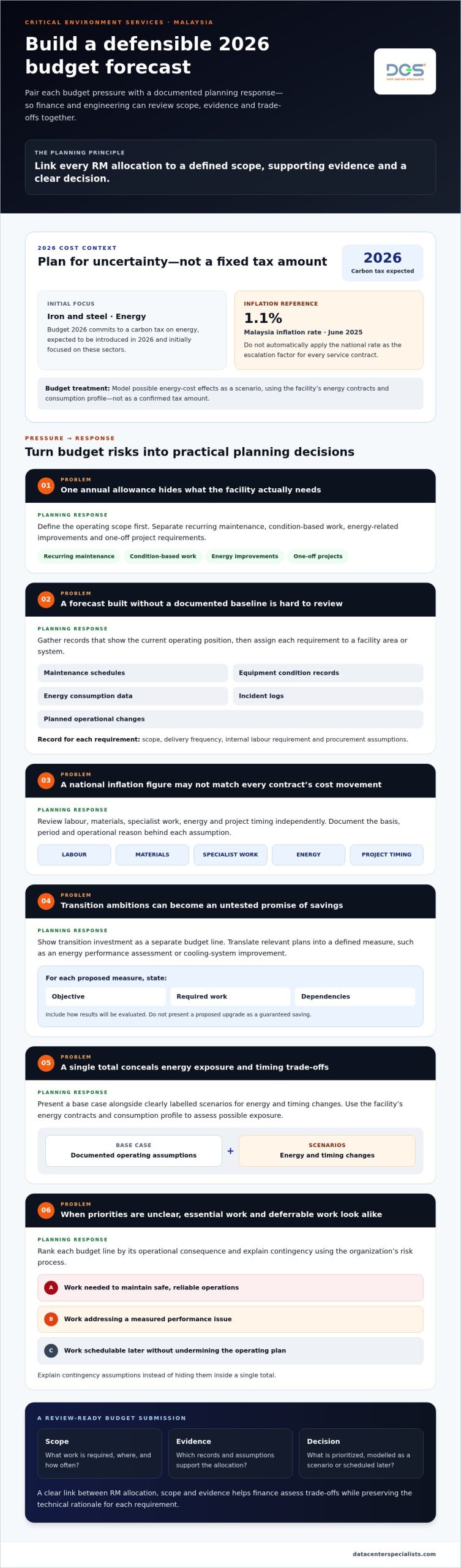
Start by defining the operating scope, then build a cost model for each critical environment service. For a Malaysian data centre, separate recurring maintenance, condition-based work, energy-related improvements and one-off project requirements. This gives finance and engineering teams a shared basis for review and helps distinguish essential operating expenditure from investment intended to improve performance.
Use a documented baseline. Gather current maintenance schedules, equipment condition records, energy consumption data, incident logs and planned operational changes. Assign each requirement to a facility area or system, such as cooling, electrical infrastructure, raised-floor spaces or contamination control. Record the scope, delivery frequency, internal labour requirement and procurement assumptions. Use the organization’s invoices and contracts for historical RM amounts rather than generic industry estimates.
Next, test the baseline against Malaysia’s 2026 cost environment. Budget 2026 commits to a carbon tax on energy, expected to be introduced in 2026 and initially focused on the iron and steel and energy sectors. Treat potential energy-cost effects as a scenario, not a fixed tax amount, and model the facility’s exposure through its energy contracts and consumption profile. Malaysia’s inflation rate was 1.1% in June 2025, but a national rate should not automatically be used as the escalation factor for every service contract.
Separate forecast assumptions by cost driver. Review labour, materials, specialist work, energy and project timing independently. For each category, document the basis of the assumption, its period and the operational reason for any change. This helps reviewers distinguish movements caused by a change in scope from those driven by external cost pressures.
Include transition investment as a separate line. Malaysia’s Budget 2026 supports investment in renewable energy, semiconductors and artificial intelligence, while its industrialisation agenda is guided by the National Industrial Master Plan 2030 and the National Energy Transition Roadmap. For a data centre, translate relevant plans into defined measures, such as an assessment of energy performance or a cooling-system improvement. State the objective, required work, dependencies and method for evaluating results. Avoid treating a proposed upgrade as a guaranteed saving.
Finally, rank each budget line by operational consequence. Identify work needed to maintain safe, reliable operations, work that addresses a measured performance issue, and work that can be scheduled later without undermining the operating plan. Add contingency according to the organization’s risk process, explaining the assumptions rather than hiding them in a single total.
For teams securing a budget for critical environment services in 2026, the strongest submission links each RM allocation to scope, evidence and a decision. Present a base case and clearly labelled scenarios for energy and timing changes. This enables finance to assess trade-offs while preserving the technical rationale behind each requirement.
3. In-house vs Outsourced Critical Environment Services
Compare delivery models based on the work, operational control and technical capability required. An in-house team understands the facility’s procedures, equipment history and escalation routes, supporting coordination during planned work and daily operations. However, specialist tasks may require training, tools and management time beyond the team’s usual responsibilities. Include these demands when assessing the full internal commitment.
Outsourcing can provide specialist personnel and defined methods for tasks that require focused technical experience. For example, a data centre may keep routine monitoring in-house while engaging specialists for contamination control or testing, adjusting and balancing. This can extend capability without transferring every facility responsibility. The operator still sets the scope, coordinates access and reviews completed work.
Assess the total resource requirement for each model, not just the visible labour charge. For an in-house approach, account for staff time, competency development, equipment, supervision and the effect of planned work on other duties. For outsourced delivery, consider the agreed scope, mobilisation needs, site induction, operational coordination and reporting. Many commercial building operators simplify this administrative overhead through single-contract planned facilities management partners such as atlassouthes.com. Use actual internal records and supplier quotations in RM; avoid comparing a narrow external quote with an all-inclusive internal estimate.
Define which activities remain under facility control before selecting a model. Internal teams should retain operational authority, access control and approval of work that affects live systems. External personnel can perform defined specialist tasks within those controls. For example, the facility manager can approve the work plan, identify protected areas and confirm handover requirements, while the service team documents completed work and observations.
Review operational fit as well as technical capability. An outsourced scope should account for site procedures, equipment, contamination risks and work windows. For in-house delivery, confirm that assigned staff can perform the task consistently and document results. In either model, establish who owns records, how findings reach the operations team and who tracks corrective actions. These details prevent gaps between completing the work and following up at the facility.
A hybrid model often suits facilities with a capable operations team but limited specialist capacity. Keep routine oversight and decision-making internal, then procure defined technical work when it requires dedicated methods or independent assessment. Set clear boundaries: overlapping responsibilities can cause delays, while unclear handovers can leave findings unresolved. Assign each task to an accountable role before approving the contract or internal work plan.
For Malaysia-based operators assessing specialist maintenance scope, review the relevant data center maintenance services alongside internal responsibilities. Use that comparison to define a practical division of work, measurable deliverables and a clear reporting path.
4. What service-level agreements and uptime targets should a critical environment contract include
Define the service boundary before setting targets. A data centre contract should identify covered systems, areas, tasks, operating windows and exclusions. For example, a cooling maintenance scope should distinguish inspection and planned servicing from fault response. Clear boundaries help prevent disagreement over whether an incident falls within the service provider’s obligations.
Separate facility availability from the service provider’s performance measures. Uptime describes the operating objective for the facility or system. A maintenance provider can instead be measured against agreed deliverables, response processes, reporting and completion records. Do not treat a service-level commitment as a guarantee of facility uptime unless the contract expressly assigns that responsibility.
Give each measure a named owner, measurement method and reporting interval. Useful measures include completion of scheduled work, delivery of inspection reports, tracking of agreed actions and notification of identified defects. State which records establish performance, such as a work order, maintenance log or incident report. Define who reviews each record and how disputed results are resolved.
For incident response, distinguish acknowledgement, attendance, diagnosis and restoration. These are different events, and a single “response time” can hide that distinction. Define the trigger, communication channel and responsible contact for each incident category. For example, an alarm affecting a critical cooling system may require immediate notification, while a non-critical documentation issue can follow routine reporting. Set target times based on the facility’s risk assessment and operating procedures.
Include planned-work controls. The agreement should specify approval requirements, work permits, isolation boundaries, site access, method statements and handover records. For work near live equipment, define coordination with the facility operations lead and the conditions for stopping work. Record how schedule changes are approved, who communicates them and how completed work is handed back to operational control.
Define reporting and corrective-action handling in practical terms. Require findings to identify the affected asset, observed condition, operational relevance and recommended next step. Assign an owner and due date through the facility’s usual process. Distinguish urgent defects from routine observations so important findings reach the right decision-maker instead of being buried in a general report.
Finally, align uptime targets with the facility’s design intent, redundancy strategy, operational risk and customer commitments. Use documented availability objectives for each system rather than applying one blanket target across all services. State how planned maintenance, external dependencies and events outside the service provider’s control are treated in measurement. Review targets after major changes to equipment, load or operating requirements.
Before execution, have operations, engineering, procurement and legal teams review the same SLA schedule. Confirm that every target is measurable, achievable within the stated scope and linked to a clear remedy or escalation path. This makes the contract useful for routine maintenance and incident reviews, not just procurement.
5. How can organizations justify critical environment budgets to finance decision-makers
Present the request as an operational decision, not a maintenance wish list. For each proposed service, identify the affected asset, current condition, operational consequence and required action. A cooling-system inspection, for example, should connect its scope to a documented performance concern or maintenance need. This gives finance a traceable reason for the expenditure and helps distinguish essential work from optional improvements.
Build the case from facility evidence. Use maintenance logs, work orders, energy records, incident reports and inspection findings from the relevant site. Note when each issue appeared and whether it recurred. Explain the operational effect in terms executives can assess, such as reduced resilience, delayed planned work or increased exposure to equipment faults. Avoid unsupported savings claims; show the evidence and assumptions instead.
Set out the financial comparison in RM using the organization’s records and quotations. Compare the proposed work with the cost and operational implications of deferral, stating assumptions clearly. Separate recurring service requirements from one-off projects, and identify which business unit or facility bears each cost. This makes the request easier to reconcile with procurement records and the annual operating plan.
Link the proposal to Malaysia’s planning context without overstating policy support. Budget 2026 is the first budget under the 13th Malaysia Plan, which covers 2026-2030. The Government aims to reduce the fiscal deficit to 3.5% of GDP in 2026. For finance teams, these conditions make a prioritised, evidence-led request more useful than an undifferentiated increase across maintenance lines.
Use a decision paper with a clear recommendation and alternatives. Show the baseline scope, recommended scope and operational effect of deferring selected work. For an energy-related project, distinguish assessment, implementation and verification. State what evidence will be collected after completion, who will review it and how the results will inform later investment decisions. Do not present projected savings as realized outcomes.
Make uncertainty visible with scenarios. Identify the assumptions most likely to change, such as energy exposure, asset condition or project timing. Show how each scenario changes the proposed scope and decision rather than concealing uncertainty in a single total. A finance committee can then approve a defined baseline, retain contingency under its normal governance process or defer lower-priority work with explicit operational consequences.
Close with accountability. Name the budget owner, technical approver and reporting route for each approved workstream. Set a review point tied to a real milestone, such as completion of an assessment or the next planning cycle. This turns securing budget for critical environment services in 2026 into a controlled business case, with documented need, transparent assumptions and a route to review actual results.
Fiscal context can also be stated precisely. Malaysia’s Public Finance and Fiscal Responsibility Act sets a medium-term target of limiting the Federal Government fiscal deficit to 3% or less of GDP, and a medium-term limit of 60% of GDP for the Federal Government debt level. These limits do not determine an individual facility’s budget, but they reinforce the value of explaining priorities, timing and consequences of deferral in a disciplined proposal.
5. What are the risks and costs of underfunding critical environment services?
Underfunding can turn a manageable maintenance backlog into competing demands for engineering attention. When planned tasks are repeatedly deferred, teams must reassess priorities alongside new work orders and operational changes. This takes staff time and can disrupt scheduling. Maintain a backlog register recording each task, its operational consequence, the reason for deferral and its next review point.
Incomplete asset records create another risk. If inspection findings, service history and corrective actions are spread across separate records, engineers may lack a clear view of an asset’s condition. A recurring control fault, for example, can appear isolated when earlier work orders are difficult to retrieve. Link records by asset identifier and make current status visible to those planning work.
Underfunded testing can leave assumptions about system performance unexamined. A facility may continue operating with control sequences or balancing conditions that no longer match its configuration. Changes to loads, equipment or operating modes can make earlier observations less useful. Schedule technical reviews when changes affect system operation, and document measured conditions, limitations and resulting actions.
Deferred services can also create coordination problems across providers and internal teams. If a task depends on access, isolation or completion of another activity, a late decision can force rescheduling. Record dependencies in the work plan and identify who is responsible for releasing each prerequisite. This reduces avoidable conflicts between maintenance work and live operations.
Contamination-related work requires its own risk assessment. Dust or construction debris in equipment areas may complicate operational housekeeping and prompt further investigation. Record where material is observed, whether construction or maintenance contributed, and which areas need controlled attention. This turns a general concern into a location-specific work scope without assuming every area has the same exposure.
Reactive work can also make financial reporting less useful. Costs recorded under broad emergency or repair categories may conceal recurring causes and make planning less precise. Review invoices, work orders and asset records together. Separate corrective work from planned tasks, then identify repeat events and their operational context. Use actual RM records to explain expenditure without assuming every reactive cost could have been avoided.
Finally, repeated deferrals can weaken accountability. Assign an owner to each postponed task and document who accepted the operational exposure. Review overdue work during the facility’s normal planning cycle, particularly when asset condition or operating requirements change. This creates a traceable basis for prioritizing action instead of relying on informal handovers or memory.
Where the review identifies a need for specialist maintenance scope, data center preventive maintenance services can be considered as part of the facility’s work plan.
National policy also shapes the funding context: Malaysia added a 300MW quota under the Feed-in Tariff programme for biogas, biomass and small hydro. Malaysia’s 2025 budget priorities include essential infrastructure and utilities such as roads, treated water, electricity, sewerage and high-speed internet in remote and underserved areas of Sabah and Sarawak. Malaysia’s flagship social assistance programmes target the B40 through income thresholds rather than addressing life-cycle risks, underscoring the need to consider service resilience alongside broader infrastructure priorities.
Data Center Specialists (M) Sdn Bhd (DCS): Professional Data Center ISO Cleaning Services
Data Center Specialists (M) Sdn Bhd (DCS) supports operators planning specialist services for mission-critical environments. Its Professional Data Center ISO Cleaning Services provide physical contamination control in data centre spaces, including equipment areas where dust and debris require managed cleaning methods. Consider this service when inspection findings, construction activity or operational planning identify a need for controlled contamination management.
For budgets involving other technical priorities, DCS also provides Data Center Energy Assessment, Testing, Adjusting & Balancing (TAB), and Cleanroom Performance Testing (CPT). These services help teams define assessment or testing scope in line with operational requirements and identify work suited to the facility’s needs.
Contact Data Center Specialists (M) Sdn Bhd (DCS) to discuss a suitable technical scope, or visit datacenterspecialists.com.
Turn facility priorities into a practical next step
For teams securing budget for critical environment services in 2026, the next step is to turn operational priorities into a defined scope that engineering and finance can assess together. Align the work with facility conditions, operational requirements and the evidence needed to evaluate its value. This creates a clearer basis for planning without treating projected outcomes as guaranteed savings.
Data Center Specialists (M) Sdn Bhd (DCS) provides Professional Data Center ISO Cleaning Services, Data Center Energy Assessment, and Testing, Adjusting & Balancing (TAB). These services support planning where contamination control, energy performance or airflow assessment is relevant to the facility’s requirements.
Discuss your critical environment priorities with Data Center Specialists (M) Sdn Bhd (DCS) and identify a suitable technical next step. A clearly scoped discussion can help your team move forward with greater focus and confidence.