
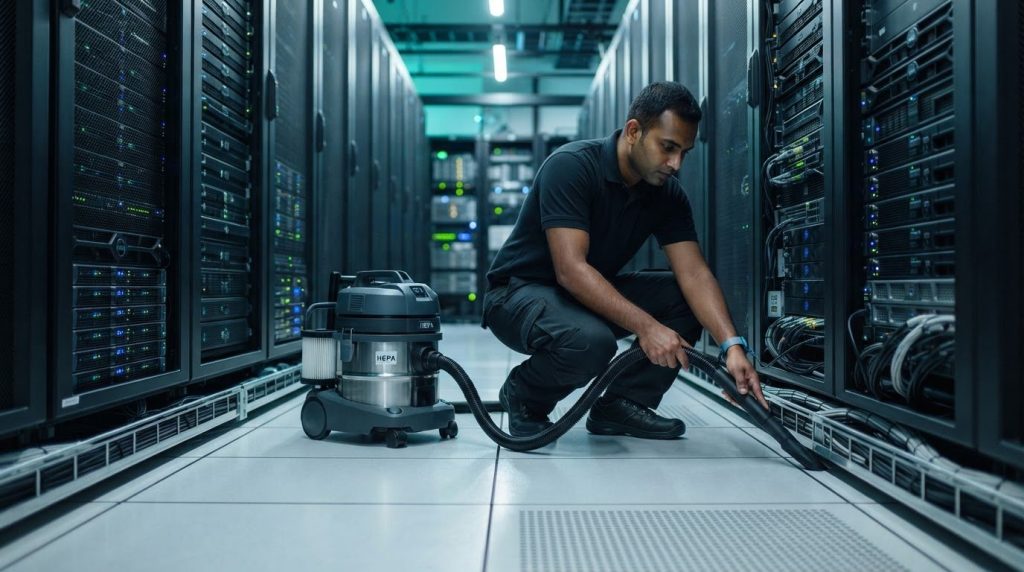
A vacuum can remove visible dust and still put sensitive equipment at risk. For teams deciding what kind of vacuum is safe for a server room, the practical choice is a sealed vacuum with HEPA filtration and ESD-aware components, selected for controlled cleaning around electronics. This combination helps capture fine particles while reducing filter bypass and electrostatic-discharge risks.
It’s understandable to assume a standard household or shop vacuum will do the job if it collects dust effectively. In a server room, however, particle emissions, static control and safe access around live equipment matter as much as suction. Dust can also accumulate beneath raised-floor panels, beyond the reach of routine surface cleaning.
This article explains which vacuum features matter, how HEPA and ULPA filtration differ in practice, and what to consider when cleaning around racks, cables and raised floors. You’ll also learn why ordinary household and shop vacuums may be unsuitable, and how to assess equipment against a Malaysian data center’s contamination-control needs.
Key Takeaways
- Prioritize a sealed vacuum design so collected dust is less likely to bypass the filtration path and return to the room.
- Assess ESD controls and cleaning technique before working near live racks, cables or sensitive equipment.
- Compare HEPA and ULPA filtration against the room’s contamination-control requirements, not suction alone.
- Consider motor exhaust and material shedding, which can reintroduce particles even when a vacuum appears to collect dust effectively.
- Treat household and shop vacuums cautiously; equipment intended for general cleaning may not provide the controls a server room requires.
1. Sealed vacuum construction and filter bypass
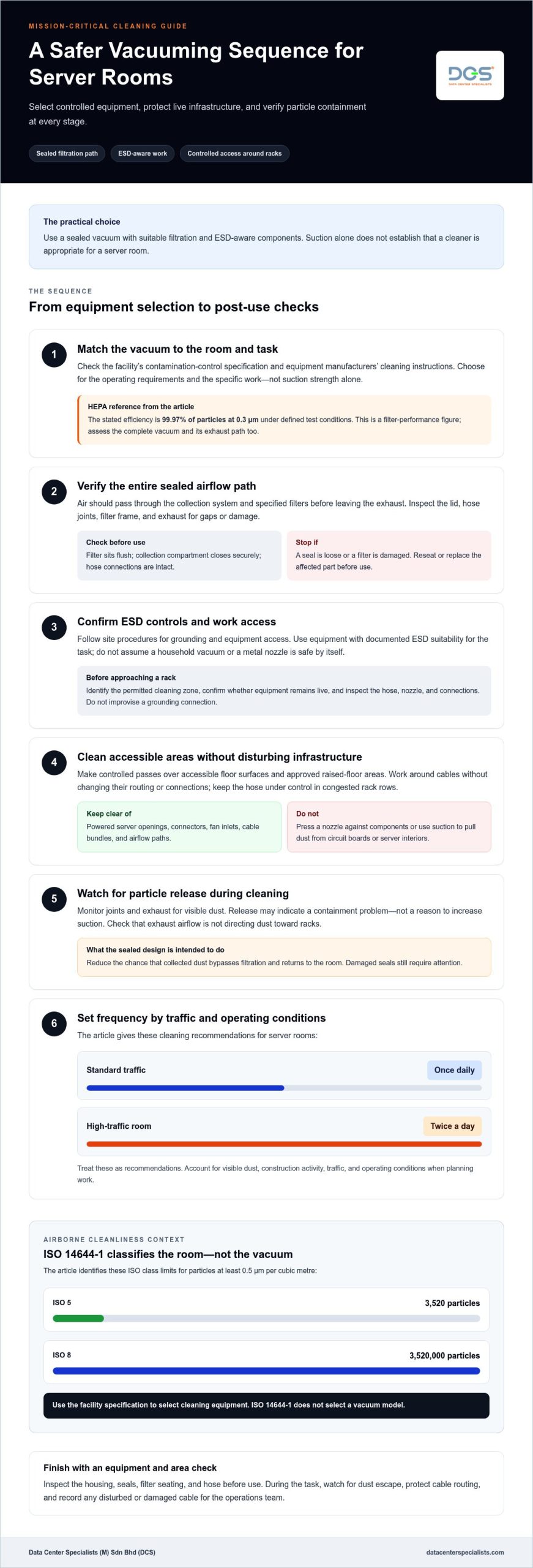
A vacuum’s filtration works only if air follows the intended route. In a sealed cleaner, air passes through the collection bag or container and specified filters before leaving the exhaust. Poor seals around the lid, hose connection, filter frame or exhaust can let unfiltered air escape, returning collected dust to the server room.
Inspect the entire airflow path, not just the filter label. Check that the filter sits flush, the collection compartment closes securely and hose joints are intact. For example, a HEPA filter fitted loosely in a leaking housing cannot control particles as designed. A sealed system reduces bypass risk, but damaged seals still need attention.
For Malaysian facilities, follow the site’s contamination-control specification and equipment manufacturers’ cleaning instructions. ISO 14644-1 classifies airborne cleanliness; it does not select a vacuum model. Its ISO 5 limit is 3,520 particles at least 0.5 µm per cubic metre, compared with 3,520,000 for ISO 8.
Look for sealed construction, suitable filtration, secure hose and filter connections, and components appropriate for ESD-controlled work. Select the cleaner for the room’s operating requirements and the specific task. Its specifications should address both captured particles and the air exhausted back into the space, not just suction strength.
Do not press a nozzle against powered server openings, connectors, fan inlets or cable bundles. Vacuum accessible floor surfaces and approved raised-floor areas using controlled methods, without pulling or shifting cables. Around live equipment, keep the nozzle clear of components and airflow paths to avoid physical disturbance during cleaning.
Cleaning frequency depends on traffic and particle accumulation. Under standard traffic conditions, clean a server room once daily; for a high-traffic room, clean twice a day. Treat these as recommendations and account for visible dust, construction activity and operating conditions when planning the work.
Before each use, inspect the housing, seals, filter seating and hose for damage. Confirm the correct collection system is installed, then check that exhaust airflow does not direct dust toward racks. Stop if a seal is loose or the filter is damaged. Replace or reseat the affected part before using the cleaner again.
During cleaning, watch for dust escaping around joints or from the exhaust. Visible release signals a potential containment problem, not a reason to increase suction. A sealed vacuum with intact filtration helps control emissions, while careful handling protects equipment, cables and the room’s airflow configuration.
2. ESD-safe vacuuming
Electrostatic discharge can damage sensitive electronics, so assess the vacuum and the operator’s grounding before cleaning. A plastic nozzle can accumulate charge as it moves across surfaces. A Server Fault commenter recommended grounding yourself with a wrist strap when using a plastic nozzle. In an operational facility, follow site procedures for grounding and equipment access rather than improvising a connection.
The cost of an ESD-safe HEPA vacuum in Malaysia depends on its specification and is provided after a quote request. Relevant cost factors include filtration performance, ESD-control features, construction, accessories and the intended cleaning environment. Compare the complete configuration, not just the purchase price or filter label.
Before approaching a rack, coordinate the work with the facility’s operating procedure. Identify the permitted cleaning zone, confirm whether equipment remains live, and keep the hose and nozzle away from connectors and cable terminations. Make controlled passes over accessible surfaces; do not insert a nozzle into server openings or press it against components. A plastic endpiece may be appropriate, but the operator must still manage electrostatic risk.
To vacuum around server racks safely, start with exposed floor and rack exterior surfaces, then work around cables without shifting their routing or connections. Keep the nozzle under control and avoid snagging patch leads, power cords or labels. Do not use suction to pull dust directly from circuit boards or server interiors. Internal equipment cleaning requires its own approved procedure and access controls.
Near live IT equipment, an unsuitable vacuum can create several hazards. Static discharge may affect sensitive components, while accidental contact can loosen a cable or obstruct an inlet. A moving hose can also disturb connectors or strike equipment. Risks rise when an operator reaches behind a rack without clear visibility or moves equipment through dense cable routes.
Do not assume household vacuums are ESD-safe because they have plastic housings or consumer attachments. A metal nozzle alone does not establish safe grounding either. Use equipment with documented ESD suitability for the task, and inspect its hose, nozzle and connections before entering the rack area. Stop if you find a damaged part or uncontrolled static path.
During the task, keep one hand free to manage the hose and stay aware of nearby cables. A second person can monitor clearance in congested rack rows. Record the area cleaned and any disturbed or damaged cable for the operations team. These steps make vacuuming a controlled maintenance activity rather than an improvised pass with a household cleaner.
3. HEPA and ULPA filter efficiency
HEPA filtration helps capture fine particles rather than returning them through a vacuum’s exhaust. The stated HEPA efficiency is 99.97% of particles at 0.3 µm. That figure describes filter performance under defined test conditions, not automatically the performance of the complete vacuum. Housing leaks, poor filter seating or damaged seals can still allow dust to bypass filtration.
Assess the vacuum as a complete assembly. Check the filter grade, its fit in the housing, the collection system and the exhaust path. For example, a correctly rated filter installed with a gap around its frame can leave a route for particle-laden air to escape. Follow the manufacturer’s installation and replacement instructions, then inspect the unit before each cleaning task.
HEPA and ULPA are distinct filtration categories, but the right choice depends on the room’s cleanliness specification and cleaning method. ISO 5 is the legacy Class 100 classification. That legacy label does not, by itself, establish which vacuum or filter a server room needs. Match the filtration selection to the required particle-control outcome and the surfaces being cleaned.
During procurement, request the filter classification and relevant performance documentation for the vacuum. Confirm that the stated filter applies to the assembled equipment, not just a removable filter element. Establish how the filter is installed, replaced and disposed of. A maintenance record can show when a filter was changed and whether inspection found damaged seals or housing components.
Filter loading matters during operation. As dust accumulates, airflow can change and the cleaner may no longer perform as intended. Follow the manufacturer’s maintenance guidance; don’t compensate for a clogged filter by pressing the nozzle against equipment. If dust escapes from the exhaust or housing, stop and inspect the filter seating and seals before continuing.
A cordless vacuum may be easier to move between rack rows, but cordless operation says nothing about filtration efficiency. Evaluate its filter configuration and exhaust control as carefully as you would a corded unit. Portability is useful in a narrow aisle only if the equipment also meets the site’s particle-control and ESD requirements.
Keep filter handling controlled. Remove a loaded filter away from sensitive equipment, seal it for disposal according to site procedures, and clean the filter compartment without dispersing captured dust. Record the vacuum model, filter type and replacement activity. These details help facility teams trace filtration changes when investigating particle contamination.
Use HEPA vacuums for server room cleaning. They capture fine particles and help prevent them from returning to the air around sensitive hardware or being blown back into the room.
4. Motor emissions and particle shedding
A vacuum can collect dust at its nozzle yet release particles elsewhere. Motor exhaust, leaking joints, worn seals and disturbed surface debris can all affect room cleanliness. For example, exhaust directed toward a rack intake may carry loose particles into the equipment’s airflow. Evaluate the complete machine in operation, not just its collection performance.
Motor design and exhaust routing vary between models. Air leaving the motor housing may pass through additional filtration or exit through a separate outlet. Check the manufacturer’s airflow diagram and position the exhaust away from server fronts, cooling intakes and open equipment. A high suction rating does not necessarily mean low particle emissions.
Particles can also come from the cleaner’s own components. Worn hose linings, frayed brush strips, damaged wheels and deteriorated seals may release fragments or disturb settled dust. Before entering a rack aisle, inspect the hose, wheels, nozzle edges and housing. Remove damaged or visibly shedding attachments from service rather than using them near sensitive equipment.
Use a controlled inspection sequence. First, examine the switched-off vacuum for loose material, cracked fittings and damaged seals. Next, run it in a designated area and check for visible dust release around joints and exhaust outlets. Then confirm the exhaust does not blow across a floor deposit or toward an equipment intake. Stop if the machine discharges debris.
A clean-looking exterior does not prove low emissions. Filter condition, correct installation, collection-container loading and housing integrity all affect the exhaust path. Follow the manufacturer’s maintenance instructions, and record filter changes or repairs. For instance, an unevenly seated filter can create a bypass route even when the filter itself looks undamaged.
Take particular care with brushes and rotating accessories on raised floors and rack surfaces. A stiff brush can loosen accumulated material, while airflow may carry particles beyond the nozzle. Choose an attachment suited to the surface, use measured movements and avoid aggressive brushing near equipment openings. Do not use a powered brush where it could catch cables or damage surface finishes.
For a practical comparison, assess the same defined area before and after cleaning under consistent operating conditions. A particle counter can help identify changes in airborne particle levels, but results depend on sampling location, timing and room airflow. Record those conditions so facility teams can interpret readings rather than treating one measurement as a complete room assessment.
Keep exhaust outlets clear of temporary barriers and stored materials during work. Recheck the machine if airflow changes, unusual noise develops or dust appears around its casing. These signs can reveal a failing component before it spreads contamination. A suitable vacuum controls both pickup and discharge, while inspection and careful operation limit secondary particle release.
5. Can standard household or shop vacuums damage servers?
Yes, an unsuitable vacuum can create contamination and equipment risks. A standard commercial vacuum is not a safe substitute for HEPA-rated equipment in a server room. Household and shop models are designed for general debris, not necessarily controlled particle capture, exhaust management or electrostatic precautions around sensitive IT hardware.
The concern is not suction alone. A general-purpose model may release collected fine dust through its exhaust or leaking joints. For example, vacuuming a dusty floor beside a rack could lift particles into nearby equipment airflow. Dust buildup can obstruct ventilation, so cleaning should remove contamination without redistributing it.
Shop vacuums are often chosen for heavier debris, but their collection capacity does not establish their filtration performance. Before bringing one into a server room, consider its filter system, housing seals, exhaust direction and suitability for the task. If it lacks appropriate filtration, keep it out of equipment areas rather than relying on a standard filter or emptying its container nearby.
Do not use a regular vacuum on a running machine. A Server Fault commenter also advised powering equipment down before cleaning it with a regular shop vacuum. In an operational facility, shutdown and access decisions must follow site procedures and equipment requirements. Never interrupt a live system solely to make an unsuitable vacuum usable.
Compressed air is not a simple workaround. Blowing dust from a circuit board can send particles into room airflow, where they may later enter servers. One commenter described using compressed air with a regular vacuum nearby to collect displaced dust, but this approach can still disturb contamination. Avoid blowing debris around live racks.
If a general vacuum has already been used, stop and inspect the area. Look for visible dust around exhaust outlets, rack intakes and floor openings. Check whether cleaning disturbed cables or left debris near equipment. Record the affected location and follow the facility’s contamination-control procedure before resuming work with suitable equipment.
For routine floor cleaning, a household vacuum may seem convenient, but convenience does not prove suitability for a mission-critical environment. Check the complete system, including filtration and sealing, and assess the cleaning method against the room’s operating conditions. A vacuum that captures dust but returns particles through its exhaust can undermine the task.
Use purpose-selected, HEPA-filtered equipment for controlled cleaning around server infrastructure. Keep ordinary household and shop vacuums away from live equipment unless the facility’s approved method establishes their safe use. The decision should account for particle containment, static exposure, equipment status and the risk of disturbing airflow or connections.
Data Center Specialists (M) Sdn Bhd (DCS): Professional Data Center ISO Cleaning Services
Data Center Specialists (M) Sdn Bhd (DCS) provides Professional Data Center ISO Cleaning Services for operators managing dust and contamination in mission-critical environments. Use this service when routine vacuuming cannot address contamination across equipment areas, raised floors or underfloor spaces, or when cleaning needs to be planned around an operational facility.
Professional data center cleaning focuses on physical contamination control, not general housekeeping. DCS’s work is suited to server rooms and critical facility conditions. Discuss the areas of concern and operating context to determine the appropriate next step.
For an assessment of your server room cleaning requirements, contact DCS about professional data center cleaning.
Set a controlled cleaning standard for your facility
Choosing what kind of vacuum is safe for a server room should be part of a broader contamination-control decision, not an isolated equipment purchase. Define the cleaning zones, operating constraints and acceptance criteria first. Then align equipment selection and work methods with the facility’s maintenance and environmental priorities.
Where the task extends beyond vacuum selection, Data Center Specialists (M) Sdn Bhd (DCS) offers Professional Data Center ISO Cleaning Services, Data Center Energy Assessment and Testing, Adjusting & Balancing (TAB). These services address physical cleaning and wider facility performance needs through distinct specialist scopes.
Use the next planning cycle to document the areas requiring attention, the equipment access controls and the outcome your operations team needs. A clear scope helps turn vacuum selection into a consistent, manageable part of facility care. Contact Data Center Specialists (M) Sdn Bhd (DCS) about professional data center cleaning to discuss your requirements and identify a suitable next step.
Frequently Asked Questions
Which type of vacuum cleaners are available?
Vacuum cleaners include upright, canister, cordless, robot, wet-and-dry and specialist models. Choose by task: a robot is designed for routine floor coverage, while a canister unit can be easier to manoeuvre around fixed obstacles. In a server room, also define whether the work covers open floors, underfloor areas or equipment exteriors. That scope helps narrow the category before you compare specifications.
What type of vacuum cleaner is safe to use in a server room?
What kind of vacuum is safe for a server room depends on the cleaning zone and the facility’s approved method. An accessible aisle floor and a rack exterior, for example, present different access and contamination-control needs. Document the permitted surfaces, equipment status and cleaning boundaries before selecting a machine. This gives procurement and operations teams a clear basis for reviewing equipment without assuming one vacuum type suits every task.
Are HEPA-filtered vacuums suitable for cleaning server rooms?
They can be suitable when the facility’s cleaning specification calls for that filtration and the vacuum is appropriate for the defined task. A filter designation alone does not establish a room’s cleanliness classification. For example, a facility targeting a particular environmental condition needs assessment against its own criteria, rather than relying on vacuum selection as proof. Align the equipment specification with the cleaning scope and room performance requirements.
Do server room vacuums need ESD-safe or antistatic features?
Use ESD controls when the facility’s procedures require them for the work area and equipment being cleaned. During equipment approval, record the vacuum configuration and the areas where it is permitted. A unit approved for floor work, for example, may not also be approved for close work at a rack. Clear equipment-use boundaries help teams apply consistent controls across shifts and avoid informal substitutions.