

Pre-commissioning ends when a system is energized. Commissioning begins when power or process fluid is introduced and the system runs. A data center pre-commissioning cleaning checklist should distinguish pre-start-up cleaning and verification from work during live commissioning. This boundary matters because dust, debris or unresolved cleaning observations can affect readiness just as equipment is brought into service.
Mechanical completion confirms that equipment has been installed, but it does not prove that the system is ready to operate. Before transition, teams need a clear record of what was inspected, what remains open and who is responsible for resolving each observation. Control liquids carefully around sensitive equipment.
This article explains where pre-commissioning ends, what to inspect and verify, how to control liquids around equipment, and how to document and close cleaning observations. It also shows how raised floors, underfloor spaces and other critical areas fit into a repeatable cleaning process, helping facility teams align cleanliness checks with project readiness activities.
Key Takeaways
- Define the handoff between pre-commissioning and commissioning so cleaning and readiness checks are completed at the right stage.
- Use a documented punch list to assign, track and close cleaning observations rather than relying on verbal updates.
- Limit liquids near sensitive equipment and select cleaning methods suited to the space and its operational status.
- Include raised-floor areas, subfloor spaces and overhead surfaces in the inspection scope, not just visible room surfaces.
- Separate routine maintenance cleaning from deeper cleaning, and use repeatable checks to support a consistent closeout.
Limiting liquids around sensitive equipment
Limit liquids in a data centre because sensitive equipment can be exposed to spills, residue and moisture migration. Keep cleaning liquids controlled, use only what is needed, and prevent damp materials from contacting electrical assemblies. A data center pre-commissioning cleaning checklist should distinguish surface cleaning from planned process flushing, which uses water in designated piping and skid systems.
Before cleaning, identify the work zone and nearby equipment. Protect openings and components that could collect dust or moisture, and use dry methods wherever they can remove contamination effectively. For surfaces, use anti-static wipes; vacuum hard-to-reach areas as needed. Professional data center cleaning applies physical contamination-control methods to mission-critical spaces rather than treating them as ordinary rooms.
Which tools, HEPA vacuums and cleaning materials are required? Use a HEPA-filtered vacuum suited to the task, anti-static wipes and clean, low-lint materials. Choose tools that capture debris instead of redistributing it. Contain liquids and keep them away from electrical equipment, then remove used materials from the work area.
What ESD, electrical safety and contamination-control precautions are needed during cleaning? Follow the site’s ESD controls and approved electrical work boundaries, and coordinate cleaning with equipment status. Control tools and materials, prevent particulate transfer between zones, and stop if the work could disturb exposed components or introduce moisture.
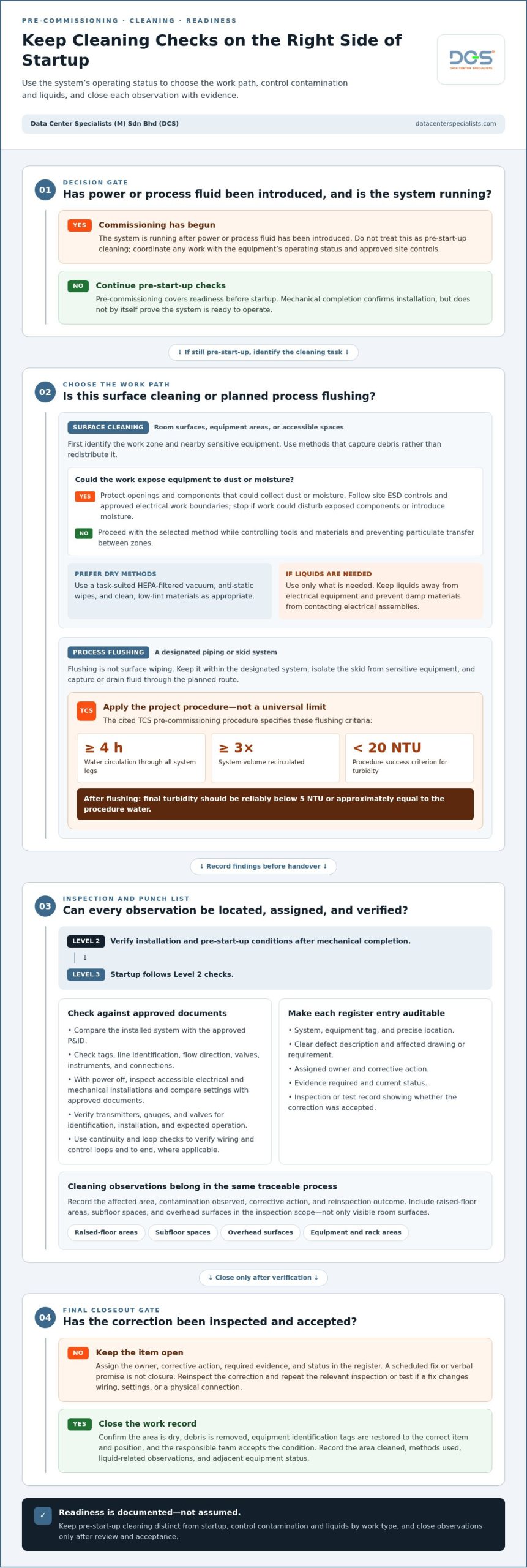
Flushing skid equipment is different from wiping a surface. Keep flushing within the designated system, isolate the skid from sensitive equipment, and capture or drain fluid through the planned route. For a TCS pre-commissioning procedure, water should circulate through all system legs for a minimum of 4 hours and recirculate at least 3 times the system volume. The procedure’s success criterion specifies turbidity below 20 NTU; after flushing, final turbidity should be reliably below 5 NTU or approximately equal to the procedure water. Treat these as project procedure criteria, not universal limits for every system.
Keep cleaning separate from equipment startup and energisation. Pre-commissioning checks establish readiness before a system is energized; commissioning begins when power or process fluid is introduced and the system runs. Cleaning activity does not establish mechanical completion or operational readiness. Before handover, record the area cleaned, methods used, liquid-related observations and the status of adjacent equipment.
Equipment identification tags must remain legible and attached to the correct item. Before wiping or working around a tagged component, note its identifier and location. If a tag is removed to clean beneath it, return it to the same equipment and position. Close the work record only after the area is dry, debris is removed, tags are restored and the responsible team accepts the condition.
Pre-commissioning punch lists
A pre-commissioning punch list turns incomplete work into trackable actions before startup. At Level 2, teams verify installation and pre-start-up conditions, including whether connections, settings and configurations match design requirements. These checks follow mechanical completion and precede Level 3 startup. Record each defect with its location, system, responsible party, required correction and status. An open item belongs in the register, not in a verbal promise.
Start with the approved Piping and Instrumentation Diagram (P&ID) and compare it with the installed system. Check equipment tags, line identification, flow direction, valves, instruments and connections against the drawing. Log discrepancies as separate punch points so the construction team can locate and resolve them. A missing valve, misplaced instrument or mismatched line connection can affect later testing and operation.
Use a structured review rather than relying on a single walk-through. With power off, inspect accessible electrical and mechanical installations, verify secure connections and compare component settings with approved documents. Check transmitters, gauges and valves for correct identification, installation and expected operation. Continuity and loop checks can verify wiring and control loops end to end, while pre-start-up reviews identify conditions to correct before energisation.
Organize the register so each entry is specific and auditable. Include:
- System and equipment tag, with the precise location of the observation.
- Clear description of the defect and the drawing or requirement it affects.
- Assigned owner, corrective action, evidence required and current status.
- Inspection or test record showing whether the correction was accepted.
Separate safety-critical and readiness-blocking items from minor documentation or finish observations, following the project’s agreed classification. Do not close an entry because work is scheduled or verbally promised. The reviewer should inspect the correction, examine relevant evidence and record acceptance. If a fix changes wiring, settings or a physical connection, update affected records and repeat the relevant inspection or test before releasing the item.
ASHRAE Guideline 0 identifies setting up issue-resolution log procedures as a pre-design activity, helping projects establish how observations will be recorded and resolved. Apply that discipline to cleaning findings too: describe the affected area, contamination observed, corrective action and reinspection outcome. This creates traceability between cleaning completion and system readiness without confusing a clean surface with a verified installation.
Before Level 3 work begins, review open points with construction, commissioning and operations representatives. Confirm that required corrections are complete, evidence is attached, and unresolved items have an explicit disposition under the project process. A commissioning coordination review can help align pre-start-up records with the next testing activities.
Why data centres need a repeatable cleaning process
A repeatable process connects cleaning scope, inspection records and release decisions to commissioning activities. It also helps teams distinguish a completed cleaning task from authorization to proceed with testing.
Particulate and cleanliness levels
Acceptable particulate levels are the cleanliness criteria agreed for the project, area and measurement method. For data centre commissioning in Malaysia, use the project specification and commissioning plan to set and assess acceptance criteria. Do not assume one particle limit applies to every facility. Dust in the wrong location can obstruct airflow or reach equipment, so record the inspection method and results before functional testing.
Cleaning floors and voids
Cleaning floors and voids removes accumulated construction dust from the air path, not just visible surfaces. A raised-floor plenum supplies cool air upward, so debris beneath tiles can move toward equipment or restrict airflow. Include tile undersides, the subfloor and accessible ceiling-void surfaces in the defined scope, then inspect and document each area before it is covered or released.
Procedure water quality matters when a pre-commissioning task includes flushing a TCS. The procedure water criteria state a maximum conductivity of 50 μS/cm, a minimum pH of 6, and no more than 1000 CFU/ml of total aerobic bacteria. Treat these as criteria for the stated TCS procedure, not general cleaning-water requirements. Record the water test results against the approved method before starting the flush.
Repeatability depends on using the same defined sequence and acceptance record across comparable spaces. Document the area, method, materials, inspection result and any corrective action. For example, if visible dust remains on an accessible floor edge, record the location, reclean it and reinspect that point. This gives commissioning and operations teams a traceable basis for deciding whether the area is ready.
Cleaning completion alone does not authorize testing. The responsible project representatives should review the defined cleaning scope, inspection records, open observations and relevant system-readiness documents before issuing proceed-to-test authorization. Keep that release separate from the cleaning record. If an inspection identifies contamination that could affect a test or equipment, assign corrective work and repeat the affected inspection before testing proceeds.
A consistent process also helps diagnose failures without confusing cause and timing. If a functional test identifies restricted airflow, compare the recorded cleanliness inspection with the affected floor or void location. The evidence can show whether debris remained, returned during later construction or entered by another route. Use the findings to correct the source and improve the next cleaning cycle, rather than repeating an undefined clean.
Issue and observation closeout
Close each cleaning observation with evidence that the corrective action addressed the recorded condition. A status change alone does not demonstrate completion. Keep the original observation, assigned owner, action taken, inspection result and acceptance record together. For example, if dust remains on a surface after cleaning, record its location, repeat the cleaning and document the reinspection before closing the item.
Use consistent records across project phases, from construction cleaning to pre-start-up readiness and turnover. Each entry should identify the room or system, the exact location, the observation date and the person responsible. Add photographs or inspection notes when they clarify the condition. These details help reviewers distinguish a new finding from one already corrected.
ASHRAE Guideline 0 identifies issue-resolution log procedures as a pre-design activity in Section 5.2.5. Section 5.2.1.6(m) identifies developing the initial log format as a pre-design responsibility. Applying a defined format early gives construction, commissioning and operations teams a shared method for recording observations, assigning actions and tracking resolution.
- Open: The finding needs assessment or corrective work.
- Assigned: An accountable person or team owns the action.
- Ready for review: The correction is complete and evidence is available.
- Closed: The designated reviewer has accepted the correction.
Agree on status definitions and acceptance authority before the first inspection. The person who makes a correction can provide evidence, but a designated reviewer should assess whether it resolves the original observation. For a cleaning issue, compare the corrected area with the recorded condition and scope. For a system-related issue, attach the relevant inspection or test record rather than relying on a cleaning sign-off.
Keep unresolved items visible at handover. Each follow-up action needs an owner, a clear due point or project milestone, and a record of its outcome. If an observation affects testing readiness, communicate its status to the commissioning team before the next activity. Do not use verbal assurance in place of evidence or an approved disposition.
Before closeout, reconcile the observation log with inspection records, cleaning reports and outstanding follow-ups. Check that duplicate entries are linked, corrected items have acceptance evidence, and open findings have clear ownership. This final review gives operations a usable record of what was found, corrected and still requires attention after turnover.
How should raised floors, subfloor spaces, and ceiling voids be cleaned?
Clean raised-floor areas as part of the data hall’s airflow path, not as isolated surfaces. The underfloor plenum distributes cool air upward; accumulated dust can move toward equipment or restrict airflow. Plan the work by zone, identify the tiles to be lifted, and protect exposed equipment from displaced particulate. Record each cleaned area before replacing access tiles.
Underfloor work requires a controlled sequence. Remove tiles carefully, then vacuum the exposed subfloor and wipe it with a staticide. Capture dust rather than pushing it toward equipment openings or neighbouring zones. Inspect corners, edges and areas around floor supports, where construction debris may remain. Keep removed tiles organized so each returns to the correct opening and orientation.
- Vacuum and wipe the exposed subfloor with a staticide after removing tiles.
- Replace the raised-floor tiles once the space beneath them has been cleaned.
- Vacuum particulate from the tile surface, then wipe the tiles with anti-static wipes.
- Mop the floor after particulate removal, following the site’s approved method.
Work in manageable sections so the team can track open tiles and completed areas. For example, mark each zone on the cleaning record, noting tiles removed, subfloor condition, debris found and completion status. This makes uncleaned sections easier to identify during inspection and prevents a finished zone from being mistaken for one still in progress.
Clean ceiling voids and overhead surfaces with the same focus on contamination control. Vacuum hard-to-reach surfaces as needed and wipe suitable surfaces with anti-static wipes. Pay attention to ledges, cable-support surfaces and other places where construction dust can settle above the data hall. Avoid disturbing debris that could fall onto clean floors or equipment, and coordinate access with teams responsible for overhead services.
After cleaning, inspect the subfloor, tile surfaces and overhead work area before releasing the zone. Check for visible dust, loose debris, misplaced tiles and cleaning materials left behind. If particulate remains, reclean the affected location and record the follow-up. A clear inspection record distinguishes completed cleaning from areas still awaiting work, especially when construction continues elsewhere.
Raised-floor cleaning supports contamination control beneath and around the access floor, where visible room cleaning cannot reach. For a project-specific scope covering floor tiles and the spaces below them, arrange professional data center floor cleaning.
Data Center Specialists (M) Sdn Bhd (DCS): Professional Data Center ISO Cleaning Services
Data Center Specialists (M) Sdn Bhd (DCS) provides Professional Data Center ISO Cleaning Services for mission-critical environments preparing for commissioning or turnover. Use the service when construction dust, particulate contamination or incomplete cleaning observations call for a defined specialist approach before equipment areas move toward operation.
The scope can cover data halls, raised floors, underfloor spaces, racks and equipment areas, with cleaning planned around site conditions and operational controls. For broader technical assessment, DCS also offers Data Center Energy Assessment, Testing, Adjusting & Balancing (TAB), and Cleanroom Performance Testing (CPT). These services address distinct facility requirements and should be selected to match the project scope.
For a technical discussion about pre-commissioning cleaning requirements, contact Data Center Specialists (M) Sdn Bhd (DCS).
Carry cleanliness requirements into operational handover
Use the data center pre-commissioning cleaning checklist as a working handover reference, not a document that ends with construction. Keep its acceptance criteria aligned with facility operating procedures so future teams can recognize the intended condition and respond consistently when contamination is found. This supports continuity between project closeout and day-to-day facility management. For facility managers coordinating broader operational hubs that require robust warehouse pallet racking and inventory systems, colbydandenong.com.au offers practical industrial storage solutions.
Before handover, make the cleaning scope, inspection records and outstanding actions accessible to the people responsible for the space. Clear documentation gives operations teams a practical baseline for maintaining environmental conditions as equipment and work areas change. It also helps project stakeholders carry lessons from commissioning into later maintenance planning. If turnover also involves hosting on-site stakeholder briefings, media walkthroughs, or opening ceremonies in Malaysia, temporary infrastructure providers such as VMS Event Rental (VMS Group) offer marquee tents and canopies to support external site events.
For a technical discussion about cleaning requirements in a mission-critical facility, contact Data Center Specialists (M) Sdn Bhd (DCS). A disciplined handover gives your team a stronger starting point for operating and maintaining the facility with confidence.
Frequently Asked Questions
At what point does pre-commissioning end and commissioning begin?
Pre-commissioning ends before a system is energized; commissioning begins when power or process fluid is introduced and the system runs. Mechanical completion confirms installation against drawings, but not operational performance. For example, a pump may be installed and inspected before startup, while functional operation and performance testing belong to commissioning. Define the handover point in the project plan so teams know which records and approvals must precede energisation.
What are the steps in pre-commissioning?
Pre-commissioning typically starts after mechanical completion with a review of approved drawings, installation condition, equipment identification and system connections. Teams then complete applicable inspections, electrical continuity and control-loop checks, and required cleaning or flushing. Record defects for correction and reinspection. Before startup, responsible project representatives review readiness records and open items. Follow the system-specific commissioning plan, since a cooling-water circuit and a control panel require different checks.
Why is pre-commissioning important?
Pre-commissioning identifies installation or documentation discrepancies before live testing depends on the affected system. For example, a mismatch between a control-point label and its approved sequence can complicate functional testing and fault diagnosis. Early review also clarifies who must correct each issue and what evidence demonstrates completion. For operators, this creates a more usable handover record and keeps unresolved construction items visible as systems move toward service.
What is included in a data center pre-commissioning cleaning checklist?
A data center pre-commissioning cleaning checklist should define the areas in scope, access conditions, approved cleaning methods and inspection criteria. Include the data hall, equipment exteriors, floor tiles, accessible underfloor areas and overhead surfaces where applicable. Record the cleaning method, materials used, observed contamination, corrective actions and reviewer acceptance. Also identify exclusions, adjacent work zones and who can release each area, so teams interpret completion consistently.
What are the recommended cleaning stages before data center commissioning?
Plan cleaning around construction progress: remove construction debris after intrusive work, perform detailed contamination-control cleaning once overhead and building work is complete, then inspect before commissioning activities. If later trades re-enter a cleaned zone, assess whether targeted recleaning is needed before equipment testing. Keep deep cleaning distinct from maintenance cleaning, which addresses recurring dust during ongoing use. The project cleaning plan should set the sequence and acceptance method for each stage.
What cleaning methods are safe for servers, electrical equipment, and sensitive components?
Use controlled, low-moisture methods near sensitive equipment, such as a suitable HEPA-filtered vacuum for dust capture and anti-static wipes on appropriate surfaces. Do not spray liquids onto equipment or direct a vacuum nozzle at exposed components. Confirm equipment status and work boundaries with the authorized site team before cleaning near electrical assemblies. Keep tools clean between zones, and stop if a method could dislodge debris into an opening or damage a component.
Who is responsible for pre-commissioning cleaning, and what sign-off records are needed?
The project’s responsibility matrix should name the party performing cleaning and the person reviewing acceptance. A cleaning team records areas treated, methods used, findings and corrective work; the designated project reviewer verifies completion against the agreed scope. Keep inspection notes, relevant photographs, observation closeout records and area-release approval together. For example, an underfloor-zone record should identify its location and reviewer, rather than stating only that the data hall was cleaned.
What data center cleaning standards and requirements apply in Malaysia?
In Malaysia, set particulate acceptance criteria using the project specification and commissioning plan; no single limit applies to every facility. If the work includes TCS flushing, follow the approved procedure, including its water-quality, circulation and turbidity criteria.