

A data center pre-commissioning cleaning checklist should guide work from scope review and area preparation through controlled removal of construction dust. It should cover overhead surfaces, racks and equipment areas, and raised-floor and underfloor spaces, followed by inspection and documented verification. Complete this physical contamination-control work before commissioning puts installed systems into operation. A clear sequence helps teams identify remaining debris before it becomes an operational concern.
A clean data hall is essential, but cleanliness alone doesn’t show that the space is ready for commissioning. Teams also need clear inspection points, defined responsibilities and records of what was cleaned and what needs attention. This article explains how to sequence the work, what to inspect and how to verify results before commissioning proceeds.
You’ll also see how pre-commissioning cleaning fits into the wider readiness process, including the distinction between cleaning and equipment testing. The focus is practical: covering data hall surfaces and critical spaces without treating mission-critical cleaning as routine janitorial work.
Key Takeaways
- Separate physical contamination control from equipment testing so cleaning tasks and commissioning checks have clear scope and ownership.
- Plan cleaning around the construction sequence, covering exposed surfaces, rack areas, raised floors and underfloor spaces before systems enter operation.
- Use visual inspection and documented verification to identify residual debris, record deficiencies and confirm corrective work is complete.
- Organize readiness checks by system, and track open issues through closure rather than relying on verbal handover.
- Apply relevant commissioning and environmental guidance to define project-specific cleanliness expectations and determine when specialist cleaning support is appropriate.
What is Pre-Commissioning Cleaning?
Pre-commissioning cleaning removes construction dust and other contaminants before a data center enters operation. It covers physical spaces and, where the project scope requires, mechanical systems. A structured data center pre-commissioning cleaning checklist defines what to clean, inspect and verify before handover.
The video outlines how commissioning levels progress toward operational readiness.
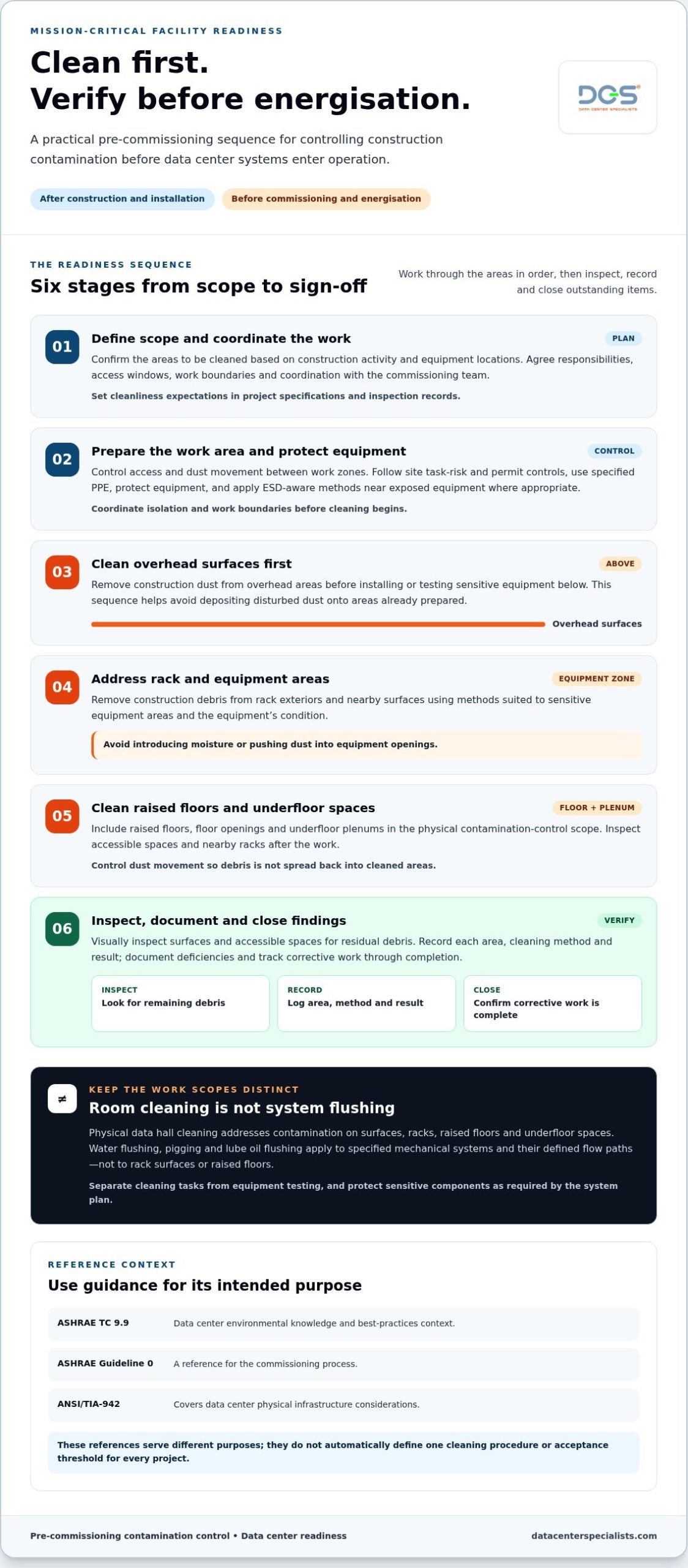
Pre-commissioning checks prepare installed systems before energisation. In data centers, cleaning can cover overhead surfaces, rack exteriors, raised floors and underfloor plenums. Define the scope based on construction activity and equipment locations. Sequence the work to avoid spreading dust onto areas already cleaned, and choose methods suited to each surface and the equipment’s condition.
Debris Removal and System Flushing
System flushing moves loose debris through a defined flow path and out of piping before operation. It matters because construction residue can obstruct strainers, affect valves or reach connected equipment. Water flushing carries loose particles from suitable piping, while the circuit design and system requirements determine the method.
Pigging uses a cleaning pig to scrape and push debris through a pipeline, often on long-distance lines. Lube oil flushing circulates oil through lubrication systems to remove contaminants against a defined cleanliness target. These methods apply to specified mechanical systems, not raised floors or rack surfaces. Protect sensitive components as required by the system plan.
For data hall cleaning, remove construction debris using methods suited to sensitive equipment areas, then inspect surfaces and accessible spaces. Avoid introducing moisture or pushing dust into equipment openings. A structured physical data center cleaning method distinguishes room contamination control from mechanical circuit flushing. Record each area, method and result for handover.
Applicable Cleaning Standards and Guidelines
ASHRAE TC 9.9 provides data center environmental knowledge and best-practices context. ASHRAE Guideline 0 is a reference for the commissioning process. ANSI/TIA-942 covers data center physical infrastructure, including architectural, electrical, mechanical, fire-safety, telecommunications and security considerations. These references serve different purposes; they don’t automatically prescribe one cleaning procedure or acceptance threshold for every project. Define expectations in project specifications and inspection records.
Contamination Risks and Safety Precautions
Dust, metal fragments and construction residue can enter equipment openings, obstruct airflow or contaminate components. Abrasive debris can also damage surfaces during cleaning. Protect equipment, control dust movement between work zones, and inspect nearby racks and floor openings after the work.
Airborne dust and loose debris can enter equipment, obstruct airflow or contaminate components. Moisture and unsuitable tools can also cause damage. Follow the site’s task risk assessment and permit controls, use specified PPE, protect equipment and control access to the work area. Apply ESD-aware methods near exposed equipment where appropriate, and coordinate cleaning with the operations team before work begins.
Pre-commissioning sequence and purpose
Pre-commissioning follows construction and installation, after mechanical completion and before commissioning. Its purpose is to verify readiness and resolve outstanding work before systems are energised.
Cleaning Sequence and Purpose
The sequence moves from completed installation checks to preparation, cleaning, verification and preservation where required. This order helps teams identify construction-related contamination before equipment enters operation.
At Level 2, equipment delivery and installation are followed by pre-start-up checks. Mechanical completion confirms installation against drawings, but it doesn’t prove that equipment functions correctly. Teams should document each check, record open items and remove temporary construction materials before moving to the next commissioning activity.
Coordination with Electrical and Mechanical Commissioning
Coordination means scheduling cleaning around electrical and mechanical work, with a defined access window for each activity. This matters because cleaning can disturb settled dust, while commissioning introduces power or process fluids into systems.
How should cleaning be coordinated with electrical and mechanical commissioning? Complete relevant cleaning and inspections before equipment energisation, and coordinate access, isolation and work boundaries with the commissioning team. For example, finish overhead work before installing or testing sensitive equipment below.
The data center commissioning sequence runs from Level 0 through Level 6. Level 0 covers planning and design review, while Level 1 covers factory testing. Factory Acceptance Testing takes place before equipment dispatch, allowing major equipment issues to be identified before shipment. These earlier stages inform site preparation, but don’t replace checks after delivery.
At Level 2, teams verify delivered and installed equipment before energisation. Site Acceptance Testing occurs after delivery and installation, checking equipment at the site. The project sequence then moves to Level 3, which focuses on starting up or energising individual plant, equipment, systems and components. Pre-commissioning ends when the system is energised.
Cleaning teams need the commissioning schedule, equipment status and work boundaries to coordinate their activities. For example, a mechanical circuit may need preparation before flushing, while electrical checks require suitable access to panels and equipment. Keep cleaning distinct from electrical testing and mechanical startup, and record any access restriction that affects completion.
After Level 3, Level 4 is functional testing, Level 5 is integrated systems testing, and Level 6 covers operational readiness and turnover. Cleaning records, inspection findings and closed defects contribute to a traceable handover. A data center commissioning approach can help align facility testing with the project sequence.
Use a shared schedule to assign cleaning areas, system boundaries, responsible teams and completion evidence. Before each transition, review the documentation and confirm that no outstanding cleaning tasks have been overlooked. This keeps the move from installed equipment to functional testing controlled and documented.
Cleanliness inspection and verification
Inspection verifies that cleaning has removed visible construction residue from the specified areas. It also records remaining defects before equipment operation. Define acceptance criteria before work starts, including the surfaces, floor voids and equipment zones to inspect. Without agreed criteria, one team may accept a surface that another considers incomplete.
Inspect in a consistent sequence, moving from overhead areas to racks, room surfaces and raised-floor spaces. Use suitable lighting to examine ledges, cable routes, floor supports and accessible equipment exteriors. Check corners and transitions where dust can collect. Record each finding by location rather than making a general note that the room needs more cleaning.
- Compare each area with the approved cleaning scope and identify inaccessible or excluded spaces.
- Look for settled dust, construction debris, fibres, residue and signs of moisture.
- Inspect floor panels and accessible underfloor areas before closing them.
- Photograph defects with clear location references and record corrective actions.
- Repeat the inspection after re-cleaning, then document completion and acceptance.
Visual inspection identifies visible residue, while particle count testing can provide additional evidence when the project specification calls for it. Set sampling locations, conditions and acceptance criteria against project requirements before testing. A result without defined locations or comparable conditions may not represent the area the commissioning team needs to assess.
Keep evidence traceable. A useful record identifies the inspected zone, inspection date, observed condition, responsible party and closure status. Attach photographs when they clarify a finding, such as dust on a rack top or debris beneath a raised floor. Store records in the project documentation system so authorised team members can retrieve them during review.
For each deficiency, assign an owner and track the item through corrective cleaning and reinspection. For example, if construction work resumes after a room passes inspection, reassess affected areas because new activity can reintroduce dust. The final review should follow the project’s agreed acceptance process, not an undocumented visual impression.
Particle results and photographs support a handover record, but neither replaces the commissioning team’s readiness checks. Keep cleaning acceptance separate from equipment performance testing. A clean surface cannot demonstrate that a system functions correctly, while a functional test cannot establish that all specified areas are free of construction residue.
Closeout should show what was inspected, what failed acceptance, how each issue was corrected and who accepted completion. Use the record to resolve disputed areas before commissioning progresses. A clearly documented inspection gives facility teams a useful baseline for distinguishing residual construction contamination from material introduced by later work.
Commissioning checklist and task coverage
A commissioning checklist organises readiness checks by system, component or equipment type. It helps teams assign tasks, record results and manage open items across project phases.
Checklist Tasks and Coverage
A system-based checklist defines what to inspect, test and document before equipment operation. This structure helps engineers identify incomplete work and prevents important checks from being missed between teams.
For mechanical equipment, cover visual defects, assembly against vendor P&ID drawings, grounding, access platforms, valve positions, drains and vents. Confirm that temporary construction materials have been removed from the work area. Record each finding against its equipment or system, then use a closed-loop punch list to track corrective action through closure.
Electrical checks should cover power and control wiring, grounding and bonding, communications settings, configuration parameters, protection settings, interlocks and system responses. For example, verify that control wiring and communications connections match approved project documentation before functional testing begins.
Utilities require separate readiness checks. Confirm that electricity, water and gas are available and functioning for the systems that depend on them. Fire readiness also requires coordinated checks of detection, alarms, suppression, fire-panel integration, emergency exits and shutdown logic.
Organise records so reviewers can distinguish a completed check from an unresolved defect. Each checklist entry should identify the equipment, inspection or test performed, result, evidence and responsible party. A punch list records every open defect and tracks it through corrective action to closure, rather than relying on a verbal promise.
Classify findings by operational significance. An unsafe condition or failed critical function is a critical snag and blocks handover. An operational inconvenience involving a non-critical function may support conditional handover. Documentation, labelling or cosmetic corrections can be tracked for closure after handover when classified as low-level snags.
Cleaning Tools and HEPA-Filtered Equipment
Cleaning tools should capture particles without dispersing them or damaging sensitive surfaces. A practical kit can include a HEPA-filtered vacuum, lint-free cloths, soft brushes and suitable access equipment. Select tools to suit the task, surface and work zone.
What cleaning tools and HEPA-filtered equipment are required for data centers? Use a HEPA-filtered vacuum for controlled dust collection, alongside lint-free cloths and soft brushes for accessible surfaces. Apply ESD-aware methods near exposed equipment, and keep cleaning tools separate from equipment used for other site tasks.
Tool selection supports, but does not replace, a defined work method. For example, vacuum raised-floor panels and accessible underfloor areas using equipment suited to the space, then inspect before replacing the panels. Protect openings and nearby equipment so collected dust doesn’t migrate into sensitive areas.
Before work starts, confirm access controls, equipment status and cleaning boundaries with the facility team. Keep electrical and mechanical checks within their assigned procedures: cleaning doesn’t prove safe energisation or functional performance. Document the area, tools used, inspection findings and completion status for the commissioning record.
What standards and guidelines apply to data center cleaning before commissioning?
No single reference replaces the project’s cleaning specification. Use commissioning guidance to define readiness, environmental references to inform contamination control, and approved project documents to set the cleaning scope and acceptance criteria.
ASHRAE Guideline 0 is a reference for the commissioning process. It helps frame commissioning as a planned process, with requirements, responsibilities and records established across project delivery. For cleaning, apply that framework by identifying the areas to be cleaned, when work occurs, who inspects it, and what evidence supports acceptance. Keep these requirements in the project documentation rather than treating a general guideline as a detailed cleaning method.
ASHRAE TC 9.9 provides data center environmental knowledge and best-practices context. Use that context when considering how dust and particles may affect equipment areas, airflow paths and facility operation. It informs environmental considerations, but does not, by itself, define a site-specific cleaning procedure or acceptance threshold. Set those criteria against the project scope and intended operating conditions.
ANSI/TIA-942 covers data center physical infrastructure, including architectural, electrical, mechanical, fire-safety, telecommunications and security aspects. Its broad infrastructure scope can help teams consider cleaning access and sequencing alongside other facility requirements. For example, overhead cleaning should be coordinated with installed services, while raised-floor work needs to account for underfloor systems and access controls.
Keep the role of each reference distinct. Commissioning establishes readiness against the project’s design and operating requirements; certification validates against a defined external framework. Neither a commissioning reference nor an infrastructure standard automatically proves that cleaning is complete. The project should define the cleanliness scope, inspection approach, records and acceptance process that support handover.
Translate the references into practical project controls. Identify each zone, surface and accessible void; note equipment protection requirements; assign cleaning and inspection responsibilities; and specify how findings are recorded and closed. If the project specification requires particle count testing, define sampling locations and acceptance criteria before testing. A test result needs its location and context to be meaningful.
For data centers in Malaysia, project teams should apply the requirements in their approved design documents and commissioning plan. Do not assume that a general international reference creates a specific Malaysian legal cleaning threshold. Instead, align the work with the facility’s environmental objectives, equipment requirements and documented project acceptance criteria.
When scope needs to be translated into a controlled physical cleaning method, review professional data center cleaning as part of the project plan. Link each cleaning record to its zone and acceptance basis. That traceability lets the commissioning team distinguish completed cleaning from open work and assess readiness against the project’s stated requirements.
Data Center Specialists (M) Sdn Bhd (DCS): Professional Data Center ISO Cleaning Services
Data Center Specialists (M) Sdn Bhd (DCS) provides Professional Data Center ISO Cleaning Services for mission-critical environments preparing for commissioning. Turn to DCS when construction activity has left dust or debris across the data hall, raised floors, underfloor spaces, racks or equipment areas, and you need professional physical cleaning aligned with the project scope.
For pre-commissioning work, clear cleaning boundaries and coordination with facility and project teams help distinguish completed areas from outstanding tasks. DCS’s data center cleaning services support contamination control in sensitive operational environments. Where project requirements extend beyond cleaning, DCS also offers Data Center Energy Assessment, Testing, Adjusting & Balancing (TAB), and Cleanroom Performance Testing (CPT).
Discuss your facility’s cleaning scope and readiness requirements with Data Center Specialists (M) Sdn Bhd (DCS), or visit datacenterspecialists.com.
Set the Cleaning Scope Before the Next Project Milestone
Before the next commissioning milestone, turn the data center pre-commissioning cleaning checklist into a project-controlled work plan. Align it with construction access, equipment installation and the commissioning schedule. Assign responsibility for each area and define how completion will be recorded, so cleaning status is visible alongside other readiness decisions.
Use the plan to resolve practical details early: which zones are accessible, what work may affect cleaned areas, and who accepts completed tasks. This gives project managers, contractors and facility teams a shared basis for coordinating work as the site moves toward operation. It also keeps scope changes and newly identified work visible through handover.
With these controls in place, the project team can carry a clear cleaning scope into the next milestone and ground readiness decisions in documented work.
Frequently Asked Questions
What are the steps in pre-commissioning?
Begin by confirming system boundaries against approved drawings and vendor documentation. Check that sensitive items, such as instruments or control valves, are protected or isolated where the work method requires it. Prepare temporary spools if the approved flushing plan calls for them. After pre-commissioning checks, restore the system configuration and confirm temporary items have been removed before startup. This prevents incomplete preparation from carrying into energisation.
What evidence is needed before handover acceptance?
Beyond signed task records, handover packages can include point-to-point validation, approved alarm thresholds, dashboard and report checks, user-role records, and event-log evidence. Include backup and restore documentation where applicable, along with operations training records. These materials help the receiving team understand how facility systems are monitored and managed. Organise them by system and document revision so reviewers can identify the relevant record without relying on informal explanations.
What happens during Pre-Commissioning?
Pre-commissioning checks establish whether equipment can be switched on safely, with relevant checks performed while power is off. Depending on the system, work can include pressure or leak testing, instrument calibration, continuity checks and end-to-end control-loop checks. For example, a loop check can confirm that a field signal reaches the intended control point. These checks establish readiness; they don’t demonstrate integrated performance under operating scenarios.
What does data center pre-commissioning cleaning include?
The work includes physically removing construction contamination from the spaces and surfaces defined in the project scope. Consider less-visible collection points such as cable-tray tops, ceiling-grid ledges, floor-panel edges and penetrations around installed services. Protect sensitive components and avoid disturbing cable terminations or installed instruments. The cleaning boundary should distinguish accessible surfaces from equipment interiors, which require their own approved work method.
What is the step-by-step data center pre-commissioning cleaning process?
Use controlled work zones so activity in one area doesn’t compromise another:
- Mark the work boundary and identify nearby sensitive equipment.
- Remove loose construction materials before fine cleaning begins.
- Work from higher surfaces toward lower surfaces, capturing released debris.
- Inspect concealed edges and service penetrations within scope.
- Re-clean any area where inspection finds remaining residue.
Coordinate each zone’s release with the site team before follow-on trades resume work.
How clean should data center rooms be before commissioning (ISO 14644 or particulate limits)?
Use the cleanliness criteria stated in the project specification; don’t assign a particulate limit by assumption. ISO 14644-1 provides a classification framework, but a data hall isn’t automatically a classified cleanroom. If particle counting is required, agree on sampling locations that represent relevant equipment areas and airflow paths. Record the measurement conditions and compare results with the project’s stated acceptance basis, not an unrelated classification.
What checklist should be used for raised floors, ceiling voids, racks, and cable trays?
Build the checklist around actual access points and surfaces, not just room names. For raised floors, include panel edges, cut-outs, pedestals and service penetrations. For ceiling voids, identify grid members and accessible ledges. For racks, include exterior tops and sides; for cable trays, consider exposed upper surfaces and support points. Mark inaccessible locations clearly so the review distinguishes exclusions from inspected areas.
How should cleaning results be documented and verified before handover?
Use a consistent zone code across the cleaning record, inspection evidence and project drawing. Include the drawing or document revision used to define the area, and label photographs with matching zone references. Where project approval is required, record the reviewer’s acceptance against the relevant criterion. Store records in the turnover package with related commissioning documents so the operations team can retrieve evidence by location or system.