

Visible dust on a server rack can be a sign of a wider contamination issue. In an operational data center, particles may also collect on nearby surfaces, raised floors, or in underfloor and overhead areas. A professional server rack cleaning service should therefore be planned as controlled physical contamination management, not routine dusting. The scope and method need to account for sensitive equipment and the facility’s operating procedures.
Start by defining exactly what the work covers. Does it include rack exteriors, accessible equipment-area surfaces, or adjacent spaces? How will the team manage access, protect the work boundary, and document completion? Clear answers help facility managers compare a proposed service with site requirements and operational priorities.
This guide explains what specialist rack cleaning can cover, how to plan the work around live operations, and what to look for when evaluating a service. It also outlines how to review facility conditions and prepare for a cleaning task. Data Center Specialists (M) Sdn Bhd (DCS) provides physical contamination control for mission-critical facilities, including server rack, equipment-area, raised-floor, and underfloor cleaning.
Key Takeaways
- Define the work by its physical scope: rack exteriors, specified equipment-area surfaces, and any adjacent spaces included in the project.
- A professional server rack cleaning service should follow a controlled sequence based on site conditions, facility requirements, and operational procedures.
- Assess a service by its scope, suitable methodology, operational coordination, and close-out records, rather than promotional claims alone.
- Set cleaning intervals according to observed contamination, facility activity, operational changes, and documented site requirements, not a universal schedule.
- DCS provides mission-critical cleaning for server racks, equipment areas, raised floors, and underfloor systems as part of physical contamination control.
What a Server Rack Cleaning Service Covers in a Data Center
A server rack cleaning service is controlled physical cleaning of defined rack exteriors and surfaces in the surrounding equipment area. It manages dust and particulate contamination without treating an operational data center like a general commercial space. It is distinct from hardware inspection, repair, firmware updates, operating-system maintenance, and other IT tasks.
Dust, fibres, and other particles can settle on rack doors, frames, and nearby horizontal surfaces. Where particles accumulate depends on facility conditions and activity. The scope should therefore name the surfaces being addressed, rather than imply that the work includes every part of the room.
See how specialist physical cleaning is carried out in a data center environment:
Which rack and surrounding surfaces may be in scope?
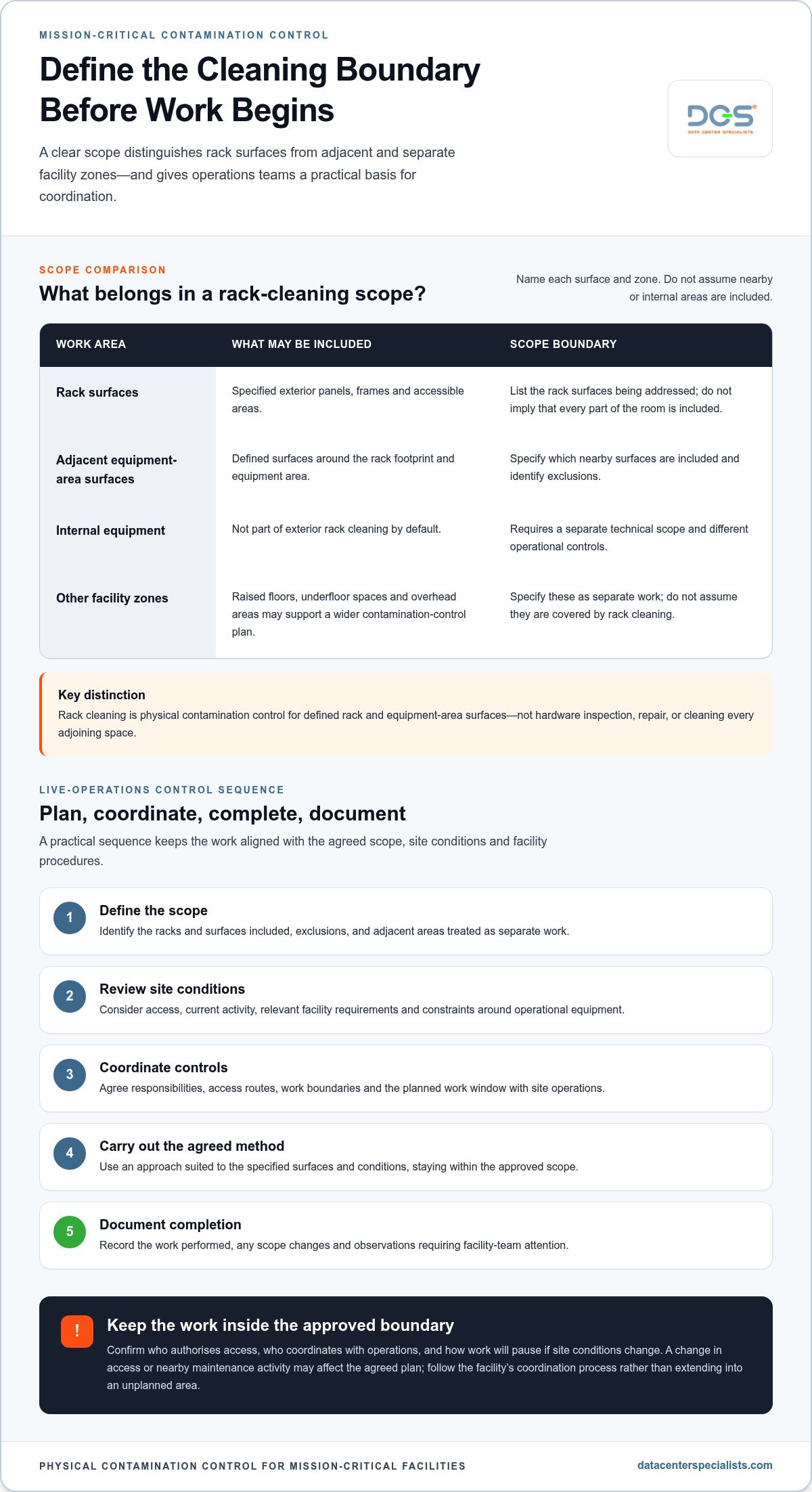
Rack exteriors and accessible surfaces form one scope area; nearby equipment-area surfaces are another. Internal equipment cleaning is separate work and needs its own technical scope because it involves installed IT assets and different operational controls. Raised-floor, underfloor, and overhead cleaning may support a wider contamination-control plan, but should be specified as separate work rather than assumed to be included in rack cleaning.
- Rack surfaces: specified exterior panels, frames, and accessible areas.
- Adjacent surfaces: defined surfaces around the rack footprint and equipment area.
- Other zones: raised floors, underfloor spaces, and overhead areas, scoped separately.
These boundaries help facility teams coordinate access and identify gaps between rack-level work and cleaning elsewhere. DCS provides professional data center cleaning for mission-critical environments, including racks, equipment areas, raised floors, and underfloor systems.
Why particulate contamination matters around racks
Particles on surfaces can be disturbed by airflow, maintenance activity, or movement through the equipment area. Once airborne, they may travel and settle elsewhere. Environmental conditions and maintenance access therefore inform how contamination should be managed. For broader context, see this overview of server room environmental control.
Rack cleaning is physical contamination control for defined rack and equipment-area surfaces. It is not a substitute for hardware maintenance or cleaning every adjoining space.
Contamination pathways can extend beyond the rack. Particles on nearby surfaces may be redistributed during facility activity, while contamination in a raised-floor void or overhead area falls under a separate scope. Identifying these areas helps operators plan related work without assuming that a rack-only task addresses the entire room.
For practical planning, document which rack exteriors and accessible surrounding surfaces are included, along with any exclusions. If internal equipment, raised floors, underfloor systems, or overhead areas need attention, define them as separate activities within the wider facility plan. This gives operations and procurement teams a precise basis for coordinating the work.
How Professional Server Rack Cleaning Is Controlled Around Live Operations
Cleaning around live racks requires a defined work boundary and coordination with the facility team. A server rack cleaning service should be planned around the facility specification, equipment-area conditions, and operational procedures, rather than applied as a fixed routine. Coordination helps manage avoidable risks, but cannot guarantee zero disruption. Site operations should guide decisions about access, timing, and operational constraints.
A practical control sequence runs from planning through close-out:
- Define the scope: identify the racks and surfaces included, exclusions, and any adjacent areas treated as separate work.
- Review site conditions: consider access, current activity, relevant facility requirements, and constraints around operational equipment.
- Coordinate controls: agree responsibilities, access routes, work boundaries, and the planned work window with site operations.
- Carry out the agreed method: use an approach suited to the specified surfaces and conditions, staying within the approved scope.
- Document completion: record the work performed, any scope changes, and observations that need facility-team attention.
Plan around live operations
Before work begins, identify the affected rack row or equipment area and the route personnel and materials will use to reach it. Confirm who authorises access, who coordinates with operations, and how the work will pause if site conditions change. Keep cleaning boundaries separate from tasks that involve opening, inspecting, or servicing IT equipment. Those activities require their own technical scope and operational approval.
A change in access or nearby maintenance activity, for example, may affect the agreed plan. The team should follow the facility’s coordination process rather than extend the work into an unplanned area. Clear handoffs help operations understand which surfaces are being addressed and what remains outside the task.
Equipment, ESD awareness, and contamination controls
Tools and methods should suit a sensitive technical environment and the surfaces in scope. ESD awareness belongs in the planning, and the work approach and personnel conduct should align with applicable facility procedures. The controls depend on the site specification, equipment-area conditions, and approved work boundaries.
Keep the method disciplined. Avoid actions that could move contamination into other areas or create unplanned contact with equipment. If an unexpected condition appears, stop work within the relevant boundary and refer it to the designated site contact instead of improvising. This preserves operational oversight and keeps the work aligned with the agreed scope.
Define the scope, review site conditions, control access, clean to the agreed method, and document the work for facility review. Close-out records should make clear what was addressed and note relevant observations. They should not imply that cleaning alone verifies equipment condition or facility-wide cleanliness.
For operators planning controlled physical cleaning across racks and related data center areas, review DCS data center cleaning services as part of facility contamination-control planning.
How to Evaluate a Server Rack Cleaning Service
Compare a service with the facility’s requirements, not just its headline claims. A sound evaluation considers whether the scope is precise, the methodology suits the environment, operations are coordinated, and records let the team review the work. These criteria help procurement, engineering, and operations teams decide whether a proposed server rack cleaning service addresses the actual contamination-control need.
What a clear technical scope should explain
Look for an explicit description of the rack areas and surrounding surfaces, plus exclusions such as internal equipment, raised floors, underfloor spaces, or overhead surfaces. The scope should identify relevant site requirements, work boundaries, and coordination needs. Keep the cleaning method distinct from any ISO reference or project-specific acceptance criteria. A standard alone does not describe the exact method used.
Before approving the scope, align internally on the intended outcome and boundaries. If the requirement is limited to rack exteriors and accessible surfaces, for example, adjacent floor or overhead work should not be assumed. DCS’s data center cleaning services provide physical contamination control in mission-critical areas, with the work scope planned in relation to facility conditions.
What records help facility teams review completed work?
Useful close-out records connect the agreed scope to the work completed. They can include the approved scope, completion notes, and documented exceptions or access limitations. Particle or inspection results should be included only when measurement or inspection was specified and carried out. Records help teams plan follow-up and maintenance, but do not by themselves prove equipment performance or guarantee a particular outcome.
Use the comparison below to structure an internal review. Evidence should be specific enough to assess against the site’s requirements.
| Criterion | Evidence to review | Question for internal stakeholders |
|---|---|---|
| Scope clarity | Defined rack surfaces, adjacent areas, exclusions | Does this match the contamination concern and intended work boundary? |
| Methodology | Written approach tied to surfaces and site specification | Is the method suitable for the equipment-area conditions? |
| Operational coordination | Access, work-window, and site coordination arrangements | Who authorises access and manages operational changes? |
| Documentation | Scope, completion notes, and recorded exceptions | Can the facility team verify what was done and what was excluded? |
| Contamination-control relevance | Connection between identified contamination and proposed work | Does the scope address the relevant surfaces without implying broader coverage? |
Give more weight to verifiable documents and clearly bounded commitments than to broad promotional language. Read any reference to an ISO standard alongside the actual methodology and acceptance requirements, rather than treating it as automatic proof of either.
For a technical discussion of rack and surrounding-area cleaning scope, speak with Data Center Specialists (M) Sdn Bhd (DCS) about the facility conditions and requirements that should inform the work.
When to Plan Rack Cleaning and Prepare the Facility
Set rack-cleaning intervals according to facility conditions and documented requirements, not a universal calendar. A planned review may be prompted by visible particulate accumulation, nearby construction or refurbishment, changes to airflow, or altered access and maintenance activity. These are reasons to assess the area and its cleaning needs. On their own, they do not prove that IT equipment is contaminated or that a specific intervention is required.
Use the facility’s risk assessment and applicable project or operational specification to shape the schedule. Record the conditions considered, the areas assessed, and the basis for the chosen interval. Revisit the decision when relevant site conditions change. This creates a schedule the team can explain and update, rather than relying on a fixed frequency that may not reflect the environment.
What conditions can prompt a rack-cleaning review?
Look for changes that may affect particulate accumulation or movement through the equipment area. Nearby construction, a visible increase in settled dust, or changes to airflow and access patterns can all justify a review. Treat each as a reason to assess conditions, not automatic evidence of equipment contamination. Where the facility has documented cleanliness criteria, use them to guide the assessment and follow-up.
Schedule design should reflect how the site operates. A rack row with changing maintenance access may need a different review approach from an area with stable conditions. Construction activity can also change the context in which previous observations were made. Avoid setting a recurring interval without considering these differences. Align review intervals with the facility’s documented assessment and applicable requirements.
How facility teams can prepare for planned work
Preparation starts with internal agreement. Confirm the affected racks and areas, access arrangements, operational contacts, and the boundaries of the cleaning task. Coordinate timing with facility operations and relevant maintenance activities so that access and overlapping work can be managed. Keep work involving internal IT equipment separate from the cleaning scope unless it has its own technical definition and approval.
- Confirm the work area: identify racks, adjacent surfaces, and exclusions.
- Set access and coordination: identify the operational contact and agree how access will be managed.
- Record constraints: note relevant site requirements, nearby activities, and any limits on the work.
- Agree escalation steps: clarify who should be notified if conditions change or the planned boundary cannot be maintained.
These steps give operations and the cleaning team a shared reference before the work window begins. If site conditions differ from the plan, pause and follow the agreed escalation process instead of extending the task by assumption. DCS provides professional data center cleaning planned around mission-critical environments. Discuss the facility’s rack-cleaning requirements with Data Center Specialists.
DCS Server Rack Cleaning as Mission-Critical Contamination Control
Effective contamination control depends on understanding how the facility operates, not treating every cleaning task as isolated. Data Center Specialists (DCS) provides professional cleaning for mission-critical IT environments. Its professional data center cleaning services include server rack, equipment-area, raised-floor, and underfloor cleaning. The work is planned in relation to facility conditions and operational requirements, with the intended outcome and boundaries defined before scheduling.
A project discussion can connect observed conditions with an appropriate cleaning scope. The goal is to align the work with site requirements, rather than assume one method or schedule suits every environment.
How rack cleaning fits into wider contamination control
Rack-level work is one part of a facility’s broader approach to physical contamination control. Operators can consider it alongside relevant site observations and maintenance planning, while keeping assessment and cleaning distinct. An air-quality assessment may provide information about environmental conditions, for example, but it does not replace physical cleaning. Contamination-prevention guidance can also help teams develop a consistent framework for reviewing risks and planning actions.
Use those inputs to clarify the reason for the work, operational constraints, and how the result will be reviewed. This grounds the project scope in facility needs rather than broad assumptions about cleanliness or equipment performance.
Discuss a rack-cleaning scope with DCS
Owners, operators, and facility managers can bring site conditions and operational priorities into a discussion with DCS. Consider what prompted the review, relevant site requirements, and any constraints that could affect access or scheduling. A project-specific discussion helps align expectations before the work plan is finalised.
To discuss your facility’s requirements and an appropriate approach, contact Data Center Specialists (M) Sdn Bhd (DCS).
Set the Next Step for Your Facility
Turn the assessment into a practical decision: identify the operational concern, assign an internal owner, and bring relevant site requirements into a scope discussion. This gives your team a clear starting point for deciding whether a server rack cleaning service fits current facility conditions and how the work should align with operational priorities.
Data Center Specialists focuses on mission-critical environments and provides professional data center cleaning, including rack and equipment-area cleaning. Discussing the facility’s conditions and requirements helps shape a project-specific approach without assuming every data center needs the same schedule or scope.
Discuss your data center cleaning requirements with DCS to define a clear scope for your facility’s needs.
Frequently Asked Questions
What is included in a server rack cleaning service?
The scope should be detailed enough for the facility team to locate and verify the work. A scope sheet can identify rack or row references, surface categories, and exclusions using the site’s own labels or drawings. This makes it easier to compare the approved work package with completion records and resolve ambiguous locations before scheduling.
Is server rack cleaning the same as cleaning inside server equipment?
No. Rack cleaning does not authorise access to server internals or make the cleaning team responsible for IT asset servicing. If a concern appears to originate inside a device, route it through the organisation’s IT asset owner or service process. Keeping that referral path clear helps facility and IT teams assign responsibility correctly and prevents exterior cleaning records from being mistaken for equipment inspection or maintenance records.
Can rack cleaning take place while a data center remains operational?
Potentially, subject to the facility’s work authorisation and operational procedures. Before scheduling, establish who can approve access, who can pause or stop the activity, and how a change in site conditions will be communicated. A defined escalation contact is useful if the agreed work area becomes unavailable. The operations team should decide based on actual site conditions, not an assumed absence of impact.
Does ISO 14644 specify how often server racks must be cleaned?
ISO 14644-1 concerns classification of air cleanliness by particle concentration. It should not be interpreted as a universal cleaning calendar for racks. Keep three items distinct in project documents: any applicable cleanliness classification, the facility’s cleaning methodology, and the interval chosen through site planning. If a specification cites an ISO document, verify the relevant part and scope before translating that reference into a cleaning requirement.
How should a facility decide when server racks need cleaning?
Maintain a review log that records the date, area observed, relevant facility activity, and reason for follow-up. Comparing observations from the same locations over time can help teams distinguish a persistent pattern from a one-off condition. Use the log to support prioritisation against site requirements, not as an automatic instruction to clean. Escalate unusual observations through the facility’s established assessment process.
What documentation should a rack cleaning provider supply?
Ask for records that can be reconciled with the facility’s work package: approved location references, completion status by area, deviations from the plan, and the person or team responsible for review. Where the project specifies inspection or particle measurement, the record should identify the procedure and results actually obtained. Keep these documents with relevant facility maintenance records so later reviews can follow the work history.
Why is ESD awareness relevant to data center rack cleaning?
Electrostatic discharge awareness helps teams account for the sensitivity of nearby electronic equipment during physical work. The facility’s ESD procedures should inform the work plan, including requirements for personnel conduct, materials, or tools. Record which site controls apply and how they are communicated to the work team. General awareness, a product description, or a cleaning record should not be treated as proof of a specific certification.
Should underfloor cleaning be included in a server rack cleaning scope?
Decide based on the facility assessment and define underfloor cleaning as a separate work package or line item. Before planning the activity, the operations team can identify relevant access locations, local restrictions, and how the area will be returned to its required condition. This prevents rack-level completion from being taken as evidence that the plenum was addressed and gives each zone its own review record.