

Maintenance intended to reduce risk can create a new exposure if it is poorly scoped or timed. De-risking data center maintenance operations means looking beyond the calendar: a routine schedule may not reflect an asset’s criticality, the consequences of failure or the hazards introduced by an intervention. In Malaysia, as in any mission-critical environment, continuity depends on coordinated power, cooling and facility systems, so maintenance decisions need a clear operational basis.
Preventive maintenance is essential, but it is most useful when teams can compare risks, plan controls and verify outcomes consistently. This guide explains how to prioritise work according to facility risk and operating context, then structure interventions with defined scopes, approvals, safety controls and post-work checks. It also explains where specialist maintenance, testing or assessment can address distinct exposures, from equipment condition and airflow performance to physical contamination. The goal is a disciplined approach that protects service continuity and gives operations, engineering and procurement teams a shared basis for deciding what work is needed, when it should happen and how its impact will be controlled.
Key Takeaways
- Start de-risking data center maintenance operations by mapping critical assets and weighing their condition against operational consequences.
- Use inspection findings, maintenance history and facility context to select a suitable mix of scheduled, condition-informed and corrective work.
- Define scope, approvals, controls and verification steps before maintenance begins in a live environment.
- Match specialist maintenance, physical contamination control, assessment or testing to the specific exposure identified.
- Evaluate work against the requirement by reviewing the methodology, safety controls, technical evidence and completion records.
Why De-Risking Data Center Maintenance Operations Starts with Exposure
De-risking data center maintenance operations starts by identifying what could be affected, not simply listing tasks due on a calendar. Maintenance risk includes the condition of an asset, the work performed on it, its connections to other systems and the facility’s ability to recover if something goes wrong. A task may be routine in isolation but consequential if it affects equipment that supports other critical functions.
Maintenance risk is the potential operational consequence of asset failure or maintenance intervention, considered alongside the controls available to prevent, detect and recover from disruption.
Risk reduction does not promise zero failures or uninterrupted operation. It is a disciplined way to make decisions using evidence, facility dependencies and approved procedures. The IT Risk Management Principles can help frame how teams identify, assess, mitigate and monitor exposure, but facility decisions must also account for physical infrastructure and operating conditions.
Uniform task lists can obscure important differences between assets. A maintenance plan should connect each activity to the asset’s operational role and the consequences of losing its function. Data Center Specialists provides data center maintenance services as part of this broader discipline, aligning work with facility priorities rather than treating tasks as interchangeable across systems.
Which maintenance exposures deserve attention first?
Separate the consequence of failure from its likelihood. A component may appear stable yet have serious consequences if it fails and no practical redundancy is available. Consider system dependencies, technician access and what recovery would require. Use inspection records, maintenance history and operating context to inform judgement instead of relying on an unsupported numerical score.
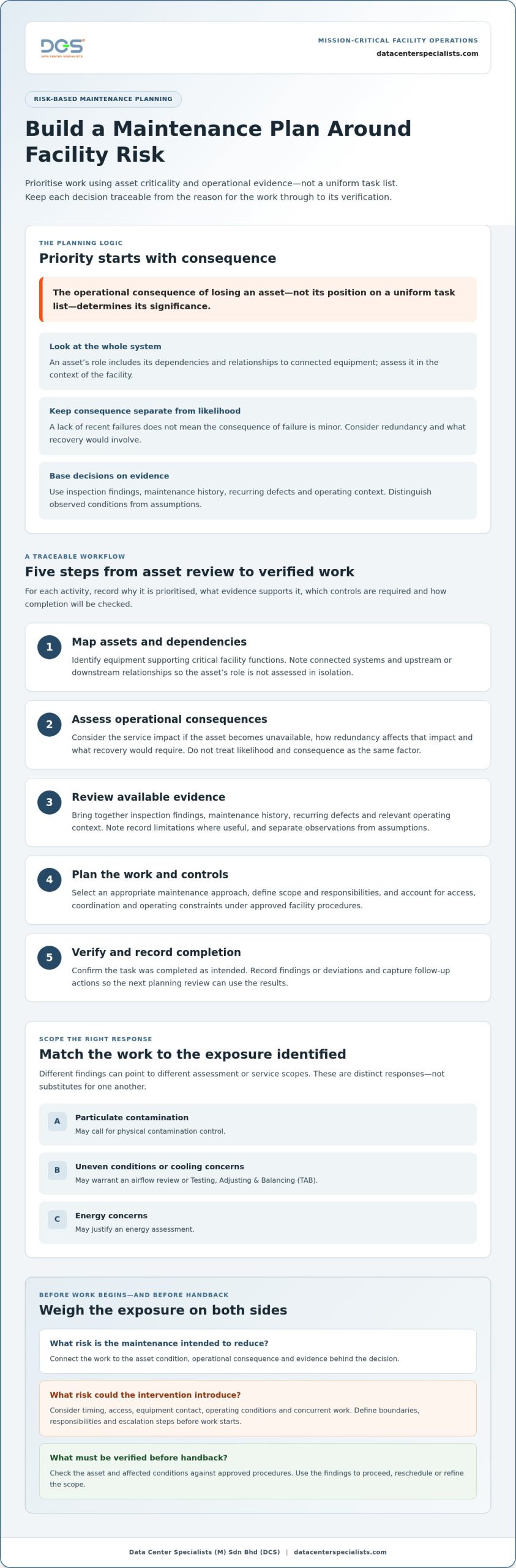
Look for evidence that points to the right type of assessment. Particulate contamination may call for physical contamination control. Uneven conditions or cooling concerns may warrant an airflow review or Testing, Adjusting & Balancing. Energy concerns may justify an energy assessment. These are distinct scopes, not substitutes for one another.
Why maintenance interventions can introduce risk
Planned work can still create exposure through its timing, access requirements, contact with equipment or effects on operating conditions. Before proceeding, identify the systems that could be affected, how the task interacts with concurrent work and which conditions must remain within approved operating limits. Controls should be specific to the task and environment and follow the facility’s approved procedures.
Assess both sides of the decision: the exposure the work is intended to reduce and the risk introduced by carrying it out. Define boundaries, responsibilities and escalation steps before work starts, then verify the asset and affected conditions before handback. This gives operations teams a reasoned basis to proceed, reschedule or refine the scope.
Build a Risk-Based Data Center Maintenance Plan
A practical plan turns facility priorities into defined work, using asset information and operational evidence rather than applying the same task list everywhere. For de-risking data center maintenance operations, keep the process traceable: record why an asset is prioritised, what evidence supports the work, which controls are needed and how completion will be verified. This helps engineering and operations teams make consistent decisions and identify gaps that need further assessment.
- Map assets and dependencies. Identify equipment supporting critical facility functions and note its relationships to connected systems. An asset’s role cannot be understood in isolation if it depends on upstream or downstream equipment.
- Assess consequences. Consider the service impact if an asset becomes unavailable, how redundancy affects that impact and what recovery would involve. Keep consequence distinct from likelihood; a lack of recent failures does not mean the consequence is minor.
- Review available evidence. Bring together inspection findings, maintenance history, recurring defects and relevant operating context. Note record dates and limitations where useful, and distinguish observed conditions from assumptions.
- Plan the work and controls. Select an appropriate maintenance approach, define scope and responsibilities, and account for access, coordination and operating constraints under approved facility procedures.
- Verify and record completion. Confirm that the task was completed as intended, record findings or deviations, and capture follow-up actions so the next planning review can use the result.
Criticality should guide maintenance priority because the consequence of losing an asset, not its position on a uniform task list, determines its operational significance. This principle connects asset-level decisions with broader facility review. The Uptime Institute Data Center Risk Assessment is a reference for considering data center risk systematically; facility teams can use risk assessment alongside their own records and procedures.
Prioritise assets using consequence and evidence
Build an asset map that makes dependencies visible, then review inspection findings, repeated issues and maintenance records against each asset’s role. If records are incomplete or a dependency is uncertain, document the gap and assign a review action. Treating unknown information as low risk can leave a critical assumption untested. Clear documentation helps teams decide where inspection or engineering input is needed next.
Choose a maintenance approach that fits the risk
Scheduled preventive tasks provide planned upkeep at defined intervals. Condition-informed work uses inspection or monitoring evidence to guide timing. Corrective work responds to an identified defect or failure. Each approach has a purpose and limits. Monitoring can inform decisions, but it does not replace competent assessment or maintenance required by facility procedures. A facility-specific data center maintenance plan can coordinate these work types with relevant physical maintenance requirements.
Use the available evidence to determine the right combination rather than forcing one approach onto every asset. Where the need is unclear, define what additional inspection or assessment would resolve the uncertainty before committing to work. This gives teams a practical basis for reviewing priorities and discussing maintenance requirements for their facility.
Compare Maintenance Approaches by Risk, Evidence and Operational Fit
Scheduled, condition-informed and corrective maintenance address different operational needs. The right choice depends on the asset’s criticality, available evidence, access constraints and the consequences of delaying work. A planned schedule provides structure, monitoring can inform timing, and corrective work can address a known defect. None is a universal substitute for the others, and no single model eliminates operational risk.
Scheduled, condition-informed and corrective work
Use scheduled maintenance for tasks that need planned execution at defined intervals. Condition-informed work responds to inspection findings or monitoring evidence. Corrective work addresses a defect or failure already identified. Each approach has limits: a schedule does not prove an asset is healthy, monitoring alone may not explain a cause, and corrective action may leave little time to coordinate the work.
| Approach | Purpose and useful evidence | Limitations |
|---|---|---|
| Scheduled | Plan recurring maintenance using asset requirements, facility procedures and maintenance history. | Intervals alone may not reflect current condition, changing operating context or asset criticality. |
| Condition-informed | Use inspections, observed trends and available monitoring to identify when further review or work may be appropriate. | Indicators need interpretation. They may not establish root cause or account for every failure mode. |
| Corrective | Respond to a reported defect or observed failure, using available condition and incident information to define the response. | Work may be urgent and harder to coordinate; addressing the immediate issue may not resolve related underlying concerns. |
Assess the mix at asset level. Maintenance history can show whether recurring scheduled tasks need closer review, while limited access or complex dependencies may affect how work is planned. Monitoring can support decisions, but it does not replace competent assessment. Predictive tools, AI or simulation can contribute evidence where appropriate; they cannot account for every operational dependency or control every intervention risk by themselves. A useful overview of varied approaches and procedural considerations appears in Data Center Maintenance Best Practices.
When specialist assessment adds a distinct control
Equipment maintenance and environmental assessment address different questions. Visible or suspected particulate contamination may call for physical assessment and targeted cleaning of areas such as raised floors, underfloor spaces or rack environments. A cooling concern may instead require an airflow review, an energy assessment or Testing, Adjusting & Balancing to investigate system performance.
Match the scope to the evidence rather than treating these activities as interchangeable. Professional data center cleaning addresses physical contamination control; it does not substitute for equipment maintenance or airflow testing. Likewise, monitoring an operating condition does not remove contamination. For de-risking data center maintenance operations, define the question first, then select the assessment, work method and verification evidence that address it.
Control Maintenance Work in Live Data Center Operations
Maintenance in a live facility is an operational change, not just a technical task. Work can introduce exposure through access, contact with equipment, coordination conflicts or an unexpected effect on operating conditions. De-risking data center maintenance operations therefore requires teams to assess both the intended benefit and the risks created by the intervention. Controls must follow the facility’s approved procedures; a generic checklist cannot replace site-specific review.
Work completion should include verification against the approved scope, followed by a documented handback of findings and outstanding actions. This makes the boundary between planned work and resumed operations clear, and gives responsible teams a record for future planning.
Before work: define scope, dependencies and controls
Start with a work package that states what will be done, where and by whom. Identify affected equipment, relevant dependencies, access boundaries and operational contacts. Then review the facility’s approved method statements, access rules and change-control process. If the work or operating context changes, pause and use the site’s approval route rather than extending the task informally.
Before intervention begins, agree how completion will be judged and how concerns will be escalated. Acceptance criteria should reflect the task and equipment, not assumptions. For example, a scope involving inspection should distinguish the inspection itself from any repair that may require separate review and approval. Confirm coordination and communication responsibilities under facility procedures.
During and after work: verify, hand back and learn
Keep work within its approved boundaries. Record relevant observations, deviations and decisions as they occur, including issues that change the original scope. If conditions differ from the work plan, follow the facility’s escalation and change-control process. This creates a traceable account without assuming that one response suits every site or task.
At handback, compare completed work with the approved scope and acceptance criteria. Record what was completed, any checks performed, unresolved items and the team responsible for follow-up. Make the operational status clear to the appropriate facility contacts through established site procedures. Do not treat a task as complete merely because the planned activity has stopped.
For financial institutions, maintenance planning must fit the facility’s operational priorities and internal control environment. Avoid assuming that one work-control model applies to every organisation. A useful record should support review of the work and inform future planning, especially where an observation may affect dependencies or require further assessment.
Use this sequence to make live work reviewable: define and approve the scope, coordinate the intervention under site controls, record deviations, verify completion and hand back with open actions assigned. To discuss a facility-specific maintenance requirement with Data Center Specialists, contact the data center maintenance team.
Connect De-Risking Data Center Maintenance Operations to Specialist Support
Specialist support is most useful when its scope follows a documented facility need. Before defining the work, state the concern, the affected area or system, the evidence available and the decision the assessment or service must inform. This keeps distinct activities from being treated as interchangeable and gives facility teams a basis for reviewing proposed methods, safety controls, technical evidence and reporting against the requirement.
Match specialist scope to the risk being managed
Choose the scope according to the issue under review. Suspected particulate contamination in equipment areas, raised floors or underfloor spaces calls for physical contamination assessment and, where appropriate, professional data center cleaning. Questions about energy use or air distribution require a different investigation; a data center energy assessment or Testing, Adjusting & Balancing (TAB) can help evaluate relevant facility conditions. Cleanroom Performance Testing (CPT) is appropriate when cleanroom performance testing is part of the defined requirement.
Data Center Specialists provides these distinct services alongside data center preventive maintenance. Define boundaries and expected evidence for each task. For example, a cleaning scope should identify the physical areas and contamination concern, while an airflow assessment should state the performance question being examined. Clear scope helps align access, controls, technical method and reporting with the facility’s operating context.
Make the next maintenance decision evidence-led
Before authorising specialist work, assemble a concise decision record that captures:
- Risk or concern: Describe the observed condition and its operational relevance.
- Evidence available: Identify inspection findings, records or assessment results, and note material gaps.
- Control owner: Assign responsibility for coordinating approvals, access and site procedures.
- Required follow-up: State what decision, verification or further action the work should inform.
For energy-related concerns, connect the findings to a defined assessment scope rather than assuming energy use and cooling performance have the same cause. A data center energy assessment provides a focused way to examine energy performance against the facility’s requirements. Keep any resulting recommendations distinct from maintenance or testing scopes that address other risks.
In practice, de-risking data center maintenance operations depends on a clear line from identified exposure to suitable work, controlled execution and usable evidence. Review the proposed methodology, safety controls, technical basis and reporting against the need identified by your team. Data center owners, operators and facility managers can discuss data center maintenance requirements with Data Center Specialists to consider a facility assessment or technical maintenance scope.
Turn Maintenance Priorities into the Next Operational Decision
Make the next review a decision point, not a routine paperwork exercise. Identify what has changed since the last assessment, which assumptions still hold and what information would help resolve open questions. This keeps de-risking data center maintenance operations responsive to the facility’s current requirements.
Bring relevant asset records, observations and operational priorities together before defining the next scope. A focused technical discussion can help your team clarify the assessment or maintenance requirement and determine an appropriate way forward.
Discuss your data center maintenance requirements with DCS to take a considered next step for your facility. Clear decisions today help your team plan future work with greater confidence.
Frequently Asked Questions
How should a data center measure maintenance risk?
Use the facility’s established qualitative risk process, recording asset criticality, potential failure consequences, relevant dependencies, evidence quality and exposure from the proposed intervention. Make the reasoning auditable: note who assessed the issue, which assumptions informed the judgement and what change would trigger reassessment. For example, a new dependency identified during a system review may alter the asset’s priority even if its physical condition has not changed.
Is predictive maintenance enough to de-risk data center operations?
No. Treat predictive or condition-informed output as an input for technical review, not a maintenance decision by itself. A developing trend may justify an inspection, while a sensor fault or missing data could make the trend misleading. Teams still need to account for required planned tasks and apply the facility’s work controls and verification. AI can assist analysis, but it does not guarantee that an asset will remain reliable.
Can maintenance work increase operational risk in a live data center?
Yes. The cumulative effect of concurrent work can matter as much as an individual task. Separate activities in adjacent areas, for example, may compete for access or affect the same operational dependency. Review work in its facility context, use the approved scope and coordination process, and apply site change control. Post-work verification helps establish whether the intended work was completed and whether any observations need escalation.
What is the difference between preventive and corrective data center maintenance?
Preventive maintenance is planned activity intended to address an identified maintenance need; corrective maintenance responds to a fault or observed issue. A scheduled inspection may uncover a defect that requires a separate corrective task. Recording the inspection and repair as distinct activities preserves the sequence of evidence and action in the asset history. Both approaches may be needed, with the choice shaped by the asset, available information and facility procedures.
When should a data center use specialist contamination-control services?
Consider specialist physical cleaning when particulate concerns or deposits are identified in mission-critical spaces, including raised-floor, underfloor or rack areas. Contamination introduced during nearby construction or other work may also prompt an assessment of affected areas. Define the cleaning scope around the observed concern and operational environment. This is targeted contamination control for data center spaces, not general janitorial work, and no universal particle threshold should be assumed.
What should a maintenance handback record include?
Make the handback traceable to the relevant asset and work record, in addition to recording completion and open actions. Include identifiers or references that let a future reviewer locate the applicable work package, evidence and approvals, along with any scope revision made during execution. Keep the record aligned with the facility’s documentation process. This helps distinguish what was observed, what was changed and what still requires a decision.
How often should data center maintenance be performed?
Set maintenance frequency using asset requirements, manufacturer information, observed condition, criticality and facility procedures rather than adopting a generic interval. Revisit the basis when the operating profile changes, a recurring finding emerges or relevant manufacturer guidance is updated. A review does not automatically mean the interval should be shortened or extended; it gives the responsible team a reason to determine whether the existing plan remains appropriate and document its decision.