

Contamination that can affect equipment is not always visible on the surfaces your team can easily inspect. Dust and other particles can move through equipment areas and airflow pathways, so a visual room check alone may leave important exposure unrecorded. A structured data center contamination audit checklist helps teams look beyond the obvious.
Visible cleanliness matters, but an effective audit also needs a defined scope, clear evidence and a consistent way to prioritise findings. In a live facility, the process must account for operational exposure and avoid unnecessary disruption.
This guide explains how to inspect relevant data center zones, document findings by location and evidence, and assign proportionate corrective actions. It also covers when further assessment, particle-count testing or professional physical cleaning may be appropriate. The aim is to connect observations to likely pathways and operational significance, rather than treating every finding as an automatic cleaning requirement.
Key Takeaways
- Distinguish a contamination audit from cleaning, particle testing and broader facility inspections so each activity has a clear purpose.
- Trace potential sources and pathways in sequence, taking recent works and maintenance activity into account.
- Prioritise findings by location, extent, recurrence, operational exposure and confidence in the evidence, rather than relying on unsupported thresholds.
- Use the data center contamination audit checklist to record the inspection scope, access limits, observations, evidence and suspected pathways consistently.
- Match follow-up to the finding: routine monitoring, further specialist assessment, particle-count testing or targeted physical cleaning.
What a Data Center Contamination Audit Should Establish
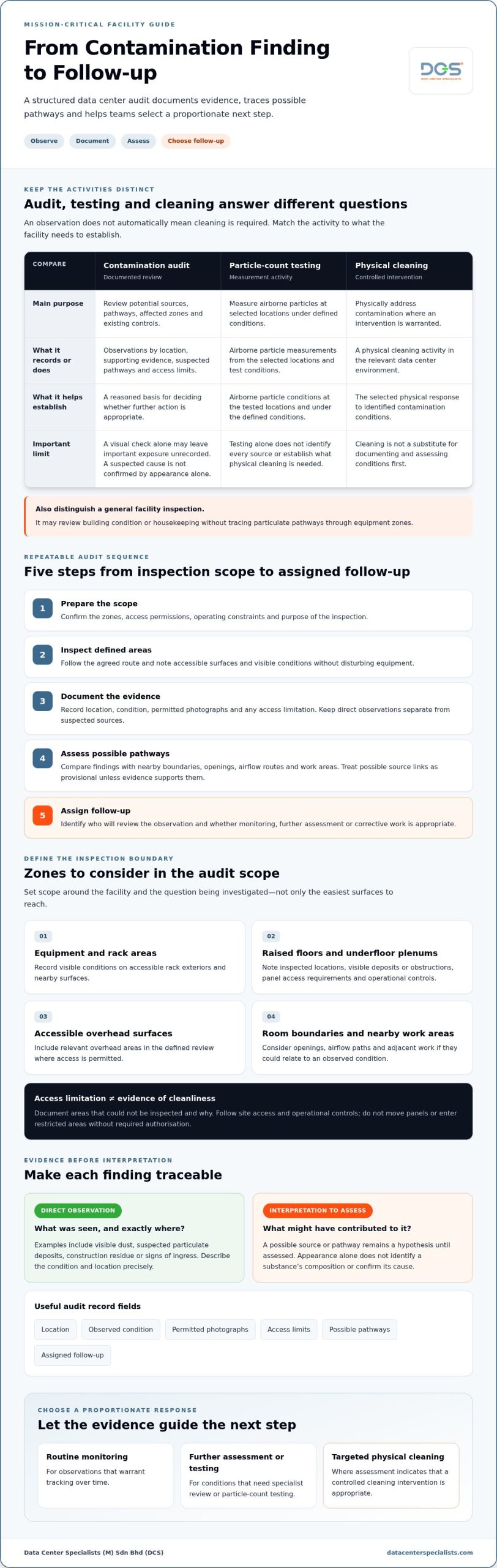
A data center contamination audit is a documented review of potential contamination sources, pathways, affected zones and existing controls. It records what was observed, where it was found, what may be contributing to it and whether further action is warranted. An audit is not physical cleaning, a particle-count test or a certification. It provides a reasoned basis for deciding whether any of those activities is appropriate.
Operators, facility managers, engineers, contractors and technical decision-makers can use audit findings to coordinate inspection and follow-up. A useful data center contamination audit checklist makes observations traceable and repeatable, rather than leaving teams with informal notes or a general impression that a room looks clean. This matters because equipment and data center environmental controls interact across equipment areas, airflow routes and building boundaries.
Keep the activities distinct. A general facility inspection may review building condition or housekeeping without tracing particulate pathways through equipment zones. Particle testing measures airborne particles at selected locations and under defined conditions; on its own, it does not identify every source or establish what physical cleaning is needed. Professional data center cleaning is a controlled physical intervention, not a substitute for documenting and assessing conditions first.
What counts as a contamination finding in a data center?
Record visible dust, suspected particulate deposits, construction residue and signs of ingress, such as material near an opening or along a possible air pathway. Describe each location and condition precisely. For example, note a deposit on an accessible rack exterior or residue beneath a raised floor panel. Do not identify a substance’s composition from appearance alone. Keep direct observations separate from suspected sources and unverified causes.
Which facility areas belong in the audit scope?
Set the scope around relevant equipment and rack areas, raised floors, underfloor plenums and accessible overhead surfaces. Consider room boundaries, airflow paths and nearby work areas if they could relate to an observed condition. Before inspection, document access limits and exclusions, especially around live equipment. Follow site access and operational controls. Do not move panels or enter restricted areas without the required authorisation.
Scope the review around the facility and the question being investigated, not just the easiest surfaces to reach. If residue appears near a room boundary, for instance, record relevant adjacent work activity or an accessible route through which material could have entered. Note what could not be inspected and why. An access limitation is not evidence that an area is clean.
For each finding, distinguish evidence from interpretation. A photograph or location reference can support an observation, while a possible source remains a hypothesis until assessed. This gives operations teams a dependable basis for prioritising follow-up without overstating what the inspection established.
How to Trace Contamination Sources and Pathways
Trace evidence systematically instead of treating each deposit as an isolated condition. A repeatable sequence helps teams compare observations across zones and separate what is known from what remains a hypothesis. Use the same approach whether the review follows construction activity, maintenance work or an unexplained deposit near equipment.
- Prepare the scope. Confirm the zones, access permissions, operating constraints and purpose of the inspection.
- Inspect defined areas. Follow the agreed route and note accessible surfaces and visible conditions without disturbing equipment.
- Document evidence. Record the location, condition, date, permitted photographs and any access limitation.
- Assess possible pathways. Compare findings with nearby boundaries, openings, airflow routes and work areas.
- Assign follow-up. Identify who will review the observation and whether monitoring, further assessment or corrective work is appropriate.
Check the operational history around the affected zone. Recent construction, cable installation, maintenance, floor-panel access and work in adjoining spaces may provide useful context. Record dates and work locations where available, but do not treat proximity or timing alone as proof of a cause. A deposit near an access route, for example, may justify checking that route and adjacent zones, not declaring it the source.
Trace plausible routes from a potential source through room boundaries and airflow paths toward the affected equipment area. Keep these links provisional unless the evidence supports them. Location and pathway records make findings actionable by directing follow-up to the zones and controls most relevant to the observation.
How should teams inspect raised floors and underfloor plenums?
Record which areas were accessible, where panels were inspected, and whether visible deposits, obstructions or other conditions were present. Note panel access requirements and operational controls before opening any panel. Do not expose a live area without the appropriate authorisation and precautions. If the inspection cannot establish the extent or significance of a condition, document that limitation and identify what further review is needed before choosing an intervention.
How should rack areas and overhead surfaces be reviewed?
Document rack exteriors, nearby surfaces and accessible overhead areas. Note where particulate accumulation appears and whether it is isolated, recurring or distributed across inspected zones. Avoid contact with equipment or actions that could disturb deposits. A visual review can guide further investigation, but it does not measure airborne particle concentration. Where measurement is needed, consider particle testing under an agreed method and project criteria.
Use applicable facility requirements and technical references as context, not as a substitute for site-specific evidence. Teams can consult ASHRAE data center environmental resources alongside their project specifications. If documented findings support physical intervention, plan it around the affected zone and operational controls. Professional data center cleaning is a corrective activity, not the source-tracing process itself.
How to Prioritise Audit Findings and Choose Follow-Up
Prioritisation should reflect more than how noticeable a deposit appears. Compare each finding by the zone affected, its extent, whether it recurs, potential operational exposure and confidence in the evidence. A small observation near sensitive equipment may warrant review sooner than a broader deposit in a lower-exposure area. Treat this as a reasoned assessment, not a numerical score or an assumed pass-or-fail threshold.
Use the categories below to select a proportionate next step. They support decision-making but do not replace site procedures, technical review or project requirements.
| Follow-up category | When it may fit | Example action |
|---|---|---|
| Immediate controls | Evidence suggests a plausible active route to an operationally sensitive area, or the condition is changing. | Notify the responsible operations lead, manage access under site controls and limit the suspected source where authorised. |
| Planned investigation | The source, extent or potential airborne exposure is unclear, or observations recur across connected zones. | Arrange a focused review, particle-count testing or a broader air-quality assessment as appropriate. |
| Routine monitoring | The observation is isolated, apparent operational exposure is limited, and available evidence does not indicate an active issue. | Record the location and condition, then compare them during a scheduled follow-up inspection. |
When is observation enough, and when is testing appropriate?
Visual inspection documents visible conditions; it does not quantify airborne particles. Consider particle-count testing when measured evidence is needed, findings recur, or the concern extends beyond visible deposits. Define sampling locations and conditions for the purpose of the assessment, then interpret results against the applicable project specification and test method. A broader air-quality assessment may be appropriate when the concern involves environmental factors beyond particles.
How should teams select corrective actions?
Match the response to the evidence. Where a plausible source is identifiable, consider source control through approved facility processes. Where the pathway or exposure remains uncertain, investigate before selecting a physical intervention. Monitoring can establish whether an isolated observation persists or changes. If assessed findings indicate that deposits should be removed from equipment areas, raised floors or underfloor spaces, plan specialist cleaning around live-operation constraints and authorised access. Professional data center cleaning is a corrective activity, not a replacement for assessment.
Record the rationale, action owner and evidence needed to close each finding. A data center contamination audit checklist is most useful when it connects an observation to a defined decision, rather than assigning the same response to every condition.
Data Center Contamination Audit Checklist: What to Record
A useful audit record lets another team member understand what was inspected, what was observed and why a follow-up decision was made. Use consistent zone names and retain enough context to compare findings over time. Adapt the checklist below to the facility’s inspection process.
- Inspection details: audit scope, date and time, inspector, facility or room identifier, and operating context such as recent work or maintenance activity.
- Zone and access: precise location or zone ID, area inspected, access restrictions, exclusions and any operational controls that limited the review.
- Observation: a factual description of the condition, including its extent and whether it appears isolated, recurring or present across multiple zones.
- Evidence: evidence type, such as direct visual observation, photograph, measurement, operator report or professional interpretation. Record environmental conditions and inspection limitations where relevant.
- Potential pathway: suspected route or source, related equipment or area, and confidence in the interpretation. Keep hypotheses distinct from confirmed observations.
- Risk and response: rationale for the finding’s priority, assigned owner, corrective or investigative action, target review point and required closure evidence.
What evidence makes an audit record useful?
Make records repeatable. Use the same zone identifiers across inspection notes, photographs and follow-up records, and date each observation. Capture photographs only where site controls permit. Frame them so the location and condition can be understood without exposing restricted information. Label evidence by type: a visible deposit is an observation, a particle-count result is a measurement, and a reported work activity is contextual information.
Record relevant conditions and limitations, including areas that could not be accessed or surfaces that could not be viewed safely. If the inspection uses an ISO 14644 reference, identify the relevant scope and project criteria accurately. Referring to the standard does not, by itself, mean the facility or audit has achieved certification.
How should findings be tracked through closure?
Assign a responsible role and a defined follow-up action to each material finding. Set a review point that fits the action and operating plan, then state what evidence will demonstrate closure. Depending on the response, this could be a follow-up observation, before-and-after records or testing documentation. Do not close a finding solely because work was scheduled; record the result and any remaining limitation.
Look for recurrence. If the same condition returns in the same zone or appears across connected areas, review potential sources and control gaps instead of repeatedly closing the visible symptom. This makes the data center contamination audit checklist a practical record of decisions, not just a collection of inspection notes. If documented findings support specialist physical cleaning, Data Center Specialists provides professional data center cleaning for mission-critical environments.
When to Use Specialist Contamination Assessment and Cleaning
Internal inspections may be sufficient when a finding is clearly visible, limited to an accessible area and straightforward to monitor under existing facility procedures. Use specialist assessment when the extent or pathway is uncertain, conditions recur, or the team needs technical evidence beyond visual observation. The purpose is to choose a proportionate response, not to escalate every finding automatically.
Keep three activities distinct. A contamination assessment evaluates conditions and potential exposure. Particle-count testing measures airborne particles at defined locations and under specified conditions. Physical cleaning removes contamination from agreed areas using a method suited to the facility and project requirements. One activity may inform another, but none substitutes for the others.
Data Center Specialists (M) Sdn Bhd (DCS) provides professional ISO cleaning, including underfloor and rack-area cleaning, as well as data center air-quality assessment and particle-count testing. These services can support a follow-up process based on documented findings:
- Use assessment to investigate uncertain conditions or determine what evidence is needed.
- Use particle-count testing when measured airborne particle data is relevant to the question.
- Consider specialist physical cleaning when the assessed condition indicates that deposits should be removed.
What should operators expect from a specialist-led follow-up?
Start with the audit record. Define the affected zones, available evidence, access limitations and operational constraints before agreeing the follow-up scope. For cleaning, establish the areas, method and acceptance criteria in the project specification. A cleaning methodology is not automatically a certification or a guarantee of a particular outcome. Any reference to ISO 14644 should be relevant to the agreed scope and interpreted against applicable project requirements.
How can audit findings inform a continuing control programme?
Use recurring observations to review possible sources, access practices and facility controls. Repeated deposits in a zone may justify examining how materials or work activities are managed nearby, while findings across connected areas may prompt a broader review. Set review intervals according to site risk, operational changes and documented facility needs. Prevention measures can complement this review by addressing how contamination enters and moves through the facility.
Close the loop by recording the intervention and reviewing its evidence against the original finding. If conditions persist, revisit the assessment rather than repeating the same action without examining its effectiveness. The data center contamination audit checklist can keep the record connected from initial observation through follow-up and review.
Data center operators and facility teams can discuss audit findings and suitable cleaning next steps with DCS.
Make Contamination Control Part of Ongoing Operations
Use the data center contamination audit checklist as a repeatable reference, updating it when facility conditions or operational activities change. Consistent records can help teams recognise patterns, revisit control measures and make follow-up decisions based on evidence rather than assumption.
When findings call for deeper technical review or physical intervention, Data Center Specialists provides professional ISO cleaning and contamination control, air-quality assessment and particle-count testing for mission-critical environments. Choose the next step based on the documented condition and the facility’s requirements.
Discuss your data center contamination findings with DCS to identify a proportionate path forward for your facility.
Frequently Asked Questions
What is a data center contamination audit?
A data center contamination audit is a structured review that helps facility teams decide whether observed conditions need monitoring, investigation or intervention. Its value lies in creating a decision trail: what prompted the review, what evidence was available, and why a particular response was selected. For example, a finding after nearby work can be compared with later observations to assess whether the condition persists after that work ends.
How often should a data center contamination audit be performed?
There is no single interval that suits every facility. Set a review cadence based on site risk, previous findings and operational changes, then reassess it when conditions shift. A post-construction or maintenance review may be appropriate after work near critical spaces, while recurring findings may justify closer monitoring. Document the rationale for the chosen frequency so teams can adjust it as equipment layouts, work practices or contamination patterns change.
Does an ISO 14644 reference automatically define a data center cleaning requirement?
No. Citing ISO 14644 does not, by itself, prescribe a specific cleaning method or mean a data center is certified. First establish whether the standard’s scope applies to the project and what the facility specification requires. A project may separately define cleaning methods, acceptance criteria and testing arrangements. Keep those requirements explicit, and do not present a cleaning activity or audit as certification unless the relevant certification process has been completed.
Can a visual inspection determine airborne particle levels?
No. A visual inspection can document deposits on accessible surfaces, but it cannot quantify particles suspended in air. If the decision depends on airborne particle data, use particle-count testing with defined sampling locations and conditions. Interpret results against the applicable method and project criteria. Testing can provide measurement evidence, but it does not necessarily identify the source of particles or determine which physical cleaning action is appropriate.
What should a contamination audit checklist include?
A practical data center contamination audit checklist should capture enough information for another person to understand and review each finding. Include the inspection scope, zone identifier, date, inspector, operating context and access limitations. For each observation, record its extent, evidence type, associated equipment or area, possible pathway and confidence level. Add the risk rationale, action owner, follow-up point and closure evidence so the record supports decisions rather than simply documenting conditions.
Will a contamination audit disrupt live data center operations?
It can often be planned around live-operation controls, but the audit scope and access method determine the operational impact. Coordinate with the facility team before entering restricted areas, opening floor panels or approaching sensitive equipment. A review limited to authorised, accessible locations may avoid intrusive activity; areas requiring additional access should be scheduled and controlled under site procedures. Record exclusions so an uninspected area is not mistakenly treated as free of contamination.
When should a data center use specialist contamination-control services?
Use specialist support when findings recur, airborne exposure needs measurement, or internal teams cannot establish the extent or suitable response. Data Center Specialists (M) Sdn Bhd (DCS) provides contamination assessment, air-quality assessment and particle-count testing, alongside professional ISO cleaning for mission-critical environments. These services address different needs: assessment clarifies conditions, testing measures particles, and cleaning physically removes contamination from agreed areas. Select the next step based on the evidence and the facility’s operational requirements.