
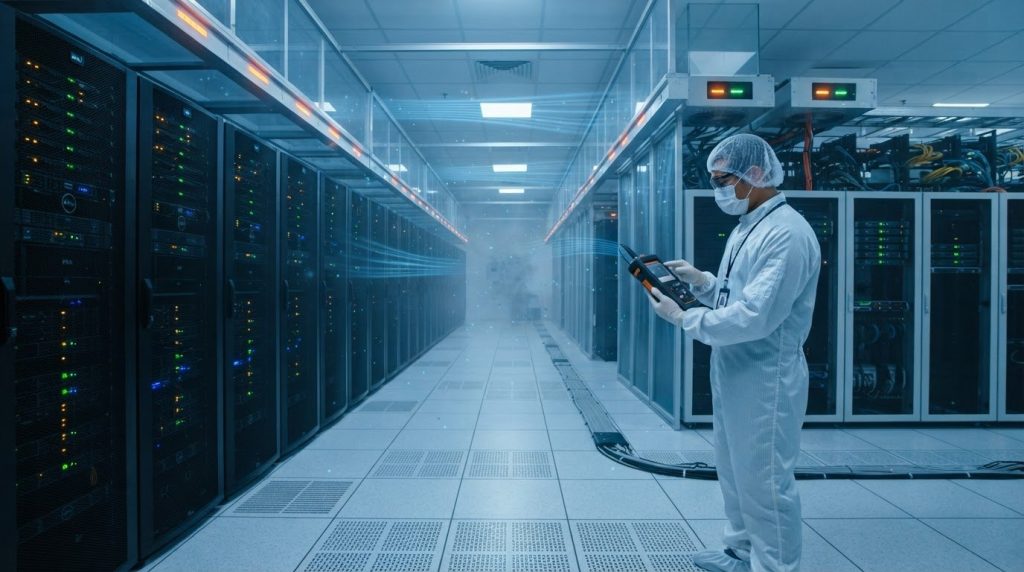
Could a clean-looking data hall still expose high-density hardware to airborne particles? Visual checks alone cannot show whether particle levels meet a defined target. The ISO 14644 standards data center teams use provide a measurable way to classify airborne cleanliness, but they do not provide a ready-made cleaning checklist.
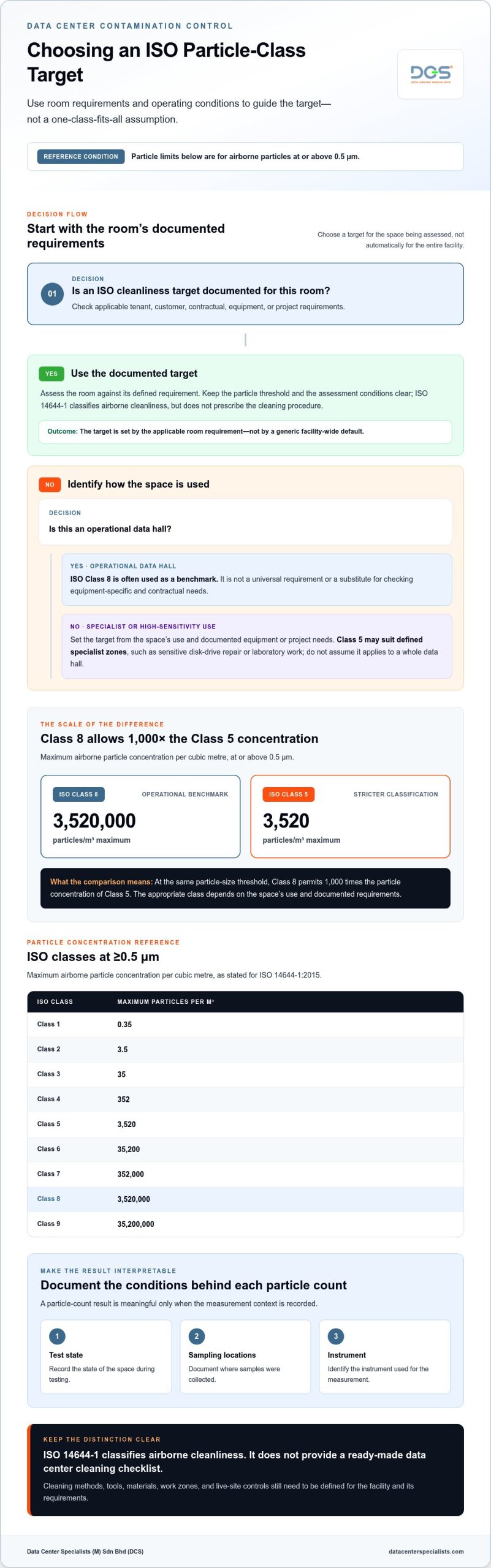
Under ISO 14644-1:2015, ISO Class 8 allows up to 3,520,000 particles per cubic metre at or above 0.5 µm. ISO Class 5 allows up to 3,520 at the same particle size. These limits illustrate the difference in airborne particle concentration, but they do not determine the right target or how to maintain it in an operating data center.
This guide explains what ISO 14644-1 classifies, how to interpret ISO Class 8 versus Class 5, and why the standard does not prescribe cleaning procedures. It also shows how to connect particle-count requirements with a repeatable contamination-control framework to manage micro-dust risks in mission-critical environments.
Key Takeaways
- Understand how ISO 14644 standards can inform data center cleanliness targets without treating the standard as a cleaning procedure.
- Learn how occupancy state and floor-area-based sampling affect particle-count testing and the interpretation of results.
- Identify how airflow management and planned maintenance can support contamination control in live environments.
- Explore why cleaning methods and filtration choices should align with the facility’s contamination-control objectives.
- See how professional assessment can help turn particle-count findings into practical steps for protecting equipment and uptime.
Understanding ISO 14644-1 in the Mission-Critical Context
Air cleanliness in a data hall is an engineering condition, not a visual impression. ISO 14644-1:2015, Cleanrooms and associated controlled environments, Part 1: Classification of air cleanliness by particle concentration, classifies airborne cleanliness using measured particle concentrations. For facility teams, the ISO 14644 framework provides a shared basis for setting and assessing particle-control targets. Cleaning methods and operational procedures still need to be defined for the facility and its requirements.
Particle size matters. Airborne particles across the 0.1 μm to 5.0 μm range can behave differently in a room and interact with equipment in different ways. In high-density and AI environments, heat loads and airflow patterns make particulate control an important part of managing equipment conditions and reliable operations.
For context, watch this overview of the data centre cleanliness standard:
The Evolution of Contamination Standards
Earlier technical environments often referenced U.S. Federal Standard 209E, which used particle-count classes such as “Class 100,000.” That standard was canceled in 2001, and ISO 14644-1 became the international framework for classifying air cleanliness in cleanrooms and associated controlled environments. The ISO 14644 Wikipedia overview provides background on the wider series. Part 1 is the classification reference relevant to airborne particle counts in data halls.
Applying the classification to a data hall gives operators a defined way to discuss airborne particle conditions, whether assessing an operational space or setting a post-construction target. It does not mean a data center becomes a pharmaceutical or semiconductor cleanroom. Access, equipment operation and airflow differ, so the cleanliness objective and assessment conditions should reflect how the facility is used.
Why Generic Cleaning Methods Fall Short
Unsuitable cleaning methods can redistribute contamination instead of capturing it. A vacuum without suitable filtration can release fine particles back into the room. Cleaning agents also need careful selection, since residues or volatile compounds from unsuitable products can introduce unwanted contamination around sensitive equipment. Specify the tools, materials, work zones and live-site controls rather than relying on appearance alone.
Where tenant, customer or contractual requirements include an agreed ISO cleanliness target, teams need to define how it will be assessed and maintained. A specialized physical cleaning and contamination-control program can support that objective through controlled methods and equipment suited to mission-critical spaces. Learn more about specialized data center cleaning.
ISO 14644 Particle Concentration Limits: Class 8 vs. Class 5
ISO 14644-1 classifies air cleanliness by the maximum concentration of airborne particles at specified size thresholds. The figures below compare classes using particles at or above 0.5 μm. Select a target against the space’s use and documented requirements rather than assuming that one class applies to every room.
- ISO Class 1: 0.35 particles/m³ or fewer at ≥0.5 μm.
- ISO Class 2: 3.5 particles/m³ or fewer.
- ISO Class 3: 35 particles/m³ or fewer.
- ISO Class 4: 352 particles/m³ or fewer.
- ISO Class 5: 3,520 particles/m³ or fewer.
- ISO Class 6: 35,200 particles/m³ or fewer.
- ISO Class 7: 352,000 particles/m³ or fewer.
- ISO Class 8: 3,520,000 particles/m³ or fewer.
- ISO Class 9: 35,200,000 particles/m³ or fewer.
These limits apply to the stated particle size. Interpret classification results using the applicable particle thresholds and sampling conditions. The IEST ISO 14644 Series Overview describes the broader standards series and helps distinguish air classification from other controlled-environment considerations.
ISO Class 8: The Operational Benchmark
ISO Class 8 is often used as a cleanliness benchmark for operational data centers. ASHRAE TC 9.9 guidance and equipment-manufacturer recommendations can inform target selection, but the class is not a universal warranty condition or a substitute for reviewing contractual and equipment-specific requirements. Cardboard packaging, exposed or unsealed concrete, and frequent personnel movement can introduce particles. Manage these sources through delivery procedures, surface management and planned contamination-control work.
At ≥0.5 μm, Class 8 permits 1,000 times the particle concentration of Class 5. That is a substantial difference, not a minor tightening of the same target. Whether Class 8 is appropriate depends on the facility’s operating conditions and documented requirements.
ISO Class 5: When Higher Precision Is Required
ISO Class 5 limits particles at ≥0.5 μm to 3,520 per cubic metre. This stricter classification may suit defined specialist zones, such as sensitive disk-drive repair or laboratory work, rather than an entire operational data hall. A pre-commissioning project involving high-sensitivity optical or medical IT equipment may also require a separately assessed target. Determine that target from equipment and project requirements instead of assuming Class 5 applies by default.
For projects requiring controlled-environment measurement, Cleanroom Performance Testing can support evaluation of cleanliness conditions against specified criteria.
Testing Methodology: Validating ISO Compliance
A particle-count result is meaningful only when the test state, sampling locations and instrument are documented. ISO 14644-1 distinguishes three occupancy states: as-built, with the space complete but without equipment or personnel; at-rest, with equipment installed and operating as agreed but no personnel present; and operational, with the facility functioning in its specified mode and occupied as defined for the test.
Operational testing is more challenging because people, live equipment and active airflow can affect readings. It is also useful for understanding conditions during facility use. State the chosen condition in the test plan and report. Results from different states should not be treated as directly interchangeable.
Set the Sampling Plan
ISO 14644-1 bases the minimum number of sampling locations on the classified area. Use the standard’s applicable table or calculation method rather than choosing locations for convenience. Distribute test points to represent the space, including areas where airflow or activity may differ. Record the room boundary, area, test state and point locations so reviewers can understand what the results represent.
Use a calibrated laser particle counter suitable for the required particle-size channels and sampling conditions. Check calibration status before testing and record the instrument identification, calibration details, sampling volume, location, date and operating conditions. These details make results traceable and help distinguish a genuine change in air cleanliness from a difference in test setup.
Particle Count Testing Procedures
A disciplined particle count testing (PCT) workflow supports repeatable results:
- Agree on the classification target, occupancy state, particle sizes and scope before sampling.
- Review the room layout and calculate the required number of locations from the classified area.
- Confirm the counter’s calibration and configure it for the specified size channels and sampling protocol.
- Collect samples at planned points, position the sampling inlet consistently and document conditions.
- Compare measured concentrations with the applicable class limits at each required particle size, then report findings and any nonconforming results.
Do not reduce the report to a pass-or-fail label. Management and audit teams need the target class, test state, sampling plan, instrument details, individual results, and any limitations or deviations. This information helps show whether a result represents the defined area and supports planning appropriate follow-up testing.
Supplementary Performance Checks
Particle classification is distinct from airflow and pressure assessment. Differential pressure monitoring can help identify conditions that may allow cross-contamination. Airflow visualization and velocity measurements can help assess distribution and filtration performance. These checks can complement particle testing, but they are not substitutes for particle counts or automatic requirements of ISO 14644-1. DCS specialized engineering testing can support a broader facility assessment.
Operational Compliance: Maintaining Standards in Live Environments
A particle classification is a snapshot of measured conditions. Maintaining those conditions takes routine control and follow-up. Build a preventive maintenance schedule (PMS) around the facility’s cleanliness target, particle-count trends, operating state, construction activity, access patterns and areas with recurring dust. ISO 14644-1 defines air-cleanliness classification, but it does not prescribe a data center cleaning frequency or maintenance schedule. Set intervals based on site risks and recorded performance, then adjust them when results or operating conditions change.
Make the schedule practical: assign responsibility, define work areas and methods, and record inspections, cleaning activity and particle test results. For example, a rising count near a delivery route may call for source control and a targeted inspection rather than repeating the same cleaning task across the entire hall.
Contamination Hotspots: Underfloor and Rack Systems
The underfloor plenum can collect construction debris and fine dust, particularly when disturbed during cable or facility work. Supply airflow may then carry contamination into equipment areas. Include accessible underfloor zones in risk-based inspections, and coordinate access and cleaning with operations so floor panels are controlled and airflow paths remain protected. Cleaning around live racks also requires ESD awareness and careful coordination. Avoid disturbing connections, obstructing intakes or exhausts, or creating a thermal event through changes to the operating environment.
Airflow, Racks and Containment
Airflow management supports contamination control by limiting unwanted mixing and directing supply air toward equipment intakes. Containment can help separate hot and cold air streams, while well-planned rack layouts support predictable airflow. DCS Smart Racks and modular containment solutions can form part of this infrastructure approach. They support equipment arrangement and airflow management, but do not remove contamination or replace particle monitoring and a suitable cleaning program.
Connecting Cleanliness and Energy Performance
Particulate buildup on heat sinks can impede heat transfer. Depending on equipment design and operating controls, equipment may respond with increased fan activity to manage temperature. Contamination control is therefore relevant to reliability and energy performance, although cleaning alone does not guarantee a change in PUE. Testing, Adjusting & Balancing (TAB) can assess and optimize airflow distribution so cooling reaches intended areas without unnecessary imbalance.
Pair airflow measurements with particle results, temperature observations and maintenance records to understand operating conditions. A data center energy assessment can help operators evaluate energy performance alongside facility conditions and identify where further investigation may be warranted.
Data Center Specialists’ assessment services cover contamination control, airflow and operational requirements.
Professional Contamination Control: The Path to ISO Certification
ISO 14644-1 classifies airborne cleanliness. It does not issue a universal “ISO certification” for data centers or prescribe a cleaning method. A credible handover connects a defined cleanliness target to documented work, particle-count testing and clear acceptance criteria. In this context, “ISO certification” is sometimes used informally to mean evidence that measured conditions meet a specified ISO class. Confirm the contract or tenant requirements before planning the work.
Evaluate contamination-control teams by how they protect the environment while working, not by headcount alone. Look for procedures that address controlled access, suitable filtration, ESD awareness, approved materials, live-site coordination, and traceable work and test records. HEPA filtration is an important control for capturing fine particles. If the project specification calls for H13 or better, verify that the equipment’s filter rating and setup meet that specification. ISO 14644-1 does not prescribe H13 as a universal cleaning requirement.
Post-Construction Handover to the Agreed Class
Plan handover in stages: remove construction debris, clean accessible surfaces and technical areas, then carry out detailed contamination-control work before verification testing. Complete dust-producing work before final cleaning, and control subsequent trades, packaging and access to reduce the risk of recontamination. Define boundaries, excluded areas, test conditions and acceptance criteria in the project documentation.
Before IT equipment arrives, inspect the data hall and relevant underfloor and overhead spaces, confirm that cleaning records are complete, and carry out particle-count testing under the agreed conditions. Record exceptions and corrective actions, then retest where the project acceptance plan requires it. A documented post-construction data center cleaning process supports a traceable handover, rather than relying on visual appearance alone.
Ongoing Monitoring and Review
ISO 14644-2 addresses monitoring cleanroom performance related to air cleanliness by particle concentration. It does not establish a blanket annual or semi-annual testing frequency for every data center. Set the monitoring plan according to the classified space, risk assessment, operating conditions and contractual criteria, then document why the chosen frequency is appropriate. Repeat assessment when changes such as construction, airflow modifications or unusual particle trends could affect cleanliness.
Environmental sensors can indicate changing conditions, but their readings should not be presented as equivalent to a classification test unless the method and instrument are suitable for that purpose. Use trend alerts to prompt investigation, and particle-count testing when verification against an ISO class is required. Consider sensor locations, maintenance and data limitations when interpreting trends.
Close out the handover with the classification target, sampling results, equipment records, cleaning documentation, deviations and monitoring plan in one controlled record set. This gives facility teams and tenants a shared basis for operational review. Planned professional maintenance helps preserve facility surfaces and equipment areas, supporting mission-critical infrastructure over time.
Turn Air-Quality Requirements into an Operational Plan
Make contamination control part of facility governance, not a task addressed only after a particle result raises concern. Assign clear ownership for monitoring, maintenance, change control and follow-up so teams can respond consistently as equipment, airflow and site activity change. A disciplined approach to the ISO 14644 standards data center framework helps translate cleanliness objectives into practical decisions that support reliable operations and tenant confidence.
Data Center Specialists provides ISO-standard critical-environment cleaning, Cleanroom Performance Testing and data center contamination-control services. These services support technical assessment and planning based on the facility’s operating conditions and documented requirements, rather than a one-size-fits-all checklist.
Bring your facility’s cleanliness targets, test findings or handover requirements to Data Center Specialists for a technical discussion about professional ISO 14644 assessment and contamination control. Contact Data Center Specialists to discuss your facility’s requirements.
Frequently Asked Questions
What is the most common ISO standard for data center cleaning?
ISO 14644-1 is commonly referenced when a data center project specifies an airborne cleanliness class. For practical procurement, do not specify only the standard number. State the target class, areas included, required test condition and particle sizes used for acceptance. This reduces ambiguity between the cleaning scope, measurement scope and evidence expected at handover.
How often should a data center undergo ISO 14644 particle count testing?
Set the testing interval in the facility’s monitoring plan and align it with tenant agreements, audit schedules and the site’s risk profile. Coordinate sampling with planned operational conditions so results can be compared meaningfully over time. Reassess the schedule when contract requirements change or monitoring trends indicate a concern. Record the rationale for the interval, not only the dates when tests were completed.
Can a general cleaning company achieve ISO Class 8 standards?
The relevant question is whether the cleaning scope is controlled and documented to meet the project’s acceptance requirements. Define which rooms and surfaces are included, how work zones are protected, who authorizes access and how exceptions are recorded. Close-out evidence can include an approved work plan, access records, completed task sheets and a signed list of outstanding items, alongside the agreed test documentation.
What happens if a data center fails its ISO 14644-1 audit?
The response depends on the audit criteria and the facility’s contract or compliance process. Identify the affected area, record the nonconformance and notify the parties responsible for acceptance or tenant reporting. Then agree on corrective actions, ownership and any required reinspection or retesting. Do not treat a single result as proof that every room is affected. Keep the response tied to the documented finding.
What is the difference between ISO 14644 and Fed Std 209E?
For legacy specifications, the practical issue is whether an old class label clearly defines the acceptance basis for current work. Review a document using a Fed Std 209E designation before translating it into a present-day requirement. Do not assume the label alone makes test methods, particle-size thresholds or records equivalent. Update project documents with an explicit current classification and measurement criteria to reduce interpretation disputes.
Does ISO 14644 address zinc whiskers in data centers?
No. If metallic-looking debris or recurring contamination is suspected, treat source identification as a separate investigation from air-classification testing. Record where the material was observed, whether it coincides with floor panels or other surfaces, and whether it recurs after cleaning. Particle concentration readings alone cannot establish composition or origin, so use an appropriate material assessment before selecting corrective measures.
What equipment is required for ISO 14644-1 compliance testing?
A particle counter configured for the test’s specified size channels is central to airborne particle classification. The testing record should identify the instrument and include current calibration documentation. Selection and setup depend on the classification being assessed and the applicable test protocol. No specific brand or model is universally mandatory. The instrument must be suitable for the documented measurement task.
Is ISO Class 8 mandatory for all server rooms?
No. A server room’s name or function alone does not establish a required cleanliness class. Before setting a target, review lease and tenant documents, project acceptance criteria, equipment guidance and internal risk objectives. Where these do not specify a class, stakeholders can agree on a site-specific target and record the reason. Clear written criteria help prevent teams from treating an internal benchmark as a universal obligation.