

Which data center audit finding needs attention first: a missing maintenance record, an access-control gap, or an environmental condition that could affect equipment? The answer depends on operational risk, not just the label in the report. Understanding common data center audit findings and how to fix them starts with distinguishing evidence gaps from control failures that could threaten continuity.
An audit report can identify a shortcoming without explaining the best next step. Teams may disagree about severity, ownership, or what evidence is needed to close the item. In a live facility, corrective work must also protect uptime, preserve access controls, and account for dependencies between systems.
This article explains how to interpret recurring findings, separate observations from material risks, and prioritize action by impact and urgency. You’ll learn how to assign ownership, plan remediation around operational constraints, and verify that corrective measures work. From incomplete maintenance evidence to weaknesses in environmental controls or contamination management, the focus is practical: address the underlying issue, document the work, and establish clear proof of closure.
Key Takeaways
- Distinguish verified deficiencies from recommendations, observations, and evidence that needs clarification before assigning corrective work.
- Use common data center audit findings and how to fix them as a framework for assessing operational exposure, recurrence, and confidence in the evidence.
- Prioritize containment, investigation, corrective action, and longer-term improvement according to risk instead of treating every finding the same way.
- Give each action a clear owner, root-cause investigation, due date, and evidence record to support a defensible close-out.
- Use specialist assessment or testing when energy, airflow, environmental performance, or maintenance findings need technical investigation or validation.
What a Data Center Audit Finding Means, and What It Does Not
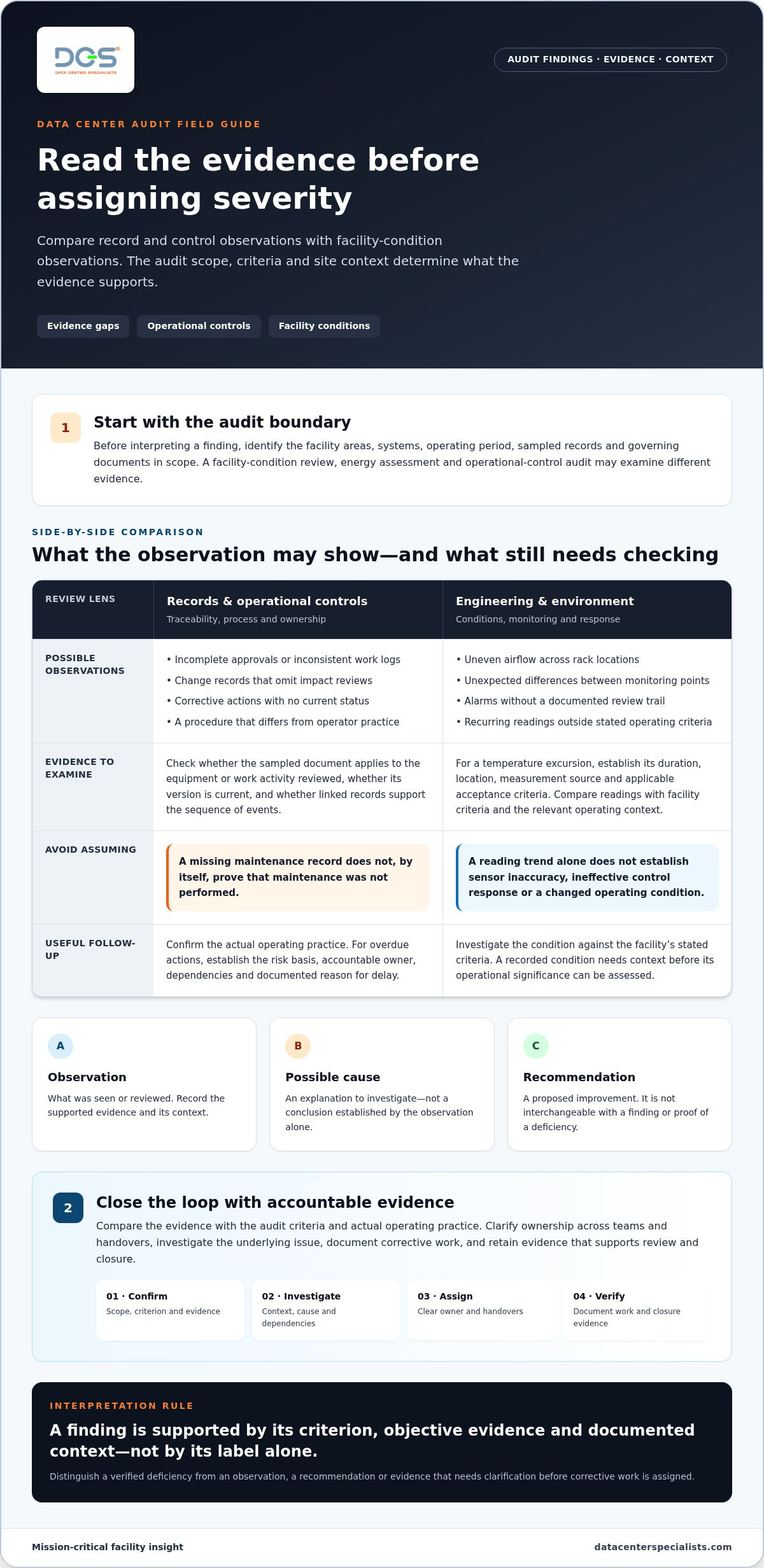
A data center audit finding is an evidence-based observation assessed against the audit’s defined scope and criteria. It identifies a supported gap, condition, or control concern. It does not automatically predict equipment failure or establish that every facility needs the same corrective action.
This distinction matters in mission-critical operations. A missing maintenance record may indicate a documentation gap, but it does not by itself prove that maintenance was not performed. Similarly, a recorded temperature excursion needs context, including its duration, location, measurement source, and applicable acceptance criteria, before its operational significance can be assessed.
To see how audit scope shapes the review, watch this overview:
Finding, observation, and recommendation: how to tell them apart
A formal finding connects three elements: the applicable criterion, objective evidence, and documented context. For example, if a defined maintenance procedure requires a completed record and the sampled record is absent, the auditor can document the gap against that criterion. The evidence supports the observation, while further investigation may be needed to establish why the record is missing or whether the work was completed.
An observation describes what was seen or reviewed. An inferred cause is a possible explanation, while a recommendation proposes an improvement. These terms are not interchangeable. A recommendation may strengthen a process without requiring corrective action. In Information Security Audit, audit scope can include technical, physical, and administrative controls, illustrating why the subject and method of a review affect its conclusions.
Why scope and criteria determine what counts as a finding
Before interpreting a report, identify its boundaries: the facility areas, systems, operating period, sampled records, and governing documents. A facility-condition review, energy assessment, and operational control audit may examine different evidence and reach different conclusions. The phrase common data center audit findings and how to fix them is useful only when interpreted against the criteria used in that particular review.
ISO/IEC 27001, ISO 22301, or ISO 50001 may be relevant when an audit explicitly covers information security, business continuity, or energy management against the applicable criteria. Their mention alone does not establish that a finding applies to every data center. An audit criterion is also distinct from a cleaning methodology: physical data center cleaning addresses contamination control, while audit criteria define what is being assessed. Verify thresholds against the facility scope and governing documents before assigning corrective work.
Common Data Center Audit Findings: Evidence Gaps, Controls, and Facility Conditions
Audit reports can flag issues in records, operational controls, and physical conditions. The examples below are possible observations, not findings that apply to every facility or automatic evidence of a standards violation. The audit criteria, site context, and sampled evidence determine whether a condition is a deficiency, a concern to investigate, or an opportunity to improve.
For each example, establish what was observed and what evidence is needed before assigning cause or severity. A trend in sensor readings, for instance, may warrant investigation, but the trend alone does not establish whether a sensor is inaccurate, a control response is ineffective, or an operating condition has changed.
Documentation and operational-control findings
Possible documentation observations include incomplete approvals, inconsistent work logs, change records that omit impact reviews, or corrective actions with no current status. A procedure may also differ from the process operators follow. These gaps can make it difficult to trace who authorized work, what changed, and whether follow-up testing took place. They do not, by themselves, prove that the underlying work was omitted or that a control failed.
Compare current records with the audit scope and actual operating practice. Check whether the sampled document applies to the equipment or work activity reviewed, whether its version is current, and whether linked records support the sequence of events. For an overdue action, establish its risk basis, assigned owner, dependencies, and documented reason for delay instead of treating age alone as a measure of operational consequence. Findings involving maintenance planning or execution may benefit from a review of data center maintenance services.
Ownership can be unclear when responsibilities cross operations, engineering, security, and vendors. Check whether the action record names the team responsible for each handover, identifies who accepts completed work, and shows how unresolved dependencies are escalated. An item may appear assigned but still lack an accountable owner for verification. Making those transitions visible helps teams distinguish work in progress from an action ready for review.
Engineering and environmental findings
Possible facility observations include uneven airflow across rack locations, unexpected differences between monitoring points, alarms without a documented review trail, or recurring environmental readings outside the facility’s stated operating criteria. These conditions call for investigation, not an automatic conclusion about cause. Confirm sensor location, calibration or verification status where applicable, time period, equipment load, and operating mode. Compare like with like before interpreting trends.
Cooling and energy observations also need context. A change in energy use may relate to load, equipment configuration, control settings, or measurement boundaries; a single reading cannot establish inefficiency. Similarly, temperature, humidity, particle, or energy thresholds must come from the applicable facility requirements and governing documents, not a universal assumption.
Physical contamination is relevant when it affects mission-critical spaces, such as dust accumulation in a raised-floor plenum or debris near equipment. Record the location, extent, and surrounding activity, then assess potential exposure before deciding on remediation. Pair the evidence with an appropriate engineering or environmental assessment when the cause or significance remains uncertain.
How to Prioritize Audit Findings Without Overreacting
Prioritize findings according to their operational exposure, not just their label or age. Consider which function, equipment, or control could be affected if the condition persists, how plausible that consequence is, whether the issue has recurred, and how reliable the supporting evidence is. Keep observed facts separate from assumptions. A report describing an airflow difference is not, by itself, proof that cooling capacity is inadequate.
Use the facility’s approved risk criteria and applicable audit requirements to set priority. Compliance frameworks differ in purpose and scope, as illustrated by the range of Data Center Compliance Standards. Do not import a scoring scale or threshold from another facility without confirming that it applies to your site.
Rank findings by consequence, likelihood, and confidence
Ask what could be affected, under which operating conditions, and what evidence supports that assessment. Check whether the observation is current, repeated, independently corroborated, or based on a single record or sensor. A potentially serious condition with uncertain evidence may call for prompt verification. A well-supported issue affecting a critical function may require immediate containment and escalation under site procedures.
Recurrence and dependencies matter too. A repeated alarm, for example, may point to a persistent condition or a recurring monitoring issue. Investigate the evidence before assigning cause. Record why the finding received its priority so operations, engineering, and management can act on the same basis.
Choose a response proportionate to the evidence
Not every finding needs the same response. Separate the decisions into four stages: contain a credible immediate exposure, investigate uncertainty, plan a correction with an accountable owner, and consider longer-term improvement when trends or repeated issues justify it. Containment should follow approved operating and safety procedures, not introduce an uncontrolled change.
For airflow or system-performance concerns, targeted measurement can help establish whether the condition is local, persistent, or related to system balance. Testing, Adjusting & Balancing (TAB) can help assess airflow distribution and system performance against the facility’s defined requirements. See data center system commissioning for related engineering context.
Sequencing matters in a live facility. Before scheduling corrective work, identify dependencies, required access, affected equipment, change approvals, and suitable work windows. A proposed adjustment may depend on another system being stable or on coordinated approval from operations and engineering. If evidence remains incomplete, prioritize an investigation that reduces uncertainty without creating avoidable operational risk.
- Risk signal: Credible immediate exposure to a critical function. Ask: What could be affected before the next review? Next step: Apply approved containment and escalation procedures.
- Risk signal: Uncertain or conflicting measurements. Ask: Are the readings valid and comparable? Next step: Verify the evidence or arrange targeted testing.
- Risk signal: Confirmed, non-immediate deficiency. Ask: What dependencies and access controls govern the fix? Next step: Assign an owner and plan an approved correction.
- Risk signal: Recurring low-exposure issue. Ask: Is there a trend or process weakness? Next step: Monitor and assess proportionate improvement.
How to Fix a Data Center Audit Finding and Prove Closure
Corrective work should address the condition documented in the finding, not simply make the report appear complete. A controlled close-out connects the original criterion to the action taken and the evidence that the action worked. Closure means documenting that the agreed corrective action meets its acceptance criteria. If the cause remains uncertain or residual risk remains, record that status rather than marking the issue resolved without qualification.
Investigate the cause before selecting the corrective action
Recheck the source evidence, affected system, operating conditions, and stated audit criterion. Separate the observed symptom from a confirmed cause: an alarm may indicate an abnormal condition, but it does not identify why it occurred. Review relevant logs, drawings, work records, and monitoring data, and compare them with conditions at the time of the observation. If evidence conflicts or is incomplete, document the uncertainty and determine whether targeted testing is needed before selecting a fix.
Implement, test, and document the fix
Before intrusive work, coordinate with facility operations, follow applicable change-control and access processes, and complete the site’s relevant safety review. Define the approved work scope, affected systems, dependencies, and verification method. Avoid equipment changes based only on an assumed cause. For example, a reported airflow concern may require measurement and a review of operating conditions before any adjustment is authorized.
Use this sequence to manage common data center audit findings and how to fix them:
- Validate: Confirm the finding’s wording, evidence, scope, and acceptance criteria with the relevant stakeholders.
- Assign: Name one accountable owner, record the supporting teams, and set a due date based on the facility’s approved priority process.
- Investigate: Examine system context and operating conditions. Record the confirmed cause, or state what remains unknown and why further testing is needed.
- Plan and approve: Specify the corrective action, dependencies, access arrangements, operational coordination, change approvals, and safety controls before work begins.
- Implement and verify: Record the work completed, responsible personnel, test method, results, and comparison with the original acceptance criteria.
- Close or follow up: Retain the evidence with the finding. Document residual risk, monitoring needs, or remaining actions, and keep the item open if the criteria have not been met.
Evidence should be specific enough for another reviewer to follow the path from finding to resolution. Depending on the issue, the record may include approved work documents, dated inspection notes, relevant trend data, test results, and sign-off by the responsible owner. Avoid relying on a brief “completed” status without supporting records.
If evidence identifies physical contamination in equipment areas, raised floors, or underfloor plenums, select a controlled response suited to the live facility. DCS provides professional data center cleaning for contamination control in mission-critical spaces, including underfloor, raised-floor, and server rack cleaning. This is specialized physical cleaning, not routine janitorial work.
For site-specific findings that need technical investigation or remediation planning, discuss the audit evidence and corrective-action needs with Data Center Specialists.
When Specialist Data Center Assessment Helps Resolve Audit Findings
Bring in specialist input when audit evidence conflicts, the cause remains unclear, or the potential impact crosses engineering systems. A documentation gap with a clear correction may be manageable through the facility’s existing process. Unexplained airflow differences, persistent environmental anomalies, or energy performance concerns may need technical investigation before the operator can select or verify an appropriate response.
Match the assessment to the unresolved question. A data center energy assessment can help investigate energy use and system performance within its defined scope. Testing, Adjusting & Balancing (TAB) is relevant when airflow distribution or system balance needs technical evaluation. Cleanroom Performance Testing (CPT) applies to controlled-environment performance questions within the agreed testing scope. None is a default response to every audit observation. Let the finding and applicable criteria determine whether specialist work is warranted.
Recognize when a finding needs specialist investigation
Specialist investigation is useful when available readings tell different stories, an observed condition has no confirmed cause, or evidence suggests interaction between systems. For example, a reported cooling concern may involve airflow, control response, equipment load, or measurement location. Avoid prescribing an equipment change until the relevant conditions have been assessed. If the concern relates to energy use, DCS data center energy assessment services can provide a structured technical basis for examining facility performance.
Define the scope before assessment begins. Identify the question to answer, the systems and areas involved, the operating conditions to consider, and the acceptance criteria that will guide interpretation. Data Center Specialists provides technical assessments and testing for mission-critical facility conditions, including energy assessments, TAB, and CPT. Assessment findings can inform operational decisions, but they do not replace the facility’s own change-control and approval processes.
Prepare a useful technical discussion
Make the discussion specific and evidence-led. Bring the finding statement, audit scope and criteria, relevant records or trends, and a concise description of operating conditions when the issue occurred. Include work already completed, current controls, access constraints, and dependencies that could affect inspection or testing. This helps distinguish what is established from what still needs verification.
Before the discussion, clarify what decision the operator needs to make: identify a likely cause, validate a measured condition, define a corrective-action scope, or determine what evidence would support closure. Note any limits on live-site access and the operational coordination required. The objective is a proportionate next step, not an expanded investigation without a defined purpose.
For unresolved findings, operators can discuss a facility assessment with Data Center Specialists, sharing the relevant evidence and scope to frame potential assessment needs. Matching the finding to the right technical discipline helps teams move from uncertainty to an informed corrective plan while preserving operational controls.
Turn Audit Evidence Into Stronger Operational Decisions
An audit report can do more than document an issue. Use each validated finding to improve how your team records decisions, assigns accountability, and learns from recurring conditions. When a similar observation appears again, compare its evidence and context with earlier records. That history can help distinguish an isolated event from a pattern that merits broader review.
When working through common data center audit findings and how to fix them, keep the connection between evidence, action, and operational outcome clear. A defensible close-out should help the next reviewer understand what changed, why the response was appropriate, and what follow-up remains. This supports continuity across operations, engineering, and management without treating every observation as an emergency.
If a finding needs technical interpretation or a site-specific discussion, discuss your data center findings with our technical team. Contact Data Center Specialists to discuss the evidence, scope, and practical next steps for your facility.
Frequently Asked Questions
How often should a data center be audited?
There is no single audit interval that suits every data center. Set a schedule based on the audit’s purpose, contractual or management-system requirements, facility risk, and the pace of operational change. A major upgrade, repeated control issue, or change in facility scope may justify a focused review before the next planned audit. Keep separate schedules for different audit types, since an energy assessment and an operational-control review examine different concerns.
What happens if a data center audit identifies a critical finding?
Escalate a critical finding promptly through the facility’s defined risk and incident-management channels. The responsible team assesses immediate exposure, applies approved protective measures where necessary, and determines whether operational leadership or affected stakeholders need notification. Preserve relevant system records and event details so the investigation can proceed from reliable evidence. Follow site procedures and applicable obligations rather than assuming every critical finding calls for the same technical intervention.
Can a data center audit be performed while the facility is operational?
Yes. Many audit activities can take place while a facility is running, provided the scope and method are compatible with live-site controls. Document reviews, interviews, and non-intrusive observations may be conducted without changing equipment operation. Any activity involving access restrictions, intrusive inspection, testing, or system adjustment needs operational coordination and appropriate approvals. Define areas, access arrangements, and stop-work conditions in advance so audit activity does not interfere with critical operations.
What evidence is needed to close a data center audit finding?
Use evidence that demonstrates the specific acceptance criteria were met, not merely that work was scheduled or marked complete. Depending on the finding, this could include an approved work order, a current procedure, a completed inspection record, relevant test results, or a dated monitoring extract. Make sure the record identifies the affected asset or area, the work performed, and the reviewer or owner who accepted the result. Keep supporting files traceable to the finding.
Is every data center audit observation a compliance failure?
No. An observation may identify a potential weakness, an improvement opportunity, or a question that needs more evidence. It is not automatically a breach of a requirement. Check the report’s classification and compare the observation with the criteria included in the audit scope. For example, a suggested improvement to a log format may not represent non-compliance if the governing requirement is already met. Ask the auditor to clarify ambiguous wording before recording a formal failure.
How do teams prevent the same data center audit findings from recurring?
Track repeat findings by system, process, and underlying cause, not just by report date. If a maintenance-record gap returns, examine whether the workflow, handover, or record system makes completion difficult to verify. Assign an owner to address the process weakness, update relevant instructions, and brief affected staff where needed. Later reviews should test whether the revised process is being followed instead of relying only on a closed action status. This makes recurring patterns easier to detect.