

What if the records presented for an environmental audit do not match conditions on site? Preparing for a data center environmental compliance audit means more than gathering documents. Operators need to understand the audit scope, connect applicable criteria to evidence, and verify that documented procedures reflect day-to-day facility conditions.
Preparation can be difficult when records and responsibilities are spread across facility operations, engineering, procurement, and environmental teams. A structured readiness checklist brings these pieces together before the audit begins. It clarifies who is responsible, organizes traceable evidence, and highlights gaps that may need corrective action or technical assessment.
This guide explains how to define the audit scope, link criteria to records and operational controls, and review areas such as energy use, cooling, and waste management where they apply. It also covers how to compare documented controls with observed conditions. The designated auditor or your organization’s compliance owner determines the applicable criteria and audit conclusions. Thorough preparation helps your team respond with clarity and confidence.
Key Takeaways
- Confirm the audit scope and applicable criteria with the auditor or compliance owner before assigning preparation tasks.
- Build an evidence matrix linking each in-scope criterion to records, owners, time periods, and physical verification.
- Review environmental risks and operational controls only where they apply to the agreed scope, including energy, water, waste, chemicals, and monitoring.
- Ask record owners to check completeness, dates, approvals, and whether documents reflect current facility practices.
- Log readiness gaps and assign corrective actions with clear owners and priorities based on applicable obligations and operational consequences.
Preparing for a Data Center Environmental Compliance Audit Starts with Scope
Start by distinguishing readiness from the audit itself. Readiness is the organization’s work to organize evidence and check controls. The auditor evaluates records and conditions against defined criteria. The audit owner or compliance lead determines the criteria and conclusions based on the facility, applicable obligations, permits, and agreed scope.
Audit readiness means having organized, traceable evidence matched to applicable criteria. Without a defined boundary, teams can spend time collecting irrelevant records and overlook evidence tied to actual site activities. Confirm which locations, spaces, systems, activities, and reporting periods are included before requesting documents.
Green Data Center Principles and Certifications discusses environmental considerations such as energy performance. Use this type of background to inform planning, not to assume a particular metric, certification, or topic forms part of your audit criteria.
The video below discusses backup generator regulations. Treat it as general context only. Requirements and audit criteria depend on the facility’s location and defined scope.
Define the audit boundary before collecting records
Record the audit purpose, criteria, dates, locations, and exclusions supplied by the audit owner. Map the facility activities and environmental aspects relevant to that scope instead of assuming every topic applies. Where relevant, distinguish operational activities from construction, commissioning, and contractor-controlled work. For example, a contractor-managed system may have a different evidence owner from a control maintained by the facility team.
Consider environmental controls in context, including physical conditions and practices that help prevent contamination. A focused review of data center contamination prevention can help identify relevant controls without expanding the audit beyond its agreed boundaries.
Assign owners and establish a controlled checklist
Assign an accountable owner and an evidence custodian to each in-scope topic. Contributors may include environmental, facilities, engineering, operations, procurement, and leadership teams. For each item, record its source, period covered, version, review status, and any access restrictions. This gives the team a clear route to retrieve evidence and flag missing or outdated records before the auditor requests them.
Keep the checklist controlled as scope decisions are confirmed. If the review identifies uncertainty, a specialist environmental or facility assessment can help compare documented controls with observed conditions. It does not replace the auditor’s criteria or the organization’s compliance decisions.
Build an Evidence Trail for Environmental Controls and Facility Conditions
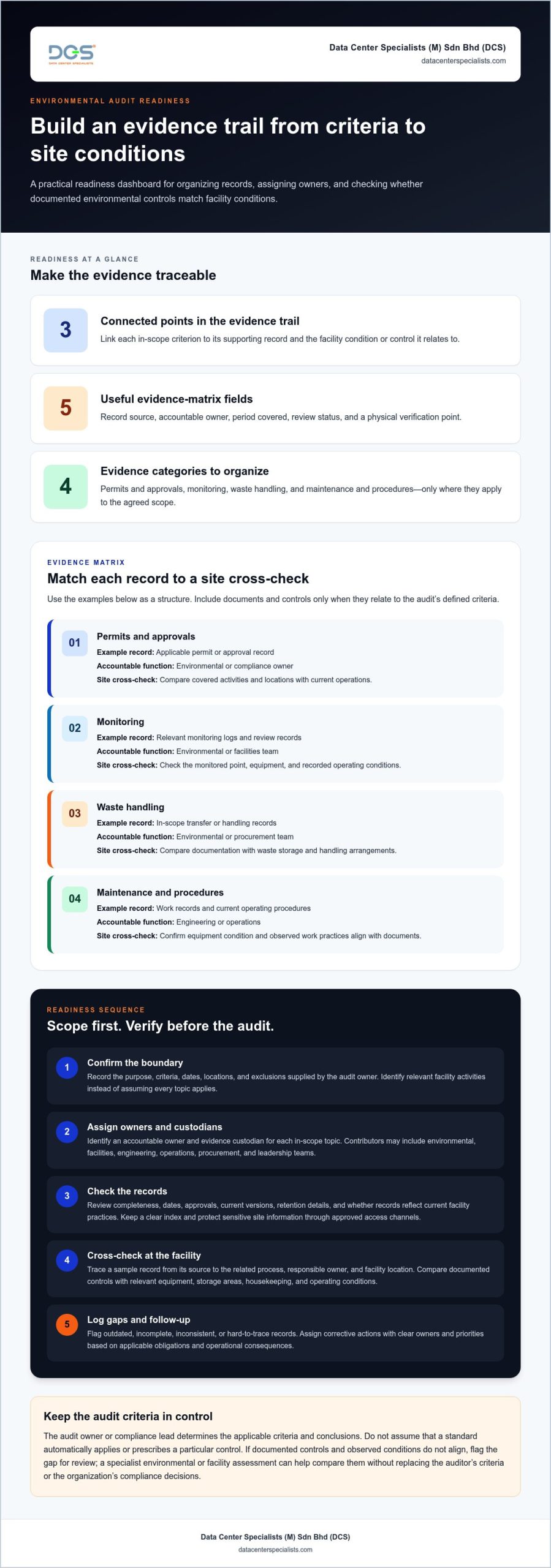
Once the audit boundary is established, build an evidence matrix connecting each in-scope criterion to supporting records and the conditions those records are meant to control. Include the document or data source, accountable owner, period covered, review status, and a physical verification point. This structure helps identify gaps before evidence is requested and makes it easier to trace records to the relevant process and facility location.
Include permits, monitoring records, waste-handling documentation, maintenance logs, and operating procedures only where they relate to the agreed scope. A procedure may be current and approved but still differ from how a control operates in practice. Flag records that are outdated, incomplete, inconsistent, or difficult to connect to site activities. Do not assume that ISO 14001 or another standard automatically applies to the facility or prescribes a particular control. Confirm the criteria set by the audit owner.
| Evidence category | Example record | Accountable function | Site cross-check |
|---|---|---|---|
| Permits and approvals | Applicable permit or approval record | Environmental or compliance owner | Compare covered activities and locations with current operations |
| Monitoring | Relevant monitoring logs and review records | Environmental or facilities team | Check the monitored point, equipment, and recorded operating conditions |
| Waste handling | In-scope transfer or handling records | Environmental or procurement team | Compare documentation with waste storage and handling arrangements |
| Maintenance and procedures | Work records and current operating procedures | Engineering or operations | Confirm equipment condition and observed work practices align with documents |
Organize records so an auditor can trace them
Keep current versions, approval history, retention details, and a clear index. Select a sample record and follow it from its source to the related process, responsible owner, and facility location. This can expose missing links, such as a log with no identified monitoring point. Protect sensitive site information and provide it through approved access channels.
Connect environmental documents with site evidence
Cross-check documented controls against relevant equipment, storage areas, housekeeping, and operating conditions. If the audit scope includes air or particulate conditions, compare applicable records with what is observed and determine whether specialist measurement is warranted. When energy performance falls within scope, Data Center Specialists’ data center energy assessment can provide targeted technical evidence. This supports readiness; the audit owner remains responsible for determining criteria and conclusions.
Check Environmental Risks, Operational Controls, and Audit-Readiness Gaps
Review the environmental aspects identified by the organization and audit owner, then assess whether relevant controls work as documented. Depending on the agreed scope, topics may include emissions, energy, water, waste, chemicals, spills, or monitoring. Do not treat every topic as automatically applicable. The audit criteria and facility activities determine what belongs in the review.
Compare four elements: operating conditions, records, assigned responsibilities, and escalation procedures. For example, consider a written spill response procedure alongside the arrangements and responsibilities observed in the relevant area. A mismatch is a signal to investigate, not a finding to assign in advance.
A readiness review identifies evidence gaps; only the designated audit process determines findings. Keep the distinctions clear. A documentation gap means expected evidence is missing or incomplete. An observed condition is something noted during a site review. A control weakness indicates a potential problem in how a control is designed or carried out. A confirmed nonconformity is determined through the applicable audit process against its criteria, not declared by a readiness checklist.
Review controls without disrupting live operations
Coordinate site observations with operations and follow established access, safety, and change-control processes. Use approved inspection windows. Do not interfere with critical infrastructure or alter operating conditions simply to obtain evidence. If an immediate safety or environmental concern arises, escalate it through the organization’s established procedures rather than waiting for audit preparation to conclude.
Prioritize gaps by evidence, impact, and ownership
For each issue, record the supporting evidence, affected process, accountable owner, and proposed next action. Separate concerns that may need prompt operational escalation from longer-term improvements to documentation, training, or procedures. This keeps the response proportionate and traceable without implying that every observation has the same significance.
If energy performance is within the audit scope or improvement plan, compare relevant records with operating conditions and identify where technical review could clarify performance. A data center energy assessment can support that focused review. Use the results as technical input; the organization’s compliance owner and designated auditor remain responsible for interpreting them against applicable criteria.
Keep the review focused on what the scope requires and what the evidence supports. This helps teams identify issues early while protecting live facility operations.
Pre-Audit Checklist to Close Gaps and Prepare Your Team
Use a defined sequence to turn readiness work into assigned actions. A folder of documents does not prove that controls are current or operating as intended. Validate the evidence against the agreed scope and site practice.
Run a focused readiness review before the audit
Walk through the checklist with compliance, facilities, engineering, and operations representatives. Sample records against the processes they describe, and log open questions for the audit owner without pre-judging the auditor’s conclusions.
- Confirm scope: Record the criteria, locations, systems, activities, dates, and exclusions provided by the audit owner.
- Assign owners: Name an accountable owner and evidence custodian for each in-scope topic.
- Index evidence: Check that records are complete, dated, approved where required, and traceable to the relevant process or location.
- Inspect controls: Coordinate site observations with operations and compare current practice with documented procedures.
- Resolve or log gaps: Record the owner, due date, status, evidence needed, and escalation route for each open action.
- Brief relevant teams: Explain the audit scope, roles, access arrangements, and escalation contacts to involved staff and contractors.
Prepare a controlled evidence room, digital or physical, with an index showing where approved records are held. Maintain a request log with the auditor’s request, the response provided, the responsible contact, and any follow-up required. Restrict access to sensitive facility information through approved channels.
Prepare staff, contractors, and evidence access
Ask record owners to verify completeness, dates, approvals, version status, and alignment with current practice. Include contractor responsibilities and records where the audit scope covers their activities. Make sure personnel know who can provide evidence and who should handle questions outside their role. If contamination control is an identified readiness action, consider whether a targeted specialist assessment or professional data center cleaning is appropriate for the facility conditions.
Keep the action log active until the audit begins. Distinguish completed corrections from items still under review, and retain supporting evidence for actions marked complete. This gives the compliance owner a clear view of readiness without representing internal checks as audit findings or certification.
For targeted technical readiness support, use an assessment aligned with the facility conditions and audit scope.
Turn Audit Findings into a Defensible Data Center Improvement Plan
After the audit, use the auditor’s definitions and the organization’s corrective-action process to record each finding and observation. Keep the original wording and reference intact, then connect it to the evidence, affected activity, and relevant control. This preserves the distinction between the auditor’s conclusion and the organization’s response.
Convert findings into tracked corrective actions
For each item, document its finding reference, supporting evidence, cause analysis, accountable owner, proposed action, and target date. Prioritize work according to the applicable obligation, operational consequence, strength of evidence, and resources or approvals needed. A concern affecting an active facility control may need a different response from an incomplete procedure or record.
Match each action to the appropriate technical expertise and follow applicable facility change-control requirements. Define closure evidence before work begins. Depending on the action, this could include an updated approved procedure, a completed maintenance record, or documented verification of a changed condition. A planned action is not completed remediation. Retain completion evidence and the organization’s verification or approval before closing the item.
Use specialist support where the gap is technical
Some actions require assessment or testing to clarify a condition or verify performance. Select support based on the specific gap: an energy assessment for a defined energy-performance concern, Testing, Adjusting & Balancing (TAB) for relevant system performance questions, or contamination-control services where environmental conditions warrant them. If measurements or performance testing in a controlled environment are part of the scope, Cleanroom Performance Testing may be relevant.
Data Center Specialists provides technical facility services that can support defined readiness or improvement needs. These services do not determine regulatory audit findings, provide legal advice, or grant certification. The designated auditor and the organization’s compliance owner remain responsible for audit criteria, conclusions, and acceptance of corrective-action closure.
Keep the improvement plan active after closure. Review overdue actions through the organization’s established escalation process, retain evidence in the controlled record system, and carry forward remaining work with a named owner. This creates a traceable link between the audit outcome, technical response, and verification.
For support aligned with a specific facility condition or improvement need, discuss data center environmental readiness with DCS.
Make Audit Readiness a Practical Improvement Process
Preparing for a data center environmental compliance audit is most effective when the scope is clear, evidence is traceable, and documented controls are checked against actual facility conditions. Assign accountable owners, validate records before the audit, and distinguish preparation gaps from findings determined through the designated audit process.
After the audit, translate findings into tracked actions with defined owners, due dates, and closure evidence. Where a gap requires technical investigation, match the response to the issue rather than applying a broad, untargeted fix. DCS provides data center environmental and contamination assessment, with relevant capabilities including energy assessment, Testing, Adjusting & Balancing (TAB), Cleanroom Performance Testing (CPT), preventive maintenance, and professional data center cleaning. These services can support technical readiness and improvement, while audit conclusions remain with the auditor or the organization’s compliance owner.
For support aligned with your facility’s needs, discuss data center environmental readiness with DCS. A methodical approach helps your team address gaps with clear ownership and move forward with confidence.
Frequently Asked Questions
What is a data center environmental compliance audit?
A data center environmental compliance audit is a structured review of whether activities and controls within an agreed scope align with specified environmental criteria. Depending on the facility and audit purpose, it may examine records alongside relevant operating conditions, such as energy use, waste handling, monitoring, or chemical storage. The audit is distinct from readiness work, legal advice, and certification. The audit owner or auditor defines the applicable criteria and determines the conclusions.
How do I prepare for a data center environmental compliance audit?
Start by confirming the audit purpose, criteria, locations, activities, and reporting period with the audit owner. Assign accountable owners for each in-scope topic, then create an evidence index identifying records, custodians, versions, and review status. Compare documents with current site practice, log gaps with owners and next actions, and brief relevant staff and contractors on their roles and evidence access.
What documents should a data center have ready for an environmental audit?
Prepare documents that match the agreed scope instead of assembling every facility record. Depending on applicable criteria, these could include relevant permits or approvals, environmental monitoring records, waste-handling documentation, maintenance logs, operating procedures, and records showing review or approval. Keep an index linking each item to its owner, location, and period covered. Check that records are complete and current, and arrange access to sensitive facility information through approved channels.
Who conducts an environmental compliance audit at a data center?
The audit is conducted by the person or body designated for that specific audit, which may vary according to its purpose and criteria. An organization may appoint an internal audit or compliance team, engage an external auditor, or be subject to an audit by an authority where applicable. The designated auditor determines findings against the defined criteria. Data Center Specialists provides technical facility services and assessments, not regulatory audit decisions or certification.
Does ISO 14001 automatically define a data center environmental audit checklist?
No. ISO 14001 does not automatically provide a facility-specific checklist for every data center audit. Whether the standard is relevant depends on the organization’s circumstances and the agreed audit criteria. A practical checklist should reflect applicable obligations, permits, facility activities, and audit scope. Do not assume that a particular control or record is required solely because the facility operates a data center. Confirm the criteria with the audit owner.
What happens if an environmental audit identifies a gap?
Follow the organization’s established process and the auditor’s definitions to record and address the gap. Document the finding reference, supporting evidence, affected process, accountable owner, proposed action, and target date. Define what evidence will demonstrate completion and how the organization will verify it. A planned action alone does not establish that remediation is complete. If the issue involves facility performance or environmental conditions, targeted technical assessment or testing may help inform the response.