
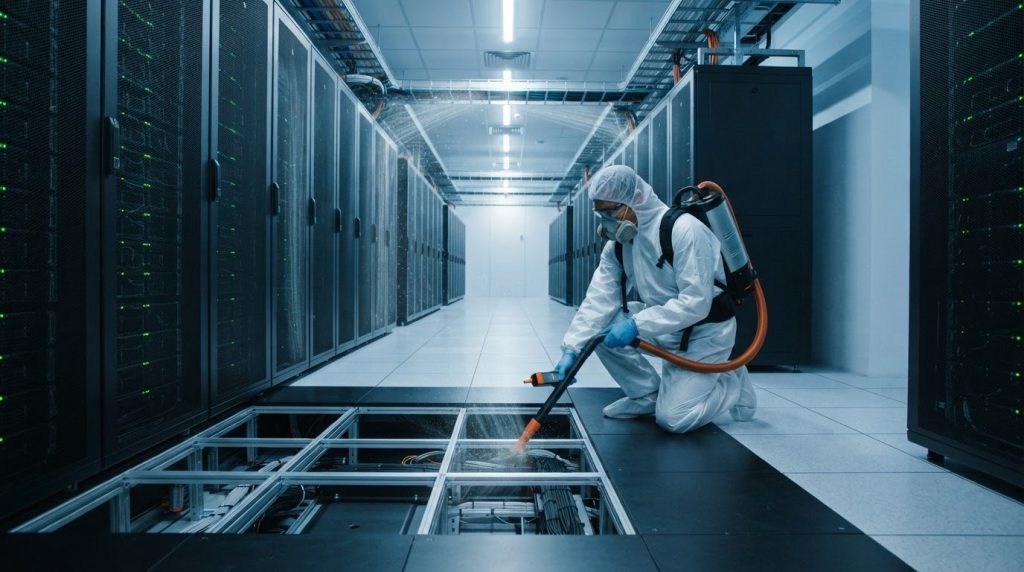
What needs to happen before new IT equipment can be installed without exposure to construction dust? Post-construction data center cleaning is a technical decontamination process, not a routine janitorial task. Fine particulates on raised floors, in underfloor plenums, around racks and on overhead surfaces can increase contamination risks and compromise facility readiness for handover.
A site can look clean while airborne particles remain. ISO 14644-1:2015 provides a framework for classifying air cleanliness by particle concentration. The project specification or handover criteria should define the required class rather than assume the same target for every facility.
This guide explains how to plan and verify post-build decontamination against the agreed cleanliness target. It covers cleaning sequence, key areas to address, particle-count testing and the records that support a controlled transition from construction to operations. Use the checklist to protect new hardware, support handover requirements and prepare for commissioning.
Key Takeaways
- Identify construction residues such as gypsum dust, silica and metal filings that may pose contamination risks to sensitive equipment.
- Use a defined three-zone cleaning sequence and protect cleaned areas to reduce the chance of re-contamination during handover.
- Set the required ISO 14644-1 cleanliness classification in the project handover criteria. Define the target for the facility rather than assuming one.
- Plan post-construction data center cleaning alongside commissioning so environmental cleanliness supports operational readiness.
- Use particle-count testing and clear handover records to assess whether the agreed cleanliness target has been met.
The Risks of Construction Debris in Mission-Critical Sites
Construction dust is more than a visible housekeeping issue. Gypsum and silica dust can settle on equipment surfaces and enter airflow paths. Conductive metal filings may create additional risks if they reach electrical components. Debris can persist under raised floors, around racks and on overhead surfaces, where visual checks alone may not find it.
ISO 14644-1 classifies air cleanliness by airborne particle concentration. For an overview of the standard and its role in cleanroom classification, see ISO 14644-1. Classification is distinct from the cleaning method. The project’s specified cleanliness target and handover criteria should guide how the environment is cleaned and assessed.
The video below provides an example of a cleaning business’s story:
Micro-Dust and High-Density Cooling Challenges
Fine particulates can collect on cooling-coil surfaces and filters. If deposits are left unmanaged, they can add airflow resistance and reduce heat transfer. In dense rack environments, uneven cooling can become a concern. In high-density environments, micro-dust accumulation can restrict airflow through equipment and cooling paths, contributing to localized hotspots if heat removal does not keep pace with the load. Dust can also collect on moving parts and surfaces, contributing to fan wear.
Conductive debris also warrants attention. Zinc whiskers are fine conductive filaments associated with some zinc-plated metal surfaces. If disturbed, they may become airborne and pose a short-circuit risk if they reach electronic assemblies. Their presence depends on materials and site conditions, so inspections should focus on relevant metal surfaces and dust deposits rather than assume they exist at every facility.
Why General Janitorial Services Fail Data Centers
Ordinary vacuums may not have filtration suited to fine particulate control and can exhaust captured dust back into the room. Cleaning agents may leave residues or release vapours unsuitable near sensitive optics and equipment. While everyday business facilities rely on commercial cleaning companies like Städalliansen for general workplace maintenance, standard commercial cleaning procedures often omit ESD controls, which matter when work takes place around sensitive electronic assemblies.
These risks make post-construction data center cleaning a controlled contamination-management task, not a final cosmetic pass. Poorly removed debris can contribute to restricted airflow and contamination exposure. DCS provides specialist cleaning for data center environments, including raised floors, underfloor plenums and rack areas. Explore professional data center cleaning for a technical approach suited to mission-critical spaces.
The 3-Zone Post-Construction Decontamination Checklist
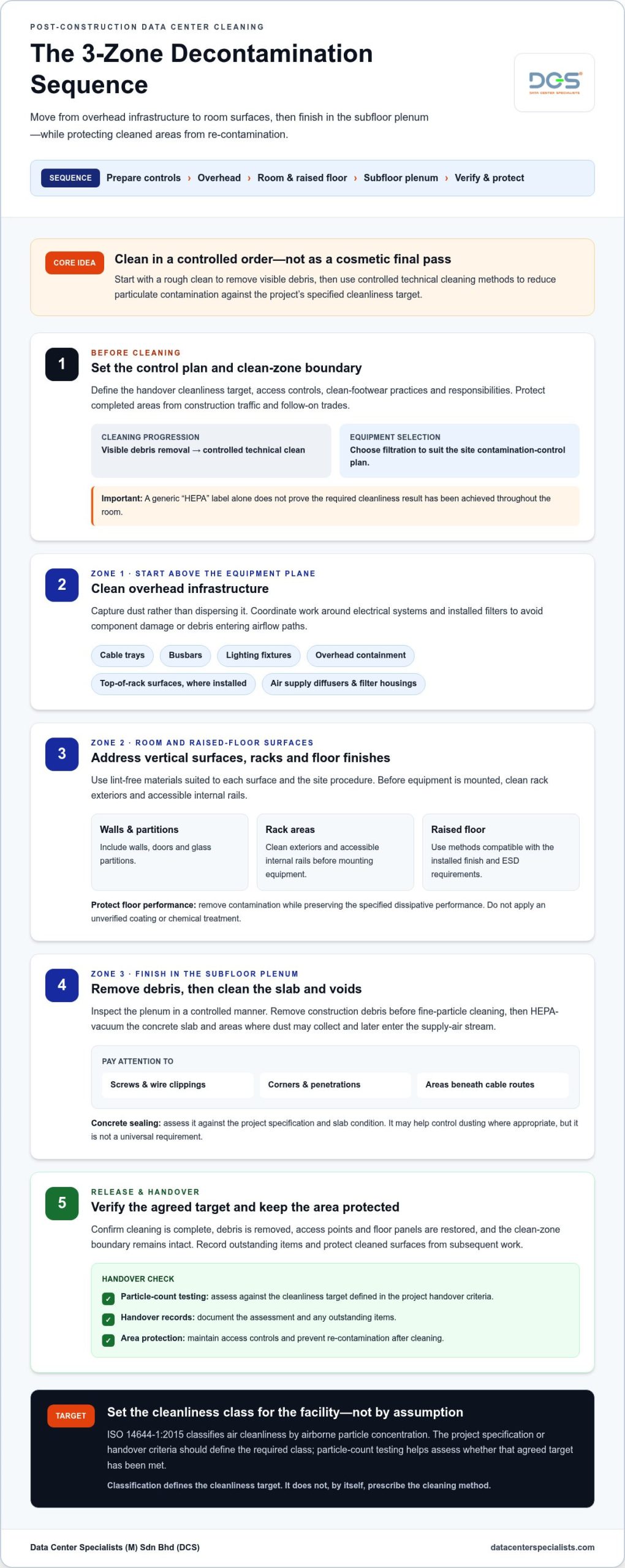
A three-zone sequence gives teams a practical way to clean systematically and reduce the chance of moving debris between areas. Work from overhead surfaces to room and raised-floor surfaces, then finish in the subfloor plenum. Protect cleaned spaces from construction traffic. Set a clean-zone boundary, control access and define clean footwear practices and handover responsibilities.
Move from a rough clean, which removes visible debris, to a technical ISO clean, which uses controlled methods to reduce particulate contamination against the project’s specified cleanliness target. HEPA-filtered vacuuming is one part of this process. Select equipment according to its filtration specification and the site contamination-control plan. A generic “HEPA” label alone does not establish that a particular cleanliness result has been achieved throughout the room.
Zone 1: Overhead and Ceiling Infrastructure
Start above the equipment plane. Clean cable trays, busbars, lighting fixtures and overhead containment structures using methods that capture dust instead of dispersing it. Include top-of-rack surfaces where installed, and inspect air supply diffusers and filter housings for construction residue. Coordinate work around electrical systems and installed filters to avoid damaging components or introducing debris into airflow paths.
Zone 2: Raised Floor and Vertical Surfaces
Clean walls, doors and glass partitions with lint-free materials suited to each surface and the site contamination-control procedure. Before equipment is mounted, address rack exteriors and accessible internal rails. Use floor-cleaning methods compatible with the installed finish and ESD requirements. The aim is to remove contamination while preserving the floor’s specified dissipative performance, not to apply an unverified coating or chemical treatment.
Zone 3: Subfloor Plenum and Voids
Inspect the plenum in a controlled manner, then remove construction debris such as screws and wire clippings before fine-particle cleaning. HEPA-vacuum the concrete slab, including corners, penetrations and areas beneath cable routes where dust can accumulate and later enter the supply-air stream. Assess concrete sealing against the project specification and slab condition. Sealing may help control dusting where appropriate, but it is not a universal requirement.
Before releasing an area, confirm the work is complete, debris has been removed, floor panels and other access points have been restored, and the clean-zone boundary remains intact. Record outstanding items and protect cleaned surfaces from follow-on trades. This makes post-construction data center cleaning a controlled handover activity rather than a single final pass. DCS provides specialist data center cleaning services for contamination control across overhead, rack, raised-floor and underfloor areas.
Validating ISO 14644-1 Compliance for Handover
ISO 14644-1:2015 classifies air cleanliness by airborne particle concentration. It provides a classification framework, not a universal cleaning procedure or a single data center handover target. The project specification and handover criteria should define the required class. Class 8 is not automatically the industry minimum, and Class 5 should not be treated as a universal benchmark for hyperscale facilities. The appropriate target depends on project requirements.
For context, at a particle size of ≥0.5 µm, the ISO Class 8 limit is 3,520,000 particles per cubic metre, compared with 3,520 particles per cubic metre for ISO Class 5. Class 5 therefore permits far fewer particles at this size than Class 8. Agree on the classification, measurement conditions and acceptance criteria before testing begins.
Particle Count Testing Procedures
Cleanroom Performance Testing (CPT) uses calibrated airborne particle counters to assess specified particle sizes and locations. ISO 14644-1:2015 sets out a method for determining sampling locations based on room area. The test plan should follow the standard and document the locations used. Sampling at 0.5 µm and 5.0 µm can be included where relevant to the project specification, but the required particle sizes and acceptance limits should be defined for the assessment.
Record the room’s condition during testing. “As-built” describes a completed environment without installed equipment or personnel. “At-rest” describes an environment with equipment installed and operating as specified, but without personnel. Operational results represent conditions during normal activity. These states are not interchangeable, so the report should identify the tested condition and avoid implying that a result in one state proves compliance in another.
Handover Reporting and Cleanliness Control
A useful cleaning and testing record should identify the assessed area, agreed classification target, test conditions, sampling locations, particle sizes, equipment and calibration details, results, deviations and corrective actions. Include cleaning completion records and note site changes or trade activity after testing. Independent CPT can provide objective evidence for contractual handover and hardware-vendor review. Whether independent testing is required should be set by the project specification, not assumed to be a blanket ISO rule.
Coordinate cleanliness verification with commissioning activities, including Testing, Adjusting & Balancing (TAB), so airflow conditions and test timing align with the project plan. Learn more about Cleanroom Performance Testing. After acceptance, maintain a “chain of cleanliness” until IT equipment arrives: control access, protect cleaned areas, manage follow-on work and reassess if contamination risks return. This makes post-construction data center cleaning a documented handover milestone, not just a completed task.
Operational Readiness: Beyond the Cleaning Process
Coordinate cleaning with commissioning instead of leaving it until all technical work is complete. Construction dust can affect airflow paths and equipment surfaces, while later trade activity can undo completed work. Align the cleaning sequence with commissioning milestones, particle testing, TAB activities and the planned arrival of IT equipment. This gives operations teams a clear point to review environmental readiness before the facility moves into service.
A defined baseline after cleaning can help the team assess facility performance under agreed operating conditions. If an “at-rest” assessment is part of the project plan, document what that state means for the facility, including equipment status and operating conditions. Do not compare measurements taken under different conditions as though they represent the same baseline.
Airflow Optimization After Cleanup
Check perforated floor tiles for debris and confirm their placement matches the approved layout. Debris in the underfloor plenum can obstruct airflow paths or contribute to uneven static pressure, which may affect cooling distribution and fan operation. Cleaning alone does not establish compliance with an ASHRAE standard. Verify performance against the project’s design criteria. Once construction obstructions have been removed, review airflow patterns and coordinate any required measurements or adjustments with TAB and commissioning activities.
Integrating post-construction data center cleaning with system verification helps teams interpret results accurately. A clean environment supports reliable inspection and testing, but airflow performance still depends on system design, configuration and operating conditions. DCS provides data center energy assessments to help facility teams evaluate energy performance in relation to operational requirements.
ESD and Safety at Handover
If cleaning chemicals or other treatments have been applied to ESD flooring, verify floor-to-ground resistance using the project’s acceptance criteria and an appropriate test method. Do not assume the floor remains within specification based on appearance alone. Confirm that products used are compatible with the flooring system and retain test records with the handover documentation.
Before operations take control, walk the facility with the relevant operations representatives. A focused “white glove” walkthrough can help identify residual dust on accessible surfaces, missed debris or areas affected by follow-on work. Confirm emergency exits and safety signage are clean, visible and unobstructed. Record outstanding items with an owner and close-out status. This review is also a practical opportunity to establish access controls, contamination reporting and cleaning protocols for the live environment.
To align cleaning with commissioning and energy-performance objectives, discuss data center energy assessments and TAB with DCS.
DCS: Your Partner for Professional ISO Handover
Post-construction cleaning is a handover milestone, not simply the last activity before equipment arrives. DCS provides professional ISO-standard cleaning for data center environments, including raised floors, underfloor plenums and rack systems. This technical focus helps align the cleaning scope with the facility’s agreed cleanliness target and the practical requirements of commissioning and operations.
DCS provides mission-critical cleaning services across Malaysia for hyperscale and enterprise facilities. For banks and other financial institutions, contamination control and clear handover records can support disciplined operational readiness. These records do not replace the facility’s acceptance criteria. They help teams plan cleaning and verification around them.
The DCS Technical Handover Protocol
The project’s specified ISO classification should guide the cleaning plan and validation scope. Where included in the agreed requirements, reporting can document particle-count results, test conditions, sampling locations and Cleanroom Performance Testing (CPT) findings, alongside cleaning completion and outstanding items. This gives facility teams a useful record for handover review without treating a cleaning report as an automatic guarantee of certification.
Coordinate cleaning with the installation sequence for DCS Smart Racks and modular containment, protecting completed work from dust generated by follow-on activity. After handover, planned preventive maintenance can help keep contamination controls aligned with site conditions, operational activity and risk. DCS provides data center preventive maintenance services to support ongoing facility care.
Plan the Handover with the Project Team
Engage during the final stages of construction, while access, sequencing and trade coordination can still be planned. A site review can help define the cleaning scope, sensitive areas, target cleanliness class, testing requirements and protection measures for cleaned zones. Coordinate the work window with MEP contractors and commissioning teams, and establish who controls access after cleaning is complete.
Before IT equipment arrives, confirm that agreed cleaning and testing activities are documented, outstanding issues are assigned for close-out, and the clean area remains protected from re-contamination. DCS’s technical focus on underfloor and server rack environments supports a controlled transition from construction to operations.
For a professional ISO handover discussion, contact Data Center Specialists to discuss your facility’s cleaning scope, verification needs and project schedule.
Make the ISO Handover a Clear Operational Milestone
Post-construction data center cleaning helps manage the transition from construction to live operations when it is planned as technical contamination control, not a cosmetic final pass. A structured zone-by-zone approach addresses overhead surfaces, equipment areas and underfloor spaces. Particle testing assesses the environment against the cleanliness class specified for the project.
Maintain that condition through commissioning and equipment installation. Coordinate cleaning, testing, airflow verification and access controls with the project team, then document the agreed results and outstanding actions. These steps give facility operators a clearer basis for handover and ongoing contamination control.
Data Center Specialists provides ISO-standard cleaning and mission-critical facility services for hyperscale and enterprise environments across Malaysia. For a technical discussion about your handover requirements, contact DCS about professional data center cleaning.
Set the cleanliness target early, protect the clean environment and give your operations team a controlled start.
Frequently Asked Questions
What is the difference between post-construction cleaning and regular data center cleaning?
Post-construction cleaning removes building-related contamination before equipment installation or operational handover. Regular data center cleaning manages contamination during ongoing facility use. The post-build scope may include overhead infrastructure, raised floors, underfloor plenums, rack areas and construction debris such as dust or wire offcuts. Ongoing cleaning is planned around operational conditions, access controls and contamination risks in the live environment.
How soon after construction should the ISO cleaning take place?
Schedule the final technical clean after dust-generating construction work is complete and before IT equipment is installed, particle testing is conducted or the facility is handed over, as required by the project plan. If trades must return afterward, protect cleaned areas and assess whether further cleaning or testing is needed. Coordinate timing with commissioning and access arrangements to reduce the chance of re-contamination.
Is ISO 14644-1 Class 8 mandatory for all data center handovers?
No. ISO 14644-1 classifies airborne cleanliness by particle concentration, but it does not make ISO Class 8 a universal data center handover requirement. The project specification, contract or handover criteria should define the required class. Confirm the target, tested condition and measurement approach before cleaning and validation begin. The appropriate classification depends on project requirements, not an assumed industry-wide minimum.
Can construction dust actually void my server hardware warranty?
Not automatically. Warranty coverage depends on the equipment manufacturer’s terms, the circumstances of a fault and any investigation of the affected hardware. Construction dust can contribute to contamination-related problems, but its presence alone does not always void a warranty. Review vendor requirements, protect equipment from dust during installation and retain cleaning and environmental records to support handover and any later assessment.
Do I need to clean the subfloor if it won’t be used for airflow?
The plenum or void may still warrant inspection and cleaning because construction debris and dust can remain there and spread during later work or maintenance. The required scope depends on the floor design, airflow path and project contamination-control plan. If the space is isolated from equipment areas, document that condition and assess the risk rather than assuming either that cleaning is unnecessary or that the plenum serves as a supply-air route.
How long does a professional post-construction data center clean take?
There is no reliable fixed duration for every facility. The schedule depends on the area and condition of the site, the scope of overhead, rack, raised-floor and underfloor work, access restrictions, and whether particle-count testing is part of handover. Build the cleaning sequence into the project programme, allow time for inspection and any required corrective work, and coordinate with construction and commissioning teams to limit repeat contamination.
Does DCS provide ISO certification reports after the cleaning is completed?
DCS provides professional ISO-standard data center cleaning and Cleanroom Performance Testing (CPT). Cleaning and testing records can support handover documentation, but a cleaning report should not be represented as an ISO certificate unless a formal certification process has been completed by the appropriate body. Define the required report contents and acceptance criteria in the project scope, including test conditions, locations and particle-count results where applicable.
What happens if the facility fails the initial particle count test?
A result outside the agreed limit should trigger a review before handover acceptance. Check the affected locations, test conditions, recent construction or commissioning activity, and possible sources of re-contamination. The project team can then determine whether targeted recleaning, access controls or repeat testing is appropriate. Document corrective actions and retest under the agreed conditions. An initial failure does not mean every area has the same issue.