

What evidence would convince your finance team that maintenance spending protects the facility rather than simply adding to operating costs? Building the business case for professional data center maintenance starts with that question. Operators must weigh maintenance against competing priorities while accounting for the operational exposure of critical infrastructure.
That scrutiny is reasonable. A generic service scope or broad promise of reliability isn’t enough to support a sound decision. The case needs to reflect your facility’s equipment, operating conditions, maintenance history and tolerance for disruption.
This article offers a practical, evidence-led way to assess maintenance value without relying on promises of guaranteed uptime. You’ll learn how to connect preventive activities to operational risk, consider lifecycle costs alongside immediate spending, and identify measurable indicators that can be checked against facility records. It also explains what to include in a professional service scope and how to compare providers on methods, documentation and outcomes. The result is a clearer basis for decisions that accounts for operational constraints and procurement requirements.
Key Takeaways
- Build the business case for professional data center maintenance around facility-specific needs and documented operational exposure, not generic reliability claims.
- Separate preventive maintenance from condition assessment, physical contamination control and performance testing so each activity has a clear purpose.
- When ROI is uncertain, establish a baseline and compare the proposed scope with the current approach using consistent assumptions and time periods.
- Evaluate proposals systematically: define the need, review the scope and methods, assess evidence, and agree on reporting and site coordination.
- Translate approved priorities into documented responsibilities and review points, adding related services only when facility findings support them.
Why Build a Business Case for Professional Data Center Maintenance?
Professional data center maintenance is planned, scoped work for the systems and environments that support critical facility operations. Its scope should reflect the facility’s design, equipment, operating conditions and documented requirements. The business case for professional data center maintenance is not simply that maintenance improves reliability. It explains why a defined scope is appropriate, which operational need it addresses, how the decision will be evaluated and which assumptions still need validation.
This distinction matters because stakeholders assess value from different perspectives. Finance may focus on budget control and lifecycle expenditure; operations may prioritize safe coordination and continuity; engineers may need technically appropriate methods and evidence; procurement needs a clear, comparable scope. A defensible proposal connects these perspectives without promising guaranteed uptime or assuming every facility has the same exposure.
Start with facility-specific evidence: maintenance records, inspection findings, equipment condition, incident history and existing procedures, where available. Label estimates and unverified concerns as assumptions rather than established facts. A review of data center management can provide general background on the disciplines involved, but the decision itself should be grounded in the site’s requirements. Data Center Specialists’ data center maintenance services are one option for discussing a professional scope suited to those needs.
What decision should the business case support?
Define whether the decision is to introduce a service, revise an existing scope or continue an investment. Identify the accountable budget owner and the technical stakeholders who can validate facility conditions before comparing options. Then separate confirmed evidence from assumptions that need inspection, records review or further assessment. This gives finance and engineering a shared basis for evaluating the same proposed work.
Why routine activity alone may not make a business case
A completed checklist or scheduled task shows that work occurred, but doesn’t by itself show that the work addressed a material facility need. Link each proposed activity to a condition, requirement or operational objective, and specify the evidence that will demonstrate completion or inform review. This doesn’t imply that an in-house team is inadequate; professional support should be assessed against its defined scope and fit.
For example, a proposal should explain which identified system or condition a task addresses, which site records or observations informed it, and what reporting the decision-maker will receive. If the need is unclear, establish what evidence is missing before approving a broader scope. This keeps the business case proportionate, supports fair procurement comparisons and makes later review more meaningful.
What Professional Data Center Maintenance Can Cover, and What to Measure
A useful scope starts with the facility, not a standard task list. Equipment type, design, operating conditions, access constraints and documented requirements determine which work is relevant. Make the boundary explicit: identify the systems and areas included, exclusions, required coordination, deliverables and responsibility for follow-up.
Distinguish the purpose of each activity. Preventive maintenance is planned work intended to maintain equipment in line with its requirements. A condition assessment examines present condition and identifies issues for review. Physical contamination control addresses dust and particulate contamination in agreed mission-critical spaces. Performance testing, such as Testing, Adjusting & Balancing (TAB), checks specified performance against defined criteria. These activities may inform one another, but they are not interchangeable or automatic parts of every maintenance scope.
Match maintenance scope to facility evidence
Use equipment records, inspection findings and operational observations to identify what warrants attention. For example, recurring observations in a particular area may justify further technical assessment, but they don’t alone establish a cause or prescribe a remedy. Set work intervals using equipment documentation, facility evidence and applicable verified guidance. If the basis is unclear, record it as a question to resolve rather than presenting an unsupported interval as necessary.
Choose measures decision-makers can interpret
Track whether agreed work was completed, what was found, which actions were raised, what remains unresolved and whether observations recur. Where reliable records exist, compare relevant operational data with an agreed baseline and document changes in operating conditions. Treat these as candidate indicators for review, not universal benchmarks or promised outcomes.
The table below shows how to connect an activity with evidence and accountability. Agree on owners and review points for each facility; these examples don’t set mandatory frequencies.
| Proposed activity | Evidence to record | Owner to agree | Frequency rationale | Review point |
|---|---|---|---|---|
| Preventive maintenance within scope | Work completed, findings, exceptions | Facility engineering lead | Equipment needs and documented requirements | Review open actions and repeat findings |
| Condition assessment | Observations and supporting records | Technical stakeholder | Triggered by identified questions or evidence gaps | Decide whether further action is justified |
| Physical contamination control, if required | Areas addressed, method and exceptions | Operations representative | Site conditions and agreed scope | Check findings against the stated objective |
| Performance testing, if specified | Test results and stated criteria | Engineering and operations | Defined by the reason for testing | Assess results and follow-up needs |
This evidence-led structure makes the business case for professional data center maintenance easier to review over time. For a facility-specific discussion of preventive maintenance scope, consider Data Center Specialists’ data center maintenance services.
How to Assess the Financial Case Without Inventing ROI
A precise return on investment may be impossible to establish before a facility has a reliable baseline. That doesn’t make the decision unmanageable. It means the business case for professional data center maintenance should distinguish recorded expenditure from estimates and explain what evidence is missing. Don’t turn a possible avoided loss, assumed failure probability or projected saving into a promised result.
Compare the proposed professional scope with the current approach over the same review period. Use Malaysian Ringgit (RM) for financial comparisons, and include internal labour or existing contract costs only when facility records support a fair comparison. Keep three categories separate:
- Documented spending: costs supported by invoices, contracts, work records or other reliable facility documentation.
- Estimated exposure: scenario-based estimates, with assumptions and uncertainty clearly stated.
- Operational considerations: factors such as coordination requirements, unresolved findings, workload and the quality of available records.
Build a transparent comparison
Set out the proposed and current approaches side by side. For each, list included activities, exclusions, responsibilities, assumptions and the review period. Account for scope differences rather than comparing unlike services. If records are incomplete, identify the gap instead of filling it with an unsupported cost or assumed productivity gain. Mark estimates as estimates, not realized savings.
Test the business case with facility scenarios
Use scenarios approved by the facility’s technical owners to examine whether the proposed scope addresses documented concerns. For example, a scenario could test how an identified recurring finding would be handled, who would review it and what follow-up evidence would be expected. Technical stakeholders should validate the assumptions before finance uses the model. The scenario tests the decision logic, not a guaranteed outcome.
Agree on a review point and decide which records would strengthen a future comparison. These may include work documentation, action status or relevant operating data already collected by the facility. If evidence isn’t yet available, make baseline development part of the decision process rather than claiming a payback period without support.
If energy performance is part of the decision, assess it as a defined, related workstream rather than assuming it is included in preventive maintenance. Data Center Specialists provides a data center energy assessment that may be relevant when facility findings support that evaluation.
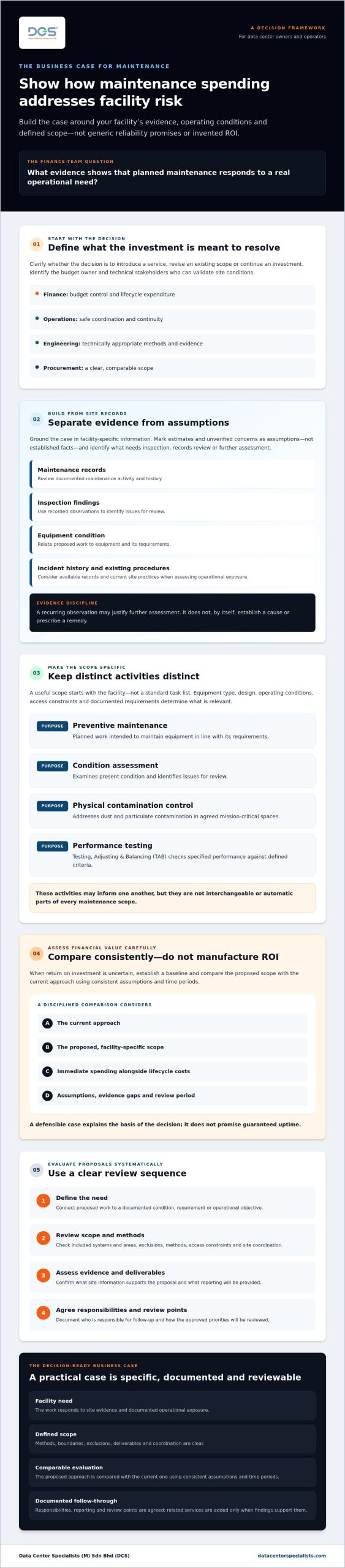
How to Evaluate a Professional Data Center Maintenance Proposal
A proposal should make the work, boundaries and decision criteria clear before approval. Use a consistent review sequence so engineering, operations, procurement and finance can assess the same scope rather than relying on broad claims.
- Define the need. State the facility concern or requirement the work is intended to address, and identify who will validate it.
- Review the scope. Check included tasks, locations or systems, exclusions, optional work and required deliverables.
- Verify the method. Ask how the proposed approach fits the equipment, site procedures and operating constraints.
- Assess the evidence. Confirm which records, inspection findings or technical basis support the activities and any proposed frequency.
- Agree on reporting. Define how completion, findings, exceptions, follow-up actions and responsibilities will be documented.
Before sign-off, clarify how work will be coordinated with site access controls, permits or approvals where applicable, operational windows, affected teams and facility-specific safety requirements. Confirm escalation routes for unexpected findings, who authorizes additional work and how unresolved items will be tracked. These details help determine whether a proposal is workable in the live operating environment, not just technically described.
Questions to ask before selecting a provider
Request a task-level scope that separates included work from optional or separately assessed services. Ask to review a sample reporting format so your team can judge whether it captures the information needed for decisions; a sample demonstrates format, not project results. Confirm how methods account for mission-critical equipment and site safety requirements, and which facility stakeholders need to coordinate or approve the work.
Compare proposals on evidence, not adjectives
Use the same criteria for each submission: methodology, role responsibilities, safety coordination, documentation and review mechanisms. Ask providers to explain the technical basis for proposed tasks and frequencies, including how facility evidence or equipment requirements inform them. Treat undefined terms such as “comprehensive” as prompts for clarification, not proof of scope. Avoid unsupported superlatives and focus on verifiable differences in deliverables and approach.
A strong evaluation makes the business case for professional data center maintenance easier to defend because it connects the need to a defined scope and reviewable evidence. To discuss a facility-specific proposal, explore professional data center maintenance services from Data Center Specialists.
Turn the Business Case into a Practical Maintenance Decision
An approved business case becomes actionable when its priorities are translated into a documented scope, a baseline, assigned responsibilities and a review cadence. Record current conditions and known data limitations before using future results for comparison. This gives facility teams a reference point and clarifies which changes can reasonably be assessed over time.
Define who owns inspection findings, corrective actions and decisions outside the approved scope. For example, a maintenance provider may document an exception, while the facility’s designated technical owner determines whether further assessment or separate authorization is required. Agree on how unresolved items will be tracked, when progress will be reviewed and who can approve a scope change.
Set a baseline and review the scope
Capture relevant records and observations available at approval, noting gaps rather than treating incomplete information as confirmed. Revisit the scope when equipment or environmental conditions change, operational requirements shift, or assessment findings raise new questions. A planned review helps keep the work aligned with facility needs without assuming every new concern belongs in the existing service.
Keep related services distinct. Professional physical data center cleaning and contamination control may be relevant where particulate or other contamination concerns are identified. A data center energy assessment, Testing, Adjusting & Balancing (TAB), or Cleanroom Performance Testing (CPT) may also be considered when facility evidence supports that need. None should be treated as an automatic inclusion in preventive maintenance.
Discuss facility requirements with DCS
Owners, operators, engineers and procurement leads can use the business case for professional data center maintenance to frame a focused discussion: what is known, what remains uncertain, which work is proposed and how findings will be reviewed. If energy performance is part of the decision, identify it as a separate requirement for consideration. If contamination is relevant, specify the affected mission-critical areas and the control objective rather than assuming a general cleaning scope.
Bring available maintenance records, inspection observations and operating constraints to the discussion. Data Center Specialists provides data center preventive maintenance and related assessment services, including energy assessment, TAB and CPT, where relevant to the facility’s needs. To discuss a suitable scope or request a technical assessment or quotation, review Data Center Specialists’ data center maintenance services. A clear discussion can help define the next step; it doesn’t replace facility-specific evaluation or guarantee an operational outcome.
Make the Next Maintenance Decision Evidence-Led
A defensible business case for professional data center maintenance connects a defined operational need to a scoped service, documented assumptions and reviewable evidence. It doesn’t depend on a guaranteed uptime claim or an invented ROI figure. Establish a facility baseline, distinguish confirmed findings from uncertainties, and compare proposals using consistent scope, responsibilities and review periods.
Then turn approved priorities into a practical plan. Assign ownership for findings and follow-up, document what is included or excluded, and revisit the scope when facility conditions or requirements change. Keep related services separate unless evidence supports them: physical contamination control, energy assessment, Testing, Adjusting & Balancing (TAB) and Cleanroom Performance Testing (CPT) each address distinct needs.
Data Center Specialists provides professional preventive maintenance services for data centers, alongside related assessment and technical capabilities. Owners, operators, engineers and procurement teams can discuss their data center maintenance requirements with DCS to clarify a facility-specific scope or next step. With clear evidence and accountable review, your team can make a more informed decision and strengthen its maintenance planning.
Frequently Asked Questions
What is professional data center maintenance?
Professional data center maintenance is planned, scoped work to support the operation of mission-critical facility systems and environments. The scope depends on facility design, installed equipment, operating conditions and documented requirements. It should specify the work included, exclusions, coordination needs and reporting. Preventive maintenance is distinct from condition assessment, physical contamination control and performance testing, although these related activities may be considered when facility evidence supports them.
Is professional data center maintenance worth the investment?
It may be worthwhile when a defined scope addresses an identified facility need and its value can be reviewed against reliable records. The business case for professional data center maintenance should consider documented spending, operational requirements, known findings and uncertainty, rather than rely on generic reliability claims. Compare the proposed service with the current approach using equivalent assumptions and review periods, then assess whether the resulting scope is proportionate to the facility’s priorities.
How do you calculate the ROI of data center maintenance?
Start by establishing a facility baseline and defining the service scope and comparison period. Compare documented expenditure for the proposed approach with reliable records for the current approach, accounting for differences in activities and responsibilities. Keep estimated operational exposure separate from recorded costs, and label scenario assumptions clearly. Don’t present assumed avoided losses, savings, failure probabilities or payback periods as realized results without facility-specific evidence to support them.
What should a data center maintenance service include?
A service should include only work appropriate to the facility’s equipment, conditions and documented requirements. The proposal should clearly state tasks, locations or systems covered, exclusions, methods, responsibilities, coordination requirements and deliverables. Reporting can record completed work, findings, exceptions and follow-up actions. Physical contamination control, energy assessment, Testing, Adjusting & Balancing (TAB) and Cleanroom Performance Testing (CPT) are separate related services, not automatic inclusions in preventive maintenance.
How often should data center preventive maintenance be performed?
There isn’t one interval that applies to every data center. Determine frequency using equipment documentation, facility conditions, operational requirements and applicable verified guidance. Review maintenance history and inspection findings to identify issues that may warrant a different approach or further technical assessment. Ask the provider to explain the basis for each proposed interval, and record assumptions where the available evidence is incomplete. Avoid adopting a generic schedule without confirming its relevance to the site.
How can we compare data center maintenance providers?
Compare proposals against the same facility-specific criteria: task-level scope, exclusions, methods, role responsibilities, site safety coordination, deliverables and reporting. Ask providers to explain the technical basis for proposed activities and frequencies, and how work will fit site procedures and operating constraints. Request a sample reporting format to assess whether findings and follow-up actions will be clear. Evaluate evidence and accountability, not broad adjectives or unsupported performance claims.
Can professional maintenance guarantee data center uptime?
No maintenance provider should be assumed to guarantee uninterrupted uptime. Maintenance can be planned and scoped to address defined requirements, but facility operations also depend on equipment condition, system design, operating practices and other factors. Ask what work is included, how exceptions are reported, who makes decisions about corrective actions and which outcomes are actually measured. Treat documented findings and clear responsibilities as useful decision evidence, not as a promise that disruption cannot occur.