
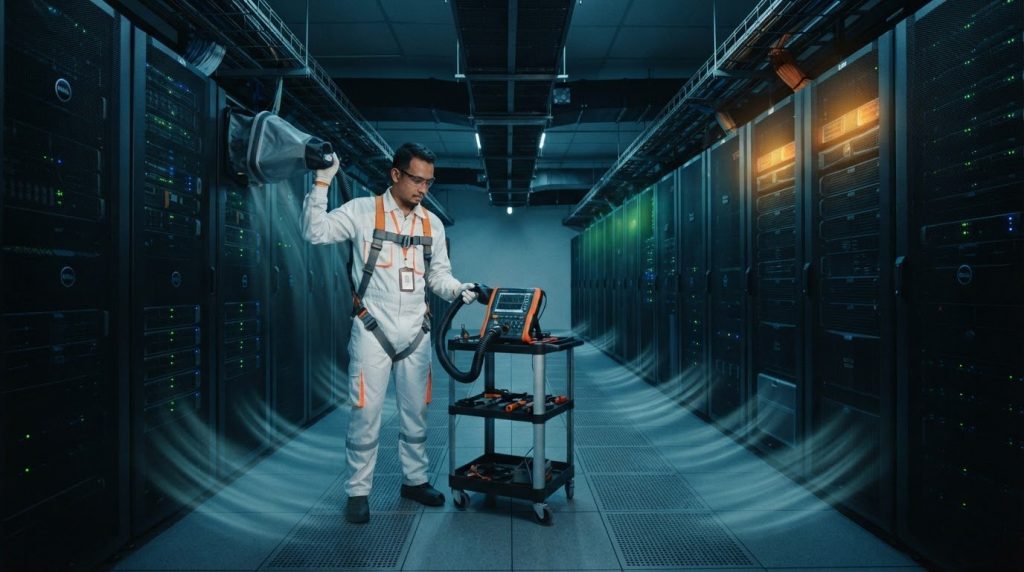
In an uncalibrated facility, up to 60% of conditioned air never reaches the servers it was chilled to protect. You already know the frustration of chasing persistent rack intake hotspots while operating cooling plants well above required capacity. Raw cooling volume simply cannot overcome static pressure imbalances or chaotic bypass leakage. Executing rigorous testing adjusting and balancing data center procedures is specialized aerodynamic thermal management, fundamentally different from routine commercial HVAC balancing.
Discover how systematic testing, adjusting, and balancing (TAB) stabilizes mission-critical airflow, neutralizes plenum pressure differentials, and protects facility uptime while optimizing energy consumption. This technical guide examines essential field methodologies, diagnostic instrumentation tolerances, and the strict engineering criteria required to evaluate and select a qualified critical facility specialist.
Key Takeaways
- Understand why testing adjusting and balancing data center systems demands specialized aerodynamic management focused on sensible heat removal rather than standard commercial comfort cooling.
- Learn how eliminating plenum static pressure imbalances prevents bypass airflow, resolves upper-rack hot spots, and optimizes facility PUE.
- Discover the multi-phase engineering methodology and calibrated diagnostic instruments required to validate critical mechanical tolerances without risking live operations.
- Identify the core technical capabilities needed to distinguish true mission-critical engineering specialists from conventional mechanical contractors.
- Explore how pairing continuous aerodynamic balancing with aisle containment maintains thermal stability through dynamic IT capacity expansions and server refreshes.
What Is Testing, Adjusting, and Balancing in Data Center Facilities?
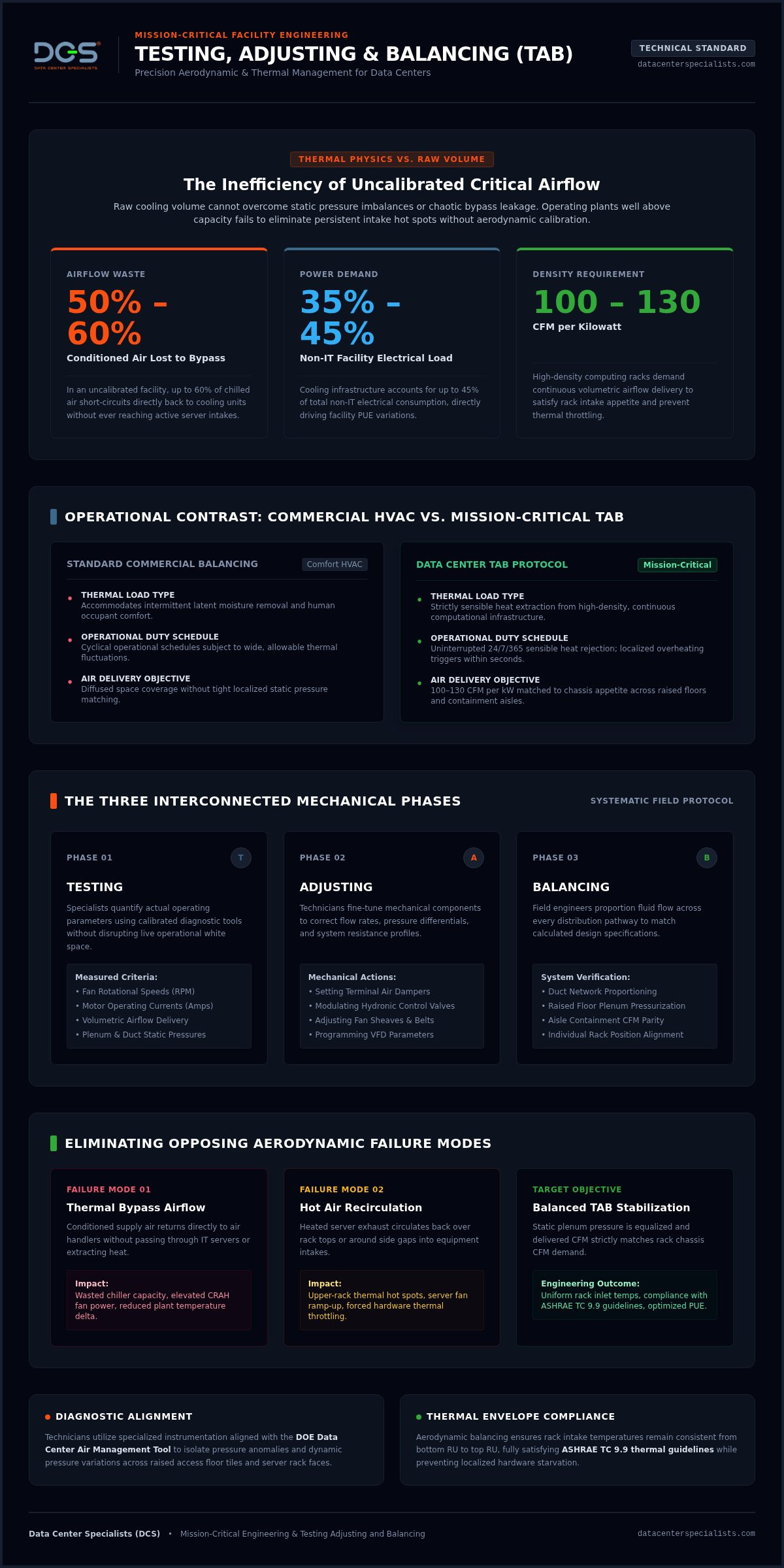
Executing specialized testing adjusting and balancing data center protocols is fundamentally an exercise in sensible heat extraction verification. While conventional air conditioning focuses on human thermal comfort and intermittent latent moisture removal, critical IT infrastructure produces concentrated, non-stop sensible thermal loads. The rigorous engineering discipline of Testing, Adjusting, and Balancing (TAB) systematically measures and regulates fluid flow throughout the cooling infrastructure. This verification ensures that physical airflow precisely matches engineered thermal dissipation models, directly protecting server inlet temperatures and overall facility resilience.
To visualize how aerodynamic imbalances and pressure differentials compromise thermal distribution across critical white space, review this CFD analysis:
The Core Phases: Testing, Adjusting, and Balancing Defined
A rigorous TAB protocol follows three interconnected mechanical phases:
- Testing: Specialists quantify actual operating parameters using calibrated diagnostic tools, recording fan rotational speeds, motor operating currents, airflow volumes, and static pressures across plenums and ductwork.
- Adjusting: Technicians fine-tune mechanical equipment by setting terminal dampers, modulating hydronic valves, adjusting fan sheaves, and programming variable frequency drives (VFDs) to hit specified operational ranges.
- Balancing: Field engineers proportion airflow and hydronic distribution throughout ducts, raised floor plenums, and containment aisles to match design specifications across every server rack position.
Distinction Between Comfort HVAC and Mission-Critical Heat Rejection
Commercial comfort HVAC accommodates variable occupant schedules and broad thermal swings. In contrast, mission-critical facilities demand continuous, sensible heat rejection to protect high-density computing loads that require 100 to 130 CFM of airflow per kilowatt. Without precise aerodynamic control, cooling air bypasses server intakes, triggering localized overheating within seconds. Bridging physical TAB verification directly with hvac system commissioning guarantees that chilled supply air directly satisfies rack intake appetites rather than wasting energy circulating through empty space.
Why Proper Airflow Balancing Is Critical for Server Reliability and PUE
Cooling infrastructure accounts for 35% to 45% of a facility’s non-IT electrical demand. Without systematic testing adjusting and balancing data center environments often lose 50% to 60% of their conditioned air to bypass pathways. When supply air distribution is uncalibrated, fans work harder to overcome uneven resistance, driving up operational costs while server fans ramp to maximum speed to compensate for localized starvation.
Mitigating Thermal Bypass and Hot Air Recirculation
Thermal bypass wastes cooling capacity by allowing chilled air to return to heat exchangers without extracting heat from active compute loads. Recirculation introduces the opposite failure mode, pulling heated server exhaust back into equipment intakes and forcing IT hardware into thermal throttling. Precise balancing resolves these opposing aerodynamic defects by matching delivered volumetric airflow directly to server chassis CFM requirements. Applying methodologies consistent with the DOE Data Center Air Management Tool helps field engineers isolate pressure anomalies across the rack face, ensuring rack inlet temperatures remain uniform and compliant with ASHRAE TC 9.9 thermal guidelines.
Optimizing Raised Floor Static Pressure and Perforated Tile Delivery
Raised floor plenums do not distribute air evenly on their own. High discharge velocity near computer room air handlers creates high dynamic pressure and depressed static pressure, which can stall airflow or draw warm room air down into underfloor grilles. Further down the plenum, airflow decelerates against perimeter walls, creating excessive static pressure. TAB engineers balance perforated tile dampers and install air baffles to counteract these Bernoulli effects. Neutralizing underfloor pressure variations allows operators to safely reduce cooling unit fan speeds by 15% to 20%, which slashes fan electrical draw by up to 49% under the fan affinity laws.
Enhancing Containment Efficiency with Balanced Air Pressures
Physical containment structures cannot deliver peak efficiency if mechanical airflow volumes fail to balance against server fan consumption. Integrating aerodynamic balancing with dcs containment systems establishes a stable micro-pressure differential between 2.5 and 7.5 Pascals within the aisle. This boundary stops chilled air from forcing open containment panel seals and prevents ambient hot air ingress. Coupling regular mechanical balancing with a comprehensive data center energy assessment provides operational teams with measurable validation of their thermal margins, driving down overall facility Power Usage Effectiveness (PUE).
The Data Center TAB Technical Methodology: How Specialists Balance Critical Systems
Executing testing adjusting and balancing data center mechanical systems requires a methodical sequence to verify design performance without jeopardizing running IT operations. Unlike non-critical buildings, testing in data halls occurs under strict change management protocols. Every adjustment directly affects downstream thermal margins, making procedural discipline essential for continuous uptime. A thorough understanding of data center airflow management as an applied fluid dynamics discipline is essential before technicians begin modifying damper positions or fan drive parameters.
Airside Distribution Balancing: CRAH Units, Plenums, and Ductwork
Airside execution begins at the cooling plant and terminates at the rack intake plane:
- Unit baseline verification: Field engineers record baseline operating conditions for every Computer Room Air Handler (CRAH) and fan wall, confirming motor running amperage, fan rotational RPM, and static discharge pressure against manufacturer performance curves.
- Duct and plenum velocity profiling: Technicians traverse primary discharge paths using multi-point Pitot arrays to calculate total delivered air volume, adjusting variable volume dampers to establish uniform pressure profiles.
- Perforated floor tile proportional balancing: Using direct-inflow capture hoods calibrated specifically for pressurized plenum discharge, technicians balance each perforated tile or grille damper, ensuring delivered CFM aligns with rack compute density.
Hydronic and Chilled Water System Balancing
Waterside performance governs the sensible heat transfer efficiency of CRAC and CRAH cooling coils. Specialists verify flow through mechanical risers and secondary distribution loops using portable ultrasonic flow meters. Technicians measure pressure differentials across modulating two-way control valves, balancing valves, and heat exchange coils. Calibrating circuit balance valves ensures that cooling units receive their engineered water flow, preventing low delta-T syndrome across central chillers while maintaining stable heat rejection under variable server loads.
Specialized Test Instrumentation and Tolerance Verification
Accurate field validation requires industry-grade diagnostic instrumentation calibrated to strict environmental standards. Certified teams deploy high-resolution electronic micro-manometers, thermal anemometer arrays, zero-pressure direct capture hoods, and non-invasive ultrasonic flow meters. Airflow and hydronic flows are tuned to meet the stringent criteria set forth in Associated Air Balance Council (AABC) standards, maintaining volumetric tolerances within plus or minus 10% of engineering design schedules.
Once balancing is complete, field engineers cross-reference all static pressure readings, hydronic flow measurements, and electrical baselines against mechanical drawings. This data forms a certified TAB report that gives operators an audited, repeatable performance baseline for their white space.
Key Selection Criteria for Data Center TAB Service Providers
Selecting a partner for testing adjusting and balancing data center environments requires looking far beyond standard commercial mechanical credentials. High-density server halls present zero-tolerance operating conditions where a minor airflow disruption, pressure shock, or accidental static discharge can compromise compute operations. Facility operators need an engineering-led team that treats aerodynamic balancing as an integral component of overall site resilience.
Commercial HVAC Balancing vs Mission-Critical TAB Specialists
Commercial contractors typically balance air handlers for occupant comfort and seasonal ventilation. In contrast, mission-critical specialists balance cooling delivery for uninterrupted sensible heat removal across active server hardware. A qualified provider understands complex redundancy configurations, such as N+1 or 2N distribution architectures, and knows how cooling loops behave during automated unit failovers. Their field technicians adhere strictly to anti-static precautions, cleanroom garment standards, and controlled equipment handling whenever working inside active white spaces.
Safety Protocols, Methods of Procedure (MOP), and Risk Mitigation
In energized production environments, mechanical adjustments must occur without exposing compute workloads to thermal shock or mechanical vibration. Professional providers execute every balancing task under an approved Method of Procedure (MOP) that specifies tool controls, exclusion zones, and contingency fallback steps. Balancing activities must coordinate smoothly alongside planned data center maintenance windows, allowing technicians to verify floor damper positions and fan speeds without triggering emergency alarms or breaker trips.
Complementary Testing: Cleanroom Standards and Environmental Audits
Aerodynamic balancing directly influences airborne particulate movement. Opening floor tiles to measure plenum static pressures or reposition dampers can dislodge dormant particulate matter into high-velocity supply streams. Specialized providers evaluate airflow through a holistic contamination lens, pairing velocity profiling with cleanroom performance testing cpt to verify compliance with ISO 14644 cleanliness standards. When adjustments displace settled dust, the provider must coordinate technical underfloor and plenum data center cleaning to prevent particulates from fouling server fans or circuit assemblies.
To safeguard your facility against thermal anomalies and mechanical drift, partner with certified engineers who understand critical environments. Review our specialized engineering testing solutions to schedule a comprehensive airflow and balance assessment for your facility.
Integrating TAB with Modern Containment and Long-Term Facility Management
Aerodynamic balance isn’t a permanent state achieved at initial commissioning and forgotten. A data hall is dynamic; every server install, decommission, or blanking panel adjustment alters white space aerodynamics. Treating testing adjusting and balancing data center environments as an ongoing operational discipline guarantees that physical cooling delivery tracks evolving thermal realities over the facility’s lifecycle.
Impact of IT Load Migrations and High-Density Rack Refreshes
Hardware refresh cycles often double or triple power density within existing footprints. Upgrading standard compute racks to high-density storage or accelerated processing hardware alters the internal impedance of the cabinet and increases volumetric airflow demand. If mechanical air delivery isn’t adjusted to compensate, the resulting pressure deficit pulls hot exhaust back into the server intake stream. Periodic re-balancing audits identify localized airflow deficits before hardware reaches thermal throttling thresholds, ensuring reliable operation for hardware mounted inside high-capacity dcs smart racks. For facilities managing surging power densities, a dedicated high density rack airflow management strategy that integrates cabinet intake velocity, row containment boundaries, and static pressure as a unified mechanical system is essential to prevent thermal throttling.
Establishing Periodic Re-Balancing Schedules for Uptime Assurance
Facility operators should integrate TAB protocols into structured maintenance calendars rather than relying on reactive troubleshooting when alarms trip. Consider re-balancing under the following operating conditions:
- Post-migration validation: Execute focused airside balancing following major IT rollouts, aisle reconfigurations, or floor tile modifications.
- Mechanical plant retrofits: Re-tune hydronic loops and CRAH discharge velocities whenever chillers, pumps, or fan arrays undergo major overhaul or replacement.
- Seasonal environmental swings: Verify waterside flow and airside delivery across seasonal transitions to ensure economizer transitions don’t upset plenum static pressures.
Partnering with Data Center Specialists for Engineering Assurance
Maintaining balanced airflow requires specialized engineering expertise tailored to mission-critical infrastructure. Data Center Specialists delivers nationwide testing adjusting and balancing data center services, cleanroom environmental audits, and thermal containment optimization. Our engineering teams evaluate physical airflow dynamics alongside contamination controls to protect critical uptime and maximize mechanical efficiency across enterprise and colocation white spaces. Contact Data Center Specialists today to discuss your site specifications and schedule a comprehensive technical balance assessment.
Secure Long-Term Operational Uptime Through Aerodynamic Precision
Oversized cooling plants can’t overcome static pressure imbalances, bypass air leakage, or unmanaged heat recirculation. Operating an efficient, reliable facility requires rigorous testing adjusting and balancing data center practices that stabilize plenum pressure, eliminate rack hot spots, and align delivered airflow with real-time IT intake demands. Approaching aerodynamic balancing as an ongoing operational standard protects critical computing assets, satisfies strict thermal guidelines, and drives down mechanical power consumption.
Founded in 2008, Data Center Specialists brings extensive mission-critical engineering experience to enterprise facilities nationwide. Our technical scope bridges precision HVAC balancing, Cleanroom Performance Testing (CPT), and ISO environmental contamination standards, directly pairing diagnostic field verification with DCS Smart Modular Containment systems to maximize thermal separation. Protect your white space against thermal drift and persistent cooling waste. Request a Data Center TAB Engineering Consultation today to calibrate your mechanical infrastructure, verify critical design tolerances, and secure dependable operational uptime.
Frequently Asked Questions
What is testing, adjusting, and balancing in a data center environment?
Testing, adjusting, and balancing in a data center is the specialized engineering verification of airside and hydronic mechanical systems to satisfy high-density sensible heat removal. Field technicians measure rotational fan speeds, static pressures, airflow volumes, and water flow rates. They then modulate balancing valves, dampers, and drive parameters to align mechanical delivery with engineered design specifications across every server rack intake.
How does data center TAB differ from standard commercial HVAC balancing?
Commercial balancing regulates airflow for occupant comfort, fresh air ventilation, and variable seasonal schedules. Mission-critical testing adjusting and balancing data center protocols focus entirely on continuous sensible heat rejection and equipment protection. Critical balancing requires managing micro-pressure differentials across containment zones, neutralizing raised floor static pressure imbalances, and preventing server fan starvation under constant, high-density computing loads.
Can testing, adjusting, and balancing be performed in an operational live data hall?
Yes, qualified specialists regularly perform TAB services within live, fully energized data halls. Work proceeds under rigorous Methods of Procedure (MOP) and strict change management protocols to prevent accidental breaker trips or cooling interruptions. Technicians use non-invasive diagnostic tools, such as ultrasonic flow meters and direct-capture hoods, making physical adjustments gradually while continuously monitoring server rack intake temperatures.
What happens if a data center operates without proper airflow balancing?
Operating without aerodynamic balancing creates severe static pressure imbalances, widespread bypass airflow, and dangerous localized hot spots. While central cooling plants may display excess capacity, uneven plenum pressure starves upper rack units of chilled air. These deficits trigger server thermal throttling, premature hardware failure, unmanaged recirculation loops, and inflated mechanical energy expenditure.
How often should a mission-critical data center undergo technical TAB services?
Facilities should undergo baseline TAB during initial commissioning and repeat comprehensive balancing following major IT migrations, rack density increases, or cooling plant overhauls. Best practices also recommend periodic balance audits annually or bi-annually. Regular testing ensures that physical airflow distribution accounts for seasonal ambient temperature shifts and ongoing white space layout changes.
Can testing and balancing services help lower data center PUE and cooling costs?
Comprehensive testing adjusting and balancing data center systems directly reduces Power Usage Effectiveness (PUE) by eliminating cooling waste. Neutralizing plenum pressure variances stops cold air bypass and allows operators to safely raise chilled water supply temperatures. Furthermore, correcting airflow distribution enables cooling unit fan speed reductions, generating substantial energy savings through the fan affinity laws.
What technical documentation and reports are delivered upon TAB project completion?
Operators receive an audited, certified TAB engineering report detailing every tested parameter across the cooling infrastructure. The documentation includes verified fan motor running amperages, design versus actual volumetric CFM readings, underfloor static pressure maps, and hydronic flow rates. This report establishes an authoritative operational baseline for compliance auditing, future capacity planning, and facility energy management.