
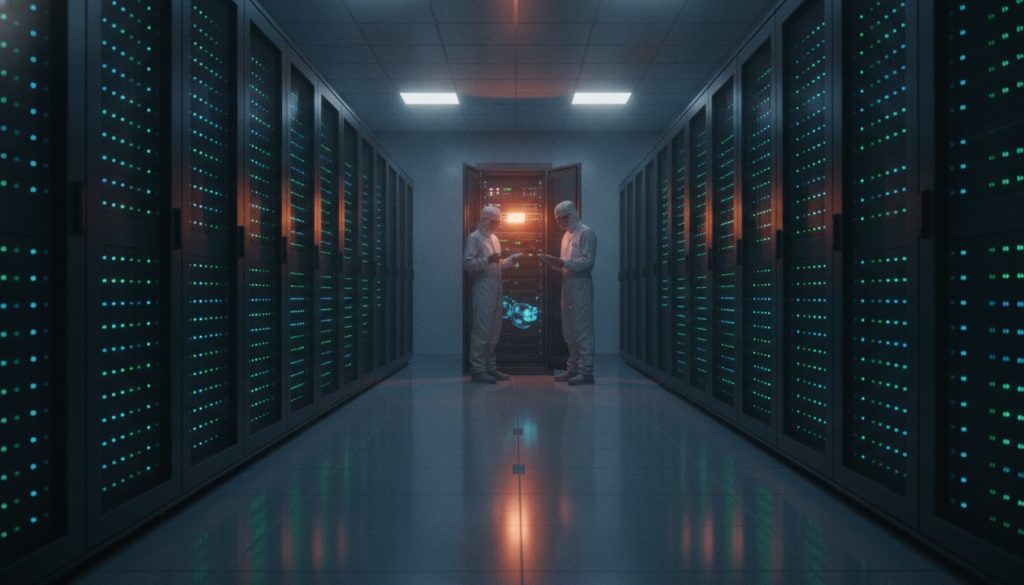
By February 2026, the mandatory adoption of the GBI Data Centre Tool Version 2.0 has transformed data center compliance standards Malaysia from a voluntary framework into a rigorous technical requirement. Operating a facility without a formal Operations Control Programme under the updated ISO 14644-5:2025 standards is no longer a calculated risk; it is a direct threat to infrastructure reliability. You understand that the friction between local MCMC licensing and international ISO certifications often creates a complex regulatory fog. This tension, coupled with the risk of hardware failure due to non-compliant environmental conditions, demands a meticulous approach to facility management.
This guide serves as your definitive roadmap to clear that confusion, offering an expert-led breakdown of the mandatory and recommended standards governing Malaysian data center operations. We will analyze the critical shifts in energy efficiency mandates, the technical requirements for Cleanroom Performance Testing (CPT), and the precise maintenance protocols necessary to safeguard your hardware from environmental non-compliance. By the end of this breakdown, you’ll possess a structured plan to achieve and maintain the certifications required for operational excellence and long-term sustainability.
Key Takeaways
- Understand the critical technical requirements of ISO 14644-1 and ISO 27001:2022 to maintain superior air quality and information security within your facility.
- Learn how to navigate the evolving landscape of data center compliance standards Malaysia, specifically regarding MS 1755 and the latest MCMC sustainability guidelines.
- Discover how Cleanroom Performance Testing (CPT) and professional ISO cleaning services act as the primary defense against contamination-related hardware downtime.
- Identify how Testing, Adjusting, and Balancing (TAB) improves airflow management to meet the stringent energy efficiency targets set for 2026.
- Gain a clear roadmap for integrating specialized technical assessments and infrastructure upgrades to achieve and sustain high-level compliance certifications.
The Evolving Landscape of Data Center Compliance in Malaysia
Data center compliance within the Malaysian digital economy framework represents a rigorous adherence to technical, environmental, and security protocols designed to ensure zero-fail performance. As the nation transitions toward a high-income digital economy, these standards serve as the bedrock for operational integrity. Governing bodies like the Malaysian Communications and Multimedia Commission (MCMC) and SIRIM Berhad now enforce stricter oversight to align local facilities with global expectations. This shift moves beyond basic uptime. It focuses on a philosophy of mission-critical excellence where every component, from air filtration to physical security, meets verified benchmarks.
The surge in investment, totaling RM144.4 billion between 2021 and mid-2025, has positioned Malaysia as a primary regional hub for global hyperscalers. This influx necessitates a standardized approach to data center management to maintain the country’s competitive edge. Operators must now navigate a dual-layered regulatory environment that balances local MCMC guidelines with international ISO certifications. To better understand the regulatory environment, watch this helpful overview of local policies:
Why Compliance is Non-Negotiable for 2026 Operations
Securing comprehensive insurance coverage in 2026 requires demonstrable proof of adherence to data center compliance standards Malaysia. Insurers increasingly view non-compliance as a liability, often raising premiums or denying claims for facilities that fail to meet ISO 14644-1 cleanliness standards. Beyond financial protection, standardized maintenance is essential for hardware warranty preservation. Most Tier-1 hardware vendors mandate specific environmental conditions; failing to document these through professional testing can void multi-million ringgit warranties. Adhering to these protocols directly supports the national goal of becoming a high-tech regional leader by fostering a reliable infrastructure for AI and cloud computing.
The Consequences of Non-Compliance in Critical Environments
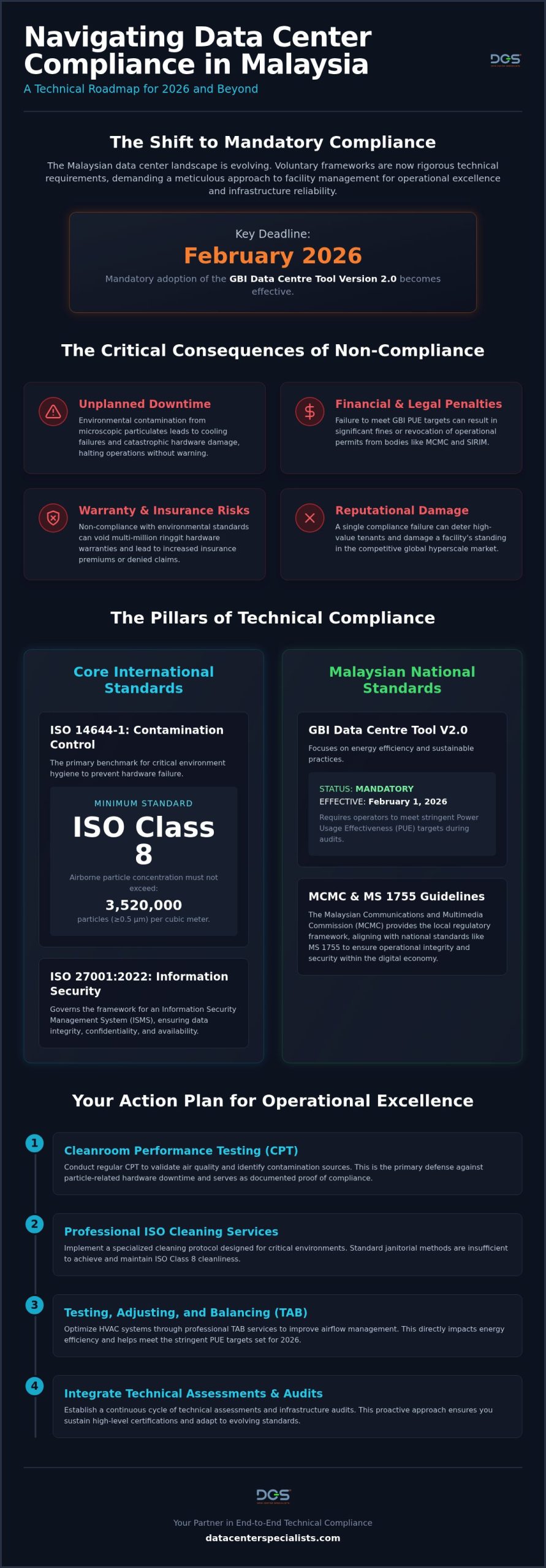
The most immediate threat of non-compliance is unplanned downtime triggered by environmental contamination. Microscopic particulates cause cooling failures and catastrophic hardware damage. Facilities that ignore the GBI Data Centre Tool Version 2.0 mandates, effective as of February 1, 2026, face severe legal and financial repercussions during energy efficiency audits. Failure to meet Power Usage Effectiveness (PUE) targets can result in significant fines or the revocation of operational permits. In the global hyperscale market, a single compliance failure causes irreparable reputational damage. It makes it difficult to attract high-value tenants who prioritize technical discipline and risk mitigation.
Core International Standards: ISO 14644 and ISO 27001
International benchmarks provide the technical foundation for any facility aiming to meet the rigorous data center compliance standards Malaysia requires. These certifications don’t just validate security; they govern the physical air quality and operational consistency that prevent catastrophic hardware failure. While local guidelines provide the legal framework, ISO standards offer the granular technical specifications needed for mission-critical reliability. Adherence to these standards ensures that Malaysian facilities remain competitive in a global market that prioritizes technical discipline.
ISO 14644-1: Contamination Control and Uptime
ISO 14644-1 is the primary benchmark for critical environment hygiene. Within the data center context, maintaining an ISO Class 8 environment is the minimum standard for operational safety. This classification dictates that the concentration of airborne particles 0.5 μm or larger must not exceed 3,520,000 per cubic meter. Achieving this level of purity isn’t possible through standard janitorial methods. It requires specialized decontamination protocols that target sub-floor voids and internal server rack surfaces. Without professional intervention, accumulated zinc whiskers and ferrous dust will eventually cause short circuits and thermal throttling. Under the latest ISO 14644-5:2025 requirements, operators must now implement a formal Operations Control Programme (OCP) to manage these risks proactively.
Security and Management Standards (ISO 27001 & 9001)
Managing physical access and digital assets falls under the jurisdiction of ISO/IEC 27001. This standard requires a comprehensive risk management process that bridges the gap between digital firewalls and physical perimeter security. Organizations must also consider the 2024 climate-action amendment, which requires climate change to be integrated into the information security management system. With the transition period for the 2022 version ending in late 2025, facilities operating in 2026 must be fully aligned with these updated controls to maintain their certification.
Complementing security is ISO 9001, which standardizes facility management processes to minimize human error. It ensures that maintenance schedules and emergency response protocols are documented and repeatable. Additionally, as Malaysia pushes toward its 2026 sustainability targets, ISO 14001 (Environmental Management) has transitioned into a mandatory component of green data center certification. It focuses on resource efficiency and waste reduction, directly supporting the PUE targets set by Malaysian authorities. Ensuring your facility meets these stringent benchmarks requires more than just internal checklists. Engaging a specialized compliance partner for technical assessments is the most reliable way to ensure audit readiness and hardware longevity.
Malaysian National Standards: MS 1755 and MCMC Guidelines
While international ISO certifications provide a global baseline, data center compliance standards Malaysia are specifically anchored by MS 1755. This national standard acts as the definitive blueprint for infrastructure within the country, ensuring that facilities are built to withstand local environmental challenges while maintaining global reliability benchmarks. It aligns closely with the TIA-942 framework, categorizing data centers into tiers based on their redundancy and fault tolerance. Adhering to MS 1755 is a strategic requirement for any operator seeking to integrate with the Malaysian government digital economy initiatives or attract high-value local enterprise clients.
MS 1755: The Blueprint for Local Infrastructure
MS 1755 dictates rigorous technical requirements for cooling systems, power redundancy, and fire suppression tailored to the Malaysian climate. It provides the necessary framework for achieving Tier 1 through Tier 4 certification, directly influencing the architectural implementation of DCS Smart Modular Containment systems. By prioritizing airflow efficiency and physical separation, these standards ensure that high-density server environments remain stable. The certification process involves local accredited bodies conducting meticulous on-site inspections to verify that every infrastructure component, from the UPS to the CRAC units, functions within specified tolerances.
Sustainability and Energy Efficiency Mandates
The MCMC Green Data Center Guidelines have introduced aggressive targets for Power Usage Effectiveness (PUE) that all operators must address by 2026. With the mandatory adoption of the GBI Data Centre Tool Version 2.0, effective February 1, 2026, facilities are now required to submit regular sustainability audits. These mandates focus on minimizing resource waste through precise monitoring and infrastructure optimization. Meeting these targets requires a methodical approach to facility management, often beginning with a comprehensive Data Center Energy Assessment to identify thermal inefficiencies.
Implementing specialized hardware like DCS Smart Racks allows for superior heat management, directly aligning your facility with the Ministry of Investment, Trade and Industry (MITI) sustainability guidelines. These technical upgrades are no longer optional; they are essential for maintaining operational licenses and demonstrating a commitment to the national green agenda. Precision in energy management reduces operational overhead while ensuring your facility contributes to the national goal of sustainable high-tech growth.
Finally, the Personal Data Protection Act (PDPA) influences physical facility design by mandating strict access controls and data residency protocols. Compliance here means ensuring the physical layout of the server hall prevents unauthorized access to sensitive hardware. This bridges the gap between infrastructure standards and legal data protection requirements, ensuring that your facility is secure from both a technical and a regulatory standpoint.
Operationalizing Compliance: Testing, Cleaning, and Audits
Transitioning from regulatory theory to operational reality requires a disciplined schedule of technical assessments and maintenance. Adhering to data center compliance standards Malaysia isn’t a one-time event; it’s a continuous cycle of verification. Facility managers must move beyond surface-level aesthetics and focus on the microscopic environment where hardware resides. This operational shift demands specialized expertise that general janitorial services simply cannot provide. Achieving audit readiness in 2026 involves a three-pronged approach: technical testing, precision decontamination, and airflow optimization.
Cleanroom Performance Testing (CPT) Protocols
Particle count testing is mandatory for maintaining ISO 14644 certification, as it provides the empirical data required during compliance audits. CPT identifies hotspots and airflow bottlenecks that often go unnoticed by standard BMS sensors. By measuring particulate levels at different heights and locations, technicians can pinpoint exactly where filtration systems are failing or where external contaminants are entering the hall. Cleanroom Performance Testing (CPT) validates the effectiveness of contamination control measures by providing a verifiable snapshot of environmental stability. Regular testing ensures that your facility remains within the Class 8 limits required for mission-critical uptime.
The Importance of Underfloor and Rack Decontamination
Dust accumulation in raised floor systems represents a hidden risk that leads to silent hardware failure. These voids often act as plenums for cold air; when they become contaminated, they distribute particulates directly into server intakes. Professional server room cleaning involves specialized HEPA-filtered vacuums and anti-static agents designed for sensitive electronics. Integrating these services into your standard operational procedure (SOP) prevents the buildup of conductive debris that causes short circuits. You should replace general cleaning staff with technicians trained in Data Center Professional ISO Cleaning Service protocols to ensure that every rack and tile meets international hygiene benchmarks.
Airflow Management and TAB Services
Testing, Adjusting & Balancing (TAB) is the primary mechanism for optimizing cooling efficiency and reducing Power Usage Effectiveness (PUE). There is a direct link between airflow balancing and meeting the MS 1755 standards required by Malaysian authorities. In high-density rack environments, air tends to bypass equipment or recirculate, creating thermal stress. TAB services rectify these imbalances by adjusting fan speeds and damper positions to ensure that cold air reaches its intended destination. This precision management is essential for meeting the 2026 sustainability targets and ensuring your cooling infrastructure isn’t working harder than necessary. To ensure your facility is prepared for its next regulatory review, consider scheduling a technical compliance audit to identify and resolve existing infrastructure gaps.
Partnering with DCS for End-to-End Technical Compliance
Data Center Specialists (DCS) operates as a primary guardian for facilities navigating the intricate requirements of data center compliance standards Malaysia. We don’t just provide services; we deliver the technical certainty required for mission-critical continuity. Our approach integrates specialized hardware with expert maintenance protocols, ensuring that your facility meets both local MCMC guidelines and international ISO benchmarks. This technical synergy is why global hyperscalers and leading financial institutions in Malaysia trust us to protect their high-value infrastructure. We understand that in a high-stakes digital economy, compliance is the only path to unwavering reliability.
Achieving compliance requires more than just meeting a checklist. It demands an understanding of how environmental variables impact hardware longevity. By utilizing our Data Center Professional ISO Cleaning Service, operators can eliminate the particulate risks that threaten certification and operational uptime. We provide the specialized expertise needed to maintain an ISO Class 8 environment, a standard that is increasingly scrutinized during national energy and performance audits. Our team ensures that your facility remains a controlled environment where technical failure is mitigated through precision.
Our Specialized Compliance Services
Our service portfolio is designed to address every technical layer of the compliance audit. We provide Cleanroom Performance Testing (CPT) to verify air quality and Data Center Energy Assessments to identify PUE inefficiencies. These assessments are critical for meeting the 2026 sustainability mandates introduced by the Ministry of Investment, Trade and Industry (MITI). Beyond testing, we supply and install technical infrastructure such as DCS Smart Modular Containment systems and DCS Smart Racks. These solutions are engineered for regulatory adherence, offering the precise airflow management required to optimize energy usage and hardware cooling. We deliver the documentation and proof points your facility needs to survive the most rigorous audits.
- Executing Testing, Adjusting & Balancing (TAB) to ensure HVAC systems meet MS 1755 standards.
- Providing empirical data from Cleanroom Performance Testing (CPT) to validate contamination control.
- Installing DCS Smart Modular Containment to optimize airflow and drive down PUE.
Securing Your Uptime Excellence
Investing in specialized technical maintenance offers a long-term ROI that far outweighs the costs of unplanned downtime or failed audits. DCS bridges the gap between raw infrastructure and refined compliance, acting as your strategic partner in operational success. We ensure that your facility isn’t just compliant on paper but resilient in practice. For a deeper look at maintaining these standards through professional hygiene, read The Definitive Guide to Data Center Cleaning Services in Malaysia (2026). To ensure your facility meets the 2026 regulatory landscape, contact Data Center Specialists today for a comprehensive compliance assessment.
Securing Your Operational Future in Malaysia
Adhering to data center compliance standards Malaysia is no longer just a regulatory formality; it’s the technical foundation for sustained uptime and hardware longevity. By integrating international ISO 14644 air quality benchmarks with national MS 1755 infrastructure requirements, operators can navigate the 2026 landscape with confidence. Success in this high-stakes environment requires moving beyond general maintenance toward specialized Cleanroom Performance Testing and professional decontamination. This proactive approach ensures your facility meets MCMC sustainability mandates while protecting mission-critical assets from environmental degradation.
As a specialist in ISO 14644-1 critical environment cleaning, Data Center Specialists (DCS) has served as mission-critical infrastructure experts since 2008. We’re trusted by hyperscalers and leading financial institutions to bridge the gap between complex regulatory demands and operational reality. Don’t leave your facility’s certification to chance. Ensure Your Facility Meets 2026 Compliance Standards—Consult Our Specialists to safeguard your technical environment today. Your commitment to precision now defines your competitive edge for the years ahead.
Frequently Asked Questions
What are the mandatory data center standards in Malaysia?
Mandatory data center compliance standards Malaysia include MS 1755 for infrastructure and the MCMC Application Service Provider Class license for cloud providers. Since February 2026, compliance with the GBI Data Centre Tool Version 2.0 is mandatory for all registered projects. Operators must also adhere to the Personal Data Protection Act 2010 to ensure physical security and data residency. These frameworks work together to establish a baseline for operational safety and national digital integrity.
How often should a data center undergo ISO 14644-1 particle count testing?
Most facilities should undergo ISO 14644-1 particle count testing at least annually to maintain their certification status. However, the updated ISO 14644-2:2015 standard recommends more frequent monitoring based on a specific risk assessment of your environment. High-density facilities or those with frequent equipment changes often opt for semi-annual testing. Consistent verification ensures that your contamination control protocols remain effective against microscopic particulates that threaten hardware reliability.
What is the difference between MS 1755 and TIA-942?
MS 1755 is the Malaysian National Standard specifically designed to address the local climate and regulatory landscape of the country. While it aligns with the tiering structures of international frameworks like TIA-942, it incorporates specific requirements for local power redundancy and fire suppression. TIA-942 remains a global benchmark, but MS 1755 is the primary blueprint for facilities seeking to integrate with Malaysian government digital initiatives and national standards.
Does MCMC require data centers to meet specific PUE targets in 2026?
MCMC and the Ministry of Investment, Trade and Industry (MITI) now enforce specific PUE targets through the GBI Data Centre Tool Version 2.0. As of February 2026, registered data center projects must demonstrate resource efficiency to maintain their standing. These mandates require operators to actively monitor Power Usage Effectiveness (PUE) and Water Usage Effectiveness (WUE). Failure to meet these energy efficiency benchmarks can lead to regulatory friction and increased operational costs.
Why is professional ISO cleaning required for compliance instead of standard janitorial services?
General janitorial services lack the specialized equipment and training required to manage critical IT environments. Standard cleaning often introduces static and redistributes dust through non-HEPA vacuums. Professional ISO cleaning utilizes HEPA-filtered vacuums and anti-static agents to meet the strict particle limits defined by ISO 14644-1. This technical approach is essential for preventing zinc whiskers and ferrous dust accumulation, which are leading causes of silent hardware failure in server halls.
Can DCS help our facility achieve green data center certification?
DCS provides the technical assessments and hardware necessary to achieve green data center certifications. We conduct comprehensive Data Center Energy Assessments to identify thermal inefficiencies and airflow bottlenecks. Our team then implements DCS Smart Racks and DCS Smart Modular Containment systems to optimize cooling distribution. These solutions directly improve your facility’s PUE, helping you meet the sustainability mandates set by the MCMC and the Ministry of Investment, Trade and Industry.
What is Cleanroom Performance Testing (CPT) and why is it vital for IT health?
Cleanroom Performance Testing (CPT) is a technical evaluation that verifies air quality through precise particle count measurements. It’s vital for IT health because it identifies environmental risks that standard sensors often miss. By ensuring your facility adheres to ISO 14644 standards, CPT helps prevent micro-dust from clogging heat sinks or causing short circuits. Regular testing provides the empirical data required to validate your contamination control measures during a compliance audit.
How does Testing, Adjusting, and Balancing (TAB) impact data center compliance?
Testing, Adjusting, and Balancing (TAB) is the process of optimizing HVAC performance to ensure precise airflow delivery throughout the facility. It impacts compliance by ensuring your cooling infrastructure meets the efficiency requirements of MS 1755. Proper balancing prevents hot spots and reduces over-cooling, which is essential for achieving the PUE targets mandated by 2026 regulations. TAB provides the technical verification that your mechanical systems are operating according to their design specifications.