
As Malaysia solidifies its position as a regional AI hub with over 1,039 MW of capacity currently under construction, the margin for operational error has effectively vanished. For facility managers overseeing these high-density environments, the difference between 100% uptime and a catastrophic outage often lies in the rigour of your data center maintenance checklist. You already know that unplanned downtime isn’t just a technical failure; it’s a significant financial risk that can cost your organization considerable RM in lost productivity and potential hardware damage.
It’s a constant challenge to balance the accumulation of micro-contamination in high-density racks with the need for optimized cooling and lower PUE. This article provides the technical protocols and ISO 14644-1:2015 standards required to master your environment. You’ll gain an audit-ready maintenance framework that prioritizes hardware longevity and energy efficiency. We’ll break down the essential physical decontamination procedures, airflow testing, and mechanical assessments necessary to safeguard your mission-critical IT infrastructure against the rigorous demands of 2026.
Key Takeaways
- Establish a proactive defense strategy by contrasting the manageable costs of scheduled maintenance against the catastrophic financial impact of unplanned downtime.
- Execute precise daily and weekly protocols for UPS systems and cooling units to ensure continuous power delivery and thermal stability across your facility.
- Implement a technical data center maintenance checklist aligned with ISO 14644-1 Class 8 standards to mitigate the risks of hardware-damaging micro-contamination.
- Utilize Testing, Adjusting & Balancing (TAB) to identify hidden hotspots and optimize airflow management, which is essential for high-density AI workloads.
- Transition from basic cleaning routines to a professional, audit-ready maintenance framework that leverages specialized expertise to protect mission-critical IT infrastructure.
The Strategic Role of Preventive Maintenance in Mission-Critical Facilities
Data center maintenance is no longer a back-office utility task. In the context of Malaysia’s rapid infrastructure expansion, it’s a proactive defense against environmental and mechanical failure. Relying on reactive repairs is a high-risk strategy that ignores the reality of modern uptime requirements. While a comprehensive data center maintenance checklist requires an upfront investment, it’s negligible compared to the catastrophic expense of unplanned downtime. For a hyperscale facility, a single hour of outage can result in losses reaching millions of RM, alongside irreparable damage to brand reputation and service level agreements (SLAs).
Effective preventive maintenance services require protocols that far exceed general facility standards. We define this as Mission-Critical Hygiene. It’s a specialized discipline where contamination control and mechanical precision are treated as core pillars of operational reliability. General janitorial services lack the technical literacy to handle sensitive IT environments. This makes specialized engineering-led maintenance the only viable path for Tier 3 and Tier 4 facilities that promise 100% availability.
Understanding the Uptime Imperative
Minor environmental shifts often trigger Tier 1 and Tier 2 outages before sensors register a critical alarm. For instance, a slight increase in particulate matter can lead to airflow blockages, causing localized hotspots. As Malaysia’s data center capacity under construction surpasses 1,039 MW, the prevalence of high-density racks increases. These units generate intense heat. They require a higher maintenance frequency to prevent thermal throttling. Regular inspections also directly impact Power Usage Effectiveness (PUE). By ensuring cooling loops are clear and airflow is unobstructed, operators can significantly reduce energy overhead and operational costs.
The Evolution of Maintenance Standards for 2026
The landscape of data center preventive maintenance has shifted toward a hybrid model. This combines real-time automated monitoring with specialized physical inspections. Legacy checklists, designed for lower-density facilities of the previous decade, no longer suffice for modern hyperscale environments. A modern data center maintenance checklist must incorporate granular contamination testing and airflow balancing to meet the demands of AI-driven workloads. Audit-ready documentation is now a non-negotiable requirement for regulatory compliance and insurance underwriting. Precise record-keeping ensures that every protocol, from UPS battery testing to underfloor cleaning, is verifiable during a site audit. This transparency builds confidence with stakeholders and ensures long-term asset protection.
Core Infrastructure Maintenance: Power, Cooling, and Connectivity
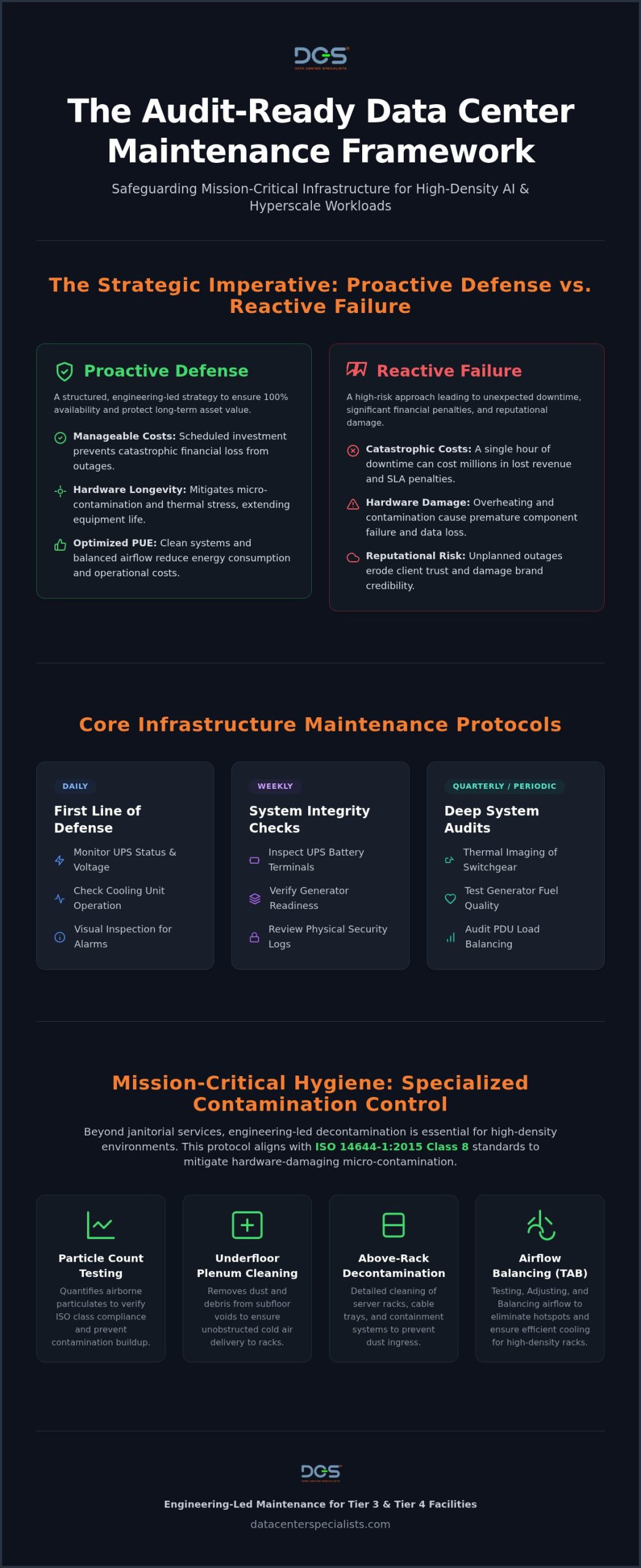
The physical foundation of a mission-critical facility dictates its operational ceiling. Even the most advanced software-defined networking cannot compensate for a failing UPS battery or a clogged cooling coil. A robust data center maintenance checklist must prioritize the mechanical and electrical layers where the majority of Tier 1 failures originate. Daily monitoring of Uninterruptible Power Supply (UPS) status lamps and battery voltage levels is the first line of defense. These checks should escalate to weekly inspections of electrolyte levels and terminal connections to identify corrosion or swelling before a discharge event occurs.
Electrical System Integrity and UPS Protocols
Precision is required when managing the power chain. Thermal imaging of electrical switchgear identifies high-resistance connections that are invisible to the naked eye. This non-invasive testing prevents arc flash incidents and localized fires. Beyond the UPS room, verifying generator readiness is vital in the Malaysian climate, where high humidity can lead to fuel degradation and microbial growth in storage tanks. Ensure your fuel quality is tested quarterly and that PDU load balancing is audited to prevent circuit overloads during peak AI workload spikes. A specialized data center maintenance assessment can identify these electrical vulnerabilities before they escalate into service disruptions.
HVAC and Thermal Management Audits
Cooling efficiency directly correlates with hardware longevity. Filter replacement schedules must be strictly enforced, as particulate accumulation forces CRAC and CRAH units to work harder, increasing energy consumption. Inspect evaporator coils for signs of scaling or microbial buildup, which significantly reduces heat transfer efficiency. In facilities transitioning to high-density liquid cooling, checking for leaks in chilled water loops and secondary fluid circuits is a high-priority task. Maintaining strict ISO 14644-1 cleanliness standards within these mechanical areas prevents the ingress of particulates that degrade evaporator efficiency and airflow sensor accuracy.
Connectivity audits often fall to the bottom of a data center maintenance checklist, yet poor cable management is a primary cause of restricted airflow and “ghost” hotspots. Physical layer inspections should look for discoloured connectors or brittle jacketing, which are early warning signs of hardware fatigue and excessive heat exposure. Use fan resonance testing on server chassis to detect bearing wear. If a rack fan is vibrating excessively, it’s likely failing. Addressing these micro-level mechanical issues during scheduled windows prevents the chaos of emergency hardware replacements during peak operational hours.
Specialized Contamination Control: The ISO 14644-1 Maintenance Standard
The presence of microscopic particulates is often the primary cause of “unexplained” hardware failures. While many facility managers focus on power and cooling, a technically complete data center maintenance checklist must incorporate the ISO 14644-1:2015 standard. Specifically, Class 8 air cleanliness is the recognized baseline for protecting sensitive electronics. Achieving this level of precision requires moving beyond visual cleanliness to measurable decontamination protocols.
General janitorial staff should never enter a mission-critical IT environment. Their equipment, typically designed for domestic or office use, lacks the filtration necessary for these spaces. Standard vacuums often vent micro-dust back into the air, while improper chemicals can introduce volatile organic compounds (VOCs) that corrode circuit boards. Professional decontamination requires specialized HEPA-filtered vacuums capable of capturing particles down to 0.3 microns and lint-free microfibre materials that don’t shed. This ensures that the environment remains a controlled space rather than a source of hardware-damaging pollutants.
Underfloor and Raised Floor Decontamination
The underfloor plenum acts as the “lungs” of the facility, distributing pressurized cold air to the racks. If this void is neglected, it becomes a reservoir for construction debris and ambient dust. This accumulation isn’t just an efficiency issue; it’s a significant fire hazard. In the event of an electrical fault, underfloor dust can act as a fuel source. Cleaning these voids requires a meticulous, non-disruptive process that avoids disturbing live cabling or triggering sensitive smoke sensors. For a deeper look at local best practices, consult The Definitive Guide to Data Center Cleaning Services in Malaysia (2026).
Mitigating Zinc Whiskers and Micro-Dust
Legacy raised floor tiles, particularly those with galvanized steel finishes, are prone to “zinc whiskers.” These microscopic filaments break off and become airborne, eventually landing on circuit boards where they cause intermittent shorts and permanent damage. Identifying these risks requires more than a visual scan. It demands rigorous particle count testing and professional data center cleaning protocols. By integrating Cleanroom Performance Testing (CPT) into your data center maintenance checklist, you can verify that your environment remains within safe limits. This proactive approach prevents the silent hardware failures that often lead to expensive, unplanned RM outlays for server replacements.
Technical Testing and Balancing: Optimizing Airflow for High-Density Racks
High-density AI infrastructure requires more than just functional cooling units; it demands precise airflow management to protect sensitive hardware. Testing, Adjusting & Balancing (TAB) is the engineering discipline that ensures your cooling capacity actually reaches the server inlets. While environmental sensors provide a general overview, they often miss localized hotspots caused by turbulent air or pressure imbalances. Integrating TAB into your annual data center maintenance checklist allows for the empirical verification of airflow distribution across the white space, ensuring that every rack receives the exact volume of air required for its specific workload.
Effective airflow optimization also relies on physical barriers to prevent the mixing of hot and cold air. DCS Smart Modular Containment systems work in tandem with TAB to maintain the necessary static pressure in the cold aisle. Without this synergy, even the most powerful CRAH units will suffer from bypass air, leading to inefficient cooling and inflated energy costs. This technical approach moves beyond basic maintenance into the realm of specialized facility engineering, where airflow is controlled with surgical precision to support mission-critical uptime.
Airflow Balancing for Maximum Cooling Efficiency
The TAB process begins with measuring cubic feet per minute (CFM) at the individual floor tile level using calibrated flow hoods. This data reveals where air is being wasted in underpopulated rows and where high-density racks are being starved. Engineers utilize proportional balancing techniques to adjust dampers and floor grilles, matching the air supply to the rack-specific heat loads. This granular approach is essential for mission-critical facilities across Malaysia that are scaling their AI capabilities and facing increased thermal demands. For a deeper technical audit, consider a comprehensive specialized engineering testing phase to recalibrate your entire airflow strategy and reclaim lost cooling capacity.
Cleanroom Performance Testing (CPT) Protocols
While TAB focuses on air volume and pressure, Cleanroom Performance Testing (CPT) validates the environmental integrity of the facility. This involves calculating air change rates to ensure pollutants are purged effectively and conducting recovery time testing to observe how quickly the room returns to ISO standards after a contamination event. HEPA filter leak testing is also mandatory for critical spaces to prevent the bypass of unfiltered air into the server room. Integrating these technical tests into your data center maintenance checklist ensures that environmental integrity is measured, not just assumed. Operators should review the latest cleanroom performance testing CPT protocols to maintain strict compliance with ISO 14644-1:2015 revisions.
Maintain peak operational efficiency by booking a professional airflow and thermal audit to identify hidden vulnerabilities in your cooling chain.
Implementing Your Maintenance Strategy with Data Center Specialists
Transitioning from a manual data center maintenance checklist to a professional, engineering-led program is the only way to guarantee 100% uptime in a hyperscale environment. While internal teams handle daily monitoring, specialized decontamination and technical balancing require expertise honed over decades. Founded in 2008, Data Center Specialists (M) Sdn Bhd (DCS) brings nearly twenty years of specialized knowledge to every mission-critical project. Partnering with a specialist that offers national coverage across Malaysia ensures that your facilities, across all your locations, adhere to a uniform standard of technical excellence.
Strategic infrastructure also plays a vital role in long-term operational success. Utilizing solutions like Data Center Specialists (M) Sdn Bhd (DCS) Smart Racks and Data Center Specialists (M) Sdn Bhd (DCS) Smart Modular Containment doesn’t just improve cooling; it simplifies the maintenance regime. These systems are designed for accessibility and airflow precision, reducing the time required for inspections and cleaning. This integrated approach ensures that your physical assets work in harmony with your maintenance protocols, creating a resilient environment for mission-critical IT infrastructure that can scale with AI-driven demands.
Professional ISO Cleaning and Decontamination
Our Data Center Professional ISO Cleaning Service is the gold standard for facility hygiene. We go beyond surface-level cleaning to provide deep decontamination of underfloor voids, rack interiors, and ceiling plenums using specialized HEPA-filtered equipment. Upon completion, we issue a certificate of cleanliness. This document is essential for audit compliance and provides verifiable proof that your facility meets ISO 14644-1:2015 standards. To ensure your environment remains within these strict parameters, you can schedule a specialized maintenance session with our technical team to address specific contamination risks.
Schedule a Comprehensive Facility Assessment
Optimization begins with empirical data. We invite facility managers and owners to contact Data Center Specialists (M) Sdn Bhd (DCS) for a professional Testing, Adjusting & Balancing (TAB) service to recalibrate airflow and eliminate persistent hotspots. In a market where power availability is becoming a constraint, conducting a Data Center Energy Assessment is a high-impact step toward lowering your PUE and reducing operational RM expenditure. Our engineering team provides a clear roadmap for these assessments, ensuring minimal disruption to your live operations while delivering actionable insights for long-term reliability. By identifying inefficiencies in your cooling chain, we help you reclaim power capacity for future expansion. Contact Data Center Specialists (M) Sdn Bhd (DCS) today to begin your facility audit and secure your mission-critical uptime.
Securing Operational Uptime for the AI Era
The evolution of facility management requires a shift from reactive repairs to a technically rigorous data center maintenance checklist that prioritizes environmental integrity. By integrating ISO 14644-1:2015 standards and professional airflow balancing, you eliminate the micro-contamination and thermal hotspots that threaten high-density IT infrastructure. These protocols don’t just protect hardware; they optimize energy efficiency and ensure your facility remains audit-ready in an increasingly regulated landscape.
As Malaysia expands its mission-critical capacity, partnering with a seasoned expert is the most effective way to safeguard your uptime. Founded in 2008, Data Center Specialists provides nearly two decades of mission-critical expertise and specialized ISO 14644-1 certified decontamination. Our team offers comprehensive national coverage across Malaysia, delivering the precision required for hyperscale and financial environments.
Don’t leave your infrastructure’s longevity to chance. We invite you to contact Data Center Specialists for a professional ISO maintenance audit to assess your current protocols and enhance operational reliability. Your facility deserves the peace of mind that comes from specialized engineering expertise.
Frequently Asked Questions
How often should a data center maintenance checklist be performed?
Perform critical checks daily for power and cooling status to ensure immediate stability. A comprehensive data center maintenance checklist should follow a tiered schedule: daily visual inspections, weekly UPS battery tests, and quarterly professional decontamination. High-density environments built for AI require more frequent airflow audits to manage intense heat loads. Regular scheduling prevents the accumulation of micro-dust that triggers silent hardware failures and ensures your facility remains audit-ready throughout the year.
What is the difference between specialized data center cleaning and general janitorial services?
Specialized data center cleaning focuses on contamination control using HEPA-filtered vacuums and lint-free materials to meet ISO 14644-1 standards. General janitorial services often use domestic vacuums that vent micro-dust back into the air or wet mops that introduce humidity and corrosive chemicals. Professional specialists understand mission-critical risks like zinc whiskers and static discharge. They ensure that physical decontamination doesn’t disrupt live IT operations or trigger sensitive smoke detection systems.
Why is ISO 14644-1 certification important for server rooms?
ISO 14644-1:2015 provides the foundational framework for classifying air cleanliness in controlled environments. For server rooms, achieving Class 8 or better is vital to prevent microscopic particulates from settling on sensitive circuitry. This certification serves as verifiable proof for stakeholders and insurers that your facility maintains the technical hygiene required for maximum uptime. It mitigates the risk of ghost hardware failures caused by conductive dust or chemical corrosion in high-density racks.
Can maintenance be performed while the data center is live?
Yes, professional maintenance from Data Center Specialists (M) Sdn Bhd (DCS) is designed to be performed in live, mission-critical environments without causing service interruptions. Specialized engineers use non-disruptive techniques for underfloor cleaning and rack decontamination. By following a rigorous data center maintenance checklist, operators can identify cooling inefficiencies and electrical hotspots while systems remain operational. This proactive approach ensures continuous availability while addressing the physical risks that lead to unplanned downtime in modern hyperscale facilities across Malaysia.
What are the most common causes of hardware failure related to maintenance?
Environmental contamination and cooling failures are the primary drivers of maintenance-related hardware issues. Microscopic particulates like zinc whiskers can cause intermittent short circuits on motherboards, leading to permanent damage. Additionally, neglected airflow management results in localized hotspots that force components to operate beyond their thermal limits. Regular physical decontamination and airflow balancing are essential to prevent these silent failures and extend the operational lifespan of your mission-critical IT infrastructure.
How does Testing, Adjusting & Balancing (TAB) improve data center efficiency?
Testing, Adjusting & Balancing (TAB) optimizes the delivery of conditioned air to high-density racks by measuring and recalibrating airflow at the floor tile level. This process eliminates bypass air and ensures that cooling capacity matches the specific heat load of each server row. By resolving pressure imbalances, TAB significantly reduces fan energy consumption and lowers the facility’s Power Usage Effectiveness (PUE). It’s a critical engineering step for maintaining thermal stability in AI-driven environments.
What equipment is necessary for professional data center decontamination?
Professional decontamination, as performed by Data Center Specialists (M) Sdn Bhd (DCS), requires specialized tools that prevent the redistribution of particulates. This includes HEPA-filtered vacuums capable of capturing particles down to 0.3 microns and calibrated laser particle counters for real-time air quality monitoring. Engineers also use anti-static, lint-free microfibre cloths and specialized non-conductive cleaning solutions. Standard domestic or office equipment is prohibited because it lacks the filtration needed to maintain the strict ISO 14644-1 cleanliness standards required for sensitive IT environments.
What is the role of a Cleanroom Performance Test (CPT) in a data center?
A Cleanroom Performance Test (CPT) validates that the data center environment meets its specified cleanliness and pressure requirements. It involves measuring air change rates, testing for HEPA filter leaks, and verifying recovery times after a contamination event. CPT provides the empirical data needed to confirm that your facility’s containment and filtration systems are functioning correctly. This testing is crucial for ensuring that high-density server rooms remain protected against the ingress of external pollutants.