
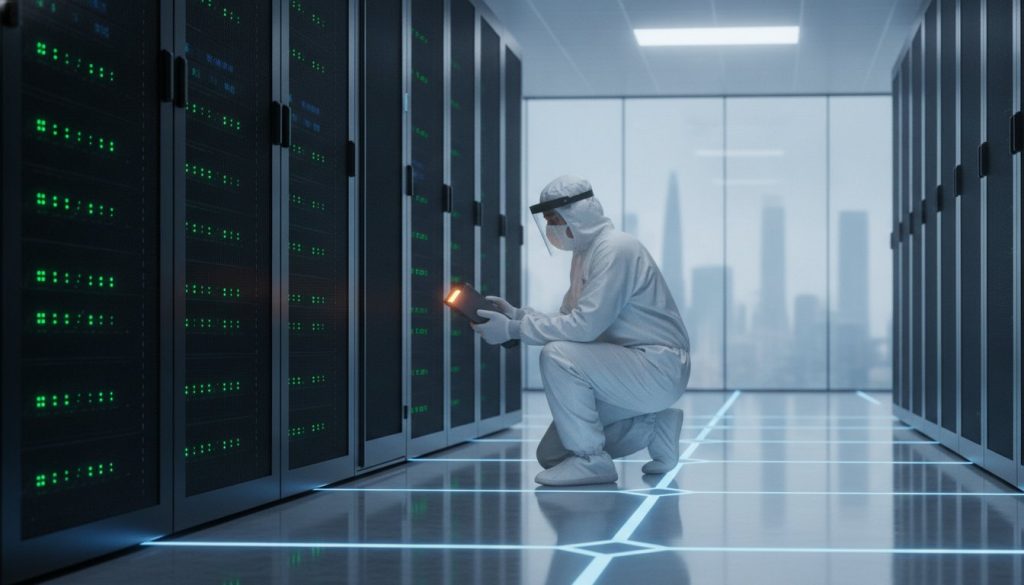
Your most dangerous operational threat isn’t a massive power surge or a cooling system collapse; it’s a layer of microscopic particulate matter smaller than a human hair. While these particles remain invisible to the naked eye, their accumulation leads to catastrophic silent hardware failures and thermal bottlenecks that general janitorial services simply aren’t equipped to handle. You likely recognize that maintaining a pristine environment is critical, yet the path to true ISO 14644-1:2015 compliance often feels obscured by technical jargon and inadequate cleaning protocols.
This guide provides the clarity you need to master data center dust control and secure your mission-critical hardware against contamination. By following these specialized decontamination strategies, you’ll eliminate unexpected downtime, ensure your facility remains audit-ready, and extend the lifespan of your expensive assets. We’ll explore the rigorous requirements of ISO air cleanliness classifications, the necessity of Cleanroom Performance Testing (CPT), and the engineering-led approaches required to maintain a resilient digital infrastructure in Malaysia’s expanding data hubs.
Key Takeaways
- Understand how microscopic particulates like skin cells and metallic fibers create thermal insulation and lead to silent hardware failure.
- Learn the technical requirements of ISO 14644-1:2015 and why Class 8 air cleanliness is the essential benchmark for Malaysian data centers.
- Discover why professional data center dust control requires ESD-safe equipment and HEPA-filtered vacuuming rather than standard janitorial methods.
- Establish a robust contamination control plan starting with Cleanroom Performance Testing (CPT) to identify hidden risks in underfloor and plenum spaces.
- Identify how to select a strategic decontamination partner capable of delivering integrated cleaning, testing, and airflow management solutions.
The Invisible Threat: How Micro-Dust Compromises Mission-Critical Hardware
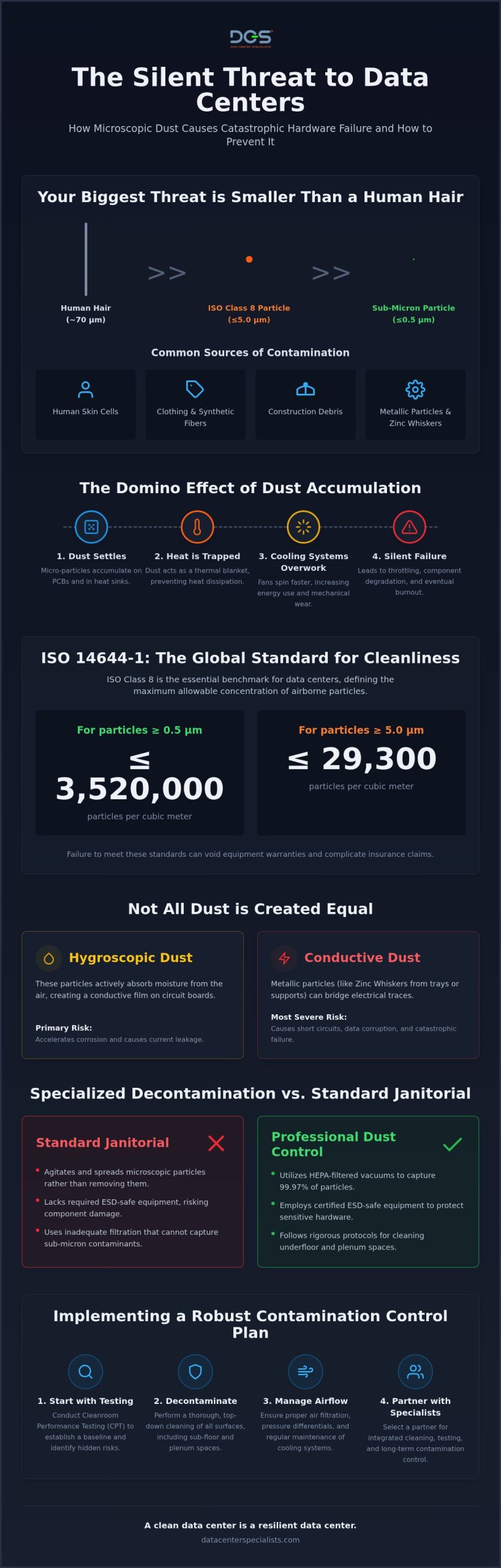
Effective data center dust control begins with the realization that your facility’s air is filled with a complex, destructive cocktail of organic and inorganic matter. This mixture consists of human skin cells, synthetic clothing fibers, and microscopic metallic debris shed from aging infrastructure or recent construction. While these particles are often invisible to the naked eye, they represent a persistent threat to the operational continuity of your server environment. Unlike a sudden power outage, contamination causes what engineers call a silent failure. This is a state where hardware continues to run within nominal temperature ranges while its internal components are slowly suffocating under a layer of particulate matter, leading to eventual fan burnout and component degradation.
In Malaysia’s tropical climate, the presence of these particulates directly impacts your facility’s Power Usage Effectiveness (PUE). As dust accumulates within server chassis, it restricts airflow and compromises cooling efficiency. To compensate for reduced heat dissipation, internal fans must spin at higher RPMs, which increases energy consumption and accelerates mechanical wear. This cycle of inefficiency doesn’t just raise your monthly utility costs; it shortens the refresh cycle of your most expensive hardware assets.
Thermal Insulation and Component Overheating
When dust settles on sensitive Printed Circuit Boards (PCBs), it acts as a thermal blanket. This layer of insulation prevents heat from escaping the processor and memory modules, forcing heat sinks to work harder with less success. Clogged heat sinks are a primary driver of localized hot spots that can trigger automatic thermal throttling, which reduces processing power and slows down mission-critical applications. It’s also vital to recognize the chemical nature of these particles. Hygroscopic dust refers to particles that actively absorb moisture from the surrounding environment, creating a conductive slurry that accelerates circuit board corrosion and leakage currents. This is particularly dangerous in regions with high ambient humidity, where even minor fluctuations in cooling system performance can lead to moisture absorption by settled dust.
The Risk of Conductive Contamination
Conductive contaminants represent the most severe category of particulate risk. These particles, often originating from rusted underfloor supports, zinc-plated cable trays, or construction debris, can bridge the tiny gaps between electrical traces on a circuit board. This leads to intermittent short circuits, data corruption, and catastrophic hardware failure. Adhering to the global standard for data center cleanliness requires more than just surface cleaning; it demands the removal of sub-micron metallic debris that standard industrial vacuums often bypass. One of the most notorious threats is the “zinc whisker,” a microscopic filament that grows from electroplated metal surfaces. These whiskers can break off, become airborne, and be pulled directly into the intake of your servers. Because standard janitorial tools lack the specialized filtration and ESD-safe properties required for data center dust control, they often agitate these conductive particles rather than removing them, increasing the risk of a facility-wide failure.
Navigating ISO 14644-1: The Global Standard for Data Center Cleanliness
Maintaining a mission-critical environment requires more than subjective cleanliness. It demands adherence to ISO 14644-1, the primary international standard for cleanrooms and controlled environments. For most Malaysian facilities, ISO Class 8 serves as the industry-accepted baseline for data center dust control. This standard isn’t merely a suggestion; it’s a rigorous framework that defines the maximum concentration of airborne particles allowed in a given volume of air. Failing to meet these thresholds doesn’t just risk hardware health; it can void equipment warranties and complicate insurance claims following a thermal event.
To achieve a comprehensive contamination control plan, operators must conduct regular particle count audits. These audits ensure that the facility remains within the mandatory limits of 3,520,000 particles per cubic metre for 0.5 μm particles and 29,300 for 5.0 μm particles. Regularity in these measurements provides the data necessary for audit readiness and long-term hardware protection. Without these benchmarks, you’re essentially operating in the dark regarding the invisible risks threatening your uptime.
Understanding ISO Class 8 Requirements
Achieving Class 8 status involves measuring particle concentrations across different operational states. Testing is conducted in three distinct phases. ‘As-built’ refers to the empty facility; ‘at-rest’ describes the facility with equipment installed but idle; and ‘operational’ covers the facility during full load with staff present. While Class 8 is the standard, many hyperscalers in the region now demand ISO Class 7 for high-density zones. This stricter classification requires a tenfold reduction in particulate matter, reflecting the increased sensitivity of modern liquid-cooling and high-density rack systems.
Gaseous Contamination and Chemical Filtration
Effective decontamination extends beyond what the eye can see or what a particle counter can detect. In industrial hubs across Malaysia, sulfur and nitrogen oxides pose a significant threat to hardware reliability. These gases react with humidity to form corrosive acids that attack silver and copper components on circuit boards. ISO standards address this through reactivity monitoring, measuring the rate of corrosion on metal coupons over a 30-day period. Implementing specialized chemical filtration alongside a Data Center Professional ISO Cleaning Service ensures that both particulate and gaseous threats are neutralized before they reach your server intakes. This dual-layered approach is essential for facilities located near manufacturing zones where air quality fluctuates.
Strategic Mitigation: Specialized Cleaning vs. Janitorial Services
Treating a data hall like a standard office environment is a costly mistake that many facility managers realize only after a hardware failure. General janitorial services are designed for aesthetic cleanliness, but they lack the specialized equipment and technical protocols required for a mission-critical environment. Using a standard industrial vacuum, for instance, is often worse than doing nothing at all. These machines typically lack the high-efficiency particulate air (HEPA) filtration necessary to trap sub-micron debris. Instead, they act as dust-redistribution units; they pull in large particles while exhausting fine, invisible dust directly into the server intakes. Professional data center dust control relies on certified HEPA vacuums that capture 99.97% of particles down to 0.3 microns, ensuring that contaminants are removed from the room rather than recirculated.
The risks extend to the tools themselves. Non-specialized cleaning equipment is rarely rated for Electrostatic Discharge (ESD) safety. Plastic vacuum nozzles and synthetic brushes can build up massive static charges that, if discharged near a server rack, can cause immediate motherboard failure or latent component damage. Additionally, the chemicals used by general cleaners often contain volatile organic compounds (VOCs). These substances can off-gas and settle on sensitive optical components, such as fiber-optic transceivers, creating a microscopic film that degrades signal quality. Strategic decontamination requires non-conductive, low-VOC solutions that are specifically formulated for electronic environments.
The Risks of Conventional Cleaning Methods
Standard cleaning techniques like sweeping or dry mopping are fundamentally dangerous in a data center. These methods agitate settled dust and send it airborne, where it’s immediately pulled into the cooling stream. High-moisture cleaning is equally hazardous; excess liquid near raised floor tiles can seep into underfloor plenums, risking short circuits in power cabling or promoting fungal growth. Most general cleaners don’t have the training to understand how their movements affect airflow dynamics, nor do they possess the security clearance to operate safely around open server racks in a live environment.
Professional ISO Decontamination Protocols
Specialized teams follow a disciplined, “Top-Down” decontamination sequence to ensure no area is overlooked. This process begins with ceiling plenums and the tops of server racks, moving down to the floor surfaces, and finally addressing the underfloor voids. By cleaning from the highest point down, technicians ensure that any particles disturbed during the process are eventually captured at the lowest level. We utilize lint-free, specialized micro-fibre materials that are designed to trap and hold particulates. In Malaysia’s high-stakes digital economy, employing background-checked and technically trained personnel is essential. These specialists are well-versed in live-environment protocols, ensuring that data center dust control is executed without risking accidental downtime or compromising facility security.
Implementing a Comprehensive Contamination Control Plan
Proactive data center dust control requires a shift from sporadic, reactive cleaning to a structured, engineering-led lifecycle. You can’t manage what you don’t measure. A holistic contamination control plan integrates physical remediation with precision airflow management to create a self-sustaining clean environment. This strategy moves beyond surface aesthetics and addresses the root causes of particulate migration, ensuring that your facility remains within ISO 14644-1:2015 limits year-round.
Follow these five essential steps to establish a resilient environment:
- Step 1: Conduct Cleanroom Performance Testing (CPT) to establish a scientific baseline of your current particulate levels and identify hidden high-risk zones.
- Step 2: Execute a deep decontamination of the underfloor voids and ceiling plenums to remove legacy debris that standard cleaning misses.
- Step 3: Install DCS Smart Modular Containment systems to physically isolate airflow, which prevents the cross-contamination of particulates between hot and cold aisles.
- Step 4: Implement a recurring Testing, Adjusting & Balancing (TAB) schedule to maintain the pressure integrity of your critical zones.
- Step 5: Deploy integrated environmental sensors to monitor humidity, temperature, and particle counts in real-time, allowing for immediate intervention if thresholds are breached.
Underfloor Decontamination and Airflow Performance
The underfloor void is the primary reservoir for contaminants in many Malaysian facilities. Because this space serves as the pressurized plenum for cooling, any dust settled here is eventually forced up through floor tiles and directly into your server intakes. This phenomenon is often worsened by “bypass airflow,” where air escapes through unsealed cable cutouts, carrying particulates into the white space. Professional underfloor cleaning removes these hidden threats, which improves cooling efficiency and significantly reduces the mechanical strain on your hardware’s internal fans.
Testing, Adjusting & Balancing (TAB) for Pressurisation
Maintaining positive room pressure is your facility’s first line of defense against the ingress of external dust. If your data hall isn’t properly balanced, every opening of a door pulls in unfiltered air from loading docks or office corridors. Through regular Testing, Adjusting & Balancing (TAB), you ensure that your Air Handling Units (AHUs) are operating at their original design specifications. This precision balancing isn’t just about thermal comfort; it’s a technical prerequisite for data center dust control that keeps external pollutants from entering your critical environment.
Partnering with Specialists for Professional Decontamination
Selecting a strategic partner for data center dust control is a decision that directly impacts the resilience of your digital infrastructure. Just as physical hygiene protects your hardware, digital security measures are paramount; industry leaders like CyberOne provide the cybersecurity expertise needed to complement your physical maintenance strategy. Additionally, ensuring the quality of hardware at the source is vital; The Inspection Company offers specialized factory audits and product inspections for businesses sourcing infrastructure from Asia. A qualified specialist does not merely clean surfaces; they understand the complex interplay between particulate physics, airflow dynamics, and hardware sensitivity. The hallmarks of a true expert include a deep literacy in ISO 14644-1:2015 standards, the use of calibrated particle counters for validation, and a team trained specifically in live-environment protocols. By moving away from general janitorial vendors, you transition from simple housekeeping to a technical maintenance discipline that safeguards your uptime.
Professional decontamination provides more than just a clean room. It delivers a verifiable audit trail that is essential for hyperscalers and financial institutions operating in Malaysia. Detailed reporting on particle counts and air quality benchmarks ensures you remain audit-ready at all times, providing the peace of mind that comes from precision. This documentation is often a prerequisite for maintaining equipment warranties and meeting the stringent compliance requirements of international insurers.
The most effective contamination control strategies are those that integrate physical cleaning with advanced infrastructure. Utilizing DCS Smart Modular Containment systems allows you to create physical barriers that prevent the migration of particulates between aisles. By combining Cleanroom Performance Testing (CPT) with a Data Center Energy Assessment, you gain a holistic view of your facility’s health. This integrated approach reveals how reducing micro-dust levels directly correlates with improved cooling efficiency and lower PUE. Position your specialized maintenance not as a recurring expense, but as a core component of your disaster recovery planning. Preventing the accumulation of conductive contaminants today is the most effective way to avoid a catastrophic hardware failure tomorrow.
Ensuring Operational Continuity
A primary concern for facility managers is the risk of accidental downtime during maintenance. Professional services are delivered using strict Method of Procedure (MOP) documents that ensure all work is performed without interrupting live IT operations. Technicians utilize ESD-safe equipment and non-conductive materials to eliminate the risk of static discharge or chemical off-gassing. The long-term ROI of this specialized care is significant. Preventing just one contamination-related outage can save your organization millions in lost revenue and reputational damage. Beyond the immediate technical benefits, professional maintenance supports your ESG goals by reducing the energy required to cool your hardware, as clean fans and heat sinks operate with much higher efficiency. To protect your investment and maintain peak performance, Secure your facility with DCS Professional ISO Cleaning Services.
Securing Your Infrastructure’s Future Through Technical Decontamination
Transitioning from reactive janitorial cleaning to an engineering-led maintenance strategy is the only way to safeguard your mission-critical assets. By embracing the rigorous requirements of ISO 14644-1:2015, you eliminate the silent threats of thermal insulation and conductive contamination that compromise uptime. Effective data center dust control isn’t just about appearances; it’s a strategic investment in hardware longevity and improved energy efficiency across your entire facility.
Our specialized Malaysian team understands the unique pressures of hyperscale and financial environments. We provide the technical precision required for comprehensive Cleanroom Performance Testing (CPT) and Testing, Adjusting & Balancing (TAB), ensuring your facility remains audit-ready and resilient. Don’t leave your operational continuity to chance with general cleaning vendors who lack the specialized tools required for high-stakes environments.
Protect your investment and secure your peace of mind with a partner who prioritizes precision. Consult with our ISO Cleaning Specialists today to establish a new standard of cleanliness for your digital infrastructure. Your hardware deserves the protection of seasoned expertise.
Frequently Asked Questions
How often should a data centre undergo professional ISO cleaning?
Professional ISO cleaning should occur at least once per year for deep decontamination of underfloor and plenum spaces. However, high-traffic facilities or those in industrial zones often require quarterly surface cleaning to maintain ISO 14644-1 compliance. Regular maintenance prevents the gradual build-up of particulates that lead to silent hardware failure. The specific frequency depends on your facility’s operational load, which is typically determined during Cleanroom Performance Testing (CPT).
What is the difference between ISO Class 8 and standard office cleanliness?
ISO Class 8 is a technical classification that limits airborne particulates to a maximum of 3,520,000 particles (0.5 μm or larger) per cubic metre. In contrast, standard office environments are unregulated and often contain ten to twenty times that concentration. Achieving Class 8 requires specialized data center dust control protocols and high-efficiency filtration systems. This standard ensures that the air quality is clean enough to prevent the thermal insulation of sensitive electronic components.
Can dust control measures help reduce our Power Usage Effectiveness (PUE)?
Effective dust control measures directly improve your Power Usage Effectiveness (PUE) by optimizing cooling efficiency. When server fans and heat sinks are clean, they require less energy to dissipate heat, allowing cooling systems to operate at higher set points. By reducing mechanical strain and minimizing bypass airflow through underfloor cleaning, facilities see measurable improvements in energy consumption. This makes technical decontamination a key component of any Data Center Energy Assessment.
What are zinc whiskers and why are they a threat to my servers?
Zinc whiskers are microscopic, conductive filaments that grow from electroplated metal surfaces, such as older cable trays or underfloor supports. These whiskers can break off, become airborne, and settle on circuit boards, causing intermittent short circuits or total hardware failure. Because they’re conductive, they represent a severe threat to operational continuity. Removing these filaments requires specialized HEPA-filtered vacuuming and technical decontamination protocols that general cleaning services simply can’t provide.
Is it safe to clean a data centre while the servers are still running?
It’s entirely safe to clean a data center while servers are running, provided the team utilizes specialized Method of Procedure (MOP) documents. Professional technicians use non-conductive, ESD-safe equipment and lint-free materials to ensure no static discharge or particulate agitation occurs. This process allows for continuous data center dust control without the need for costly maintenance windows. Specialized training ensures that personnel can navigate the white space safely without disturbing critical cabling or airflow.
What equipment is required for ISO-standard data centre decontamination?
ISO-standard decontamination requires specialized tools that meet strict cleanroom requirements. This includes HEPA-filtered vacuums capable of capturing 99.97% of particles down to 0.3 microns, as well as ESD-safe nozzles and brushes. Technicians also utilize lint-free micro-fibre cloths and non-conductive, low-VOC cleaning solutions that won’t off-gas onto optical components. Using standard industrial equipment is prohibited, as it lacks the filtration needed to prevent the redistribution of sub-micron particles back into the environment.
How does Cleanroom Performance Testing (CPT) differ from a standard audit?
Cleanroom Performance Testing (CPT) is a technical evaluation that measures actual particulate concentrations and airflow integrity against ISO standards. A standard audit is often a visual checklist, whereas CPT uses calibrated particle counters and anemometers to provide empirical data. This testing identifies specific zones where contamination risks are highest, allowing for targeted remediation. It’s a critical step for hyperscalers who require scientific proof of environmental stability to meet their strict operational SLAs.
Why should I avoid using general janitorial services for my server room?
General janitorial services lack the technical training and specialized equipment required for critical IT environments. They often use standard vacuums that redistribute micro-dust and chemicals that can corrode circuit boards. Untrained staff may accidentally disturb sensitive cabling or use high-moisture cleaning methods that risk electrical shorts. Partnering with a specialist ensures that decontamination is handled by background-checked professionals who understand live-environment protocols and the high stakes of data center uptime.