

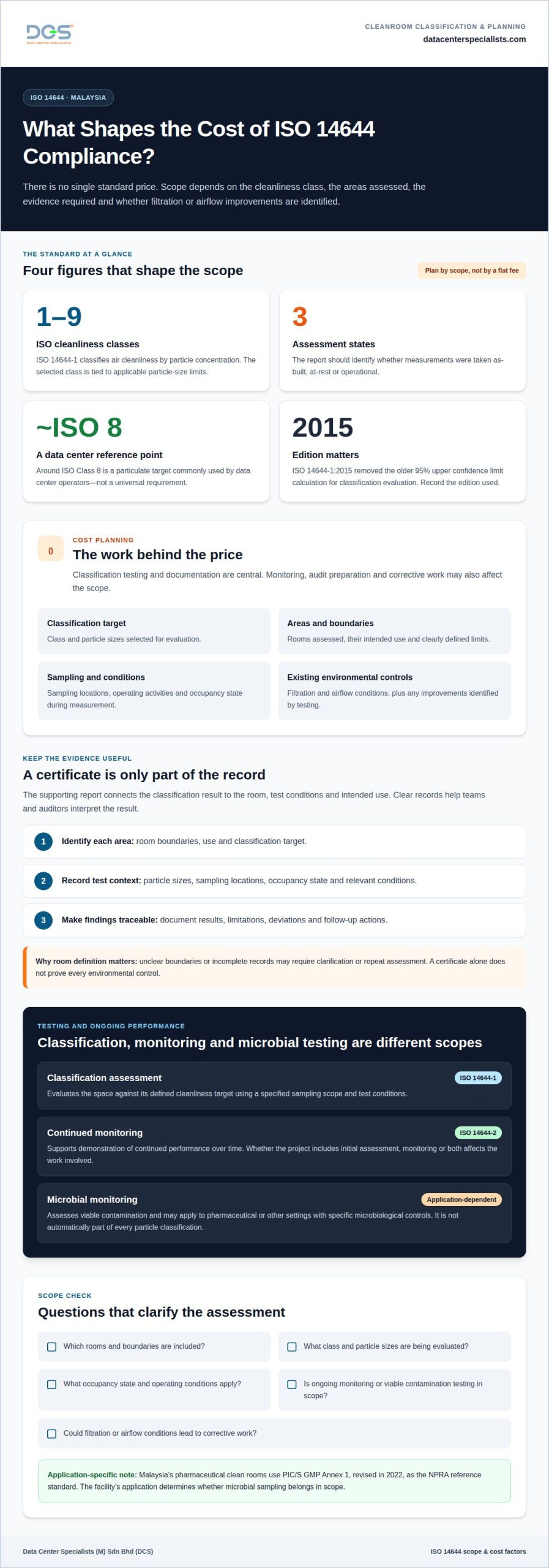
There’s no single standard price for the cost to achieve ISO 14644 compliance in Malaysia: the total depends on the cleanliness class, the areas assessed and whether testing identifies improvements to filtration or airflow. According to the International Organization for Standardization, ISO 14644-1:2015 classifies cleanroom air by particle concentration, so the required classification and the evidence needed to demonstrate it shape the work involved.
Classification testing and documentation are central to the budget, but they are not the only considerations. Monitoring, audit preparation and corrective work can also affect the scope. A facility with suitable environmental controls may need less work than one requiring system changes.
This article explains the main cost factors for Malaysian facilities, including classification, records, particle monitoring, audits and filtration. It also clarifies how the required test scope and the condition of the controlled environment influence the overall effort, helping data center and facility teams plan with a clearer understanding of what compliance work involves.
Key Takeaways
- Plan the budget around the required cleanliness classification, areas assessed and condition of existing environmental controls, rather than assuming one standard fee.
- Allow for classification records and supporting documentation as part of the compliance scope, not just testing.
- Monitoring requirements depend on the cleanliness class and the evidence needed to demonstrate ongoing performance.
- Filtration and airflow conditions can affect both the assessment scope and any corrective work identified.
- Clarify which cleanroom tests apply to the facility and its occupancy state before estimating the work involved.
Classification certificates and documentation
A classification certificate records the stated cleanliness class and the conditions under which the assessment took place. For an ISO 14644 project, the supporting report matters as much as the certificate. It gives facility teams and auditors the technical basis for interpreting the result, rather than relying on a class label alone.
Define the classification scope before commissioning assessment work. Identify each controlled area, its boundaries, intended use and occupancy state. ISO 14644-1 recognises as-built, at-rest and operational states. A pharmaceutical room assessed while empty may produce a different result from the same space during operations. The report should make the assessed state clear.
ISO 14644-1 classifies air cleanliness by particle concentration. Its classes run from ISO Class 1 through ISO Class 9, with the selected class tied to applicable particle-size limits. A data centre white-space particulate target commonly used by operators is around ISO Class 8. That is not a universal requirement: the relevant target depends on the application and its environmental control objectives.
Documentation should connect each measured result to the correct room and test conditions. A clear report typically identifies:
- The room or area assessed, including its boundaries and use.
- The classification target and particle sizes evaluated.
- The occupancy state during measurement.
- Sampling locations, recorded results and relevant test conditions.
- Any limitations, deviations or follow-up actions affecting interpretation.
These records help prevent a common planning error: treating a certificate as proof of every environmental control. ISO 14644 addresses airborne particle cleanliness, while broader regulatory or pharmaceutical requirements may involve additional controls. Set the intended application first, then map its documentation needs to the applicable standard and regulatory framework. That step keeps the classification scope proportionate.
Use the edition and calculation approach applicable to the assessment. The 2015 edition of ISO 14644-1 removed the older 95 percent upper confidence limit calculation for evaluating classification results. Reports based on different editions may therefore present results differently. Record the edition used, so later reviews can interpret the classification consistently.
Documentation quality affects project effort. Unclear room boundaries, missing environmental context or incomplete records may require clarification or repeat assessment. For example, a report that groups several rooms together may not show whether each individual area met its intended limit. Define each space clearly, preserve traceable results and record corrective actions separately. This creates a useful compliance record for operational reviews, future monitoring and regulatory assessments.
Particle and microbial monitoring requirements
Particle monitoring evaluates airborne contamination against the facility’s selected cleanliness objective. According to the International Organization for Standardization, ISO 14644-1:2015 classifies cleanroom air by particle concentration and defines ISO Classes 1 through 9. The selected class and sampling scope influence the cost to achieve ISO 14644 compliance in Malaysia, alongside monitoring and reporting requirements.
Sampling plans account for particle sizes, locations and operating conditions. Test areas should represent the controlled space and support the intended classification decision. For example, a room with distinct work zones may need sampling points that capture differences in activity and airflow, rather than relying on a single location to represent the whole environment. The plan should state the purpose of each sampling location.
Classification testing and ongoing monitoring serve related but different purposes. ISO 14644-2 covers cleanroom monitoring and intervals for demonstrating continued compliance. A monitoring programme helps identify changes over time, while a classification assessment evaluates the space against its defined target. Whether the project includes initial assessment, continued monitoring or both affects the overall compliance budget.
Microbial monitoring is separate from particle counting. It evaluates viable contamination and may be relevant to pharmaceutical or other applications with specific microbiological controls. Malaysia’s pharmaceutical clean rooms use PIC/S GMP Annex 1, revised in 2022, as the NPRA reference standard. The facility’s application determines whether microbial sampling belongs in the assessment scope; it should not be assumed to form part of every ISO particle classification.
Several practical elements shape monitoring effort:
- The cleanliness class and particle sizes selected for evaluation.
- The number and placement of sampling locations across the controlled area.
- The occupancy conditions and operating activities during measurement.
- Whether viable contamination testing is relevant to the application.
- The need for follow-up assessment when results vary between locations.
In electronics manufacturing, particle results can reveal changes in airborne cleanliness, but they do not automatically identify the source. An increase in a specific location may prompt examination of airflow, filtration, materials movement or work activity. Reviewing counts alongside operating records can help focus further investigation and avoid broad corrective work without a clear technical basis.
Monitoring scope affects how results can be used. Each measurement should be linked to its location, test conditions and intended purpose. This helps facility teams distinguish a classification outcome from routine performance tracking and plan future monitoring around meaningful changes in the controlled environment. Trends are more useful when measurement conditions are documented consistently.
Where particle conditions need professional assessment, Cleanroom performance testing can provide a structured scope for evaluating environmental performance.
Regulatory compliance assessments and audits
An assessment compares the facility’s documented controls with its intended ISO 14644 classification and applicable regulatory framework. Audit preparation also examines how production activity, materials and environmental conditions affect controlled areas.
Compliance Assessment and Audit Scope
A compliance assessment reviews whether the facility’s procedures and environmental evidence support its stated requirements. It matters because an ISO classification alone may not address every regulatory obligation. For Malaysian pharmaceutical cleanrooms, PIC/S GMP Annex 1, revised in 2022, is the NPRA reference standard. The assessment should therefore separate particle classification evidence from broader GMP controls.
Consultant Fees for Gap Assessments
In Malaysia, consultant fees depend on the case and are provided after a quotation request. Area count, documentation condition, sampling scope and support needs shape the charge. A gap assessment identifies differences between current controls and the facility’s target. It may include document review, site observations, interviews and a corrective-action plan. Assessing one controlled room with traceable records involves different work from assessing a multi-zone production facility with incomplete procedures.
Costs and Risks of Noncompliance
Noncompliance means the facility cannot demonstrate that its controlled environment consistently meets its defined requirements. Consequences may include further investigation, repeat testing, corrective work and production disruption. Ongoing maintenance costs depend on the cause, such as deteriorating filtration, inconsistent procedures or contamination introduced through materials movement. Addressing the cause is more useful than repeatedly treating symptoms.
Audit preparation should connect documented records with actual operating practice. For example, an auditor may compare area procedures with observed personnel movement, cleaning records and maintenance activities. Differences between written controls and active production conditions can weaken the evidence, even if an earlier assessment produced acceptable results.
A structured review commonly considers:
- Whether each controlled zone has a defined purpose, boundary and classification target.
- Whether procedures address personnel, materials, cleaning and contamination control.
- Whether monitoring and maintenance records support the facility’s stated controls.
- Whether pressure relationships or airflow changes could affect adjacent areas.
- Whether identified deviations have owners, corrective actions and closure records.
These items help distinguish documentation gaps from engineering issues. A missing record may call for a process correction, while a pressure imbalance or recurring contamination may require technical investigation. Classify findings by cause and operational impact, then assign corrective actions that address the underlying condition.
Keep the assessment boundary clear. ISO 14644 evidence supports air-cleanliness classification, while pharmaceutical production may involve additional controls under PIC/S GMP Annex 1. Aligning the audit scope with the facility’s application prevents unrelated requirements from being mistaken for classification criteria and helps teams direct effort toward the actual gap.
Air changes, HEPA and ULPA filtration
Airflow and filtration influence both particle control and the scope of an ISO 14644 assessment. Air changes per hour (ACH) describe how often a room’s air volume is supplied or replaced. The required rate depends on the cleanliness target, room design, heat loads and contamination sources. ISO classification should not be treated as a universal ACH specification.
ACH ranges sometimes cited for cleanroom applications include 240-480 for ISO Class 5 environments and 30-60 for ISO Class 7 cleanrooms. These figures are application-specific examples, not verified design values or general requirements. They should not be used as design prescriptions without facility-specific engineering review. A professional assessment considers the room’s airflow pattern, occupancy state and particle results before identifying whether changes to system operation may be needed.
Filtration selection also depends on the application. HEPA and ULPA filters capture airborne particles, but the required filter type and system arrangement must match the cleanliness objective. A figure of 99.9995% efficiency at 0.12 µm may appear in a specific ULPA filter specification; it should be confirmed against the product documentation and test basis, and should not be applied automatically to data centers or other controlled spaces.
Filter testing helps identify leakage or installation problems that could compromise performance. Filter leak testing can help identify problems that affect cleanroom performance, and its timing should reflect the facility’s monitoring needs. The assessment scope depends on the number of filters, access conditions, operating requirements and the evidence needed for the facility’s monitoring programme. Testing should be planned to reduce disruption to active operations.
Replacement is a separate planning consideration. A 3-5-year replacement interval is sometimes cited for cleanroom HEPA/ULPA filters, but it is not a general maintenance requirement and should not be assumed without application-specific guidance. Actual timing depends on condition and operating context. Pressure drop, damage, leakage findings and changes in particle performance can influence maintenance decisions. A fixed replacement interval alone does not demonstrate that a filter remains suitable.
A technical review can connect airflow, filtration and measured cleanliness through coordinated checks, such as:
- Reviewing filter configuration, installation condition and available maintenance records.
- Assessing airflow distribution and identifying areas with potential stagnation or short-circuiting.
- Comparing particle-testing results with the defined classification objective.
- Recording findings and recommended corrective work for operational planning.
Personnel movement, packaging and work practices can introduce particles even when filtration is functioning properly. For example, a cleanroom receiving materials through a poorly controlled transfer route may experience local contamination. Assess these operational contributors alongside the mechanical systems.
In data centers, airflow balancing and particle testing can help distinguish filtration issues from distribution problems. Testing, Adjusting & Balancing (TAB) assesses system performance, while particle-count testing evaluates airborne cleanliness. Coordinating the scope helps avoid treating an airflow imbalance as a filter defect or replacing filters without addressing the actual cause.
ISO 14644 Cleanroom Tests and Costs in Malaysia
The required test scope depends on the assessment objective, facility conditions and applicable requirements. ISO 14644-3 covers cleanroom test methods, helping determine which measurements can support a performance assessment. Establish the purpose first, so each test has a defined role in the facility’s compliance evidence.
Airborne particle counting assesses whether measured concentrations align with the selected classification limits. The test plan identifies the areas and conditions to assess, then records results for interpretation. A manufacturing facility with separate controlled zones, for example, may need a distinct plan for each area. Room boundaries and intended use help determine where measurements are meaningful.
Supplementary tests may examine airflow direction, room pressure relationships, filter integrity or recovery performance. Each addresses a different aspect of environmental performance. Include these tests when they serve a defined assessment objective, rather than treating every possible test as essential. This helps the project team separate classification evidence from broader engineering investigations.
Testing conditions influence the work and interpretation. ISO 14644-1 recognises as-built, at-rest and operational occupancy states. A test during active operations can require different coordination and access arrangements from one conducted in an unoccupied space. The selected state should reflect the purpose of the assessment, with relevant conditions recorded alongside the results.
There is no universal price by room size or cleanliness class. The cost to achieve ISO 14644 compliance in Malaysia depends on the defined scope, including areas covered, sampling locations, access constraints, test methods and reporting requirements. A quotation should distinguish classification testing from supplementary checks and any follow-up work.
Before defining the assessment, identify each area, its intended classification, operating state and required test outputs. Drawings and previous reports can clarify boundaries and existing conditions. For example, describing separate rooms as one zone may create uncertainty about test coverage and reporting. Clear documentation helps align the proposed scope with the facility layout.
Scheduling also affects project planning. Testing in an active facility may require coordination around access, operating activities and site procedures. If findings lead to corrective work, follow-up measurements may fall outside the initial assessment scope. State whether the requested work covers only the initial test or includes subsequent verification.
Finally, link every measurement to an acceptance objective. Particle counts assess airborne cleanliness, while airflow and filter tests assess other performance characteristics. A clearly defined programme makes the report more useful for technical review and future planning, while helping procurement understand which deliverables the proposed scope includes.
Data Center Specialists (M) Sdn Bhd (DCS)
Data Center Specialists (M) Sdn Bhd (DCS) helps facility teams understand the work behind ISO 14644 assessment and environmental control. Its services include Cleanroom Performance Testing (CPT), Testing, Adjusting & Balancing (TAB), Data Center Energy Assessment and Professional Data Center ISO Cleaning Services.
Turn to DCS to define a testing scope, assess airflow performance, address physical contamination or plan specialist cleaning for a mission-critical environment. The appropriate scope depends on the facility, its classification objective and assessment results, rather than a standard package. This connects technical findings with practical operations and procurement planning.
Contact Data Center Specialists (M) Sdn Bhd (DCS) to discuss your facility’s ISO 14644 assessment requirements.
Turn the assessment scope into a practical plan
Planning the cost to achieve ISO 14644 compliance in Malaysia means translating the facility’s target into a clear sequence of decisions. Set out which areas need assessment, what operational conditions matter, and how findings will inform maintenance or future investment. This gives engineering, operations and procurement teams a shared basis for prioritising work.
Before commissioning the next phase, bring together those responsible for environmental controls, facility operations and budget approval. Their input can align assessment timing with site activities and make the scope more useful for ongoing planning. In data centers, this coordination also supports continuity while contamination and airflow concerns are evaluated.
Data Center Specialists (M) Sdn Bhd (DCS) provides professional ISO cleaning, energy assessment and TAB services for mission-critical facilities. Discuss your facility’s requirements and assessment scope with the team to determine a suitable next step.
Contact Data Center Specialists (M) Sdn Bhd (DCS) to discuss your requirements and move forward with a clear, technically grounded plan.
Frequently Asked Questions
What is ISO 14644-1?
ISO 14644-1 provides a method for assigning a cleanliness classification to controlled spaces. In practical terms, the class gives project teams a common reference for facility specifications, commissioning records and later comparisons. It does not certify an entire organisation or replace product-specific quality systems. Keep the classification tied to the defined room, measurement conditions and intended use so the result is not applied beyond its scope.
What is the cost of ISO 14644 cleanroom certification in Malaysia?
There is no single Malaysia-wide fee for ISO 14644 cleanroom classification or related support. Also distinguish a classification report from a broader certification or regulatory approval, since these terms describe different deliverables. Request a scope that identifies the assessed spaces, report format and any follow-up work. The cost to achieve ISO 14644 compliance in Malaysia is established against that defined scope, not a universal certification tariff.
What are the costs of ISO 14644 cleanroom testing and certification by room size and ISO class?
Room size and ISO class alone are not enough for a reliable cost comparison. Two rooms of similar area can differ in access, layout, testing conditions and documentation needs. A useful quotation should specify the rooms and deliverables included, rather than bundle different scopes under one label. This lets procurement compare equivalent work without assuming that class or floor area predicts the full testing effort.
Which ISO 14644 standards and parts apply to cleanroom compliance?
Relevant parts depend on whether the project concerns classification, monitoring, test methods, facility design or operation. ISO 14644-1 addresses classification, Part 2 monitoring, Part 3 test methods, Part 4 design, construction and start-up, and Part 5 cleanroom operations. Part 16 addresses energy efficiency in cleanrooms and separative devices. A project team can map each part to a defined deliverable instead of treating the series as one blanket certification.
What equipment, facility upgrades, and HVAC changes are typically needed to meet ISO 14644?
No standard equipment package applies to every cleanroom. Before specifying upgrades, connect the intended use and classification objective with the facility’s design information and observed performance. This helps avoid buying equipment that does not address the actual requirement. In a project nearing handover, design and commissioning records can help distinguish an original design issue from a change that arose during operation.
What factors affect ISO 14644 compliance costs in Malaysia, including location, industry, and cleanroom class?
Project coordination can affect the work involved as well as the technical scope. Site access, operating restrictions, available facility records and the number of stakeholders can influence planning. Industry also affects which additional quality or regulatory frameworks need consideration alongside classification. For projects across Malaysia, provide consistent scope information across sites so estimates reflect actual facility requirements, not differences in how the work is described.
Are there Malaysian regulations, accreditation requirements, or grants relevant to ISO 14644 compliance?
Malaysia’s pharmaceutical clean rooms use PIC/S GMP Annex 1, revised in 2022, as the NPRA reference standard. ISO 14644 classification is not, by itself, proof of every sector-specific regulatory requirement. Accreditation and funding are separate matters: the applicable framework depends on the facility’s activity, while grant eligibility depends on the relevant programme’s rules. Do not assume that classification automatically qualifies a facility for accreditation or financial support.
How often must cleanrooms be tested and recertified under ISO 14644?
ISO 14644-2:2015 calls for cleanroom classification to be repeated at least annually. The stated intervals are every 12 months for ISO Class 5 and cleaner rooms, and every 24 months for ISO Classes 6-9; HEPA/ULPA filter leak testing has a maximum interval of 24 months.